|
TRANSLATE THIS ARTICLE
Integral World: Exploring Theories of Everything
An independent forum for a critical discussion of the integral philosophy of Ken Wilber
  Frank Visser, graduated as a psychologist of culture and religion, founded IntegralWorld in 1997. He worked as production manager for various publishing houses and as service manager for various internet companies and lives in Amsterdam. Books: Ken Wilber: Thought as Passion (SUNY, 2003), and The Corona Conspiracy: Combatting Disinformation about the Coronavirus (Kindle, 2020).
Check out my other conversations with ChatGPT
The Philosophy of Mind:
Douglas Hofstadter: The Strange Loop of Human Intelligence David Chalmers and the Hard Problem of Consciousness Bernardo Kastrup and the Metaphysics of Idealism, Douglas HofstadterThe Strange Loop of Human Intelligence - And the Limits of His ExplanationFrank Visser / ChatGPT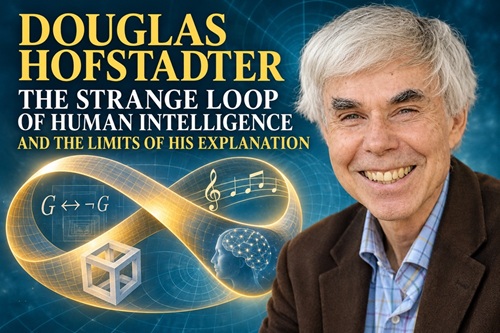 Introduction: The Man Who Tried to Explain the MindFew contemporary intellectuals have attempted something as ambitious as Douglas Hofstadter. A cognitive scientist, computer scientist, philosopher, and literary experimenter, Hofstadter has spent much of his career investigating one of the most difficult questions in science and philosophy: How does a physical system, made of ordinary matter, give rise to consciousness, intelligence, meaning, and a sense of self? His best-known book, Gödel, Escher, Bach: An Eternal Golden Braid (1979), became an intellectual sensation. It connected mathematical logic, visual art, music, computation, and the philosophy of mind in an extraordinary interdisciplinary construction. Its central ambition was to show how self-reference and formal systems could illuminate the emergence of consciousness. Hofstadter subsequently developed these ideas in I Am a Strange Loop (2007), arguing that the self is not a mysterious entity residing inside the brain but a high-level pattern that emerges from the brain's complex activity. There is much to admire here. Hofstadter is intellectually adventurous, suspicious of simplistic explanations, and deeply committed to understanding human thought without resorting to supernatural assumptions. Yet his project also illustrates a recurring problem in contemporary intellectual life: the tendency to mistake an illuminating metaphor for a sufficiently developed scientific explanation. Hofstadter offers a fascinating account of how the self might emerge. But does he actually explain consciousness? And how much of his celebrated synthesis survives when we distinguish mathematical insight, computational analogy, psychological theory, and empirical evidence? 1. Gödel, Escher, Bach: A Brilliant Intellectual ConstructionGödel, Escher, Bach is an unusual book even by the standards of ambitious intellectual nonfiction. Its dialogues, puzzles, musical structures, mathematical demonstrations, and philosophical reflections are woven together to create an elaborate meditation on self-reference. Hofstadter identifies a common pattern in the work of three seemingly unrelated figures. Kurt Gödel demonstrated that sufficiently powerful formal mathematical systems contain statements that refer, indirectly, to their own provability. M. C. Escher produced visual paradoxes in which representations seem to turn back upon themselves. Johann Sebastian Bach composed musical structures involving repetition, inversion, recursion, and intricate transformations. For Hofstadter, these are manifestations of a deeper phenomenon: strange loops. A strange loop occurs when a system moves through a hierarchy of levels and eventually returns to a point that appears to be higher or different, creating a paradoxical form of self-reference. This is a powerful intellectual connection. Gödel's incompleteness theorems really do reveal fundamental limitations in formal mathematical systems. Escher's artwork genuinely exploits perceptual and representational contradictions. Bach's compositions demonstrate remarkable recursive and self-referential structures. But an important distinction must be maintained. Similarity of structure does not establish identity of mechanism. A mathematical proof, an artistic representation, a musical composition, and a conscious brain are not interchangeable examples of the same phenomenon. They may illuminate one another, but the explanatory burden remains: what exactly connects them? Hofstadter's achievement is to make the reader see unexpected relationships. His weakness is that the resulting intellectual architecture can sometimes appear more explanatory than it actually is. 2. The Strange Loop and the Emergence of the SelfIn I Am a Strange Loop, Hofstadter brings his earlier ideas directly into the philosophy of consciousness. His central argument is that the human self is a high-level symbolic pattern emerging from the brain's activity. The brain contains enormous networks of interacting neurons, but through learning, memory, language, perception, and social interaction, it develops increasingly sophisticated representations of the world. Eventually, it develops a representation of itself. The self, in this account, is not an additional substance or an immaterial observer. It is a pattern that becomes sufficiently complex to represent its own existence. This is an attractive naturalistic position. It avoids Cartesian dualism and does not require a supernatural soul. It also connects the subjective sense of personal identity with recognizable psychological and neurological processes. However, the argument raises a crucial question. Does a system that represents itself thereby become conscious? A computer can contain a model of its own operations. A thermostat can monitor its temperature. A software program can examine its own code. More sophisticated systems can construct representations of their own internal states. Yet self-monitoring, self-reference, and self-modeling are not automatically equivalent to subjective experience. Hofstadter's theory helps explain how a system might construct a self-concept. It does not conclusively establish why such a system should experience anything at all. The distinction between having information about oneself and actually being someone remains one of the central difficulties in consciousness studies. 3. The Problem of the Hard ProblemHofstadter is generally associated with a naturalistic approach to consciousness. He is not sympathetic to the idea that consciousness requires an immaterial substance or an inexplicable supernatural intervention. That is a defensible starting point. But naturalism is a philosophical commitment, not by itself a scientific explanation. David Chalmers famously distinguished between the so-called easy problems of consciousness and the hard problem. The former concern functions such as perception, attention, memory, behavioral control, and information processing. The latter concerns why these processes are accompanied by subjective experience. Hofstadter's work is particularly illuminating regarding the former. He explores how a brain can construct increasingly abstract representations, develop symbolic capacities, and generate a sense of personal identity. But the question of subjective experience remains. Why should a particular pattern of neural activity feel like something from the inside? Why should the representation of pain be accompanied by the experience of pain? One possible response is that the hard problem is badly formulated, or that its apparent mystery will dissolve as cognitive science advances. Hofstadter's naturalism is compatible with that possibility. But compatibility is not resolution. A theory cannot claim to have explained consciousness merely because it has shown how certain cognitive functions and representations can emerge from physical processes. The distinction between explaining the organization of cognition and explaining subjective experience must remain visible. 4. Analogy Is Not MechanismOne of Hofstadter's greatest intellectual strengths is his ability to recognize patterns across disciplines. Unfortunately, this is also a potential weakness. The language of recursion, feedback, self-reference, emergence, and strange loops can become so attractive that it begins to function as a universal explanatory vocabulary. But these concepts do not all mean the same thing. Recursion is a formal or computational technique. Feedback describes causal interaction within a system. Self-reference concerns a system's capacity to refer to itself or its own operations. Emergence describes the appearance of higher-level properties or patterns arising from lower-level interactions. They can interact, but none automatically entails the others. More importantly, none automatically entails consciousness. A weather system exhibits feedback. A computer program can be recursive. A mathematical system can contain self-referential statements. A biological organism can exhibit emergent properties. These phenomena are fascinating, but their existence does not establish that they possess subjective experience. The temptation to move from structural similarity to explanatory equivalence is widespread in interdisciplinary thinking. Hofstadter is not immune to it. The real challenge is to specify which mechanisms are necessary, which are sufficient, and what empirical observations would distinguish the strange-loop hypothesis from competing theories. 5. The Limits of the Computational MetaphorHofstadter's intellectual development is closely associated with artificial intelligence and computational approaches to cognition. Yet he has also been an unusually persistent critic of simplistic claims about machine intelligence. His position is more subtle than the familiar assertion that the brain is merely a computer. Human intelligence, he argues, depends on flexible analogies, concepts, categories, and the ability to recognize deep similarities between apparently unrelated situations. This emphasis on analogy is important. Much of human thinking does indeed involve transferring structures from one domain to another. However, it raises another difficulty: what is the relationship between computation and understanding? The fact that a machine can manipulate symbols does not necessarily mean that it understands what those symbols mean. Conversely, the fact that human understanding involves biological processes does not establish that computation is irrelevant to explaining it. The philosophical challenge is to avoid both extremes: reducing understanding to symbol manipulation without remainder, and treating human cognition as something fundamentally beyond mechanistic investigation. The emergence of large language models has made this debate particularly urgent. These systems can generate sophisticated analogies, discuss mathematical paradoxes, imitate philosophical reasoning, and produce convincing accounts of their own supposed mental states. Hofstadter's emphasis on analogy provides a useful perspective for evaluating such systems. But it also invites a question he would likely find interesting: if an artificial system develops increasingly elaborate representations of itself, at what point, if ever, would a strange loop become a conscious self? There is no established answer. 6. Hofstadter's Intellectual IsolationAnother interesting aspect of Hofstadter's career is his somewhat unusual position within contemporary cognitive science. He has never been entirely comfortable with the dominant fashions in artificial intelligence. He has criticized the limitations of statistical approaches and expressed reservations about the idea that increasingly powerful pattern recognition necessarily leads to human-like understanding. His intellectual independence deserves respect. Scientific progress often depends on people who resist fashionable consensus. But independence also has risks. A deeply personal intellectual framework can become difficult to revise when new developments challenge its central assumptions. The strange-loop approach is sufficiently broad that it can accommodate many different phenomena. That makes it intellectually fertile, but it also creates a problem of scientific specificity. What would count as evidence against the theory? Which observations would show that self-reference is insufficient for consciousness? What would distinguish a genuinely conscious strange loop from an elaborate but unconscious self-model? A theory that can accommodate almost everything risks explaining very little unless it specifies its limits. Hofstadter's work is at its strongest when it opens new questions. It is less convincing when its conceptual vocabulary is treated as a completed explanation. 7. A More Modest Achievement: Understanding the Self as a ProcessNone of these criticisms should obscure what Hofstadter has contributed. The idea that the self is a process rather than a fixed entity is philosophically important. Our identities are constructed through memory, language, bodily experience, social relationships, and ongoing interaction with the world. We are not simply born with fully developed selves. Our self-understanding changes throughout life. It can be disrupted by neurological injury, altered by psychological experience, and reshaped by relationships and cultural circumstances. Hofstadter helps us recognize that the self is not necessarily a separate thing that possesses a brain. It may instead be something that the brain does. This is a significant conceptual shift. It also connects with broader developments in cognitive science, including embodied cognition, predictive processing, and theories of the self as a constructed model. These approaches differ substantially from Hofstadter's, but they share an interest in explaining the self through physical and cognitive processes rather than through an independent mental substance. The important point is that a naturalistic account of personal identity does not require the assumption that one particular metaphor, whether strange loops or predictive models, provides the final answer. Conclusion: A Brilliant Map Is Not the TerritoryDouglas Hofstadter deserves recognition as one of the most imaginative interdisciplinary thinkers of the past half-century. Gödel, Escher, Bach remains an extraordinary intellectual achievement, and I Am a Strange Loop offers a provocative naturalistic interpretation of personal identity. His work encourages us to see connections between mathematics, art, computation, language, and consciousness. It challenges simplistic understandings of the self and reminds us that apparently stable entities can arise from complex underlying processes. But the central philosophical question remains unresolved. Self-reference is not consciousness. Information processing is not automatically understanding. A representation of the self is not necessarily a subject of experience. And an elegant analogy is not yet a causal explanation. The strange-loop concept may be an important part of understanding how brains construct selves. It may even turn out to be central to a more comprehensive theory of consciousness. But that possibility should not be confused with an established result. Perhaps the most appropriate way to appreciate Hofstadter is to recognize both sides of his achievement: his remarkable ability to connect intellectual worlds, and the temptation to regard those connections as explanations in themselves. He has given us a fascinating map of the strange territory of mind. We should be grateful for the map, while remembering that the territory remains to be explored.
Comment Form is loading comments...
|