|
TRANSLATE THIS ARTICLE
Integral World: Exploring Theories of Everything
An independent forum for a critical discussion of the integral philosophy of Ken Wilber
  Frank Visser, graduated as a psychologist of culture and religion, founded IntegralWorld in 1997. He worked as production manager for various publishing houses and as service manager for various internet companies and lives in Amsterdam. Books: Ken Wilber: Thought as Passion (SUNY, 2003), and The Corona Conspiracy: Combatting Disinformation about the Coronavirus (Kindle, 2020).
Check out my other conversations with ChatGPT
Motivational Speakers:
Deepak Chopra: The Quantum Guru and the Business of Spiritual Science Tony Robbins and the Business of Personal Transformation Tony Robbins and the Business of Personal TransformationNeuro-Linguistic Programming, motivational spectacle, and the promise of unlimited human potentialFrank Visser / ChatGPT
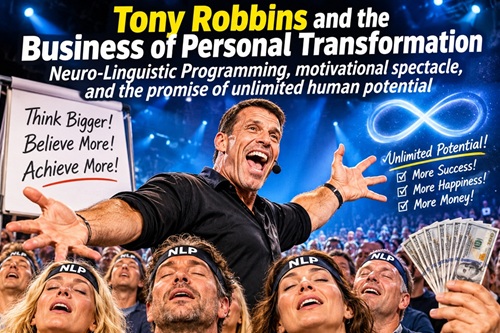 Tony Robbins is one of the most recognizable figures in the international self-help industry. With his booming voice, imposing physical presence, trademark enthusiasm, and seemingly inexhaustible supply of motivational slogans, he has built a global empire around the promise that people can radically transform their lives. From financial success and professional achievement to romantic relationships, emotional resilience, and personal happiness, Robbins presents himself as someone who can help people break through their limitations and unleash their hidden potential. His appeal is not difficult to understand. Many people feel trapped in unsatisfactory jobs, dysfunctional relationships, financial insecurity, or a general sense of purposelessness. They want more than abstract philosophical advice. They want something practical, immediate, and emotionally compelling. Robbins offers precisely that: a highly energetic combination of psychological techniques, motivational performance, personal storytelling, and promises of transformation. Yet beneath this impressive motivational machinery lies a more complicated question: how much of Robbins's approach rests on sound psychological knowledge, and how much depends on theatrical persuasion, oversimplified models of human behavior, and the commercial packaging of personal empowerment? His association with Neuro-Linguistic Programming (NLP) makes this question particularly relevant. NLP claims to provide practical techniques for changing thought patterns, emotional responses, and behavior through the relationship between language, subjective experience, and bodily states. Robbins helped popularize these ideas, turning them into a mass-market system of personal development. The problem is that the scientific standing of NLP is considerably weaker than its confident presentation suggests. And when questionable psychological theories are combined with charismatic authority and an enormous commercial enterprise, critical examination becomes essential. 1. From NLP student to motivational superstarBorn Anthony J. Mahavoric in 1960 in California, Robbins had a difficult childhood and subsequently reinvented himself as a motivational speaker, author, and entrepreneur. His rise began in the 1980s, when he became associated with the emerging human-potential movement and the teachings of NLP. An important influence was John Grinder, one of NLP's founders, as well as motivational speaker and NLP practitioner Jim Rohn, under whom Robbins initially worked. He also drew inspiration from other figures in the human-potential movement, including psychologist and hypnotherapist Milton Erickson. Robbins's early books, particularly Unlimited Power (1986) and Awaken the Giant Within (1991), established the foundations of his approach. He subsequently expanded into seminars, coaching programs, television appearances, business consulting, and a considerable collection of commercial enterprises. His central message is straightforward: people are not prisoners of their circumstances. They can change their emotional states, beliefs, habits, and decisions, thereby transforming their lives. There is something attractive about this message. People often underestimate their capacity for change, and many become trapped in repetitive patterns of avoidance, pessimism, and self-defeat. Encouraging people to take responsibility for their decisions and to develop greater confidence can be genuinely helpful. But Robbins goes considerably further than this relatively uncontroversial observation. He presents personal transformation as something that can be systematically engineered through a collection of psychological techniques. This is where his claims deserve closer scrutiny. 2. The questionable scientific foundations of NLPNeuro-Linguistic Programming emerged in the 1970s through the work of Richard Bandler and John Grinder. Its original ambition was to identify the supposedly successful communication and behavioral patterns of exceptional therapists and make these patterns available to others. NLP rests on several propositions: that subjective experience can be understood through representational systems, that language influences mental processes, that patterns of behavior can be identified and reproduced, and that changing these patterns can produce substantial psychological transformations. Some of these propositions sound reasonable. Language certainly influences how we interpret experience. Expectations affect behavior. Mental imagery can influence emotions. Reframing a problem can sometimes make it easier to approach. But these observations do not establish the distinctive theoretical claims of NLP. One of its best-known propositions is that individuals have preferred sensory representational systems: visual, auditory, or kinesthetic. According to this model, successful communication supposedly requires identifying someone's preferred system and adapting one's language accordingly. Another familiar NLP claim concerns eye movements, which practitioners have interpreted as indicators of particular mental processes, such as remembering or constructing visual images. The difficulty is that these specific claims have not acquired convincing empirical support. A systematic review published in the British Journal of General Practice in 2012 examined experimental studies of NLP interventions. It found little evidence of improved health outcomes and emphasized the limited quantity and quality of the available research. A 2019 review by Jonathan Passmore and Tatiana Rowson, published in the International Coaching Psychology Review, similarly concluded that NLP's distinctive practices are poorly supported by research evidence. This distinction matters. NLP practitioners sometimes defend their approach by pointing to the fact that some of its techniques resemble established psychological practices. But the fact that a technique resembles something used in evidence-based psychology does not validate the theoretical system in which it is embedded. Reframing, visualization, goal setting, relaxation, and confidence-building exercises can all have legitimate applications. They do not need NLP to justify their existence. Indeed, this raises an awkward question: if the useful elements of NLP can be explained through ordinary psychology, what exactly is the added value of NLP's distinctive theoretical framework? Robbins has never needed to answer this question convincingly to maintain his popularity. 3. From NLP to Neuro-Associative ConditioningRobbins does not simply reproduce the original NLP system. He developed his own approach, which he calls Neuro-Associative Conditioning (NAC). The central idea is that human beings associate particular experiences with pleasure or pain, and that these associations influence their behavior. To change undesirable behavior, one must supposedly alter the emotional associations that sustain it. Robbins typically presents this process through several stages: identify what needs to change, develop a strong emotional motivation for change, interrupt the old behavioral pattern, create a more desirable alternative, and reinforce the new association. There is a recognizable psychological principle here. Behavioral conditioning, reinforcement, emotional learning, and habit formation are established areas of psychological research. But Robbins's presentation tends to blur the distinction between established principles and his own proprietary interpretation of them. An especially relevant academic examination appeared in 2001. Psychologist Anthony Grant analyzed Robbins's Neuro-Associative Conditioning and concluded that, although several techniques drew upon established research, Robbins's broader claims about immediate control over mental, emotional, physical, and financial destiny were unjustified. Grant also questioned the empirical support for specific techniques, including the scramble pattern and future pacing. This is an important criticism because Robbins frequently presents his system as if it were a coherent technology of personal transformation. Yet the existence of recognizable psychological ingredients does not establish that the complete recipe works as advertised. There is a difference between helping someone change a habit and suggesting that a general method can unlock practically unlimited human potential. 4. The psychology of motivational spectaclePerhaps Robbins's greatest talent is not his psychological sophistication but his ability to create powerful emotional experiences. His seminars are carefully constructed performances. Loud music, dramatic lighting, physical exercises, group participation, emotional storytelling, and extended periods of high-intensity stimulation create an atmosphere in which participants become increasingly receptive to his message. Robbins himself is a commanding performer. He moves energetically across the stage, raises his voice, challenges participants, tells stories, and encourages people to confront their fears. The result can be exhilarating. Participants may experience an unusual sense of confidence, solidarity, and personal possibility. They may feel that they have broken through psychological barriers that previously seemed insurmountable. But what exactly has happened? One possibility is that participants have genuinely learned something about themselves. Another is that they have experienced a temporary emotional high produced by an unusually stimulating social environment. These possibilities are not mutually exclusive. The problem arises when the intensity of an experience is confused with the durability of its results. A person who feels extraordinarily confident after an intensive weekend seminar has not necessarily acquired the skills, resources, or psychological resilience required to sustain that confidence in everyday life. This is a familiar problem in the self-help industry: the emotional experience of transformation can be mistaken for transformation itself. Robbins's famous firewalk illustrates this distinction particularly well. Participants are encouraged to walk barefoot across glowing hot coals as a symbolic demonstration that fear can be overcome. The activity is presented as an opportunity to accomplish something that previously seemed impossible. In June 2016, however, more than 30 participants at a Dallas seminar were treated for burns following the exercise, with five taken to hospital for evaluation. The incident raises an interesting question about the relationship between motivational symbolism and physical reality. Walking across hot coals is not evidence that someone has overcome an inner psychological limitation. It is a demonstration involving particular physical conditions, risks, and techniques. The symbolic interpretation attached to the activity is a separate matter. A motivational experience may be memorable without being a reliable demonstration of a general psychological principle. 5. The ideology of unlimited personal responsibilityOne of the most persistent themes in Robbins's teaching is that individuals must take responsibility for their lives. Again, this contains an important truth. People sometimes attribute too much of their unhappiness to external circumstances and too little to their own decisions. Recognizing one's agency can be an important step toward change. But the emphasis on personal responsibility can easily become an ideology. If success is principally a matter of attitude, determination, emotional state, and decision-making, what happens to people who remain unsuccessful despite their best efforts? Do they simply have the wrong mindset? This is where motivational individualism becomes problematic. It tends to underestimate the importance of social circumstances, economic inequalities, educational opportunities, physical limitations, discrimination, family backgrounds, and sheer bad luck. Not everybody starts from the same position. Not everybody has the same resources. And not every problem can be solved by changing one's attitude. Consider unemployment. A positive attitude may improve someone's chances of finding work, but it cannot create jobs where none exist. Consider poverty. Better financial habits can be useful, but they cannot compensate indefinitely for inadequate wages, expensive housing, or structural disadvantages. Consider illness. Emotional resilience may help people cope, but it does not give them unlimited control over their physical condition. Robbins's rhetoric can make these distinctions disappear beneath the more attractive proposition that people can achieve almost anything if they change their internal state. This is motivational optimism taken too far. It also creates an unfortunate reversal of responsibility: if the promised transformation does not materialize, the individual may conclude that he or she simply did not try hard enough. The motivational guru, meanwhile, remains the successful entrepreneur whose methods have supposedly been vindicated by his own success. 6. The commercial business of transformationRobbins is not simply a motivational speaker. He is the central figure in a large commercial enterprise built around personal development. His business includes books, online programs, live seminars, coaching, business education, and other services. His brand is associated with the promise that investing in personal transformation can produce extraordinary returns. There is nothing inherently wrong with charging money for educational or motivational services. People routinely pay for books, workshops, coaching, and professional development. The question is whether the commercial presentation accurately communicates what participants can reasonably expect. A particularly interesting recent example comes from the British Advertising Standards Authority. In October 2025, the ASA upheld a complaint against a paid advertisement for Robbins Research International's Business Mastery program. The advertisement featured claims about growing businesses by 30 to 130 percent or even 180 percent through a small number of changes, alongside testimonials. The regulator found the advertising misleading because it implied that the advertised earnings outcomes were typical. This is not a judgment that Robbins's entire business education program is worthless. Nor does it establish that individual participants cannot benefit from it. But it does illustrate a central problem with the personal-development marketplace: exceptional success stories can create expectations that are not representative of ordinary outcomes. The distinction between inspiration and evidence becomes particularly important when substantial sums of money are involved. Anecdotes about successful entrepreneurs are not substitutes for systematic evaluations of the results achieved by ordinary participants. And a successful business guru's own wealth is not proof that his teachings are universally effective. 7. The charismatic authority problemThere is another dimension to Robbins's success that deserves attention: the relationship between charisma and critical thinking. Robbins presents himself not merely as someone who has studied human behavior but as someone who has mastered it. His physical presence, confidence, emotional intensity, and apparent ability to read an audience contribute to an image of exceptional personal authority. This creates an interesting paradox. His message is ostensibly about empowering individuals to become independent and take control of their lives. Yet the delivery depends heavily on the authority of a charismatic personality who tells people what they need to think, feel, and do. The audience is encouraged to trust the process, follow the exercises, and surrender to the emotional momentum of the event. This is not necessarily sinister. Charismatic teachers can inspire people to overcome inertia and take constructive action. But charisma is not evidence of expertise. Indeed, charisma can make it more difficult to distinguish between genuine psychological insight and persuasive performance. The audience may interpret the intensity of the speaker's conviction as an indication that his theories are scientifically established. But confidence and correctness are different things. A useful test of any personal-development system is whether it encourages participants to question its underlying assumptions, examine its evidence, and develop independence from the teacher. To what extent does Robbins encourage that kind of intellectual autonomy? His emphasis is overwhelmingly on action, motivation, and emotional commitment. These are valuable qualities, but they cannot substitute for critical reflection. 8. What Robbins actually gets rightA critical examination should not overlook the genuine merits of Robbins's work. His insistence that people can change their behavior is reasonable. His emphasis on goal setting, taking initiative, overcoming procrastination, and developing constructive habits has practical value. He also recognizes something that more academically oriented approaches sometimes neglect: people do not make decisions through rational analysis alone. Emotions, expectations, motivation, and social environments play important roles in human behavior. Furthermore, his energetic presentation may be particularly effective for people who need encouragement rather than another abstract explanation of why they are unhappy. His work can provide an initial stimulus for change. There is also a legitimate distinction between Robbins as a motivational performer and NLP as a purported psychological science. One can appreciate the former without accepting the latter. A person attending a Robbins seminar might acquire useful ideas, develop a new sense of direction, or finally take action on a long-postponed decision. Such benefits should not be dismissed simply because the theoretical framework is questionable. However, these benefits do not establish the validity of Robbins's more ambitious claims. We should distinguish at least three things:
The first is clearly demonstrated by his popularity and the enthusiasm of many participants. The second requires more systematic evidence. The third remains particularly problematic where NLP's distinctive claims are concerned. These are different questions, and success in one area does not automatically establish success in the others. 9. Robbins and the larger self-help industryTony Robbins is best understood as part of a much broader cultural phenomenon: the commercialization of personal transformation. Over recent decades, the self-help industry has increasingly presented human potential as something that can be unlocked through specialized methods, intensive experiences, and expert guidance. The vocabulary varies. Some practitioners emphasize NLP, others mindfulness, positive psychology, neuroscience, manifestation, subconscious reprogramming, or spiritual awakening. But a common pattern emerges. A complex human problem is reduced to a relatively simple explanatory model. A collection of techniques is presented as the solution. A charismatic expert provides the authority. And personal transformation becomes a product that can be purchased. This industry often borrows the language of science without accepting the corresponding obligations of scientific investigation. Words such as neuroplasticity, conditioning, subconscious, energy, and reprogramming can lend an impressive scientific appearance to ideas that have not been adequately tested. Robbins is not necessarily the most extreme example of this tendency, but he is certainly one of its most successful representatives. His particular achievement has been to combine motivational psychology, entertainment, entrepreneurship, and personal branding into a highly effective commercial format. In that respect, he is not merely selling techniques. He is selling an experience of becoming a different person. And that experience is precisely what makes the industry so attractive. 10. A naturalistic alternative to motivational mythologyWhat would a more scientifically responsible approach to personal development look like? It would begin by abandoning the idea that human potential is practically unlimited and that virtually every obstacle can be overcome through the right psychological technique. Human beings are capable of remarkable changes, but they are also biological organisms with limitations, vulnerabilities, and dependencies on their social environments. A more realistic psychology of personal development would combine several elements. First, it would recognize the value of motivation without treating motivation as a sufficient explanation of behavioral change. Long-term improvement generally requires habits, resources, supportive environments, and sustained effort. Second, it would distinguish between established psychological findings and speculative techniques. Cognitive behavioral therapy, behavioral activation, implementation intentions, and evidence-based approaches to habit formation have research traditions that should not be casually conflated with NLP. Third, it would take individual differences and circumstances seriously. What works for one person may not work for another. A technique that helps someone overcome public-speaking anxiety may be irrelevant to someone struggling with unemployment, chronic illness, or social isolation. Fourth, it would encourage realistic expectations. Change is frequently gradual, uneven, and sometimes unsuccessful. Relapses and setbacks are not necessarily evidence of insufficient commitment. Finally, it would promote intellectual independence rather than dependence on a motivational authority. Personal development should make people better equipped to understand their lives, not more dependent on someone else's formula for living. This would be a considerably less spectacular enterprise than the Robbins experience. But it would also be a more intellectually defensible one. Conclusion: The limits of unlimited potentialTony Robbins deserves recognition as an exceptionally successful motivational entrepreneur. He understands the emotional needs of his audience, knows how to communicate persuasively, and has developed a remarkable ability to turn personal-development ideas into large-scale public performances. His message contains several useful insights: people can change, motivation matters, habits can be modified, and taking responsibility for one's decisions can improve one's life. But these relatively modest truths are wrapped in a much more ambitious package. His association with Neuro-Linguistic Programming lends a scientific appearance to a collection of psychological claims that have not acquired convincing empirical support. His Neuro-Associative Conditioning system incorporates recognizable psychological principles but also makes claims about personal transformation that go beyond the available evidence. His seminars demonstrate the power of emotional stimulation and charismatic leadership, but an intense motivational experience should not be confused with lasting psychological change. And his commercial success should not be mistaken for proof that his methods produce similarly extraordinary results in the lives of ordinary participants. Perhaps the deepest problem with Robbins's philosophy is its tendency to turn human complexity into a question of personal willpower. It is comforting to believe that we can overcome almost every obstacle by changing our internal state. But reality is less accommodating. Sometimes people need motivation. Sometimes they need therapy, education, financial assistance, medical treatment, social support, or simply better circumstances. Often they need several of these things simultaneously. There is no universal psychological key that unlocks all human problems. The more interesting question, therefore, is not whether we possess unlimited potential, but how we can develop our actual potential within the constraints and possibilities of the world we inhabit. That is a less glamorous proposition than Robbins's promise of unlimited personal power. It is also a considerably more realistic one.
Comment Form is loading comments...
|