|
TRANSLATE THIS ARTICLE
Integral World: Exploring Theories of Everything
An independent forum for a critical discussion of the integral philosophy of Ken Wilber
  Frank Visser, graduated as a psychologist of culture and religion, founded IntegralWorld in 1997. He worked as production manager for various publishing houses and as service manager for various internet companies and lives in Amsterdam. Books: Ken Wilber: Thought as Passion (SUNY, 2003), and The Corona Conspiracy: Combatting Disinformation about the Coronavirus (Kindle, 2020).
Check out my other conversations with ChatGPT
Motivational Speakers:
Deepak Chopra: The Quantum Guru and the Business of Spiritual Science Tony Robbins and the Business of Personal Transformation Deepak ChopraThe Quantum Guru and the Business of Spiritual ScienceFrank Visser / ChatGPT
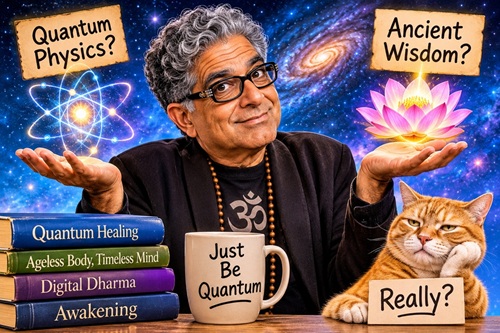 Deepak Chopra occupies an unusual position in contemporary spirituality. He is simultaneously a physician, bestselling author, meditation teacher, public intellectual, entrepreneur and advocate of what might be called New Age metaphysics. For several decades, he has presented a vision in which ancient Indian wisdom, modern physics, consciousness research and holistic medicine converge on a single profound truth: consciousness is not merely something produced by the brain but the fundamental ground of reality itself. This is an attractive proposition. It promises to overcome the apparent limitations of materialism, restore meaning to a scientifically disenchanted universe and reconnect human beings with a deeper dimension of existence. It also offers a seemingly scientific justification for spiritual practices, meditation, healing and personal transformation. Yet Chopra's intellectual project deserves considerably more scrutiny than it usually receives in spiritual circles. His frequent invocation of quantum mechanics, his expansive claims about consciousness, and his blending of medical language with metaphysical speculation raise important questions about the boundaries between science, philosophy and spiritual belief. The central problem is not that Chopra takes consciousness seriously, or that he draws inspiration from Indian philosophical traditions. Both are legitimate intellectual pursuits. The problem is that he repeatedly presents speculative metaphysical interpretations as though they receive substantial support from contemporary science. To understand his influence, and the limitations of his approach, we need to distinguish the different elements of his work. From conventional medicine to spiritual entrepreneurshipBorn in India in 1946, Chopra trained as a physician and subsequently established himself in the United States as an endocrinologist. His professional medical background gave him an important advantage in presenting spiritual ideas to a Western audience increasingly interested in alternative medicine and Eastern philosophy. His encounter with Maharishi Mahesh Yogi and Transcendental Meditation during the 1980s proved particularly influential. Chopra became associated with Ayurvedic medicine and meditation, eventually developing an independent career as a spiritual teacher and author. His breakthrough came with books such as Quantum Healing (1989), followed by Ageless Body, Timeless Mind (1993) and numerous subsequent publications. The timing was favorable. Western culture was experiencing a growing interest in meditation, holistic health, personal development and the perceived limitations of conventional medicine. Chopra offered an appealing synthesis: retain the authority of modern medicine while incorporating the spiritual insights of ancient India. His message was that human beings are not simply biological machines. They are expressions of an underlying field of intelligence, consciousness and creative possibility. Chopra's extraordinary publishing success demonstrates that this message resonates with a large audience. But popularity should not be confused with scientific validation. Quantum healing: when physics becomes metaphysicsChopra's most controversial contribution is undoubtedly his use of quantum mechanics. The title Quantum Healing suggests that the discoveries of modern physics have opened up a new understanding of the relationship between consciousness, the body and health. According to the general argument, the body is not simply a collection of material structures but an expression of a deeper field of intelligence. By changing consciousness, one can supposedly influence the body's fundamental processes and promote healing. There is a legitimate starting point here. The human organism is not a static machine. It is a complex, dynamic biological system involving feedback loops, neural regulation, hormonal activity, immune responses and environmental interactions. Psychological states can influence physiological processes, and stress reduction, meditation and other behavioral interventions can have measurable health benefits. But none of this requires quantum healing. Quantum mechanics describes physical phenomena at microscopic scales. Its mathematical formalism has extraordinary explanatory and predictive power. However, the fact that quantum physics challenges certain classical intuitions does not mean that consciousness can freely influence biological matter, that thoughts can reorganize the body at will, or that spiritual intention can overcome the ordinary constraints of physiology. This is where Chopra's argument becomes problematic. He frequently uses terms such as quantum field, nonlocality, observer, energy and consciousness in ways that blur their scientific and philosophical meanings. A concept that has a precise technical definition in physics is transformed into a much broader metaphysical principle. Quantum nonlocality, for example, is a genuine and experimentally established feature of quantum theory. But it does not demonstrate that human consciousness is interconnected across the universe, that distant minds can influence one another, or that the universe operates according to spiritual intentions. The distinction is fundamental: a scientific discovery can inspire philosophical reflection without proving the metaphysical conclusions subsequently attached to it. Chopra's quantum vocabulary often functions less as an explanatory scientific framework than as a legitimizing language for pre-existing spiritual convictions. Consciousness as the foundation of realityBehind Chopra's interest in quantum physics lies a much more ambitious philosophical position: consciousness is fundamental, whereas matter is derivative. This position has a respectable philosophical pedigree. It resembles aspects of Advaita Vedanta, the nondual tradition of Indian philosophy, according to which ultimate reality is not a collection of separate material objects but an undivided ground of being, often identified with Brahman. The individual self, properly understood, is not ultimately separate from this ground. Chopra frequently translates this perspective into contemporary language. The universe, he suggests, is an expression of consciousness, and our ordinary perception of ourselves as separate individuals is a limited construction of awareness. There is nothing inherently illegitimate about defending such a position. Philosophical idealism, panpsychism and forms of cosmopsychism are serious alternatives within contemporary philosophy of mind. Materialism is not the only conceivable metaphysical framework. However, three distinct propositions need to be kept apart:
The first proposition is widely acknowledged. The second is a legitimate philosophical possibility. The third is a much stronger metaphysical commitment. Chopra tends to move between these propositions without adequately establishing the connections. The so-called hard problem of consciousness, associated with philosopher David Chalmers, asks why physical processes should be accompanied by subjective experience at all. It does not establish that consciousness precedes matter, let alone that a universal consciousness creates the physical universe. An explanatory gap is not automatically evidence for a spiritual explanation. Indeed, there is a danger here of turning an unsolved scientific and philosophical problem into a ready-made confirmation of one's preferred metaphysics. If neuroscience cannot yet explain subjective experience, Chopra sees an opening for consciousness-first metaphysics. But the absence of a complete materialist explanation does not constitute positive evidence for Advaita Vedanta, cosmic consciousness or any particular spiritual worldview. The philosophical debate remains open. The problem with the universal observerOne recurring feature of Chopra's worldview is the idea that consciousness is the ultimate observer of reality. This sounds profound, but it raises an elementary question: what exactly is this observer? Is it the human mind? An individual subject? A universal field of awareness? Or an impersonal principle that somehow gives rise to all subjective experience? These alternatives are not interchangeable. In Advaita Vedanta, pure awareness is not simply an enlarged version of individual human consciousness. It is supposed to be the underlying reality in which the distinction between subject and object ultimately dissolves. But translating this insight into scientific terminology does not make it a scientific discovery. The existence of subjective experience is something we know directly. The existence of a universal subject behind all experience is a further philosophical hypothesis. And the claim that this universal subject generates the physical world is another step beyond that. Chopra's presentations sometimes make these distinctions disappear into a generalized vocabulary of awareness, intelligence and consciousness. The result is a metaphysics that can sound comprehensive while remaining difficult to evaluate. What would count as evidence against it? What observations would distinguish a universe grounded in universal consciousness from one in which consciousness emerges through biological evolution? Without answers to such questions, the theory risks becoming unfalsifiable. Ayurveda and the limits of holistic medicineChopra's popularity also rests on his advocacy of Ayurveda, meditation and holistic health. Here, a more discriminating assessment is necessary. Conventional medicine has historically been too reductionistic in some of its approaches. It can concentrate on isolated symptoms, biochemical processes and pharmaceutical interventions while neglecting psychological, social and environmental dimensions of illness. Chopra is right to emphasize that health involves more than the absence of disease. Mental well-being, stress, lifestyle, relationships, nutrition and a sense of purpose can all influence health. Meditation, relaxation and certain forms of yoga have demonstrated benefits in particular contexts. There is no need to invoke mysterious quantum processes to appreciate these benefits. The difficulty arises when holistic medicine becomes a vehicle for claims that exceed the available evidence. Ayurveda is a historically important medical tradition, but its traditional theories should not automatically be treated as established biomedical knowledge. Individual Ayurvedic interventions need to be evaluated on their own merits, including their safety, effectiveness and possible interactions with conventional treatments. The same applies to claims about aging, immunity, cellular intelligence and the body's supposedly hidden healing capacities. The word natural is not synonymous with safe, and the word holistic does not guarantee scientific validity. Chopra's medical credentials make this distinction particularly important. A physician's professional authority can lend credibility to claims that are philosophical, speculative or insufficiently tested. The danger is not necessarily that meditation or relaxation will harm someone. It is that a persuasive spiritual narrative can blur the difference between supporting the body's natural recovery processes and claiming to possess a fundamentally new understanding of disease. Patients deserve that distinction. The commercialization of enlightenmentThere is another dimension to Chopra's career that deserves attention: the transformation of spirituality into a highly successful commercial enterprise. Chopra has written more than ninety books, developed meditation programs, established wellness initiatives and built an international brand around consciousness and personal transformation. His website presents a continuing stream of books, courses and programs. His recent publications include Awakening (2026), while Digital Dharma explores the relationship between artificial intelligence and spiritual development. There is nothing inherently objectionable about earning a living through books, teaching or wellness programs. Spiritual teachers need not be financially ascetic, and commercial success does not automatically invalidate their ideas. Nevertheless, the relationship between spiritual authority and commercial interests deserves scrutiny. Chopra's message frequently concerns liberation from the ego, material attachment and the illusion of separateness. Yet the dissemination of this message takes place through an elaborate marketplace of books, branded experiences and personal-development products. This creates an interesting tension. Spirituality is presented as a path beyond the ordinary structures of consumer society, while its dissemination becomes integrated into those very structures. The customer is invited to purchase access to a deeper understanding of consciousness, a healthier body, a more abundant life and ultimately a more awakened self. One might call this the consumerization of enlightenment. The problem is not that spiritual instruction should be free. It is that the promise of personal transformation can become difficult to distinguish from the marketing of an aspirational lifestyle. The more comprehensive the promises, the more important it becomes to ask what is actually being delivered. The New Age synthesis: ancient wisdom dressed in scientific languageChopra is best understood as a representative of a broader New Age intellectual movement that seeks to reconcile ancient spiritual traditions with modern scientific discoveries. This movement has several characteristic features. First, it tends to interpret scientific developments as confirmations of spiritual insights that were supposedly known thousands of years ago. Second, it treats the apparent limitations of scientific materialism as evidence for a more expansive spiritual worldview. Third, it borrows concepts from physics, biology and neuroscience to construct a vocabulary that makes traditional metaphysical ideas appear scientifically contemporary. Chopra has become one of the most successful exponents of this approach. But there is a historical irony here. Ancient Indian philosophy does not need quantum mechanics to justify its philosophical importance. Advaita Vedanta can be studied, appreciated and critically evaluated on its own terms. Likewise, contemporary physics does not need to be interpreted through Vedanta to retain its extraordinary explanatory power. The insistence that the two must confirm one another can actually diminish both. It risks reducing complex philosophical traditions to simplified spiritual slogans while simultaneously misrepresenting scientific theories by extracting their terminology from its technical context. This is not a genuine synthesis. It is often a juxtaposition of different intellectual languages. A genuine synthesis would have to demonstrate precisely where the two traditions converge, where they differ and what new explanatory achievements result from bringing them together. Merely observing that both speak about unity, interconnectedness or the observer is insufficient. Has Chopra changed his position?An interesting development deserves mention. In August 2026, Chopra published an article entitled "I Was Wrong About Quantum Physics", in which he publicly withdrew a longstanding argument connecting quantum mechanics and consciousness. He explicitly acknowledged that the quantum-mechanical observer is not equivalent to the conscious awareness discussed in spiritual philosophy. He also rejected the popular claim that human consciousness collapses quantum wave functions. This is a significant concession. Chopra admitted that he had conflated two different meanings of the word observer, thereby confusing his readers and himself. It would be unfair to ignore this intellectual self-correction. Public figures who revise their positions in response to criticism deserve some credit for doing so. But it also raises a question: how much of Chopra's earlier spiritual-scientific synthesis depended on precisely the confusion he now acknowledges? If quantum physics cannot establish the priority of consciousness, then his consciousness-first metaphysics must stand on independent philosophical grounds. That is entirely possible. But it requires a different kind of argument. Chopra's challenge now is to distinguish what he believes about consciousness from what contemporary physics actually demonstrates. Chopra and the contemporary consciousness movementChopra's work also connects with a larger contemporary debate involving philosophers and researchers such as David Chalmers, Donald Hoffman, Bernardo Kastrup and others who question the assumption that physical matter is the ultimate foundation of reality. These thinkers should not simply be grouped together as representatives of one spiritual movement. Their arguments differ considerably. Chalmers approaches consciousness through analytical philosophy and the hard problem. Hoffman develops a mathematical theory of perception in which spacetime is not fundamental. Kastrup defends analytic idealism, according to which individual minds are dissociated aspects of a universal consciousness. Chopra's position overlaps with some of these perspectives, especially in its emphasis on consciousness as fundamental. But there is an important difference between constructing a philosophical theory and offering an inspirational spiritual worldview. A philosophical theory must clarify its basic concepts, identify its assumptions, engage with competing explanations and establish what follows from its premises. A spiritual worldview can operate more freely through analogy, metaphor, personal experience and existential interpretation. Both have their place. Problems arise when the latter presents itself as the former without meeting its standards. Chopra's contribution to the consciousness debate is therefore more inspirational than theoretically decisive. He has helped popularize the possibility that consciousness is not merely a by-product of matter. He has not, however, established that this is the correct explanation of reality. Digital Dharma: spirituality in the age of artificial intelligenceChopra's more recent interest in artificial intelligence offers another revealing example of his intellectual approach. In Digital Dharma: How AI Can Elevate Spiritual Intelligence and Personal Well-Being (2024), he explores how conversational AI might assist people in self-inquiry, meditation and personal development. There is something worthwhile in this proposal. AI systems can help people explore philosophical traditions, compare interpretations, formulate questions and reflect on their assumptions. But there is also a danger of confusing the simulation of spiritual wisdom with the possession of spiritual insight. An AI system can explain Advaita Vedanta, summarize Buddhist teachings, discuss meditation techniques and generate apparently profound reflections on consciousness. None of this establishes that the system possesses subjective awareness, enlightenment or direct spiritual experience. The distinction between linguistic competence and conscious experience is particularly important in a worldview that places consciousness at the foundation of reality. If Chopra argues that consciousness is irreducible to information processing, he must explain why increasingly sophisticated information processing should be regarded as spiritual intelligence. Can AI become a genuine participant in spiritual awakening, or does it merely reproduce the language through which human beings discuss awakening? This is a question that Chopra's own philosophical commitments make especially interesting. His enthusiasm for AI as a spiritual companion should therefore be accompanied by considerable epistemic caution. What Chopra gets rightA critical assessment should not overlook the positive aspects of Chopra's work. His insistence that human beings cannot be adequately understood through purely mechanical descriptions of their bodies and behavior is valuable. Medicine benefits from taking psychological and social circumstances seriously. His promotion of meditation has introduced many people to practices that can improve attention, emotional regulation and general well-being. His engagement with Indian philosophy has also helped bring non-Western perspectives into popular discussions of consciousness and reality. And his willingness to question philosophical materialism is not inherently unscientific. Scientific materialism is itself embedded in broader philosophical assumptions, and those assumptions deserve examination. Most importantly, Chopra has helped make consciousness a subject of public discussion beyond the confines of academic philosophy and neuroscience. These are legitimate contributions. But they should not be confused with proof of his more ambitious metaphysical claims. Conclusion: the difference between spiritual inspiration and intellectual achievementDeepak Chopra is an influential popularizer of spirituality, but a much less convincing interpreter of modern science. His enduring appeal rests on a powerful combination: the authority of medical training, the attraction of Eastern nondual philosophy, the prestige of quantum physics and the universal human desire for health, meaning and transcendence. This combination has produced an extraordinarily successful spiritual enterprise. Yet its intellectual foundations remain uneven. Chopra's strongest contributions concern the importance of consciousness, the limitations of reductionist approaches to human experience, the value of contemplative practices and the existential significance of nondual philosophy. His weakest contributions concern the scientific justification of these ideas. Quantum mechanics has repeatedly been recruited to support conclusions it does not establish. The mystery of consciousness has sometimes been treated as though it were already evidence for a universal consciousness. And the language of holistic medicine has occasionally blurred the boundary between reasonable health advice and speculative healing claims. His recent public correction concerning quantum physics is welcome, but it also illustrates how long scientific terminology can be used to support metaphysical convictions without adequate justification. Ultimately, Chopra's project would benefit from a more rigorous division of intellectual labor. Let physics investigate physical reality. Let neuroscience investigate the biological conditions of consciousness. Let philosophy examine the conceptual and metaphysical questions that remain unresolved. And let contemplative traditions explore the nature and significance of subjective experience. These disciplines may inform one another, but they should not be collapsed into a single spiritual narrative. There is no need to make quantum physics mystical to appreciate the mystery of existence. Nor is there any need to invoke a cosmic consciousness to recognize the extraordinary richness of human awareness. Perhaps the most valuable lesson to take from Chopra's career is precisely this: the search for a deeper understanding of reality should not come at the expense of intellectual clarity. Spirituality becomes more credible, not less, when it abandons the temptation to borrow scientific authority for conclusions that science has not established. And consciousness remains sufficiently fascinating without being turned into a universal explanation for everything.
Comment Form is loading comments...
|