|
TRANSLATE THIS ARTICLE
Integral World: Exploring Theories of Everything
An independent forum for a critical discussion of the integral philosophy of Ken Wilber
  Frank Visser, graduated as a psychologist of culture and religion, founded IntegralWorld in 1997. He worked as production manager for various publishing houses and as service manager for various internet companies and lives in Amsterdam. Books: Ken Wilber: Thought as Passion (SUNY, 2003), and The Corona Conspiracy: Combatting Disinformation about the Coronavirus (Kindle, 2020).
Check out my other conversations with ChatGPT
Heated Cosmic Conversations:
The Heat Death of the Universe. Inevitable? Bobby Azarian's Denial of Heat Death Carroll and Azarian on Cosmic Heat Death Evolution, Entropy and ComplexitySean Carroll and Bobby Azarian on the Direction of the UniverseFrank Visser / ChatGPT
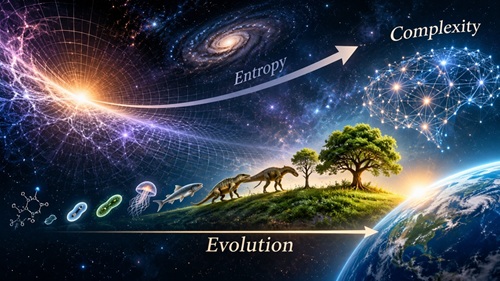 Introduction: Two naturalists, two visions of cosmic evolution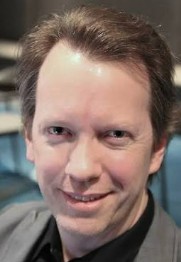 Sean Carroll The relationship between evolution, entropy and complexity is one of the most fascinating questions at the intersection of physics, biology and philosophy. How can a universe governed by the second law of thermodynamics, which describes the tendency of entropy to increase, nevertheless produce increasingly elaborate structures, living organisms, intelligence and perhaps consciousness? Two contemporary thinkers, physicist Sean Carroll and cognitive scientist Bobby Azarian, have offered particularly interesting answers. Both work within a broadly naturalistic framework. Neither needs to invoke supernatural intervention to explain the emergence of complexity. Both recognize that the development of organized structures is compatible with the laws of thermodynamics. Yet their interpretations diverge considerably when they move from explaining how complexity emerges to asking what this development means for the universe as a whole. 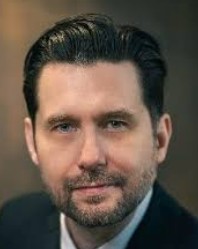 Bobby Azarian Carroll offers a physical explanation of how order, life and complexity can emerge in a universe whose total entropy increases. Azarian goes considerably further. He sees the evolutionary emergence of complexity as evidence of a pervasive cosmic tendency toward greater organization, intelligence and perhaps even consciousness. The difference is important. Explaining how complexity is possible is not the same as demonstrating that complexity is the ultimate direction of cosmic evolution. This distinction will be central to the following comparison. 1. Sean Carroll: Complexity as a temporary consequence of the entropy gradientCarroll's account is particularly interesting because he refuses to accept the conventional opposition between entropy and complexity. In popular presentations, entropy is often equated with disorder, while complexity is associated with organization. From that perspective, the emergence of life seems almost paradoxical: how can something become more organized in a universe that supposedly becomes more disorganized? Carroll's answer is that these are two different dimensions of physical reality. In his book The Big Picture (2016), and especially From Eternity to Here (2010), he explains that the second law does not prevent local increases in organization. What matters is the total entropy balance. Living organisms maintain their organization by consuming energy and exporting entropy into their surroundings. Plants capture relatively concentrated solar energy, while animals consume food and dissipate energy as heat. The Earth can develop increasingly elaborate biological structures because it receives energy from the Sun and radiates energy into space. There is no thermodynamic contradiction here. Carroll makes an additional distinction that is particularly important for understanding evolution: complexity does not simply increase or decrease with entropy. In fact, complexity can increase during a substantial portion of the universe's movement toward higher entropy. Consider the development of the universe. The early universe was remarkably smooth and homogeneous. As gravity acted on small density fluctuations, matter accumulated into stars, galaxies and eventually planetary systems. These structures made possible chemical complexity and, much later, biological evolution. The universe thus passed through a period in which increasingly elaborate structures emerged while entropy continued to increase. But this process need not continue indefinitely. Carroll emphasizes that complexity can rise and subsequently decline. The universe's increasing entropy does not guarantee an ever-increasing abundance of complex structures. Indeed, the eventual depletion of usable energy gradients could bring about a cosmological future in which the processes sustaining life and organization become impossible. In a conversation with Lex Fridman, Carroll describes organisms as surfers riding the wave of increasing entropy. Life does not oppose the second law; it depends on the energetic processes through which entropy increases. This is a powerful explanatory framework because it avoids turning the emergence of complexity into a mysterious exception to physics. The importance of the initial conditionsThere is another important dimension to Carroll's account: the origin of the arrow of time itself. The fundamental microscopic laws of physics do not generally distinguish between past and future in the way our everyday experience does. The macroscopic direction of time is associated with the extraordinarily low entropy of the early universe. This is sometimes called the Past Hypothesis: the universe began in a special low-entropy condition, from which the familiar increase of entropy follows. Carroll therefore places the emergence of complexity within a much larger cosmological story. The question is not simply why life evolves, but why the universe possesses the particular thermodynamic conditions that make irreversible processes, stars, chemistry and biological evolution possible in the first place. His account is intellectually modest in an important sense. It explains why complexity is physically possible without claiming that the universe must ultimately produce intelligence or consciousness. There are still substantial unanswered questions, especially concerning the origin of life itself. Explaining the thermodynamic conditions that permit life is not equivalent to explaining how the first self-replicating systems emerged. Carroll's approach leaves room for these unresolved problems rather than filling them with an overarching evolutionary narrative. 2. Bobby Azarian: The universe as a self-organizing evolutionary processAzarian's The Romance of Reality (2022) starts from much the same scientific background but develops a considerably more ambitious interpretation. His central thesis is that the universe is not merely a place in which complexity occasionally emerges. It is a universe with a remarkable propensity to generate increasingly complex and organized structures. Azarian draws on several fields, including thermodynamics, evolutionary biology, information theory, neuroscience and complexity science. His narrative connects the formation of stars and galaxies with chemical evolution, the emergence of life, multicellular organisms, nervous systems, intelligence and human civilization. This is not simply a history of successive scientific discoveries. It is an attempt to identify a general evolutionary tendency running through nature. Azarian's argument is attractive because it challenges the picture of the universe as nothing more than an ultimately meaningless succession of random events. Although evolution contains enormous amounts of contingency, it also produces recurring patterns of self-organization, increasing functional complexity and information processing. In this interpretation, life is not an inexplicable accident added to an otherwise indifferent cosmos. It is an expression of deeper natural tendencies. There is something worth taking seriously here. Nature is not merely a collection of isolated objects. Matter can organize itself into structures that maintain themselves, exchange energy, process information and reproduce. Evolutionary processes can generate new levels of organization that were not explicitly present in their simpler predecessors. Azarian is also right to resist the simplistic assumption that entropy necessarily means that everything becomes progressively less interesting. However, the difficulty begins when these observations are assembled into a general narrative of cosmic complexification. From the emergence of complexity to cosmic directionalityThe central question is whether the emergence of complexity in particular circumstances establishes a general direction of cosmic evolution. Azarian tends toward an affirmative answer. The universe, in his account, displays a tendency toward increasing organization, information and awareness. But several distinct propositions are being brought together here. First, physical processes can generate organized structures. This is well established. Second, biological evolution can produce increasingly complex organisms and new forms of information processing. This is also well established, although evolutionary history contains numerous simplifications, extinctions and losses of complexity. Third, the universe as a whole tends toward greater complexity. This is a much stronger proposition. Fourth, this tendency points toward increasingly sophisticated intelligence and consciousness. Stronger still. The first two propositions do not automatically establish the latter two. Azarian's challenge is to demonstrate that the patterns observed in particular evolutionary systems can be generalized to the cosmos as a whole. That requires more than assembling examples of increasing complexity. It requires a sufficiently precise definition of complexity, a demonstration of its large-scale trajectory, and an explanation of why that trajectory should continue. 3. The entropy problem: Where the two accounts really divergeThe disagreement becomes especially interesting when we examine how the authors interpret the second law of thermodynamics. For Carroll, entropy is not an obstacle that evolution somehow overcomes. It is the very condition that makes the emergence and maintenance of complex systems possible. For Azarian, entropy is also compatible with increasing complexity, but he explores the possibility that the familiar picture of an entropic universe winding down might be fundamentally incomplete. His February 2023 essay in Noema, entitled Life Need Not Ever End, takes this argument considerably further. Azarian questions whether the conventional heat-death scenario follows necessarily from the second law when applied to an expanding universe. He distinguishes the classical thermodynamic conception of entropy, concerned with the dispersal of useful energy, from the statistical-mechanical conception, concerned with the number of microscopic configurations compatible with a macroscopic state. He then explores arguments associated with thinkers such as Julian Barbour and David Deutsch, suggesting that the expansion of the universe might permit continuing opportunities for organization and life. This is an interesting cosmological question, but it is important not to confuse questioning the inevitability of heat death with demonstrating the indefinite continuation of life. The distinction is crucial. The fact that the universe expands does not, by itself, establish that usable energy gradients will remain available forever. Nor does the absence of a simple, universally applicable definition of entropy for an expanding universe demonstrate that entropy ceases to constrain the future of physical systems. The thermodynamics of cosmology is genuinely complicated. General relativity, gravitational entropy, black holes and dark energy all complicate simplistic accounts of the universe's eventual fate. But these complications are not evidence that cosmic complexification will continue indefinitely. Carroll's approach is more cautious. He recognizes that our understanding of cosmological entropy is incomplete, but does not treat this incompleteness as evidence for an optimistic alternative. Azarian's argument risks turning an open scientific question into an opportunity for a much more ambitious evolutionary vision. 4. The problem of defining complexityOne weakness shared by many theories of cosmic evolution is that they speak about increasing complexity without establishing exactly what is being measured. What does it mean for the universe to become more complex? There are several possible answers. Complexity might refer to the number of components in a system, the number of interactions between them, the amount of information they process, their functional differentiation, their capacity for adaptation, or the sophistication of their internal organization. These measures are not interchangeable. A galaxy is more structurally differentiated than a cloud of hydrogen gas. A living cell has organizational properties that a rock does not possess. A human brain processes information in ways that exceed the capabilities of simpler nervous systems. But does that mean the brain is necessarily more complex than every other biological system? And how do we compare biological complexity with technological, ecological or social complexity? There is no universally accepted metric that allows us to place all these phenomena on one straightforward evolutionary scale. This matters particularly for Azarian because his argument depends on identifying a general trend that connects physical, biological and cognitive evolution. Carroll is more careful about this distinction. His discussion of complexity does not require the assumption that every successive stage of cosmic history represents an objectively higher level of complexity. Rather, he examines how the physical conditions of the universe permit complexity to emerge and flourish during particular periods. Azarian's more ambitious narrative needs a stronger empirical foundation. If complexity cannot be defined consistently across different domains, how can we establish that the universe as a whole is becoming more complex? The problem is not that cosmic evolution is an illegitimate subject of investigation. It is that a compelling narrative of cosmic evolution should not be mistaken for an established scientific law. 5. Evolution is not necessarily progressA second problem concerns the relationship between evolution and progress. Biological evolution has produced organisms with increasingly elaborate nervous systems, sophisticated sensory capacities and remarkable behavioral flexibility. But Darwinian evolution does not contain an intrinsic preference for complexity. Natural selection favors reproductive success under particular environmental conditions. Sometimes this favors greater complexity. Sometimes it favors simplification. Parasitic organisms, for example, can lose structures that were useful to their ancestors. Organisms living in relatively stable environments may become less elaborate. Entire evolutionary lineages disappear. Evolution is therefore not a universal ladder ascending toward greater sophistication. It is a branching historical process shaped by environmental conditions, genetic variation, natural selection, developmental constraints, ecological interactions and chance. This does not mean that large-scale trends toward complexity cannot be investigated. There are plausible reasons why the maximum complexity attainable within certain evolutionary systems might increase over time. Once complex organisms exist, new evolutionary possibilities become available. But an increase in maximum attainable complexity is not the same thing as a universal increase in average complexity, let alone an inevitable movement toward intelligence. Azarian sometimes gives the impression that the universe possesses an intrinsic evolutionary orientation toward greater sophistication. This is where his account risks moving from evolutionary science into evolutionary philosophy. The question is not whether complexity has increased in certain important respects. Clearly it has. The question is whether this historical development reflects a universal principle or whether it is the contingent outcome of physical and biological processes operating under particular conditions. 6. Self-organization: An explanation or a new name for the phenomenon?Azarian places considerable emphasis on self-organization. This is understandable, because self-organization is one of the most important concepts in contemporary complexity science. We find it in chemical reactions, convection patterns, biological development, ecosystems and many other phenomena. But self-organization is not a single mechanism. Different systems organize themselves through different physical and informational processes. Convection cells, chemical reaction networks, biological organisms and neural networks cannot simply be explained by invoking the same general principle without specifying the relevant mechanisms. Self-organization describes a family of phenomena in which relatively organized structures emerge from interactions among components without requiring an external designer to assemble them. It does not automatically explain why a particular structure emerges, why it persists, or why it should develop into something more sophisticated. There is a danger here of confusing a descriptive generalization with a causal explanation. Saying that the universe self-organizes is interesting. Demonstrating the particular physical conditions, mechanisms and constraints responsible for each form of organization is considerably more demanding. Carroll's approach is preferable in this respect because he repeatedly brings the discussion back to the underlying physical processes. He does not need self-organization to function as an all-purpose explanation. Azarian's challenge is to maintain this explanatory discipline throughout his much larger evolutionary narrative. 7. Does evolution point toward consciousness?The most philosophically ambitious aspect of Azarian's project concerns the emergence of consciousness. If the universe has a tendency toward increasing complexity, and if increasingly complex biological systems can develop increasingly sophisticated information-processing capacities, perhaps consciousness is not an entirely accidental feature of cosmic history. Perhaps the emergence of conscious beings represents an important development in the universe's capacity to process information and understand itself. This is an attractive philosophical possibility. It also resonates with the older tradition of cosmic evolution associated with Herbert Spencer, Pierre Teilhard de Chardin and, more recently, certain interpretations of integral theory. But there is an important distinction between explaining the evolutionary emergence of the biological capacities associated with consciousness and demonstrating that consciousness is the goal or destination of cosmic evolution. The former is a legitimate scientific research program. The latter is a much more ambitious philosophical proposition. Nothing in the second law of thermodynamics requires the universe to produce conscious observers. Nothing in Darwinian natural selection guarantees the emergence of intelligence. And nothing in the existence of intelligent life establishes that the cosmos is intrinsically oriented toward awareness. We should also remember that consciousness itself remains incompletely understood. Even if we establish the evolutionary history of increasingly sophisticated nervous systems, the relationship between information processing, subjective experience and self-awareness remains a difficult scientific and philosophical problem. Azarian's universalist interpretation therefore goes beyond what his naturalistic mechanisms presently establish. This is not an argument against the possibility that consciousness has a special place in cosmic history. It is an argument against treating that possibility as an established consequence of evolutionary physics. 8. Carroll and Azarian comparedTheir differences can be summarized as follows:
The table highlights an important asymmetry. Carroll is primarily interested in explaining the physical conditions under which complexity emerges. Azarian wants to explain not only how complexity emerges but also why its emergence might be understood as part of a larger cosmic story. This difference should not be exaggerated. Carroll himself is fascinated by the emergence of complexity and has devoted considerable attention to its relationship with entropy. He is not a defender of a static or uninteresting universe. The disagreement concerns the conclusions one is entitled to draw from these observations. 9. The philosophical difference: Naturalism versus evolutionary universalismThere is a useful philosophical distinction here that helps clarify Azarian's position. His explanatory program is broadly naturalistic: the universe develops through physical processes, thermodynamics, biological evolution and information processing. But his interpretation of these processes is more universalistic. He sees the emergence of life, intelligence and consciousness as expressions of a general cosmic tendency. These two positions are not necessarily contradictory. One can be a naturalist about mechanisms while remaining an evolutionary universalist about the larger significance and direction of those mechanisms. Indeed, this combination is what makes Azarian's project interesting. He is not simply proposing a supernatural cosmic intelligence that intervenes in evolution. He wants to discover a natural explanation for what earlier philosophical and religious traditions described in more metaphysical language. But this raises a difficult question: how much of the traditional evolutionary worldview can be retained once its supernatural elements have been removed? If cosmic evolution is said to have a direction, what establishes that direction? If the universe is said to move toward greater complexity, how do we distinguish an actual physical tendency from a retrospective interpretation of its history? And if consciousness is presented as a significant evolutionary development, what would count as evidence that it is more than one contingent outcome among many? These questions become particularly important when Azarian moves from scientific explanation to claims about cosmic purpose and meaning. A naturalistic universe can generate beings who experience meaning, formulate purposes and reflect on their place in nature. But that does not automatically establish that the universe itself possesses a purpose. We should not confuse the emergence of purpose within the universe with the existence of a purpose governing the universe. 10. Conclusion: Explaining complexity without turning it into destinySean Carroll and Bobby Azarian share an important starting point: the emergence of life and complexity does not contradict the second law of thermodynamics. The universe can become more complex in particular respects while its total entropy increases. There is no need to invoke supernatural intervention, nor is there any reason to regard biological evolution as a violation of fundamental physics. Carroll provides the more restrained account. He places the emergence of complexity within the thermodynamic history of the universe, emphasizing the importance of low-entropy initial conditions, gravitational structure formation and the availability of energy gradients. He recognizes the extraordinary fact that complexity has emerged without treating this development as an inevitable cosmic destiny. Azarian offers a more ambitious synthesis. He sees the successive emergence of organization, life, intelligence and consciousness as evidence of a general evolutionary tendency in nature. His vision is intellectually stimulating, and his attempt to connect physics, biology and information theory deserves serious consideration. But his explanatory ambitions also create additional obligations. He needs to demonstrate that complexity can be measured meaningfully across different levels of organization, that its increase represents a genuine general tendency rather than a selective reading of evolutionary history, and that the proposed cosmic directionality follows from the physical mechanisms he invokes. Most importantly, he needs to distinguish between what thermodynamics permits and what it actually predicts. That distinction is fundamental. The second law permits local organization, life and evolution. It does not predict that life must emerge, that intelligence must evolve, or that consciousness will become an increasingly dominant feature of the cosmos. Likewise, the fact that we live in a universe that has produced extraordinary complexity does not establish that the universe is designed, predisposed or destined to produce it. Carroll's account leaves us with a remarkable natural history of complexity without promising that it will continue forever. Azarian wants to turn that history into a more optimistic story about the universe's evolutionary potential. Perhaps he is right that our understanding of cosmic evolution remains incomplete. But scientific incompleteness is not evidence for cosmic optimism. The universe may be capable of producing complexity without being committed to its continuation. Evolution may produce intelligence without being directed toward it. And consciousness may be a remarkable achievement of nature without being the ultimate purpose of nature. That, I think, is where Carroll's scientific caution provides a useful corrective to Azarian's evolutionary enthusiasm. Appendix: Sean Carroll the existentialist and Bobby Azarian the eternalist?There is an interesting philosophical contrast between Sean Carroll and Bobby Azarian that becomes particularly apparent when we consider the ultimate fate of life in the universe. One might characterize Carroll as an existentialist and Azarian as an eternalist. These labels are not meant as strict philosophical classifications, but they capture an important difference in their attitudes toward cosmic evolution, mortality and the future of life. Sean Carroll: Finding meaning in a finite universeCarroll's cosmological outlook is fundamentally finite in spirit. He takes seriously the possibility that the universe will eventually exhaust its available energy gradients, leaving no conditions suitable for the continuation of complex structures, biological life or conscious observers. This is the familiar heat-death scenario. As the universe expands and approaches thermodynamic equilibrium, the opportunities for doing useful work become increasingly scarce. The processes that sustain stars, planets and living organisms cannot continue indefinitely under conventional assumptions. Carroll does not regard this prospect as a tragedy requiring metaphysical compensation. Nor does he believe that the absence of cosmic permanence makes human existence meaningless. His position is closer to secular existentialism: meaning is something conscious beings create, discover and experience within their finite lives. We do not need an eternal universe, an immortal soul or a cosmic purpose to justify our existence. Indeed, finitude can give human existence much of its significance. Our relationships, intellectual achievements, cultural creations and ethical responsibilities matter precisely because they occur within a limited span of time. This is not nihilism. It is an affirmation of life without guarantees of eternity. Carroll's naturalism therefore has a certain existentialist dignity: we are temporary inhabitants of a universe that does not owe us an everlasting future. Bobby Azarian: The dream of an endlessly evolving universeAzarian's outlook is considerably more optimistic about the long-term prospects of life. In The Romance of Reality, and especially in his later essay Life Need Not Ever End (2023), he explores the possibility that life and complexity might continue indefinitely through cosmic evolution. His argument challenges the assumption that the second law of thermodynamics necessarily condemns all life to eventual extinction. The expanding universe, he suggests, might provide opportunities for the continued emergence and maintenance of organized systems that conventional heat-death scenarios overlook. This is an intriguing possibility, but it is important to distinguish between two different propositions. The first is that life might survive for extraordinarily long periods, perhaps through technological adaptation, changes in energy sources or exploitation of new physical opportunities. The second is that life could continue literally forever. The latter is a much stronger claim, and it has not been established by Azarian's arguments. Nevertheless, his philosophical orientation is clearly more optimistic than Carroll's. Where Carroll accepts the possibility of an ultimate cosmic ending, Azarian searches for physical scenarios in which the evolutionary story need never end. One might therefore describe him as an eternalist, provided we understand the term in a cosmological rather than a personal sense. He is not necessarily arguing for the immortality of individual human beings, but for the possibility of indefinitely continuing life and complexity. Two different responses to the same existential question The contrast can be summarized as follows:
Is immortality a scientific hypothesis or an existential preference?Here is where a critical question arises. Azarian is entitled to investigate whether the conventional heat-death scenario is inevitable. Cosmology is not a finished science, and the relationship between entropy, gravity, cosmic expansion and the long-term future of physical systems remains a legitimate subject of research. But there is a difference between challenging a particular prediction and demonstrating its opposite. The possibility that life might persist longer than previously imagined does not establish that it can persist forever. Nor does the fact that complexity has emerged during cosmic history demonstrate that the universe possesses an unlimited capacity for further complexification. One should also be alert to a possible psychological dimension. The prospect of an indefinitely evolving universe is an attractive alternative to the thought that everything we value will eventually disappear. But attractiveness is not evidence. There is a danger that evolutionary optimism can become a form of secularized religious consolation: instead of promising personal immortality through an afterlife, it promises the indefinite continuation of life through cosmic evolution. The supernatural has disappeared, but the existential aspiration remains. Carroll, by contrast, seems more willing to accept the possibility that there is no ultimate escape from finitude. His naturalism does not require the universe to provide an eternal future for its inhabitants. My conclusion: Immortality is not necessary for meaningI find this contrast philosophically revealing. Carroll's position has the advantage of not making the meaningfulness of existence dependent on the indefinite continuation of cosmic evolution. Even if the universe eventually becomes inhospitable to life, that does not retrospectively invalidate the existence of everything that preceded it. Azarian's optimism is understandable, and his cosmological speculations deserve scientific consideration. But his vision risks making the continuation of complexity carry more philosophical weight than the evidence warrants. There is something liberating about accepting that life may be temporary without regarding this as a cosmic failure. Perhaps the most mature form of naturalism is neither pessimistic nor optimistic about eternity. It recognizes that the universe has produced something extraordinary in the here and now, without requiring that this achievement last forever. In that sense, Carroll's existentialism may be philosophically more robust than Azarian's eternalism. We can celebrate the emergence of life without having to turn its continuation into a cosmic imperative.
Comment Form is loading comments...
|