|
TRANSLATE THIS ARTICLE
Integral World: Exploring Theories of Everything
An independent forum for a critical discussion of the integral philosophy of Ken Wilber
  Frank Visser, graduated as a psychologist of culture and religion, founded IntegralWorld in 1997. He worked as production manager for various publishing houses and as service manager for various internet companies and lives in Amsterdam. Books: Ken Wilber: Thought as Passion (SUNY, 2003), and The Corona Conspiracy: Combatting Disinformation about the Coronavirus (Kindle, 2020).
Check out my other conversations with ChatGPT A Mea Culpa on ImageryDillard Has a PointFrank Visser / ChatGPT
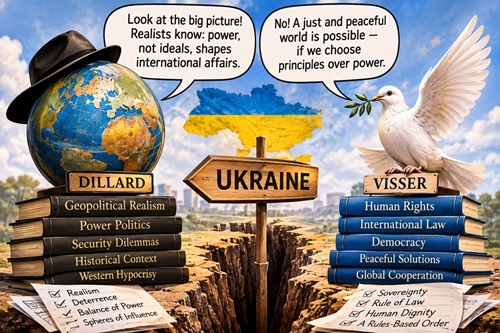 When an illustration misrepresents the argumentJoseph Dillard has raised a legitimate complaint about the illustrations accompanying my essays on the Ukraine war. Images do not merely decorate an argument. They can frame it before the reader has even begun to consider the accompanying text. They can assign intellectual positions, suggest moral sympathies, and simplify disagreements that are considerably more complex than a cartoon can convey. In this particular case, I have to admit that I got the imagery wrong. The illustration accompanying my discussion of our disagreement inadvertently suggested that I represented the geopolitical realist position, while Dillard occupied the position of moral criticism of Western policy. This was a reversal of our respective intellectual territories. Dillard has consistently emphasized geopolitical realism, power politics, security dilemmas, historical context, and the institutional interests shaping international relations. My own approach places greater emphasis on Ukrainian sovereignty, international law, national self-determination, and the moral distinction between aggression and resistance. I actually noticed the misrepresentation when I first saw the image. But I left it in place, partly because I found it amusing and partly because I was portrayed as frowning. In retrospect, that was not a particularly good editorial justification. An image can be funny and still be misleading. Dillard is right to object when an illustration assigns him a position that is not his own. The problem with visual framingDillard's broader point deserves attention. An illustration can establish an interpretive framework before the reader encounters the argument itself. A speech bubble attributed to a recognizable participant is especially consequential: it can make that person appear to defend a position he does not hold. Even when the accompanying essay is more nuanced, the image may remain the reader's first and most memorable impression. This is not a trivial editorial matter. A cartoon can be satirical, provocative, and deliberately exaggerated, but when it represents an actual intellectual disagreement, it should not reverse the positions of the participants. The image should illuminate the argument, not substitute a different one for it. I also accept Dillard's criticism that the prose of an essay can be more nuanced than its illustration. That is precisely what happened here. The image compressed our disagreement into a misleading opposition. The jealous husband: a metaphor worth qualifyingThere is another image Dillard criticizes: Putin as a jealous husband attempting to prevent Ukraine from leaving his sphere of control. I understand his objection. International relations are not domestic relationships, and the analogy risks turning a complex geopolitical conflict into a simple household drama, with Russia as the possessive husband, Ukraine as the victimized wife, and the West as the rescuing partner. That framing can obscure important questions. Ukraine has its own political history, interests, divisions, and agency. Western governments have their own strategic interests, which do not necessarily coincide with Ukrainian interests. Russia's security concerns, NATO's policies, and the history of the post-Cold War European order also deserve examination. Dillard is right that an analogy should not be mistaken for a complete explanation. But I would not abandon the metaphor altogether. It was meant to highlight an aspect of Putin's relationship with Ukraine that can be overlooked in some realist narratives: the possessive, almost proprietary conception of Ukraine that has repeatedly surfaced in Russian political rhetoric and in Putin's own historical arguments. Putin does not merely regard Ukraine as a strategically important neighboring country. He has repeatedly questioned the legitimacy of Ukrainian statehood as an independent historical and political reality. His account of Russian and Ukrainian history tends to subordinate Ukrainian identity to a supposedly larger Russian historical unity. Ukraine's decision to pursue a separate political future is consequently treated not simply as an unwelcome geopolitical development, but as something fundamentally illegitimate. The jealous-husband analogy attempts to capture this possessive dimension. It suggests a relationship in which one party cannot accept the other's independence, even when that independence is freely chosen. The crucial point is not that Putin literally thinks of himself as a husband, but that his political conception of Ukraine can resemble ownership: Ukraine is expected to remain within Russia's orbit, regardless of what Ukrainians themselves want. And the consequences have been devastating. Putin's determination to prevent Ukraine from escaping that orbit has involved a full-scale invasion, the destruction of cities and infrastructure, mass displacement, and enormous casualties on both sides. The analogy draws attention to the extraordinary lengths to which he has been willing to go to preserve a relationship of domination. In this sense, it highlights something that a purely strategic account can understate: the extent to which the war is also about denying another nation the right to determine its own future. Of course, this does not mean that every realist account overlooks the ideological and personal dimensions of Putin's politics. Nor does it mean that Russian security interests are imaginary or irrelevant. But explanations based primarily on spheres of influence, NATO expansion, and great-power competition can inadvertently make Ukraine appear as an object in a geopolitical chess game rather than as a country whose independence is being attacked. The possessive dimension of Putin's outlook deserves to remain visible. The metaphor therefore has a legitimate, though limited, purpose. It highlights one aspect of the conflict; it cannot explain the entire conflict. I should have made that distinction clearer. A better illustrationThe new illustration I have commissioned is considerably more faithful to the disagreement. It places Dillard on the left, represented by a globe surrounded by books on geopolitical realism, power politics, security dilemmas, historical context, and Western hypocrisy. I appear on the right as a dove standing on books about human rights, international law, democracy, peaceful solutions, and global cooperation. This is still a cartoon, of course. Neither of us can be reduced to these labels. Dillard is not indifferent to moral principles, and I am not oblivious to geopolitical realities. But the image now conveys the broad intellectual distinction much more accurately: Dillard approaches the conflict primarily through geopolitical realism, while I give greater weight to normative principles, sovereignty, and the rights of nations to determine their own futures. Correcting the picture without surrendering the argumentMy acknowledgment of the imagery problem should not be confused with a retreat from my substantive position on the Ukraine war. Dillard and I continue to disagree about the relative importance of Western policy, Russian security concerns, Putin's ambitions, and the responsibilities of the various actors involved. Those disagreements should be settled through arguments and evidence, not through cartoons. I appreciate that Dillard has brought the issue to my attention. His criticism is a useful reminder that editorial choices carry intellectual responsibilities. If we portray another person's position visually, we should make a serious effort to represent it fairly. And if we use an analogy to make a moral point, we should acknowledge what it illuminates as well as what it obscures. The original illustration failed that test. The jealous-husband analogy, although limited, still points to an important dimension of Putin's attitude toward Ukraine. Both points can be acknowledged without contradiction. A good illustration should make an argument more accessible without quietly changing its meaning. In this instance, the picture needed to change. I am happy to say that it has.
Comment Form is loading comments...
|