|
TRANSLATE THIS ARTICLE
Integral World: Exploring Theories of Everything
An independent forum for a critical discussion of the integral philosophy of Ken Wilber
 Dr. Joseph Dillard is a psychotherapist with over forty year's clinical experience treating individual, couple, and family issues. Dr. Dillard also has extensive experience with pain management and meditation training. The creator of Integral Deep Listening (IDL), Dr. Dillard is the author of over ten books on IDL, dreaming, nightmares, and meditation. He lives in Berlin, Germany. See: integraldeeplistening.com and his YouTube channel. He can be contacted at: joseph.dillard@gmail.com
When the Illustration Decides the ArgumentEmotional framing, geopolitical simplification, and a clarification of my positionJoseph Dillard / ChatGPT
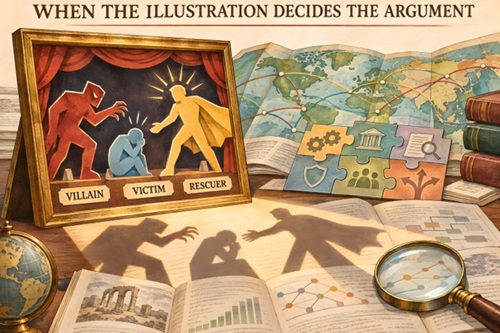 An illustration can make an argument before the accompanying essay has begun. It can assign innocence and guilt, distinguish the reasonable observer from the misguided critic, and suggest which loyalties a decent person ought to possess. When an image accomplishes these things through caricature, qualifications in the text do not automatically undo its framing. It is similar to a sensational lie being spread all over the media while a later retraction is scarcely noticed. In the meantime, the original lie has had its effect on collective assumptions. This concerns me in some of Frank Visser's illustrated essays on Integral World. The issue is particularly clear when an illustration puts words into my mouth. In the picture accompanying his essay about our continuing disagreement, I am represented as saying, “It's about the moral failure of the West.” Frank is assigned geopolitics, power, and realism. The visual contrast extends to our coffee mugs: his affirms facts; mine invokes higher truth. Readers could reasonably understand this as a summary of our underlying positions. That is precisely the problem. It turns one object of my criticism into the governing premise of my thought, while assigning to Frank an intellectual territory—geopolitical realism—that has been central to my own writing. I criticize Western moral failures. However, my argument examines how identities, institutions, incentives, and geopolitical interests can prevent people from recognizing damaging consequences and changing course. Moral criticism participates in that inquiry. It cannot adequately substitute for it. In my essay on a multi-perspectival approach to geopolitics, I explicitly acknowledge my preference for a realist and rational approach. I discuss ideology, nationalism, security, material interests, diplomacy, and the limitations of realism itself. Representing our disagreement as realism on one side and moral denunciation on the other obscures this published position.2 My more recent work on Adaptive Reorganization Theory, or ART, takes the inquiry further. It asks whether established arrangements remain capable of receiving information, testing alternatives, and reorganizing when their previous adaptations become destructive. That question applies to Western institutions, Russian centralization, Chinese information control, and emerging international arrangements. Multipolarity receives no guarantee of virtue. Western loss of predominance need not constitute civilizational failure; it could involve successful adaptation.3 The proposed standard is therefore broader than the moral standing of a civilization. It concerns the capacity to correct conduct before consequences impose a more destructive correction. My emphasis on Western responsibility also reflects my participation in Western society and investment in Integral thought. Those relationships create reasons to examine our own institutions closely. They do not establish that wrongdoing belongs exclusively to us. In my discussion of an Integral moral stance, I explicitly extend criticism to non-Western governments, including Russia and China. Concentrating on institutions in which one participates is a choice of responsibility and emphasis, open to criticism like any other. It is not sufficient evidence of an allegiance to their adversaries.4 For those who have not read Frank's essay and therefore have not seen the picture at issue, I am providing it here: 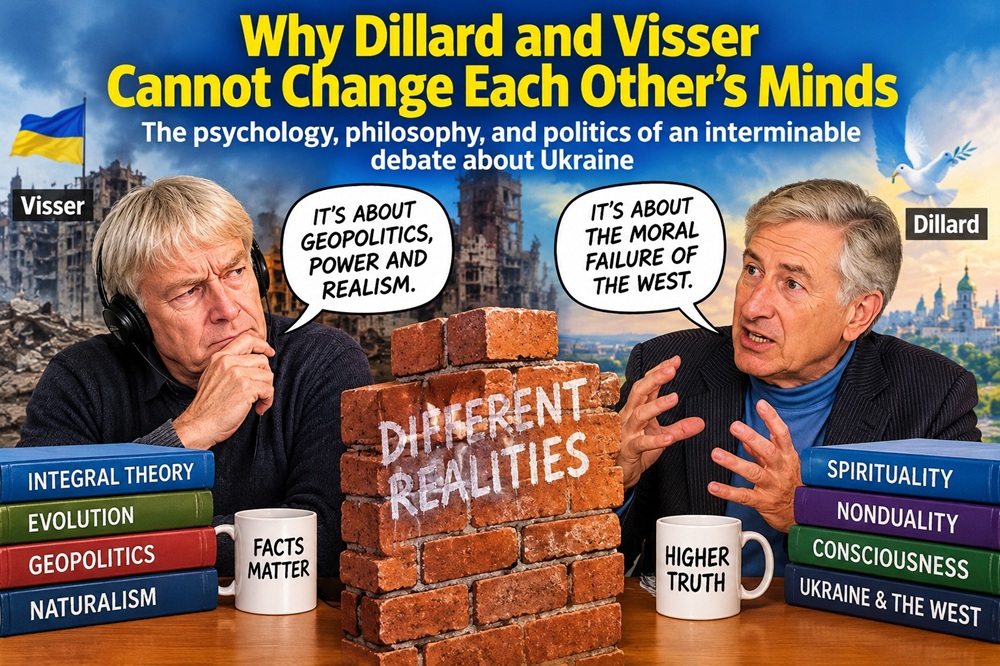 The spiritual contrast in the illustration is equally questionable. My account of functional nonduality does not confer privileged access to an answer. It seeks to loosen the authority of an established identity long enough for alternatives to receive consideration. Those alternatives then require discrimination, behavioral testing, and revision. An interviewed perspective is not a revelation, and an adaptive outcome cannot simply be declared by the theorist.5 There are substantial disagreements Frank could pursue with these arguments. He could question my evidence, challenge my weighting of competing causes, or show where my stated standards fail to govern my conclusions. In fact, he often does those things in the body of his essays. The problem is that such illustrations bypass and trivialize that work by offering a more immediately recognizable opponent. A related problem appears in the jealous-husband analogy. The opening image depicts Putin restraining a fleeing woman representing Ukraine, who is moving toward signs for the European Union and NATO. The West appears visually as a destination of refuge; the accompanying argument develops the role of outside protection. This creates the recognizable relationship of persecutor, victim, and rescuer.
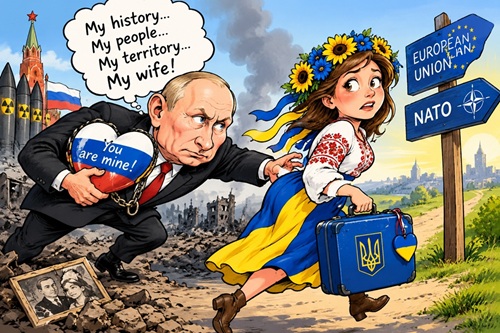 Frank does acknowledge the analogy's limitations, including near the beginning, and recognizes strategic complexity and Ukrainian agency. Those qualifications deserve acknowledgment.6 The question is whether the image invites readers to treat a limited analogy as a comprehensive explanation. The analogy has an intelligible moral purpose. Shared history does not establish ownership of another people. Recognizing domination and suffering is necessary. My objection does not require denying either. But an analogy must be judged by the distinctions it obscures as well as those it illuminates. A household is not an international security system. A military alliance is not simply a circle of friends. States possess armies, institutions, competing constituencies, strategic commitments, and capacities to threaten one another. The relevance of those differences must be investigated; it cannot be settled by the emotional familiarity of domestic abuse. Once the conflict is pictured as a violent husband pursuing his escaping wife, security arguments are liable to appear as excuses offered by the abuser. Inquiry into the conduct of outside powers can acquire the moral character of blaming the victim. A reader may then feel pressure to establish sympathy with the victim before asking whether a particular policy protects her. This does not prove that any Russian security claim is valid, or that any Western policy caused a particular Russian decision. It identifies a problem in the conditions of inquiry: the metaphor can make some questions suspect before their evidence is examined. There is a further difficulty with the rescuer role. A party can provide real assistance while pursuing its own strategic interests. Its intervention can protect autonomy in one respect while constraining choices in another. Whether assistance succeeds must be assessed through consequences, alternatives, risks, and the wishes of those affected. The moral legitimacy of helping someone does not establish the wisdom of every measure undertaken in their name. Nor does identifying an aggressor settle the causal history of a conflict or the comparative merits of possible responses. These are related questions, but answers to one cannot simply be transferred to the others. Ukraine's agency also requires more than assigning it the sympathetic role. A population includes disagreements, regional experiences, changing preferences, and competing judgments about risk. Respect for that agency requires inquiry into how decisions are made and whose interests receive weight. The image of a fleeing spouse compresses those questions into a single emotionally legible movement. For example, Ukrainians fleeing from or protesting against secret torture chambers are not running from Russian abuse. These limitations make the illustration partial. It becomes mistaken when the selected relationship is treated as sufficient to explain motivations, allocate all relevant responsibility, or validate a policy. The same criticism would apply to an image depicting Russia as an innocent victim, NATO as the sole persecutor, and some opposing coalition as humanity's rescuer. Reversing the casting preserves the simplification. Why, then, choose such images? One plausible purpose is simply to attract attention. A vivid illustration can invite readers into an essay they would otherwise overlook. But then, why not an equal and opposite illustration if the particular illustration is not chosen to make a point? Another is pedagogical: a familiar relationship can make an abstract issue easier to grasp. A third is moral urgency: the author may fear that discussion of complexity will obscure suffering or weaken opposition to coercion. None of these purposes necessarily involves dishonesty. Yet they raise further questions. Is the image intended to open inquiry or to establish the emotional boundaries within which inquiry will occur? Does it represent a hypothesis to be tested, or the moral interpretation the reader is expected to retain? Is the critic being invited to challenge the argument, or being assigned a role that makes disagreement appear discreditable? While I cannot determine Frank's private motives from his illustrations, choosing and publishing an illustration is an editorial act with a public meaning. Readers have grounds to ask what relationship that act bears to the author's stated position. If the caricature accurately expresses his underlying understanding, then its omissions require substantive defense. However, instead of offering that defense, these essays largely provide caveats that serve to tone down the implications of these illustrations. Why should this particular selection of motives and relationships organize the account? What evidence would require it to change? If the caricature does not adequately represent Frank's understanding, why give it such prominence? Why introduce a complex argument through an image that encourages readers to misunderstand the position the prose subsequently qualifies? There is also an intermediate possibility: the illustration expresses a sincerely held moral intuition, while the essay supplies qualifications the author also sincerely accepts. That need not be calculated manipulation. It may reveal an unresolved tension between the account that feels compelling and the account that can withstand examination. This is where questions of loyalty become relevant without requiring accusations about hidden intentions. Does the image's distribution of sympathy correspond to the author's identification with a geopolitical community? Are the actions of that community framed as protection while those of its adversaries are explained through character defects? Would comparable conduct receive comparable treatment if the actors changed places? These are questions to investigate, not diagnoses to pronounce. Qualifications in the prose matter. They can show care, sincerity, and willingness to acknowledge complexity, but their presence does not establish that the initial image has been adequately corrected. The image can remain the interpretive frame through which every concession is read: complexities belong in the background, while the original distribution of innocence and blame retains authority. In the essay about our disagreement, Frank's prose is more nuanced than the illustration. It recognizes that explaining geopolitical context and assigning responsibility involve distinguishable questions. That makes the discrepancy worth addressing directly. The greater care in the text provides a reason to improve the picture, rather than an automatic defense of it. My own position must remain subject to the scrutiny I request. I can overstate Western causation, underweight Russian or Ukrainian agency, or use a theoretical framework to protect conclusions I prefer. In my essay on moral identity, I explicitly identify evidence that should lead me to revise my assessments. Opposition to Western policy offers no immunity from groupthink, and evolutionary language confers no exemption from error.7 Reciprocity requires that I extend the same caution to Frank. His use of a reductive image does not establish that his accompanying argument is false, that his concern for Ukraine is insincere, or that he is incapable of reconsideration. Those conclusions would repeat the substitution of characterization for examination that I am criticizing. What I ask is that the illustration become as accountable as the essay. A speech bubble attributed to an identifiable person should represent that person's position faithfully. A political analogy should disclose its limits without making inquiry beyond those limits appear morally suspect. An emotionally compelling image should remain open to correction when it misleads. Attention is a legitimate editorial objective. Accuracy must govern how that attention is obtained. When a picture misstates an opponent's argument or gives a partial geopolitical narrative the appearance of a settled moral reality, revising the prose is only part of the necessary correction. The picture itself needs to change.
Endnotes
Comment Form is loading comments...
|