|
TRANSLATE THIS ARTICLE
Integral World: Exploring Theories of Everything
An independent forum for a critical discussion of the integral philosophy of Ken Wilber
 Dr. Joseph Dillard is a psychotherapist with over forty year's clinical experience treating individual, couple, and family issues. Dr. Dillard also has extensive experience with pain management and meditation training. The creator of Integral Deep Listening (IDL), Dr. Dillard is the author of over ten books on IDL, dreaming, nightmares, and meditation. He lives in Berlin, Germany. See: integraldeeplistening.com and his YouTube channel. He can be contacted at: joseph.dillard@gmail.com Dr. Joseph Dillard is a psychotherapist with over forty year's clinical experience treating individual, couple, and family issues. Dr. Dillard also has extensive experience with pain management and meditation training. The creator of Integral Deep Listening (IDL), Dr. Dillard is the author of over ten books on IDL, dreaming, nightmares, and meditation. He lives in Berlin, Germany. See: integraldeeplistening.com and his YouTube channel. He can be contacted at: joseph.dillard@gmail.com
Check out my other conversations with ChatGPT Who Gets to Decide What Matters?From Integral Politics to Adaptive ReorganizationJoseph Dillard / ChatGPT
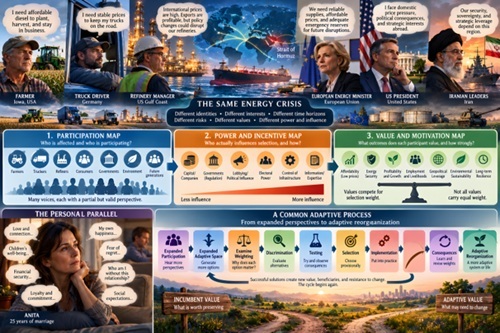 A farmer in Iowa starts his tractor. A truck driver in Germany fills his tank. A refinery manager on the American Gulf Coast looks at international diesel prices. A European energy minister looks at emergency reserves. An American president looks at domestic prices and political pressure. Iranian leaders look at the Strait of Hormuz and the conflict surrounding them. Each is participating in the same energy crisis, but none is confronting quite the same problem.1 You and I see food and transportation becoming more expensive. The farmer sees the cost of planting and harvesting. The trucker sees the cost of staying in business. The refinery sees an international market in which scarce diesel commands exceptionally high prices.2 The American government sees domestic economic and political pressure as well as strategic interests abroad. European governments see immediate price pressures while worrying about what will happen if emergency reserves are depleted and another disruption occurs. Iran sees its own security, sovereignty, and strategic leverage. What appears from a distance to be a single problem—a shortage of diesel—is actually an intersection of different identities, interests, time horizons, risks, values, and concentrations of power. Integral political theory tells us something important about such a situation. We will misunderstand it if we reduce it to a single perspective. It is not enough to say that oil companies are greedy, farmers are protecting themselves, Europeans are dependent, Americans are hegemonic, or Iranians are threatening global commerce. Each description selects part of a much larger system and makes it central. An Integral approach asks us to resist that reduction, include perspectives that our preferred narrative excludes, recognize the partial validity of competing interpretations, and create conditions in which, as Elke Fein has put it, the system can listen to itself.3 Adaptive Reorganization Theory, or ART, agrees. Then it asks a more difficult question: Once we have heard everyone, how much should each one count? That question changes the problem. The American farmer may want the United States to restrict diesel exports so that more fuel remains available domestically. American refiners have strong reasons to oppose such restrictions because international prices make exports highly profitable and because they argue that export restrictions could disrupt refinery economics and ultimately reduce production.4 European governments want adequate supplies but also want to preserve emergency reserves against a prolonged crisis.5 American policymakers face pressure to reduce domestic fuel prices while preserving energy relationships with allies. You and I want affordable fuel and food. Environmental interests point toward the longer-term necessity of reducing fossil-fuel dependence altogether. All of these perspectives can be heard without possessing anything close to equal influence over what happens. This is where an important limitation of Integral politics becomes visible. Political adaptation is not merely a problem of including perspectives. It is a problem of weighting them.6 From the Diesel Pump to the Kitchen TableThe same problem appears in a much more intimate form. Imagine a woman, we'll call her Anita, who has been married for twenty-five years. She once chose her husband because she loved him. They raised children together, bought a house, developed friendships, created traditions, accumulated memories, and built a shared understanding of who they were. Their lives are economically intertwined. Their children understand themselves partly through the existence of their family. Their retirement plans assume a shared household. Her social world contains people who know them primarily as a couple, but the relationship has gradually become deeply unsatisfying. Anita has thought about leaving. Perhaps she has discussed it with friends and a therapist. She can list perfectly good reasons for staying and perfectly good reasons for leaving. She can understand her husband's perspective. She can understand her children's concerns. She knows what her friends think. She can imagine herself five years after divorce and five years after remaining married. Her problem is not lack of perspectives, nor is it necessarily lack of intelligence. She may understand the situation extraordinarily well. The problem is that these considerations do not enter her decision with equal weight.7 Love carries weight. So does resentment. Loyalty carries weight. So does the desire for freedom. Anita's children matter. Financial security matters. Sexual intimacy matters. Loneliness matters. The house matters. Twenty-five years of shared memories matter. Her promise to remain married matters. Fear of regretting a divorce matters. Fear of spending another twenty-five years in an unhappy relationship matters. Her identity as a wife matters. Her image of herself as someone who keeps commitments matters. Perhaps religious or cultural expectations matter. Perhaps the embarrassment of telling friends and relatives matters more than she would like to admit. The question is therefore not simply: What alternatives can she imagine? It is: Why does each alternative carry the weight that it does? That is the same question hiding inside the diesel crisis. Success Creates Its Own Resistance to ChangeThe relationship example reveals something important about successful adaptation. Anita did not make a foolish decision twenty-five years ago merely because the marriage is troubled today. The relationship may have been extraordinarily successful. It may have generated love, security, children, intimacy, economic stability, friendship, identity, and meaning. That success is precisely why reorganizing it is so difficult. If the relationship had produced nothing of value, leaving might be easy. Instead, successful organization accumulated value.8 Something similar happens with energy systems. Europe's transportation, agriculture, manufacturing, trade, and standards of living developed around an energy infrastructure that worked extraordinarily well. Pipelines, refineries, ports, vehicles, supply chains, contracts, alliances, industries, and patterns of consumption accumulated around it. Diesel became deeply embedded in agriculture, trucking, construction, industry, and commerce. That organization created enormous value. That accumulated value created beneficiaries.9 The farmer owns diesel machinery. The trucking company owns diesel trucks. The refinery owns infrastructure optimized for particular fuels. Workers depend upon industries organized around existing arrangements. Governments depend upon tax revenues. You and I organize our lives around available transportation. Corporations possess contracts and investments whose value depends upon continuity. Successful stabilization therefore does more than create structure. It creates interests in preserving structure.10 The same thing has happened in the marriage. Anita's identity, family, finances, relationships, expectations, memories, and plans have precipitated around a successful organization called “our marriage.” Neither system resists change simply because it is stupid or rigid. It resists change because there is something valuable to lose. This is one of ART's central propositions. Successful organization creates not only structural resistance to reorganization but motivational resistance because identities and beneficiaries form around the value that successful organization has generated. Participation Is Not InfluenceSuppose Anita goes to couples therapy. Both partners speak. Their children are considered. Each listens to the other's perspective. Perhaps the therapist is exceptionally skillful at helping each understand how the other experiences the relationship.11 While this may be enormously valuable, it is also not enough. The husband might completely understand Anita's unhappiness while placing greater weight on preserving the marriage. She might completely understand his fear of abandonment while placing greater weight on autonomy. Both might understand their children's desire that they remain together while disagreeing about how much that desire should determine their own lives. Everyone has participated, but participation does not tell us how much each perspective should count. Exactly the same distinction appears politically. American farmers can speak. Oil companies can lobby. European governments can protest. Economists can publish analyses. You and I can complain. Environmental organizations can issue reports. Iranian officials can explain their security concerns. The system is, in one sense, listening to itself, but existence is not participation, participation is not influence, influence is not selection, selection is not implementation, and implementation is not necessarily adaptive reorganization.12 A perspective can be perfectly well understood and still receive almost no weight. Who Gets to Determine the Weights?Now the political problem becomes clearer. Farmers possess political influence because agriculture matters economically and farm states matter electorally. Oil companies possess capital, technical expertise, lobbying organizations, production capacity, employment, and control over infrastructure. Governments possess regulatory and coercive authority. European governments possess diplomatic leverage but cannot vote in American elections. European consumers can bear consequences of American energy decisions while possessing almost no direct influence over them. Future generations possess no votes at all. Ecological systems cannot hire lobbyists.13 The problem is therefore no longer simply, “Who is represented?” It becomes, “Who determines how much each participant counts?” That is a question about power. Power, from an ART perspective, is partly the capacity to determine weighting within a selection environment. Money changes weighting. Ownership changes weighting. Political office changes weighting. Expertise changes weighting. Control over information changes weighting. The ability to reward, punish, employ, fund, exclude, sanction, or grant access changes weighting. The same phenomenon appears internally in the marriage.14 Anita's fear of economic insecurity may possess enormous weighting power. Her identity as a loyal spouse may possess another kind. Her anger may temporarily dominate both. Her children may possess emotional influence far greater than their formal authority. Twenty-five years of investment creates sunk costs. Fear of loneliness can amplify the value of familiarity. A new romantic possibility could suddenly distort weighting in the opposite direction. Neither political nor psychological selection occurs on a level playing field. Alternatives enter a selection environment.15 What Integral Politics Gets RightThis is where Integral politics remains important. Imagine making policy about the diesel crisis while considering only American consumers. The result could impose enormous costs on allies and destabilize international supply. Imagine considering only refinery profits. Imagine considering only European energy security. Imagine considering only the geopolitical conflict with Iran. Imagine considering only climate change. Every reduction excludes relevant information. Integral politics therefore performs an essential function by asking us to broaden the field. It challenges psychological and political geocentrism—the tendency to treat the perspective from which we happen to be looking as the center around which all other perspectives should revolve. The same principle applies to the marriage. If Anita sees the situation only through her unhappiness, she may miss important information. If she sees it only through her children's needs, she disappears from the decision. If she sees it only through loyalty, she may perpetuate a destructive arrangement. If she sees it only through autonomy, she may undervalue what twenty-five years of relationship has created. Perspective-taking expands adaptive space, but that is where Integral politics tends to stop too soon. The harder question is, “What happens after the perspectives have been included?”16 Why “Both/And” Is Not EnoughThe marriage makes the problem obvious. “Both stay and leave” is not a solution. Eventually something has to happen, but the choice need not be restricted to staying exactly as things are or divorcing tomorrow. Expanded participation might generate alternatives neither partner previously considered: a temporary separation, changes in living arrangements, intensive couples therapy, renegotiated expectations, greater independence within the marriage, changes in work or caregiving responsibilities, or experiments designed to discover whether particular sources of dissatisfaction can actually change. The movement is therefore not simply: either/or ? both/and. It is: either/or ? expanded participation ?expanded adaptive space?alternative weighting? discrimination ? testing ? selection.17 The diesel problem is structurally similar. The alternatives need not be reduced to “ban American diesel exports” or “let the market decide.” Governments can release strategic reserves, coordinate releases internationally, adjust taxes temporarily, subsidize particular essential uses, encourage refinery production, negotiate supply arrangements, protect minimum reserve levels, accelerate substitutions, reduce nonessential consumption, or combine several measures. Expanded perspectives matter because they may reveal alternatives that the original polarization concealed, but those alternatives still have to be evaluated. Functional Non-Duality Becomes PracticalThis is where a term that otherwise sounds highly abstract—functional non-duality—becomes concrete. Suppose Anita can temporarily ask, “What would I value if protecting my present identity as a wife were not determining the answer?” That does not mean she should leave. Anita can also ask, “What would I value if my present anger were not determining the answer?” That does not mean she should stay. Functional non-duality does not provide the answer. It temporarily reduces the monopoly that a dominant identity and its incentives exercise over the weighting process.18 The same principle applies politically. An American policymaker might ask, “What would we consider adaptive if lowering American diesel prices mattered, but European energy security also received genuine weight?” A European policymaker might ask, “What would we consider adaptive if lowering current prices mattered, but preserving sufficient reserves against a prolonged disruption also received genuine weight?” A refinery executive might ask, “What would we choose if shareholder returns remained important but the reliability of domestic and allied energy supplies also carried meaningful weight?” No participant has to abandon their interests. Functional non-duality does not require altruism, agreement, passivity, or compromise. It requires something simpler: My interest does not automatically receive infinite weight merely because it is mine. Perspectival and Motivational GeocentrismThis distinction helps clarify psychological geocentrism. Perspectival geocentrism says, “My perspective receives privileged epistemic status because it is mine.” Motivational geocentrism says, “Outcomes serving the identity with which I am identified receive privileged selection weight because they serve me.” The two are related but not identical. Anita may understand her husband's perspective beautifully while remaining unable to assign meaningful weight to it. An American policymaker may understand European vulnerability perfectly while remaining politically incentivized to prioritize domestic prices. A refinery executive may understand farmers' difficulties while remaining institutionally obligated and financially motivated to maximize returns. Empathy can reduce perspectival geocentrism without substantially altering motivational geocentrism. That is why understanding is necessary but insufficient.19 The Three MapsThe diesel crisis can therefore be examined using three simple maps. The first is a participation map, an example of which we have above. It asks, “Who is affected and who is participating?” Farmers, truckers, refiners, consumers, governments, European industries, Iranian interests, shipping companies, food producers, manufacturers, environmental interests, and future populations all belong somewhere on that map. The second is a power and incentive map, It asks, “Who actually influences selection, and what rewards or constrains them?” Governments possess regulatory authority. Oil companies possess production capacity and capital. Farmers possess electoral and lobbying influence. European governments possess diplomatic and economic leverage. You and I possess diffuse political influence. Future generations possess almost none.
The third is a value and motivation map. It asks, “What outcomes does each participant value, and how strongly?” Affordability, profitability, reelection, food security, energy security, alliance reliability, geopolitical leverage, national autonomy, environmental sustainability, employment, economic growth, and long-term resilience compete for selection weight. The same maps can be drawn for the marriage. Who participates? Wife, husband, children, friends, perhaps therapists, relatives, employers, religious communities, and other important relationships may or may not. Who possesses influence? Emotional attachment, economic dependence, children, property ownership, cultural expectations, legal arrangements, social networks, and the partners themselves all influence selection differently. What is valued? Love, loyalty, autonomy, security, sexuality, family continuity, honesty, companionship, financial stability, social belonging, personal development, and peace of mind may all receive different weights. Suddenly ART's abstraction becomes recognizable as something we do every day.20 The Life Compass as Reorganization Rather Than Inner WisdomAnita does not need a Higher Self that already knows whether she should remain married. She needs a process capable of improving the conditions under which she discovers what to do. This also clarifies the “Life Compass,” an Integral Deep Listening concept. It is not a “thing” but a process, similar to how navigating at night on the open sea by the North Star is an orienting process. Different interviewed perspectives can, over time, generate agreement regarding life direction. This points us toward a hypothetical Life Compass rather than ever arriving at it. If Anita does an IDL interview, it may introduce a perspective that values her situation differently from how she does. One interviewed perspective might place surprisingly little weight on preserving appearances and considerable weight on honesty. Another might value loyalty more than she expected. Another might care less about whether she stays or leaves than about whether she stops relating to her husband through resentment. None automatically knows the answer, but each alters the selection environment, often in significant ways. This resembles the Integral emphasis on expanding the domain of participants. The Life Compass can therefore be understood as the ongoing process through which sufficiently diverse sources of information generate alternative organizations, expose hidden weighting, discriminate among possibilities, test them against consequences, and revise values and motivations accordingly. The question is not, “What does my intuition or inner wisdom tell me to do?” It is, “Can I reorganize the process through which I determine what deserves to matter?”21 ARCR and TestingThis is where Autonomy, Reciprocity, Confirmation, and Reliability (ARCR) become important. Autonomy asks whether the alternatives are sufficiently independent of Anita's preferences and assumptions to provide genuinely different information. In the case of the diesel example, how independent are decision options from the very powerful influence of the refiners and government? Regarding Anita's decision, how independent are her options from her waking preferences and emotions? Reciprocity asks whether the consequences for other participants have been seriously considered. How much weight has been given to the environment and future generations? How much consideration has been given to the innate yet relatively autonomous perspectives of dream elements? Has Anita actually made small behavioral changes and monitored what happened? Confirmation asks whether assumptions can be checked against independent evidence. Regarding diesel, what does the data say about the possible impact on consumer prices? What are for Anita the most realistic objective outcomes of staying and leaving? Reliability asks whether an alternative repeatedly produces what it claims to produce. Based on past history, how likely is pushing ahead with the refiner's preferences likely to succeed this time? Based on past history, how reliable are Anita's hopes and fears as determinants in this instance? Suppose an interviewed perspective tells Anita, “Leave your husband.” IDL does not transform that statement into revelation. She can test smaller implications. What happens if she becomes more autonomous within the marriage? What happens if she states needs she has previously suppressed? What happens if the couple changes particular patterns for three months? What happens if they temporarily separate? Do affection and curiosity return, or only relief? Do the children actually respond as catastrophically as feared? Are financial assumptions accurate? Does her own emotional state improve? The selection environment begins receiving new information from behavior rather than imagination alone. The diesel crisis requires analogous experimentation. A coordinated release of reserves is not proof that reserve releases are the correct solution. It is an intervention generating evidence. Do prices fall? For how long? How quickly are inventories depleted? Does refinery production increase? Does demand change? Does European vulnerability rise? Do international markets interpret commitments against export restrictions as credible? What happens if geopolitical disruption continues? The adaptive question is not whether policymakers selected the right answer once; it is whether they can learn quickly enough to change it.22 Can the System Select a Surprise?ART asks, “Can the system surprise itself?” That tests whether alternatives to incumbent organization can arise. However, the diesel crisis and the marriage reveal a harder question, “Can the system select a surprise that disadvantages the identity or beneficiaries produced by its present organization?” Anita may generate the insight that her marriage needs fundamental change. Can she act on it if doing so threatens her identity, economic security, social standing, and familiar life?23 A corporation may generate an analysis demonstrating that its established business model is becoming obsolete. Can it invest in an alternative that cannibalizes its present revenue? A government may commission a report demonstrating that established policy is failing. Can it abandon that policy if doing so damages powerful constituencies or requires admitting error? Europe may recognize that energy dependence creates strategic vulnerability. Can it reorganize an energy infrastructure upon which its current prosperity depends before circumstances force it to do so?24 Generating the surprise tests adaptive space. Selecting the threatening surprise tests reorganizability.25 Incumbent Value and Adaptive ValueThe marriage also makes another distinction easier to understand. The value accumulated within the relationship is incumbent value. Love, memories, home, family, financial security, identity, social connections, and shared history are real. ART does not dismiss them as mere attachments obstructing development. The existing energy system likewise contains enormous incumbent value. It feeds populations, transports goods, powers machinery, employs millions, generates revenue, and supports complex industrial societies. Incumbent value is not the enemy. Indeed, successful systems succeed precisely because incumbent value and adaptive value once substantially overlapped. The problem arises when circumstances change. Then preserving everything that presently has value may prevent the creation of value necessary for future adaptation. ART cannot simply declare which value is “adaptive.” That would reproduce the same epistemic privilege it criticizes elsewhere. Adaptive value has to remain provisional. It emerges through inclusive participation, examination of weighting distortions, ARCR discrimination, testing, consequences, and continued correction. Perhaps the marriage should end. Or perhaps it might best survive in a radically different form. Perhaps the process reveals that its deepest problems are reparable and that remaining together is more adaptive than leaving. ART does not know, and that is the point. It provides a methodology for adaptive reorganization; it does not provide or ensure adaptive reorganization.26 From Integral Politics to Adaptive PoliticsThis brings us back to Integral politics. Integral politics correctly recognizes that a political system becomes dangerously narrow when it cannot see beyond its preferred perspectives. It therefore emphasizes inclusion, perspective-taking, developmental complexity, dialogue, and the capacity to hold apparently contradictory truths. ART accepts these contributions but places them within a longer process. Integral politics asks, “Can the system hear its different voices?” ART adds, “How much does each voice count? Why? Who determines its weight? What interests influence that weighting? Can those weights themselves change? What happens when alternatives are tested? Can consequences overturn the organization that produced the original decision?” The distinction is not primarily between two competing political ideologies; it is between stages of an adaptive process. Integral politics is particularly strong at: decentering → expanded perspectives → expanded participation → expanded adaptive space. ART continues: expanded adaptive space → examination of weighting → discrimination → testing → selection → implementation → consequences → reweighting → adaptive reorganization.27 ART recognizes that successful reorganization will eventually become incumbent organization too. Today's solution creates tomorrow's interests, identities, investments, institutions, and beneficiaries. The cycle begins again.28 What Makes an Adaptive Civilization?The diesel crisis ultimately makes the central problem of The Adaptive Civilization surprisingly tangible. The question is not whether Europe, America, Iran, oil companies, farmers, environmentalists, or consumers possess the correct perspective, nor is it whether we can integrate all their perspectives into a harmonious whole. The question is whether our institutions can preserve enough autonomy among relevant participants to receive information they do not want, enough reciprocity to recognize costs imposed upon others, enough confirmation to test competing claims against consequences, and enough reliability to maintain cooperation while changing course. Above all, the question is whether the weighting system itself can change. A civilization can be extraordinarily intelligent, diverse, democratic, technologically sophisticated, and polycentric while remaining motivationally organized around values that no longer serve its long-term viability. Artificial intelligence could make such a civilization vastly more capable without making it more adaptive. Expanded intelligence operating within a captured selection environment merely provides more powerful means for pursuing incumbent ends.29 The same principle applies to a human life. Anita can be intelligent, empathic, self-aware, psychologically sophisticated, and capable of seeing numerous perspectives while remaining trapped because her identity is also the principal beneficiary of remaining unchanged. That is why the farmer starting his tractor, the European minister looking at emergency diesel reserves, and Anita, lying awake beside the person she married twenty-five years ago, are confronting versions of the same adaptive problem. Each possesses something valuable that deserves preservation. Each faces conditions that may require change. Each can imagine alternatives. Each has reasons to fear those alternatives. Each operates within a selection environment in which some values carry far more weight than others, and none can know with certainty beforehand what should be preserved and what should be reorganized. The purpose of adaptive politics, like the purpose of adaptive self-development, is therefore not to discover the final correct organization. It is to improve the process through which organization can be questioned without being casually destroyed, alternatives can be generated without being automatically selected, interests can be represented without becoming absolute, and consequences can revise the values and incentives that produced previous choices. Integral politics asks us to listen beyond ourselves. That is indispensable. ART asks what happens next. Can we give what we hear enough weight to change what we do? Can we test that change rather than merely believe in it? Can the consequences alter what we value? And, most difficult of all, can we select an alternative that threatens the identity, security, status, wealth, relationships, or institutions that taught us what mattered in the first place? A civilization becomes adaptively reorganizable not merely when it can hear alternatives to itself, but when those alternatives can acquire enough weight to be tested before catastrophe selects among them for us. The same may be true of a marriage, a career, a personality, and a life.30
For more information about ART, see AdaptiveReorganizationTheory.Com. For more information about IDL, see IntegralDeepListening.Com.
Notes
1. By early October 2026, global diesel markets remained unusually tight despite the recovery of some crude-oil flows. The disruption reflects several interacting factors rather than one simple shortage: the continuing US-Iran conflict and disruption to Persian Gulf refining and shipping, reduced Russian refined-product exports, damage to refining infrastructure, limited refining capacity, and uncertainty surrounding trade restrictions. Diesel is particularly consequential because it remains deeply embedded in freight transportation, agriculture, construction, and industrial machinery, allowing fuel-price increases to propagate through supply chains into consumer prices. Recent estimates suggest that sustained high diesel prices could add measurable pressure to headline and core inflation. 2. It is useful to distinguish the current refined-products problem from a simple shortage of crude petroleum. By October 2026, Gulf crude exports had substantially recovered, while diesel and other refined products remained much tighter. This distinction strengthens rather than weakens the ART example because it demonstrates how an apparently simple category such as “energy supply” can conceal bottlenecks at different scales of organization—production, refining, shipping, inventories, and distribution. 3. Elke Fein explicitly describes integral/metamodern politics in terms of creating conditions that help social and political systems “see themselves” and developing “Listening Societies.” Her work places this within a broader developmental understanding of political consciousness and institutional transformation. Tom Atlee similarly describes integral politics as integrating diverse perspectives into guidance for communities through generative conversation, stakeholder participation, and collective intelligence. ART accepts this expansion of participation as valuable while questioning whether perspective inclusion alone adequately explains political selection.
4. The conflict described in the essay is not hypothetical. During the 2026 diesel-price surge, American agricultural interests and farm-state politicians pressed for measures to protect domestic diesel availability, including discussion of export restrictions. Refiners and energy interests opposed such restrictions, arguing that they could disrupt refinery economics and ultimately reduce rather than increase supply. The Trump administration considered restrictions but, following the October G7 agreement, backed away from an export ban. The case therefore illustrates competing definitions of adaptive value: immediate domestic price relief, refinery utilization and profitability, international reliability, allied energy security, and longer-term supply incentives. 5. IEA members maintain emergency petroleum stocks precisely to cushion major supply disruptions. Members are generally required to hold stocks equivalent to at least ninety days of net oil imports, although national systems differ considerably and stocks may consist of crude oil, refined products, or combinations of the two. Releasing reserves therefore creates a genuine intertemporal selection problem: additional supply may reduce present scarcity and price pressure, but every barrel released also reduces the buffer available against subsequent disruption. This is an unusually clear example of different time horizons receiving different selection weights. 6. Adaptive weighting is being proposed here as an ART construct rather than cited as an established term in political science. However, its components have well-established parallels. Political science distinguishes formal participation from actual influence, while theories of agenda-setting and power examine how some actors can determine which issues become politically actionable at all. Behavioral economics likewise demonstrates that alternatives do not enter human decision-making neutrally: reference points, loss aversion, status-quo effects, and previous investments affect their perceived attractiveness. ART attempts to place these phenomena within a more general sequence of participation → adaptive space → weighting → discrimination → selection.
7. Relationship commitment is not determined by satisfaction alone. The marriage example has substantial empirical support in Caryl Rusbult's Investment Model of Commitment. The model distinguishes relationship satisfaction from commitment and proposes that commitment depends upon satisfaction, perceived quality of alternatives, and the magnitude of investments accumulated within the relationship. Later research and meta-analysis have strongly supported these relationships. In a meta-analysis involving more than 50,000 participants across 202 independent samples, satisfaction showed the strongest association with commitment, followed by investment size and the perceived quality of alternatives. Thus an unhappy relationship may remain highly difficult to leave because dissatisfaction is only one component of the selection environment. 8. ART's proposition that successful organization can create its own resistance to later reorganization has parallels in several established literatures. Behavioral economics documents status-quo bias, endowment effects, and loss aversion. Historical institutionalism describes path dependence and increasing returns through which established arrangements create growing incentives for their continuation. Organizational ecology describes structural inertia as something that can itself emerge through processes of selection. ART attempts to generalize these observations into the proposition that successful organization accumulates structures and value that subsequently increase the cost of becoming differently organized. 9. Energy systems are particularly strong examples of path dependence because vehicles, refineries, ports, pipelines, supply chains, industrial equipment, regulatory structures, investment patterns, and consumer behavior co-evolve around particular energy sources. The current diesel shortage illustrates the resulting rigidity: even when crude oil becomes more available, insufficient refining capacity or disruption of refined-product supply can remain a binding constraint. The IEA's differentiated treatment of crude and refined-product reserves reflects this practical distinction. 10. Hannan and Freeman's classic work on structural inertia argues that organizational reliability and reproducibility can themselves generate resistance to structural change. Pierson's analysis of increasing returns similarly explains how political arrangements can become progressively more difficult to reverse as actors adapt to them and investments accumulate. ART adds a proposed motivational extension: successful organization does not merely become structurally difficult to change; it creates beneficiaries whose identities, resources, careers, authority, or security may depend upon its continuation. This proposed transition from structural inertia to selection capture requires empirical testing rather than being assumed from the earlier literatures. 11. “Discernment counseling” was developed specifically for couples in which one partner is leaning toward divorce while the other wishes to preserve the relationship. Its stated purpose is not automatically to preserve the marriage or facilitate divorce, but to increase clarity and confidence about the next step. The possible outcomes include maintaining the status quo, proceeding toward divorce, or undertaking couples therapy in an attempt to reconcile. This is strikingly compatible with the ART principle that expanded participation should improve selection rather than predetermine what must be selected. 12. The distinctions among participation, influence, selection, and implementation are an ART analytical sequence rather than an established taxonomy. It parallels long-standing distinctions in theories of political power. Theories associated with Dahl emphasize observable decision-making power; Bachrach and Baratz emphasize agenda control and the exclusion of issues from decision-making; Lukes extends the analysis to the capacity of power structures to shape perceptions and preferences themselves. ART's “weighting” concept potentially connects these dimensions to adaptive selection by asking how power affects the probability that particular information or alternatives become consequential. 13. The claim that oil and energy interests possess political resources is empirically supportable, although lobbying does not mechanically determine policy. Kang's study of US federal energy legislation found statistically significant effects of lobbying expenditure on policy enactment probabilities and estimated substantial private returns to lobbying, while also finding that the marginal effect on enactment probabilities was small. Other research describes oil and gas as an industry with substantial political donations, lobbying, and political connections. The appropriate ART point is therefore not “oil companies control government,” but that participants enter political selection environments with dramatically unequal resources for affecting weighting. 14. ART's proposed definition of power as partly “the capacity to determine weighting within a selection environment” overlaps with, but is not identical to, established multidimensional theories of power. Agenda-setting theory is particularly relevant because political power can operate before a formal decision occurs by determining which alternatives are treated as legitimate, realistic, or worthy of consideration. ART extends this idea by asking whether control over weighting reduces the system's capacity to test alternatives threatening incumbent organization. 15. Prior investments can influence continuation decisions, but that does not imply that remaining in a long relationship is therefore irrational. Rusbult's model treats investments as one legitimate determinant of commitment alongside satisfaction and available alternatives. Behavioral research on sunk costs and status-quo bias shows that previous investments and anticipated losses can also distort decision-making. ART's task is therefore not to eliminate the weight assigned to accumulated value but to determine whether its present weighting remains appropriate under changed circumstances. 16. Integral political approaches explicitly emphasize multiple perspectives, developmental complexity, dialogue, collective intelligence, and the attempt to move beyond partisan reductionism. Fein's work additionally applies adult-development theory to political analysis, including questions of identity, meaning-making, complexity, and self-protective action logics. ART's proposed addition is to separate the expansion of perspective from the subsequent processes of weighting, discrimination, behavioral testing, and selection. 17. Deliberative and dialogical approaches have evidence supporting their capacity to reduce some forms of polarization and improve relations among opposing groups. A multidisciplinary review concludes that deliberation can produce opinion change and improve relations between opposed groups under some conditions. This supports Integral politics' emphasis on dialogue while leaving open ART's subsequent question: after dialogue expands the range of understood possibilities, what mechanisms determine which alternative should actually be selected? 18. Functional non-duality is an IDL/ART construct. Abstract non-duality is well-researched in meditation literature. Interviewed dream elements or personifications of life issues provide perspectives that are relatively non-invested in common life dualities of good/bad, right/wrong, alive/dead, true/false, and real/illusory, yet can state preferences that are concrete and functional. Functional non-duality refers operationally to a temporary reduction in the monopoly that a particular identity and its associated interests exercise over weighting. It does not imply metaphysical non-duality, neutrality, agreement, equal weighting, passivity, or compromise. A possible empirical research program would test whether practices intended to reduce identity fusion increase willingness to give consequential weight to disconfirming information or to interests outside one's immediate identity group. 19. Perspectival versus motivational geocentrism are proposed ART/IDL distinctions. Perspectival geocentrism describes the privileged epistemic status given to one's own standpoint; motivational geocentrism describes disproportionate selection weight given to outcomes benefiting the identity with which one is presently identified. Existing empathy research provides indirect support for distinguishing understanding from motivation: meta-analysis finds significant but far from perfect associations between cognitive or affective empathy and prosocial behavior. Understanding another's experience therefore cannot simply be equated with behaving in accordance with that person's interests. 20. The Participation Map, Power/Incentive Map, and Value/Motivation Map are proposed ART diagnostic devices. Their purpose is to prevent three different questions from being collapsed into “inclusion.” The Participation Map asks what relevant sources of information, experience, consequence, or alternative organization enter adaptive space. The Power/Incentive Map asks what determines their actual influence. The Value/Motivation Map asks what outcomes influential participants value and why. These maps should be treated as hypotheses-generating instruments until their reliability, independence, weighting rules, and predictive validity are empirically established. 21. “Life Compass” is an IDL term. The essay deliberately removes it from ontological claims about an inner Self, soul, intuition, consciousness, or organismic intelligence. The proposed ART interpretation treats the Life Compass as an orienting process inferred from patterns of adaptive reorganization across perspectives and over time. The North Star analogy is therefore methodological rather than metaphysical: convergence among independently generated perspectives may provide orientation without establishing that any one perspective possesses privileged access to truth. Empirical validation would require demonstrating that Life Compass procedures predict outcomes beyond ordinary reflection, psychotherapy, perspective-taking, expectancy effects, or nonspecific therapeutic factors. 22. Autonomy, Reciprocity, Confirmation, and Reliability are ART/IDL's proposed criteria for improving discrimination among alternatives. Their political application in this essay is an extension of the framework rather than an established empirical instrument. Importantly, ARCR is not intended as a list of virtues. Its proposed function is procedural: autonomy protects relatively independent information; reciprocity incorporates consequences for interacting participants; confirmation subjects claims to independent checking; and reliability examines whether an alternative repeatedly produces its expected consequences. Developing validated measures capable of distinguishing ARCR from established constructs such as institutional trust, procedural justice, reciprocity, accountability, and organizational learning remains an important research task. 23. The recommendation to test smaller changes before making irreversible decisions has an analogue in discernment counseling's refusal to assume that ambivalence must resolve immediately into either divorce or reconciliation. The clinical literature recognizes multiple possible pathways and emphasizes improved clarity about the decision. ART adds the more general principle of reversible experimentation: where consequences permit, smaller behavioral tests can provide information unavailable through introspection alone. This does not imply that experimentation is appropriate in abusive or dangerous relationships, where safety considerations take precedence. 24. On October 2, 2026, the G7 called for completion of the remaining 100 million barrels of a previously pledged emergency-stock release over four months, with a substantial amount of diesel to be front-loaded within twenty days. Members simultaneously committed to avoiding energy export restrictions. Prices responded immediately, with European gasoil and US diesel futures falling after the announcement. Whether the intervention proves adaptive cannot be inferred from the immediate price response alone. ART would treat subsequent prices, inventories, refinery output, supply security, reserve adequacy, and responses to further geopolitical disruption as feedback bearing upon whether the selected intervention should be maintained, expanded, modified, or reversed. 25. This is a proposed extension of ART's existing diagnostic question, “Can the system surprise itself?” The first question concerns generativity: can information or organization emerge that incumbent expectations did not predict? The second concerns selection independence: can such an alternative acquire sufficient weight to be tested when doing so threatens incumbent beneficiaries? Organizational research on structural inertia and political research on path dependence provide established analogues for why such changes may be difficult. 26. These are proposed ART terms. Incumbent value refers to genuine benefits produced by present organization, not merely pathological attachment to the status quo. Adaptive value refers provisionally to benefits that survive broader participation, correction for identifiable weighting distortions, discrimination, testing, and consequential feedback under changing conditions. This distinction is intended to prevent ART from equating novelty with adaptation or incumbency with maladaptation. It also parallels the insight from status-quo research that preserving existing arrangements can sometimes be rational because switching itself carries genuine costs. 27. Integral politics and ART are different portions of a longer process. The essay's sequences— Integral politics: decentering → expanded perspectives → expanded participation → expanded adaptive space and ART: expanded adaptive space → weighting → discrimination → testing → selection → implementation → consequences → reweighting → adaptive reorganization should be understood as an analytical comparison, not as Integral politics' own formal self-description. Integral political theorists may reasonably object that their frameworks also address action, institutions, power, or implementation. The narrower claim is that ART makes the post-participatory processes of weighting, selection, testing, and recursive reorganization its explicit theoretical center. Fein's developmental political work and Atlee's process model demonstrate that Integral politics is broader than perspective-taking alone. 28. Historical institutionalism and organizational ecology provide strong analogues for ART's recursive proposition that successful arrangements can generate conditions favoring their own continuation. Pierson emphasizes increasing returns and path dependence in political development, while Hannan and Freeman show how selection can favor organizational structures possessing substantial inertia. ART generalizes this into a recurring adaptive cycle: successful reorganization stabilizes, accumulated organization creates value and investment, and that stabilization eventually becomes part of the environment against which subsequent adaptation must occur. 29. The statement that AI can increase capability without increasing adaptiveness is an ART hypothesis rather than a settled empirical conclusion. Its logic follows from distinguishing generativity from selection: systems capable of generating vastly more alternatives can nevertheless select among them using unchanged objectives and incentives. A strong ART research program should therefore test whether increases in generative capacity improve outcomes primarily when accompanied by improvements in selection criteria, feedback, error correction, incentive alignment, and capacity to revise objectives themselves. 30. The final proposition is deliberately stronger than standard pluralism. ART does not define an adaptive civilization by the number of perspectives it tolerates but by whether consequential alternatives, including alternatives threatening incumbent identities and beneficiaries, can enter adaptive space, receive non-trivial selection weight, be tested where possible, and modify future organization when consequences support doing so. This remains a theoretical proposition requiring prospective tests. It is consistent with established findings on path dependence, structural inertia, agenda control, investment effects, and status-quo bias, but it is not reducible to any one of them.
References
Atlee, T. (2010). Integral politics as process. Integral Review, 6(1). Atlee conceptualizes Integral politics as the integration of diverse perspectives through generative conversation, stakeholder participation, democratic legitimacy, and collective intelligence. Bernaerts, K., Kesberg, R., Smets, L., & Spruyt, B. (2023). Deliberation and polarization: A multi-disciplinary review. Frontiers in Political Science, 5, 1127372. Doherty, W. J., Harris, S. M., & colleagues. (2016). Discernment counseling for “mixed-agenda” couples. Journal of Marital & Family Therapy. The approach addresses couples in which one partner is leaning toward divorce while another favors preserving the marriage. Emerson, A. J., Harris, S. M., & Ahmed, F. A. (2021). The impact of discernment counseling on individuals who decide to divorce: Experiences of post-divorce communication and coparenting. Journal of Marital & Family Therapy, 47(1), 36-51. Fein, E. (2010). Adult development theory and political analysis: An Integral account of social and political change in Soviet and post-Soviet Russia. Integral Review, 6(1). Fein, E. (2025). Helping systems to see themselves: The essence of integral/metamodern politics. Keynote, Institute for Integral Studies, Freiburg. Fein describes the creation of political processes through which systems can see, sense, and acknowledge their own dysfunctions and move toward a “Listening Society.” Hannan, M. T., & Freeman, J. (1977). The population ecology of organizations. American Journal of Sociology, 82(5), 929-964. Hannan, M. T., & Freeman, J. (1984). Structural inertia and organizational change. American Sociological Review, 49(2), 149-164. International Energy Agency. (2026). Energy security. The IEA describes the emergency stockholding obligations of member countries and its coordinated responses to severe oil-supply disruptions. International Energy Agency. (2026). Oil security and emergency response. Describes emergency stocks, national stockholding systems, and the different roles of crude-oil and refined-product reserves. Kahneman, D., Knetsch, J. L., & Thaler, R. H. (1991). Anomalies: The endowment effect, loss aversion, and status quo bias. Journal of Economic Perspectives, 5(1), 193-206. Kang, K. (2016). Policy influence and private returns from lobbying in the energy sector. Review of Economic Studies, 83(1), 269-305. Pierson, P. (2000). Increasing returns, path dependence, and the study of politics. American Political Science Review, 94(2), 251-267. Pierson argues that increasing-return processes can make established political paths progressively more difficult to reverse. Rusbult, C. E. (1980). Commitment and satisfaction in romantic associations: A test of the investment model. Journal of Experimental Social Psychology, 16(2), 172-186. Rusbult, C. E. (1983). A longitudinal test of the investment model: The development (and deterioration) of satisfaction and commitment in heterosexual involvements. Journal of Personality and Social Psychology, 45(1), 101-117. Rusbult, C. E., & Buunk, B. P. (1993). Commitment processes in close relationships: An interdependence analysis. Journal of Social and Personal Relationships, 10(2). Rusbult, C. E., Martz, J. M., & Agnew, C. R. (1998). The Investment Model Scale: Measuring commitment level, satisfaction level, quality of alternatives, and investment size. Personal Relationships, 5, 357-387. Tran, S., Judge, M., & colleagues. (2019). Commitment in relationships: An updated meta-analysis of the Investment Model. Personal Relationships. The meta-analysis included 50,427 participants across 202 independent samples and found substantial associations of commitment with satisfaction, investment size, and quality of alternatives. Yin, Y., et al. (2023). Is empathy associated with more prosocial behaviour? A meta-analysis. Asian Journal of Social Psychology. Across 62 studies and more than 71,000 participants, both cognitive and affective empathy showed positive but moderate relationships with prosocial behavior, supporting the distinction between understanding another perspective and giving it sufficient motivational weight to change behavior. Widget is loading comments...
|