|
TRANSLATE THIS ARTICLE
Integral World: Exploring Theories of Everything
An independent forum for a critical discussion of the integral philosophy of Ken Wilber
  Frank Visser, graduated as a psychologist of culture and religion, founded IntegralWorld in 1997. He worked as production manager for various publishing houses and as service manager for various internet companies and lives in Amsterdam. Books: Ken Wilber: Thought as Passion (SUNY, 2003), and The Corona Conspiracy: Combatting Disinformation about the Coronavirus (Kindle, 2020).
Check out my other conversations with ChatGPT The Nine Scales of Integral PoliticsKen Wilber's Ambition to Transcend the Political DivideFrank Visser / ChatGPT
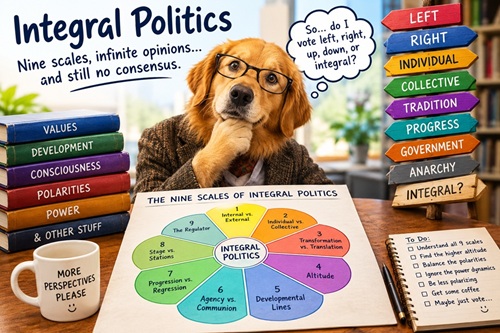 Introduction: Politics, the Integral WayKen Wilber and Integral Life have returned to a familiar ambition: to overcome political polarization by means of a more comprehensive understanding of human development. Their latest offering, The Major and Minor Scales of Integral Politics, presented by Wilber and Corey deVos in a new edition of The Ken Show, promises to do precisely that. The promotional announcement, dated October 30, 2026, describes nine political polarities, four major and five minor, that supposedly operate within every political system, from early tribal societies to contemporary democracies. Rather than choosing between competing political positions, Integral Politics proposes to understand the partial truths contained in each of them. The promise is attractive. Political disagreements are rarely exhausted by the familiar opposition between left and right. Freedom and equality, individual and collective responsibility, cultural values and material conditions, tradition and transformation: these are genuine tensions that cannot simply be wished away. But there is a question that deserves more attention than Integral Life gives it: Does having a more comprehensive map of political disagreements actually provide us with a better understanding of politics, let alone a better way of governing? My answer is qualified. Wilber's framework contains useful insights, but its claims to developmental comprehensiveness introduce problems of their own. In particular, the distinction between understanding political perspectives and ranking them according to their supposed developmental altitude deserves much closer scrutiny. 1. The nine scales: what is actually being proposed?Before criticizing the framework, it is important to reconstruct it accurately. Wilber's nine scales are not simply nine political opinions. They are dimensions along which political systems, movements and ideologies can be analyzed. The four major scales are: First: Internal versus External. Are the causes of human suffering primarily located within individuals, in their values, attitudes and behavior, or in external circumstances such as economic inequality, social institutions and historical conditions? Wilber associates this polarity broadly with the political Right and Left, respectively. Second: Individual versus Collective. Should political arrangements primarily protect individual freedom and autonomy, or emphasize collective responsibility, solidarity and social rights? Wilber argues that neither individual nor collective can be considered primary. Third: Transformation versus Translation. Should society preserve and stabilize its existing structures, or move toward new developmental possibilities? Wilber associates translation with conservatism and transformation with progressivism, although his distinction is more elaborate than this political shorthand suggests. Fourth: Altitude. At what developmental level do political ideas originate, and which levels of human development do they serve? Here Wilber introduces his familiar color-coded developmental hierarchy, from archaic and magical to mythic, rational, pluralistic and integral perspectives. The five minor scales refine this picture. Fifth: Developmental Lines. Political actors may possess different levels of development in different capacities. Wilber's familiar distinction between what somebody can talk about and what they actually walk in their behavior becomes relevant. Sixth: Agency versus Communion. Political and social arrangements can emphasize individual initiative and autonomy or relationships, solidarity and belonging. Seventh: Progression versus Regression. Developmental change can move toward greater complexity and inclusion, or toward the loss of previously attained capacities. Eighth: Stage versus Stations. Political arrangements must recognize that people occupy different developmental stages and that their specific circumstances and social positions also matter. Ninth: The Regulator. How much governing authority should be exercised? This scale ranges from minimal or absent government to a maximalist state. This inventory is taken from Wilber's earlier Integral Politics: Its Essential Ingredients and the accompanying 2018 Integral Life presentation. The October 2026 offering is therefore best understood as a new packaging and presentation of an established model, rather than the introduction of a new political theory. There is something worthwhile here. Political disagreements really do involve multiple dimensions, and the conventional left-right spectrum is inadequate for understanding them. The distinction between individual and collective interests, for example, is not reducible to a simple ideological preference. Nor can social problems be understood exclusively through individual psychology or external structures. But the fact that a distinction is useful does not automatically validate the larger theoretical architecture in which it is embedded. 2. The problem with reducing the Left and Right to psychological orientationsOne of the most questionable elements of Wilber's political map is his characterization of the Left as predominantly externalist and the Right as predominantly internalist. According to his formulation, the Left tends to explain human suffering through bad nurture, social circumstances and structural conditions, whereas the Right emphasizes personal responsibility, family values and individual character. There is a recognizable historical pattern here, but it is much too broad to function as a reliable description of contemporary political thought. Consider the Left's concern with education, personal development, civic responsibility and individual agency. These are not exclusively externalist concerns. Conversely, the political Right has its own substantial tradition of institutional criticism, economic structural analysis and concern with the distribution of power. Even more importantly, the same political problem can have several interacting causes. Poverty, for example, can involve inadequate education, inherited disadvantage, discrimination, labor-market structures, personal decisions, housing costs and institutional failures. Identifying these different causal factors is not a matter of assigning one political camp to the interior and the other to the exterior. Wilber's quadrants remind us to investigate multiple dimensions. They do not establish that political movements can be adequately characterized by their preferred quadrant. There is also a danger of treating an analytical distinction as though it were a complete explanation. Saying that both individual and environmental factors matter is a reasonable starting point. It does not tell us how much each factor contributes in a particular case, which interventions are effective, or how competing policy objectives should be balanced. That requires empirical investigation, not merely a more comprehensive vocabulary. 3. The developmental hierarchy: who gets to govern from above?The most consequential feature of Integral Politics is not its first three polarities. It is the fourth major scale: altitude. Here Wilber introduces his developmental model into the political arena. Political movements are no longer simply different in their priorities, interests or assumptions. They are also located at different levels of psychological and cultural development. This changes the character of the discussion considerably. Wilber's formulation is revealing: "At any point in history, the political ideal is to let each stage be itself, and govern from the highest reasonably available at any given time." The sentence sounds inclusive. Every developmental stage is entitled to its own values, while governance should be conducted from the highest available perspective. But several questions immediately arise. Who determines which political position represents a higher developmental stage? By what independent criteria is that determination made? Can competing political movements be evaluated without first accepting Wilber's developmental assumptions? And what happens when someone rejects the classification? The problem is not that political ideas cannot be evaluated according to their intellectual sophistication, ethical implications or empirical adequacy. Of course they can. The problem is that Wilber's model risks turning disagreements about political principles into judgments about the developmental maturity of the people holding them. A disagreement about taxation, immigration, national sovereignty, environmental regulation or social welfare can thus become a disagreement between developmental altitudes. This is a substantial shift. Instead of asking whether a political argument is factually correct, legally defensible, economically sustainable or ethically justified, one can begin asking whether its proponents have attained the appropriate level of consciousness. That is a dangerous shortcut. A person can possess considerable cognitive sophistication and still defend an empirically mistaken political position. Someone with relatively conventional moral values can make a sound argument about a particular policy. And a person who identifies with an allegedly higher developmental stage can be just as susceptible to ideological blind spots as anybody else. Developmental sophistication is not a substitute for political knowledge. 4. The talk-walk distinction: a useful insight with an uncertain applicationWilber's fifth scale, developmental lines, introduces a potentially interesting qualification. People do not develop uniformly. Someone may be intellectually sophisticated but emotionally immature, morally conventional but cognitively advanced, or spiritually experienced without possessing corresponding political wisdom. This is an important corrective to simplistic developmental models. However, applying this distinction to political movements creates methodological difficulties. How do we establish the developmental center of gravity of a political party, its leadership, its voters and its intellectual representatives? These are four different populations, and they need not share the same characteristics. Wilber's distinction between what political theorists say and what they actually practice is valuable. But it also invites an uncomfortable question: who evaluates the evaluators? Integral thinkers are not exempt from the discrepancy between their professed values and their actual conduct. Claiming an integral perspective does not demonstrate that one has achieved it. Indeed, the language of higher development can become a particularly effective way of insulating one's own worldview from criticism. The integral observer risks becoming the person who can see what everybody else cannot. 5. The illusion of symmetry: are both sides always partially right?The new Integral Life presentation repeatedly emphasizes that each side of a political argument usually contains a partial truth. Its interactive exercise, Healthy Poles, Hard Swings, illustrates how two legitimate values can become distorted when either is pursued excessively. This is an appealing way of approaching political disagreement. Individual freedom without social responsibility can produce neglect of the common good. Collective solidarity without individual freedom can produce conformity and coercion. But there is a fundamental distinction between recognizing that two values are important and assuming that two opposing political positions are equally justified. Sometimes one side has better evidence. Sometimes one proposed solution is demonstrably more effective than another. Sometimes a political position is internally inconsistent or rests on demonstrably false assumptions. The fact that two principles are legitimate does not mean that every political expression of those principles deserves equal consideration. Take the distinction between freedom and security. Both are important political values. But this does not mean that every restriction of freedom is justified in the name of security, or that every appeal to freedom should override legitimate public protections. The relevant question is not whether both sides have a partial truth. It is how those truths should be evaluated in concrete circumstances. Integral Politics occasionally seems to confuse the recognition of multiple perspectives with the achievement of political wisdom. There is also a subtle danger in its language of polarity. Political conflicts are not always symmetrical struggles between two equally healthy values. They can involve unequal distributions of power, different degrees of responsibility, violations of rights and conflicts between factual claims of radically different evidential quality. A framework that begins by looking for two healthy poles must remain capable of recognizing when the actual situation is not symmetrical. 6. Transformation, translation and the metaphysics of political progressThe third major scale deserves special attention because it reveals how deeply Wilber's political model depends on his general philosophy of evolution. Wilber distinguishes between transformation and translation. Translation preserves and stabilizes an existing developmental level, whereas transformation moves toward a higher one. He associates these processes with Agape and Eros, respectively, and broadly connects them with conservatism and progressivism. There is an interesting observation here: societies need both continuity and change. Institutions must be sufficiently stable to perform their functions, but they must also be capable of reform when existing arrangements become inadequate. However, Wilber goes further than this ordinary political insight. He embeds political change within a developmental and evolutionary narrative in which upward transformation is associated with Eros and regression with Thanatos. This introduces a problem that has appeared throughout his work: the tendency to translate complex historical and social developments into a general metaphysics of evolutionary ascent. Political history does not proceed along a single developmental trajectory. Changes that appear progressive in one respect can be regressive in another. Institutional reforms can produce unforeseen consequences. Revolutionary movements can liberate some groups while subordinating others. Conservative movements can preserve valuable institutions, but they can also defend unjust arrangements. There is no automatic correspondence between political change and developmental progress. Nor is conservatism necessarily a refusal to evolve. A conservative may recognize the need for substantial reform while remaining skeptical about the ability of political planners to anticipate all the consequences of their interventions. Conversely, a progressive may advocate change without possessing an especially sophisticated understanding of the systems being changed. The distinction between transformation and translation is useful as a conceptual tool. Its elevation into a general evolutionary principle is much less convincing. 7. The regulator: a political question that needs political scienceWilber's ninth scale concerns the degree of governmental regulation, ranging from an absence of government to a maximalist state. This is an important dimension, and it is good that he distinguishes it from the individual-collective polarity. A collectivist orientation does not necessarily imply centralized state control. Communities can organize cooperatively through local institutions, voluntary associations and decentralized arrangements. Conversely, a political movement that emphasizes individual freedom may still support substantial state intervention in areas such as policing, national defense or the protection of property rights. But the scale remains rather abstract. Political science has developed extensive ways of investigating the relationship between state capacity, institutional design, democratic accountability, administrative competence and economic performance. These are not merely different altitudes of consciousness. A state can be too weak to provide basic public services, too powerful to respect individual rights, or simultaneously weak in some domains and intrusive in others. The question of how much government is desirable cannot be answered by locating a political position somewhere between anarchism and maximalism. We need to know what government is supposed to accomplish, what institutional mechanisms are available, how its performance can be measured and what unintended consequences its interventions might produce. Here again, Integral Politics supplies a map but not the necessary empirical investigation. 8. Nine scales, but where is the evidence?This brings us to a more general methodological objection. Wilber presents the nine scales as an inventory of the essential dimensions of political systems. But what establishes that these are the nine most important dimensions? Are they exhaustive? Are they independent? How were they selected? And have they been tested against actual political systems? The scales also overlap conceptually. Transformation and progression, for example, are closely related. Individual versus collective and agency versus communion are distinguishable in theory, but their practical separation is not always straightforward. Altitude and developmental lines introduce further assumptions about the classification of political actors. A comprehensive taxonomy does not become a scientific theory merely by being comprehensive. To establish the explanatory value of Integral Politics, one would need to demonstrate that its categories can be operationalized, that different investigators can apply them with reasonable consistency, and that they yield insights not already available through established political science, sociology, economics and social psychology. One would also need to show that the developmental classifications have independent validity, rather than simply reproducing the assumptions of the theory that generated them. For example, could independent researchers reliably distinguish an orange political movement from a green one without being told beforehand which political positions Wilber associates with those stages? Could they agree on the developmental center of gravity of a political constituency? Could the model predict something about political behavior that competing approaches cannot? These are reasonable research questions. The promotional material does not answer them. The interactive exercises advertised by Integral Life may be useful educational devices. A pendulum illustrating the dangers of excessive individualism or collectivism can make an abstract distinction more accessible. An exercise that contrasts different understandings of equality can stimulate reflection. But an interactive visualization is not evidence for the theory it illustrates. It demonstrates how a conceptual model can be presented, not whether the model accurately describes political reality. 9. The missing dimension: power, interests and political conflictPerhaps the most important omission concerns the actual dynamics of political power. Political disagreements are not simply misunderstandings between people operating from different developmental levels or emphasizing different values. They also involve material interests, institutional privileges, economic resources, competing social groups and struggles over authority. People may disagree because they have different information or moral commitments. But they may also disagree because they benefit from different arrangements. A wealthy property owner and a tenant may have very different interests in housing policy. A multinational corporation and a local community may have different priorities concerning environmental regulation. An employer and an employee may have different bargaining positions. These conflicts cannot be adequately understood as different expressions of interior and exterior perspectives, or as competing developmental altitudes. Wilber is certainly aware of power. Integral Life has devoted other discussions to it, including Integrating Power (2022). Nevertheless, in the nine-scales presentation, power appears more as one consideration within a comprehensive map than as a central organizing principle of political analysis. That is a significant limitation. Political institutions do not simply harmonize different values. They allocate resources, establish rights, enforce obligations and distribute authority. They also create winners and losers, sometimes deliberately and sometimes unintentionally. A genuinely comprehensive political analysis must investigate these processes directly. It must ask not only which values are represented, but whose interests are served, who has the power to make decisions, who bears the costs and what mechanisms exist for accountability. The language of integration should not obscure the reality of political conflict. 10. The integral observer: above the political fray?There is one final issue that deserves particular attention: the position from which Integral Politics is presented. Wilber's model promises to transcend the limitations of conventional political perspectives. The integral observer supposedly recognizes the partial truths contained in competing positions and can therefore construct a more comprehensive political understanding. But this raises a question that the theory itself does not adequately resolve: is the integral perspective genuinely above the political fray, or is it another political perspective with its own assumptions, preferences and blind spots? The danger is that Integral Theory creates a privileged position for its own adherents. Conservatives, liberals, socialists, libertarians and progressives can all be classified according to their developmental altitude, while the integral theorist assumes the role of the person who understands the limitations of all these positions. This is an attractive intellectual position. It is also potentially self-serving. The integral observer can always explain disagreements as evidence that other people have not yet integrated the relevant perspectives. If somebody objects to the developmental hierarchy, that objection itself can be interpreted as evidence of insufficient developmental sophistication. Such a framework risks becoming difficult to challenge from within its own assumptions. A genuinely critical integral approach would have to apply its developmental scrutiny to itself. It would need to demonstrate that integral thinkers are not merely reproducing their own cultural preferences at a higher level of abstraction. And it would have to acknowledge that political wisdom does not necessarily belong to those who possess the most elaborate theory of human development. Sometimes the person with the best understanding of a particular political problem is simply the person who has studied that problem most carefully. 11. From integral maps to democratic practiceWhat, then, could be salvaged from Wilber's nine scales? Quite a lot, actually, provided we reduce their theoretical ambitions to more manageable proportions. The distinction between individual and collective interests is indispensable. The relationship between personal agency and external circumstances deserves serious attention. Political institutions must balance continuity and reform. Different dimensions of human development can influence political attitudes, and political movements should not be understood exclusively through their official manifestos. These are useful analytical considerations. But none of them requires accepting Wilber's entire AQAL architecture, his metaphysics of Eros and Agape, or his developmental color hierarchy. We could retain the useful questions while abandoning the assumption that they form part of a single universal developmental sequence. More importantly, we should supplement them with empirical research into political institutions, economic interests, social inequalities, historical circumstances and the actual consequences of public policy. There is also a democratic consideration. Political legitimacy does not depend on whether the governors occupy the highest available developmental stage. It depends on constitutional arrangements, accountability, the protection of rights, public participation and the capacity to correct mistakes. The suggestion that society should be governed from the highest reasonably available developmental altitude is particularly problematic unless we establish who gets to identify that altitude and how their authority is constrained. In a democracy, nobody should receive political authority simply by claiming to possess a more evolved consciousness. The integral aspiration to include different perspectives is valuable. But inclusion should not become a justification for establishing an intellectual elite that considers itself entitled to govern the rest. Conclusion: Nine scales do not make an integral politicsIntegral Life's new presentation of Wilber's nine scales is an attractive educational package. Its interactive exercises, accessible examples and emphasis on overcoming simplistic political binaries may encourage people to think more carefully about political disagreements. Yet the underlying theory is considerably less convincing than its presentation suggests. Its strongest contributions are also its least original: political life involves multiple dimensions, competing values and interactions between individuals, communities and institutions. These observations are already familiar to political philosophy and the social sciences. Its more distinctive contributions are also its most questionable: the classification of political movements according to developmental altitude, the interpretation of political change through Eros and Agape, and the assumption that an integral perspective can identify the highest available level from which society should be governed. The central problem is that Wilber repeatedly moves from a useful conceptual distinction to a much larger theoretical claim without adequately demonstrating the connection. His map may help us ask more questions about politics. It does not necessarily help us answer them. And that distinction matters. A genuinely comprehensive political analysis would not begin by assuming that its own framework has already transcended the limitations of competing perspectives. It would remain open to correction by historical evidence, empirical research, institutional experience and competing theories. It would also recognize that political wisdom is not a developmental trophy. The nine scales may help us see more dimensions of political reality. But seeing more dimensions is not the same as understanding their relative importance, and understanding them is not the same as knowing what to do. That is where the real work of political analysis begins. Appendix: Is Integral Politics an Academic Field, a Movement, or a Political Party?There is a question lurking behind Ken Wilber's ambitious presentation of Integral Politics that deserves to be asked explicitly: What exactly is Integral Politics? Is it an academic discipline, a political philosophy, an intellectual movement, a political program, or perhaps an embryonic political party? These are not interchangeable categories, and the distinction matters when assessing the claims made on its behalf. 1. Is it an academic discipline?Not in the conventional sense. There is certainly an academic literature dealing with Integral Theory and its political applications. For example, Gregory Wilpert's The Dimensions of Political Ideology and Integral Politics appeared in the Journal of Integral Theory and Practice in 2006. Alastair M. Taylor published an analysis of Wilber's social and political implications in World Futures in 2001. There are also academic discussions of Integral Theory in education, psychology, organizational studies and social theory. So it would be inaccurate to say that Integral Politics has no academic presence whatsoever. But an academic presence is not the same as an established academic discipline. Political science has its own institutions, professional associations, university departments, peer-reviewed journals, research methodologies and extensive traditions of empirical investigation. Integral Politics has nothing comparable as an autonomous field. More importantly, its principal theoretical framework comes from Wilber's AQAL model, rather than from a body of independently validated political research. There is a difference between applying a philosophical framework to politics and establishing a new scientific discipline. 2. Is it an intellectual movement?Here the answer is much more clearly yes. Ken Wilber's Integral Institute, founded in 2000, and Integral Life, co-founded in 2007, have helped establish an international community of writers, teachers, practitioners and enthusiasts committed to developing and applying Integral Theory. Wilber's own biography explicitly describes Integral Life as a hub for the worldwide Integral movement. Integral Politics belongs to this broader intellectual and cultural movement. It seeks to apply the Integral worldview to political questions, just as Integral Theory has been applied to education, business, psychology, spirituality and other domains. There are also different interpretations within this movement. Steve McIntosh, for example, has described Integral Politics as the political platform or agenda of people who share the values of the Integral stage of consciousness. That formulation goes considerably further than simply using AQAL as an analytical framework. This distinction is important: Integral Politics is not merely an academic exercise in classifying political viewpoints. It also expresses an aspiration to bring a particular developmental worldview into political practice. 3. Is it a political party?No. There is no Integral Party with a recognizable electoral organization, membership structure, candidates, parliamentary representation or official political platform. Nor is there a unified political program that Integral adherents are expected to support. Integral thinkers can hold quite different political positions, including conservative, liberal, progressive, libertarian and communitarian ones. This raises an interesting ambiguity. If Integral Politics is supposed to transcend conventional political ideologies, what would its actual political program look like? What would it propose concerning taxation, healthcare, immigration, climate policy, economic redistribution, international relations or democratic governance? The nine scales do not provide answers to these questions. They offer a vocabulary for discussing political orientations, not a platform on which voters could cast their ballots. Indeed, Integral Politics sometimes seems to occupy an advantageous position: it can criticize all existing political parties for their partial perspectives without having to expose itself to the practical consequences of running one. 4. The movement's political ambitionsNevertheless, it would be a mistake to dismiss Integral Politics as merely an intellectual hobby. The movement has explicitly political ambitions. Wilber has repeatedly advocated a trans-partisan approach that would overcome the limitations of conventional left-right politics. Integral Life's 2008 presentation, Integral Trans-Partisan Politics, already expressed this aspiration. Its 2011 presentation, The Spectrum of Political Thought, developed similar themes. The European LiFT Politics project, supported through the Erasmus+ program, also illustrates how Integral thinking can be incorporated into broader educational and political initiatives. European Commission But an intellectual movement seeking political influence is not necessarily a political movement in the organizational sense, let alone a party. And there is a further question: whose political interests does this movement actually represent? Its advocates speak of humanity's developmental future, but there is little reason to assume that their preferred vision of development enjoys broad democratic support. 5. A distinction worth maintainingI would therefore distinguish three different activities:
These activities can overlap, but success in one does not establish success in the others. A useful analytical framework does not automatically constitute a convincing political philosophy. A convincing political philosophy does not automatically produce workable policies. And a political movement does not become democratically legitimate simply because it claims to represent a higher stage of consciousness. Conclusion: Politics by developmental certification?Perhaps the most revealing feature of Integral Politics is its unresolved identity. It presents itself as more than an academic framework, but has not established itself as a recognized political science discipline. It has the characteristics of an intellectual movement, but lacks the organizational coherence of a political party. And it has political ambitions, but its practical program remains considerably less developed than its theoretical architecture. This is not necessarily a fatal objection. Political philosophies do not have to become parties, and intellectual movements can contribute valuable ideas without seeking electoral power. But Wilber and Integral Life should be clearer about what they are offering. Are they proposing a new way of studying politics, a new philosophy of government, or a new political worldview to which others should eventually subscribe? These are three different projects. My particular concern is with the last possibility. Once Integral Politics moves from describing political differences to identifying the developmental altitude from which society ought to be governed, it is no longer merely an impartial mapping exercise. It becomes a normative political project, complete with assumptions about who is qualified to see the bigger picture. And that brings us back to the original question: who certifies the developmental credentials of the people claiming to represent Integral Politics? A political movement that claims to transcend ordinary politics should be especially careful not to turn its own developmental hierarchy into a new form of political elitism. That would be a rather unfortunate outcome for a philosophy whose declared purpose is to include everybody.
Widget is loading comments...
|