|
TRANSLATE THIS ARTICLE
Integral World: Exploring Theories of Everything
An independent forum for a critical discussion of the integral philosophy of Ken Wilber
  Frank Visser, graduated as a psychologist of culture and religion, founded IntegralWorld in 1997. He worked as production manager for various publishing houses and as service manager for various internet companies and lives in Amsterdam. Books: Ken Wilber: Thought as Passion (SUNY, 2003), and The Corona Conspiracy: Combatting Disinformation about the Coronavirus (Kindle, 2020).
Check out my other conversations with ChatGPT The Geopolitics of Blame-ShiftingJan Krikke's Historical Context for the Ukraine War and the Problem of Explaining Away Russian AgencyFrank Visser / ChatGPT
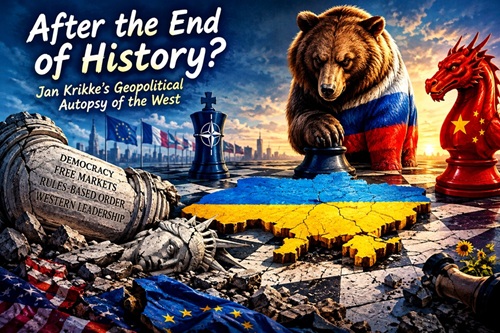 Introduction: When Context Becomes an AlibiJan Krikke's reply to Frank Visser, “Why the Historical Context of the Ukraine War Matters,” presents itself as a corrective to an overly narrow interpretation of the war in Ukraine. Where Visser emphasizes the importance of Russian agency and Ukrainian sovereignty, Krikke insists that we must look further back: to British imperial geopolitics, Halford Mackinder's Heartland Theory, American grand strategy, NATO expansion, Western interventions in Russia's neighborhood, and the economic and military contradictions of the post-Cold War order. His conclusion is unmistakable. The United States and its allies repeatedly provoked Russia, ignored its security concerns, and pursued a strategy that made a Russian response increasingly likely. Without NATO expansion and the American effort to detach Ukraine from Russia's orbit, Krikke suggests, the invasion might never have happened. There is a serious argument to be made here. Western policymakers have made consequential mistakes, NATO enlargement was controversial, American interventions have damaged the credibility of Western appeals to international law, and the post-Cold War assumption that liberal institutions would expand indefinitely without provoking geopolitical resistance was naïve. These are legitimate subjects for critical examination. But Krikke's essay illustrates a recurring problem in geopolitical commentary: the tendency to mistake an explanatory framework for a demonstrated explanation. Historical context is indispensable, but it does not establish causation by itself. A state's security concerns may be genuine without being objectively decisive. A rival power's strategic ambitions may be real without constituting a coherent master plan. And a government's decision to invade another country cannot be adequately explained by reconstructing the grievances it invokes, much less by treating those grievances as proof that its opponent bears primary responsibility. Krikke wants to correct a Western-centered account of the war. Yet in doing so, he risks replacing it with a Russia-centered account in which Moscow's conduct becomes the predictable consequence of Western actions, while the choices of Russian leaders and the political preferences of Ukrainians recede into the background. This is not a sufficiently critical analysis of geopolitics. It is a shift in the distribution of blame. 1. Mackinder's Ghost: A Map Is Not a Causal TheoryKrikke begins with Halford Mackinder's Heartland Theory, developed in the context of British imperial competition. The central proposition is that control over Eastern Europe provides access to the Eurasian Heartland, whose domination could confer decisive global power. Krikke then connects Mackinder to Zbigniew Brzezinski's argument in The Grand Chessboard that American predominance depends on preventing any single power from dominating Eurasia. The historical connection is not frivolous. Geography constrains strategic options, Eurasian transport corridors matter, and American policymakers have long worried about the emergence of a rival continental power. Brzezinski's writings are relevant to understanding the strategic assumptions of the post-Cold War period. But what exactly follows from this? That American strategists have thought about Eurasian dominance does not establish that every subsequent American policy was designed to fragment Russia, that NATO expansion was principally an offensive geopolitical operation, or that the invasion of Ukraine was the intended or predictable result of a unified Anglo-American strategy. Krikke moves too quickly from intellectual genealogy to political causation. Mackinder wrote about the strategic significance of geography. Brzezinski developed a later account of American power. Neither proposition, on its own, demonstrates that the United States orchestrated a continuous century-long campaign to provoke Russia into war. A geopolitical theory can illuminate a government's strategic vocabulary without explaining every decision it makes. Policymakers disagree, institutions pursue competing objectives, administrations change, and events frequently produce consequences that no participant intended. The historical record of American policy toward Russia includes containment, cooperation, economic integration, arms control, and confrontation. Reducing this complex history to the persistence of a single imperial script is analytically convenient but historically inadequate. Krikke's geographical determinism is particularly striking when he describes Ukraine as a critical chokepoint in the struggle over Eurasian connectivity. Ukraine certainly occupies a strategically important position. But its geographical location does not determine its political allegiance. The country is not an empty square on Mackinder's chessboard. It is a sovereign political community with its own history, divisions, aspirations, and security concerns. A theory that makes Ukraine important because of where it sits, while paying insufficient attention to what Ukrainians want, reproduces precisely the great-power mentality that a genuinely critical geopolitics ought to question. 2. The Missing Subject: Ukraine as a Political AgentKrikke acknowledges that Ukrainian sovereignty is real and vital. Yet this recognition has surprisingly little influence on the explanatory architecture of his essay. Ukraine repeatedly appears as an object of strategic competition: a Western bulwark, a geopolitical chokepoint, a territory being detached from Russia's orbit, and a piece on a global chessboard. This is the fundamental weakness of his analysis. The political future of Ukraine is discussed primarily through the preferences of Washington and Moscow. The popular mobilizations that helped bring about the political upheaval of 2013-2014 are treated chiefly through the lens of Western influence. Krikke mentions American financial support for Ukrainian civil society and the leaked telephone conversation in which Assistant Secretary of State Victoria Nuland discussed possible political appointments with the American ambassador. These are relevant details. They establish that Washington was interested in the outcome and attempted to influence the political process. But influence is not the same as control. Financial assistance to civil society does not establish that a popular uprising was manufactured by a foreign power. Nor does evidence that American officials preferred some political outcomes over others establish that Ukrainians themselves lacked reasons to oppose their government. The distinction matters because political movements can have domestic causes while receiving foreign support. These possibilities are not mutually exclusive. Citizens can oppose corruption, resent authoritarian tendencies, favor closer European integration, and still be susceptible to external influence. The existence of foreign involvement does not erase indigenous political agency. Krikke himself briefly concedes this when he acknowledges that many people who filled the streets of Tbilisi, Bishkek, and Kyiv had grievances of their own. But this qualification is not fully integrated into his larger narrative. The more his account emphasizes the strategic purposes of Washington, the more the political agency of Ukrainians becomes an incidental detail. The same asymmetry applies to Russia. Moscow's preferences receive elaborate historical explanation; Ukrainian preferences are largely filtered through their strategic consequences for Moscow. Russia's fear of encirclement is treated as a major causal variable. Ukraine's fear of Russian domination receives no comparable treatment. A serious geopolitical analysis must ask why Ukraine sought closer ties with the West, why different Ukrainian governments pursued different foreign-policy orientations, and why Russia's conduct helped make Western security relationships more attractive to its neighbors. If NATO expansion is partly a response to the behavior of Russia itself, the causal arrow runs in both directions. The paradox is devastating for Krikke's argument. In trying to explain how the West provoked Russia by drawing Ukraine into its orbit, he insufficiently considers how Russian pressure on Ukraine contributed to Ukraine's desire to escape that orbit of influence in the first place. 3. NATO Expansion: Strategic Error or Sufficient Explanation?NATO enlargement is the centerpiece of Krikke's causal argument. After the Soviet collapse, he observes, Russia became economically integrated with Western Europe, particularly through energy exports and infrastructure projects such as Nord Stream. Yet NATO continued to expand eastward, producing what Krikke describes as a glaring contradiction between economic integration and military encirclement. There is a genuine historical problem here. Western leaders underestimated the depth of Russian opposition to NATO enlargement, and the failure to establish an inclusive European security order deserves serious scrutiny. The 2008 Bucharest declaration that Ukraine and Georgia would eventually become NATO members, without providing them an immediate membership path, created expectations and tensions that proved difficult to manage. But Krikke's formulation assumes too much. Economic integration and military cooperation are not identical processes. A country can trade extensively with another state while remaining suspicious of its military intentions. Germany's dependence on Russian energy did not automatically settle the security concerns of Russia's neighbors, just as Russia's commercial relationship with Europe did not mean that Moscow had abandoned its own geopolitical ambitions. Nor does NATO's enlargement prove that the alliance was preparing to attack Russia. NATO is a military alliance, and its expansion has strategic consequences; those consequences must be examined. But states that sought membership had their own historical reasons for doing so. For many countries in Central and Eastern Europe, joining NATO was a means of reducing their vulnerability to Russian pressure, not participating in an American conspiracy against Russia. Krikke's explanation is weakest precisely where it needs to be strongest. He must demonstrate not merely that NATO enlargement angered Moscow, but that it was a decisive cause of the 2022 invasion and that alternative outcomes were unavailable or substantially less likely. He does not establish this. Instead, he treats the Russian response as the foreseeable consequence of Western provocation. That is a plausible hypothesis about one contributing factor, not a demonstrated explanation of the war. Even if NATO enlargement contributed substantially to Russian insecurity, several questions remain unanswered. Why did Russia choose a full-scale invasion rather than diplomatic pressure, limited military action, or a negotiated security arrangement? Why was Ukraine's political independence deemed incompatible with Russian security? What role did the Kremlin's own ambitions, threat perceptions, and assumptions about Ukrainian resistance play in the decision? These questions cannot be answered by invoking geography or NATO policy alone. There is also a counterfactual problem. Krikke writes that without NATO expansion and the American strategy to detach Ukraine from Russia's orbit, the invasion might never have happened. The word might is important. Counterfactuals can be useful, but they are difficult to prove. The possibility of a different outcome does not establish that the proposed alternative would have prevented war, especially when the intentions of the principal actors remain contested. A more defensible conclusion would be that Western policy contributed to a deteriorating security environment while Russian leaders retained agency over how they responded to it. Krikke instead comes close to treating Russia's response as the logical culmination of a process initiated in Washington. 4. The Afghan Trap and the Conspiracy of ContinuityKrikke strengthens his argument by connecting the invasion of Afghanistan in 1979, the American covert assistance authorized for Afghan opposition forces earlier that year, the color revolutions in the former Soviet sphere, the Maidan protests, and a 2019 RAND Corporation study examining ways to overextend and unbalance Russia. This sequence is designed to reveal a persistent American strategy: pressure Russia in its neighborhood, weaken its regional position, and exploit its vulnerabilities. Some of the underlying historical episodes are well documented. The United States did provide covert support to Afghan opposition forces before the Soviet invasion. Western governments and organizations supported civil society and election-monitoring initiatives in several post-Soviet states. American officials attempted to influence political developments in Ukraine. And the RAND study did examine strategic options that could impose costs on Russia. The difficulty lies in the interpretation placed upon these facts. Krikke moves between different types of activity—covert warfare, democracy assistance, diplomatic maneuvering, and strategic analysis—as though they were manifestations of a single continuous plan. Yet they differ substantially in purpose, scale, method, and evidentiary significance. The fact that a government funds an opposition newspaper does not establish that it engineered a revolution. A diplomatic conversation about possible cabinet appointments does not prove that Washington controlled the government that emerged. And a military research report examining ways to impose costs on a rival does not demonstrate that the recommendations were adopted as an operational strategy, much less that they explain a subsequent war. The RAND report is particularly revealing. Strategic research routinely examines ways to exploit an adversary's vulnerabilities. Such analysis can be provocative, reckless, or dangerous, but the existence of a proposal is not proof of implementation. To establish a causal connection, Krikke would need to trace the relevant recommendations into actual policy and show how they influenced Russian decision-making. Instead, the reader is invited to infer a unified strategy from a succession of suggestive episodes. This is the logic of geopolitical pattern recognition at its most seductive. Once one assumes that Washington's fundamental objective is to weaken Russia, almost every American action in the region can be interpreted as evidence of that objective. Activities described by their sponsors as democracy promotion become instruments of encirclement; strategic studies become operational blueprints; political upheavals become pieces in a long game. Such an interpretation can become difficult to falsify. Evidence of American cooperation with Russia can be understood as tactical. Evidence of confrontation confirms the larger strategy. Contradictory policies disappear into the background, while every hostile episode is recruited to establish continuity. The result is less a demonstrated historical explanation than a narrative organized around a prior suspicion. 5. The Global South and the Selective Use of HypocrisyKrikke's discussion of the Global South introduces a legitimate and important consideration: Western governments have often applied international law inconsistently, and their record of military intervention weakens their moral authority when they condemn similar conduct by others. The invasion of Iraq in 2003 and NATO's bombing campaign against Yugoslavia in 1999, conducted without explicit authorization from the UN Security Council, are relevant examples. The history of Western intervention in Asia, Africa, Latin America, and the Middle East is essential to understanding why many governments reject Western claims to moral leadership. But the argument from hypocrisy has limits. If Western governments have violated international law, they should be criticized. Their violations do not make the invasion of Ukraine lawful, nor do they establish that Russian objections to Western conduct are sincere, consistent, or sufficient to justify military aggression. Krikke acknowledges that Western governments are right to invoke international law against Russia. This is an important concession, but it sits uneasily beside a narrative in which Western hypocrisy occupies much of the explanatory foreground and Russian conduct is presented primarily as a reaction to Western behavior. The danger is that moral criticism becomes a device for redistributing responsibility. Rather than asking whether Russia violated the sovereignty of a neighboring state, the discussion shifts toward whether Western governments have earned the right to complain. They may indeed have forfeited some credibility. But credibility and legality are not the same thing. Nor does the record of American military intervention settle the question of who bears responsibility for a particular war. Counting interventions can provide useful context, but raw totals are not self-interpreting. Interventions differ in their legal status, objectives, scale, and consequences. The relevant question is not simply which power has intervened more often, but what happened in each case and how the comparison illuminates the present conflict. There is an additional irony here. Krikke objects to Western universalism because it assumes that Western values and institutions can expand without resistance. Yet his own geopolitical framework risks substituting another universalizing assumption: that great powers inevitably seek control over their surrounding regions and that smaller countries must accommodate the resulting security requirements. Why should the security preferences of great powers automatically take precedence over the political choices of their neighbors? Why should the historical experience of Russia determine the permissible foreign policy of Ukraine? The Global South's skepticism toward Western power does not imply a collective endorsement of Russian imperial ambitions. Nor should governments in Asia, Africa, and Latin America be reduced to supporting one side or the other in a struggle between geopolitical blocs. Many have their own interests and historical experiences, and their positions cannot be derived from a single narrative of Western hypocrisy. A genuinely multipolar world should allow smaller states greater freedom of action, not merely replace Western predominance with competing regional spheres of influence. 6. Nord Stream: Suspicion Is Not ProofKrikke's discussion of the Nord Stream explosions is perhaps the clearest example of how his essay moves from circumstantial evidence to insinuation. He notes that the United States opposed Nord Stream 2, that President Joe Biden publicly threatened to bring the project to an end if Russia invaded Ukraine, and that the pipelines were destroyed in underwater explosions in September 2022. The sequence, he writes, left an indelible mark. It certainly raises questions. Biden's statement was striking, and the destruction of critical infrastructure demanded a serious investigation. The political and economic consequences were substantial, particularly for Germany and the wider European energy market. But the sequence of events does not establish American responsibility. A public threat to prevent a pipeline from operating is not proof that the government issuing the threat subsequently destroyed it. The destruction could have been carried out by different actors for different reasons, and those possibilities must be evaluated through evidence. Krikke carefully notes that the American government denied involvement. He does not explicitly claim to have proved that the United States was responsible. Nevertheless, the placement of the episode within his broader narrative invites the reader to treat American culpability as a likely conclusion. This is a recurring weakness in the essay. Evidence is often presented in a manner that makes one interpretation feel inevitable without establishing that it is the best-supported explanation. The appropriate question is not whether Washington had a motive to oppose Nord Stream 2. It plainly did. The question is who carried out the sabotage, what evidence identifies the perpetrators, and what the investigation establishes about their motives and connections. Geopolitical analysis should be especially careful when discussing covert operations because the gap between motive and proof is often substantial. Otherwise, suspicion becomes a substitute for evidence, and the reader is encouraged to treat an unresolved question as confirmation of an overarching theory. 7. Fukuyama and the Convenient CorrectionKrikke's discussion of Francis Fukuyama is more nuanced. He accepts Visser's distinction between the claim that liberal democracy represents the endpoint of ideological evolution and the much stronger claim that geopolitical conflict has ended. He also acknowledges that a failed prediction does not invalidate an ideal. Krikke explains that he used Fukuyama as a shorthand for the post-Cold War policy consensus that markets, liberal democracy, and Western institutions would advance together, eventually moderating Russia and China through economic integration. This is a reasonable clarification. The confidence that economic interdependence would steadily transform international relations was indeed excessive, and the persistence of geopolitical rivalry exposed the limitations of that expectation. Yet Krikke's clarification also reveals a problem with his original framing. If the claim that the liberal international order was "laid to rest in Ukraine" was intended to describe the collapse of confidence in inevitable convergence, then the headline overstated the conclusion. Krikke admits as much, acknowledging that the headline phrasing was stronger than the argument that followed. But the issue is not merely rhetorical. The dramatic language helps frame the war as a decisive geopolitical defeat for the West, reinforcing the larger thesis that Western strategic arrogance brought about its own downfall. The actual historical picture is less tidy. The war has exposed serious failures in Western assumptions, but it has also strengthened NATO's cohesion in important respects, encouraged greater defense spending among European states, and prompted Finland and Sweden to join the alliance. Russia's invasion has not simply demonstrated the futility of NATO enlargement; it has also reinforced the security concerns that led some states to seek NATO membership. These developments do not prove that NATO policy was wise in every respect. They do, however, complicate the narrative of a West that blindly pursued expansion until the geopolitical order collapsed. Krikke's framework is better at interpreting developments that support his thesis than at incorporating those that complicate it. 8. Multipolarity Is Not a Moral AchievementAt the end of his reply, Krikke agrees with Visser that multipolarity describes a distribution of power rather than a moral blueprint. He also accepts that the decline of Western predominance does not legitimize the powers challenging it. These are welcome qualifications. But they raise a question that Krikke's essay never adequately resolves: what, exactly, is the normative lesson of his geopolitical analysis? If the West must recognize the limits of its power, that is sensible. If it should avoid assuming that its institutions can expand indefinitely without resistance, that is a useful warning. If it should establish more credible security arrangements and take the interests of other states seriously, that is a worthwhile policy objective. None of these conclusions requires treating Russian conduct as an understandable strategic reflex that the West could have prevented by behaving differently. The problem is not recognizing that Russia has security interests. Every state does. The problem is assuming that those interests entitle a great power to determine the security arrangements and political orientation of its neighbors. If Ukraine's movement toward the West threatens Russian geopolitical ambitions, that does not mean Ukraine's movement toward the West is inherently illegitimate. A Russian government may regard neighboring countries' independence as a strategic loss, but a strategic loss for a great power is not automatically an injustice. This distinction is indispensable. Without it, the language of realism can become an elaborate justification for spheres of influence. The smaller state is told to recognize the geographical realities that constrain its choices, while the larger state is granted considerable latitude to enforce its preferences. Such a world may be multipolar, but it is not necessarily more peaceful, more democratic, or more just. Krikke is right that the transition away from American predominance could produce a dangerous international environment. Yet a realistic account of multipolarity must recognize that regional powers can be as coercive as global ones, and that smaller states have legitimate interests that cannot simply be absorbed into the strategic calculations of their neighbors. 9. Explaining an Invasion Is Not the Same as Explaining It AwayKrikke's central claim is that the invasion of Ukraine cannot be understood without examining NATO expansion, American strategic ambitions, and the longer history of Western efforts to constrain Russia. On this broad point, he is right. The war did not emerge from a historical vacuum, and Western policy deserves scrutiny. But his final assertion—that without NATO expansion and the American strategy to detach Ukraine from Russia's orbit, the invasion might never have happened—goes further than his evidence warrants. To establish that conclusion, he would need to demonstrate that Western policy was a decisive cause, that Russian leaders would otherwise have refrained from invasion, and that alternative explanations are less convincing. His essay does not do this. It assembles historical precedents, strategic theories, political interventions, and circumstantial evidence into a coherent narrative, but coherence is not the same as proof. Most importantly, the explanation underplays the possibility that Russia's objectives were not limited to defensive security. The Kremlin's conduct toward Ukraine raises questions about territorial ambition, political control, imperial identity, and the unwillingness to accept Ukraine as a fully independent state able to choose its own international orientation. These factors cannot be reduced to NATO enlargement without further argument. Nor does acknowledging Russian agency require ignoring Western responsibility. The two can coexist. Western policymakers may have underestimated the risks of enlargement, mishandled relations with Moscow, and contributed to a deteriorating security environment. Russian leaders nevertheless chose to invade. Ukraine's government and citizens, meanwhile, had their own interests and were entitled to resist military coercion. This is not a demand for moral symmetry. It is a demand for causal precision. A critical analysis should distinguish background conditions from triggering events, strategic incentives from demonstrated intentions, and contributing causes from sufficient explanations. It should also be willing to consider evidence that challenges its preferred account. Krikke's essay does some of this work, particularly when he acknowledges that Western support for civil society is not equivalent to staging a coup and that the West remains entitled to condemn Russia's violation of international law. Yet these qualifications are repeatedly overshadowed by a larger narrative in which American strategy occupies the driver's seat and Russian aggression appears as the foreseeable result. That is not a fully adequate explanation of the war. It is an explanation tilted toward the very great-power perspective that Krikke otherwise encourages us to scrutinize. Conclusion: Beyond the ChessboardJan Krikke has identified real weaknesses in the post-Cold War Western worldview. The belief that economic integration would steadily dissolve geopolitical rivalry was misguided. NATO enlargement carried risks that Western leaders did not adequately resolve. American interventions have damaged the credibility of Western appeals to international law. And the assumption that the global order could expand indefinitely under American leadership without provoking resistance was never a serious substitute for strategic judgment. These criticisms deserve to be taken seriously. But Krikke's essay turns them into a more sweeping narrative than the evidence can sustain. Mackinder's Heartland Theory becomes the blueprint for a century of Anglo-American strategy. Western support for political movements becomes part of a persistent campaign to undermine Russia. NATO enlargement becomes the principal explanation for the invasion. The destruction of Nord Stream becomes a suggestive episode in a story of American strategic duplicity. And Ukraine becomes the geographical site where the West's geopolitical assumptions finally collapse. The result is a form of historical determinism in which the map seems to dictate the politics, the past determines the present, and the choices of smaller countries are subordinated to the calculations of larger powers. The irony is that Krikke's own criticism of Western strategic arrogance should lead him toward a more radical conclusion. If great powers are capable of mistaking their interests for universal principles, then Russia must be subjected to the same critical scrutiny as the United States. If Western policymakers were wrong to assume that they could shape the political future of Eurasia without resistance, Russian policymakers were equally wrong to assume that Ukraine's future could be settled by force. The lesson of the Ukraine war is not simply that Washington should have understood Moscow better. It is also that Moscow failed to understand—or refused to accept—that Ukraine was not merely a strategic buffer between rival powers. It was a country whose political future could not legitimately be determined by its more powerful neighbor. Geopolitics matters. History matters. Security dilemmas matter. But none of these concepts should become a mechanism for making the agency of powerful states disappear into the language of necessity, or for making the sovereignty of weaker states conditional on the comfort of their neighbors. Krikke asks us to look beyond the immediate causes of the war. Fair enough. But looking further back should deepen our understanding of responsibility, not dissolve it into an endless chain of historical grievances. The United States did not need to be innocent for Russia to be responsible for its invasion. NATO did not need to be strategically infallible for Ukraine to have a right to defend itself. And Russia did not need to be free of legitimate security concerns for its decision to wage war to remain a decision for which Russian leaders were accountable. The real test of geopolitical analysis is whether it can hold all these propositions together without allowing one to cancel out the others. Krikke's essay does not quite pass that test. It offers a valuable corrective to Western triumphalism, but in its determination to expose the geopolitical designs of Washington, it grants too much explanatory power to the fears and calculations of Moscow. It criticizes the chessboard mentality of the liberal international order while continuing to organize its own account around the strategic ambitions of great powers. A more convincing analysis would begin where Krikke's ultimately falters: with the recognition that geography creates constraints, history supplies context, and great powers pursue interests—but none of these facts relieves political leaders of responsibility for the choices they make.
Widget is loading comments...
|