|
TRANSLATE THIS ARTICLE
Integral World: Exploring Theories of Everything
An independent forum for a critical discussion of the integral philosophy of Ken Wilber
 Jan Krikke is a former Japan correspondent for various media and former managing editor of Asia 2000 in Hong Kong. He pioneered the study of axonometry, the Chinese equivalent of European linear perspective overlooked by Jean Gebser. He is the author of several books, including Leibniz, Einstein, and China, and the editor of The Spiritual Imperative, a macrohistory based on the Indian Varna system by feminist futurist Larry Taub. Why the Historical context of the Ukraine war mattersA Reply to Frank VisserMackinder's Heartland TheoryJan Krikke / Various LLMs
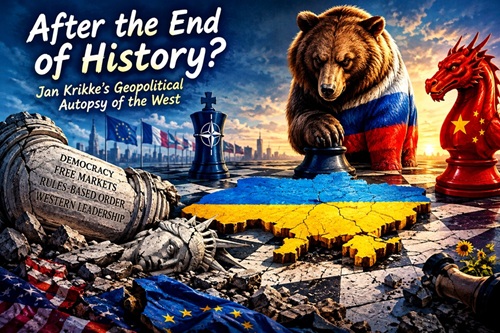 When Frank Visser critiques my Asia Times article, "After the End of History," his main objection is that I focus too heavily on Western geopolitical miscalculations—specifically NATO expansion—and give insufficient weight to Russian agency and Ukrainian sovereignty. He argues that Western policy may have been flawed, but this does not adequately explain Russia's decision to invade. Visser's essay "After the End of History?" raises fair questions about causality. Rather than address them one by one, let me give some historical context for the conflict, namely the century-old geopolitical script that has dictated Western strategy toward the Eurasian landmass since the era of the British Empire. To understand the war in Ukraine, we must look beyond the immediate post-Cold War years and examine the enduring influence of the Heartland Theory, the contradictions of the post-Soviet era, the deliberate provocation of a land power by a naval power, and the perspective of the Global South. The Heartland Theory and the Anglo-American Grand StrategyThe conflict in Eastern Europe closely follows a script written a century ago by British geostrategist Halford John Mackinder. In his 1919 publication Democratic Ideals and Reality, Mackinder laid out the geographical pivot of history: "Who rules East Europe commands the Heartland; who rules the Heartland commands the World-Island; who rules the World-Island commands the world." Mackinder wrote this when Britain ruled the waves. Like rival colonial powers, Britain's power was based on naval dominance. But Mackinder recognized that the railroad could change the global battlefield.
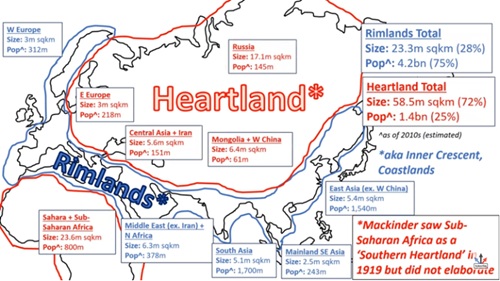 Fig. 1 illustrates this geographic reality. The Heartland—the vast region from Eastern Europe to Siberia—is protected from Western naval power by imposing natural defenses: arctic ice in the north, the Gobi desert in the southeast, and the Himalayas in the south. The only unimpeded route to this "ultimate citadel of land-power" is the northern German plains into Poland, Ukraine, and Russia.
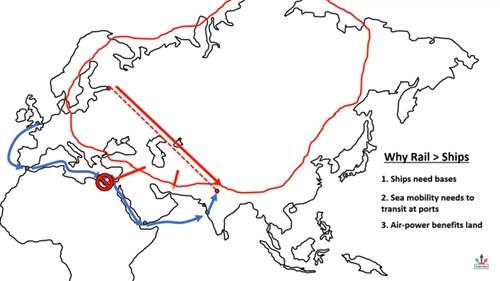 Fig. 2 demonstrates why this distinction matters. Naval powers require bases and transit ports, while air-power is ultimately constrained by the need for land-based infrastructure. Rail, however, gives land powers the advantage of speed and internal mobility across the vast Eurasian interior. It is precisely this mobility that the West has historically sought to counter. Mackinder's theory did not die with the British Empire; it was inherited by the United States. In his 1997 book The Grand Chessboard, Zbigniew Brzezinski—national security adviser to President Jimmy Carter—argued that the US could retain global supremacy only if it prevented the emergence of a single dominant power on the Eurasian landmass.
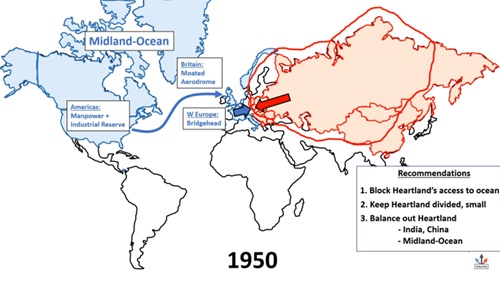 Fig. 3 shows the Cold War-era application of this strategy, mapping out how the US, operating from its "Midland-Ocean" and leveraging the British "moated aerodrome" and Western European "bridgehead," sought to contain the Heartland. The recommendations on the map are explicit: block the Heartland's access to the ocean, keep it divided and small, and balance out its power. Brzezinski, a fervent anti-communist of Ukrainian-Polish descent, was instrumental in shaping the US strategy that would eventually provoke a Russian response in Ukraine. His protégés, among them Ukrainian émigré Victoria Nuland, later became a powerful voice in the US State Department. Brzezinski's strategy of drawing Russia into its own "Vietnam" in Afghanistan (Operation Cyclone) succeeded. In the years after the 2014 Maidan protests in Kyiv, the US followed a similar script by pouring hundreds of millions of dollars of military aid into Ukraine, with the desired result: a Russian response. The Contradiction: Economic Integration and Military EncirclementVisser suggests that the West simply made a series of ideological errors—assuming markets would bring democracy. But the historical record shows something more calculated, and profoundly contradictory. After the Soviet collapse, Russia sought to integrate with the West. It became one of the largest suppliers of energy to Europe, forging a deep economic interdependence. The Nord Stream pipelines were the ultimate symbol of this connection—a physical link binding the Russian economy to the European industrial heartland, especially Germany. If the post-Cold War goal was to integrate Russia into a cooperative European security order, this economic bond was the foundation. Yet, as Russia supplied Europe with energy, NATO continued to expand eastward. The first NATO Secretary General, Lord Hastings Ismay, famously summarized the alliance's purpose: "to keep the Soviet Union out, the Americans in, and the Germans down." After the Cold War, the first two pillars were quietly maintained, but the third was altered: Germany was integrated, but Russia was kept out. The contradiction was glaring: on one hand, Europe relied on Russia for its energy; on the other hand, the US-led military alliance was systematically moving toward Russia's borders, turning Ukraine into a de facto NATO bulwark. But the Heartland thesis cuts both ways.
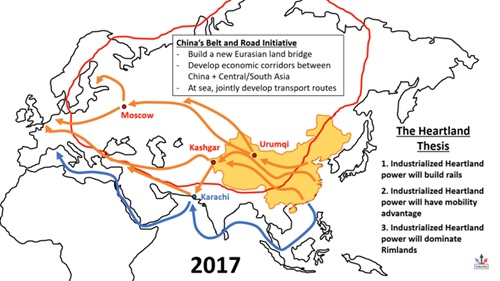 Fig. 4 illustrates the emergence of China's Belt and Road Initiative (BRI) in 2017. As Mackinder predicted, the development of rail infrastructure across Eurasia threatens the dominance of naval powers. The BRI proposes a new Eurasian land bridge, connecting China to Europe through Central Asia, Moscow, and the Middle East. To US strategists, this represents the ultimate nightmare: the economic integration of the World-Island under a single, non-Western framework. Ukraine, situated on the western edge of the Heartland, becomes a critical chokepoint in this battle for Eurasian connectivity. The View from Moscow and the Global SouthRussia's sense of encirclement also has a history closer to its borders. Along its southern flank, Western governments have repeatedly supported forces opposed to Moscow or its allies. In July 1979, months before Soviet troops entered Afghanistan, President Carter authorized covert aid to the Afghan opposition, as former CIA director Robert Gates confirms in his memoir From the Shadows. Zbigniew Brzezinski later told Le Nouvel Observateur that the operation “had the effect of drawing the Russians into the Afghan trap.” In Georgia's Rose Revolution of 2003, Western-funded organizations, including George Soros's Open Society Institute, supported the youth movement and election monitors that helped topple Eduard Shevardnadze. In Kyrgyzstan in 2005, The New York Times reported that US-funded programs, among them an opposition newspaper printed on a press run by Freedom House with US government money, had helped prepare the way for the uprising that ousted President Askar Akayev. In Ukraine, Assistant Secretary of State Victoria Nuland said in December 2013 that the United States had invested more than $5 billion since 1991 in Ukraine's “democratic aspirations,” and a leaked call in early 2014 recorded her discussing with the US ambassador who should enter the next government. In 2019, a RAND Corporation study prepared for the US Army examined options for “overextending and unbalancing Russia,” including efforts to reduce its influence in the South Caucasus and Central Asia, though it judged most of them unlikely to succeed. Western governments describe such programs as democracy promotion, and many of the people who filled the streets of Tbilisi, Bishkek and Kyiv had grievances of their own. Funding civil society is not the same as staging a coup. But seen from Moscow, the pattern looks different, and a serious analysis of the war has to account for how it looks from there. To understand why Russia views Western invocations of international law with deep suspicion, we must also consider the perspective of the Global South. Many governments in Asia, Africa and Latin America remember the West less as the guardian of a rules-based order than as a frequent user of force. The Military Intervention Project at Tufts University counts almost 400 US military interventions since 1776, about half of them after 1950 and more than a quarter after the end of the Cold War. Of the roughly 75 interstate wars since 1945 in a standard list, about one in three involved the United States, Britain, France or other NATO members as direct belligerents, from Korea, Suez and Vietnam to Panama, Kosovo, Afghanistan, Iraq and Libya. No other group of states comes close: Russia or the Soviet Union took part in about a dozen, China in fewer than ten. Two of those wars, the bombing of Yugoslavia in 1999 and the invasion of Iraq in 2003, were fought without authorization from the UN Security Council. When Western governments invoke international law against Russia, they are right to do so. But they rarely acknowledge how their own record weakens the argument in the eyes of the countries they ask to join them. The West still acts as the world's policeman, and policemen are seldom asked to account for themselves. Nord Stream and the Limits of DeniabilityThis contradiction came to a head with the Nord Stream pipelines. The US had long opposed the project, viewing it as a geopolitical threat that tied Europe too closely to Moscow. President Joe Biden made this explicit. In February 2022, just days before the invasion, Biden declared: "If Russia invades... there will no longer be a Nord Stream 2. We will bring an end to it." When a reporter asked how the US would accomplish this, given that the pipeline was in German control, Biden replied, "I promise you, we will be able to do it." Days later, Russia invaded Ukraine. Months later, in September 2022, the Nord Stream pipelines were blown up in a series of underwater explosions. The US government immediately denied any involvement. Yet the sequence of events—the explicit threat, the subsequent destruction, and the denial—left an indelible mark. The End of the Unipolar Moment and the Fukuyama DistractionVisser argues that my analysis risks treating the failure of Western expectations as the principal explanation for the catastrophe. But the failure of the West to understand the consequences of its own provocations is not merely an ideological miscalculation. It is a tragic historical pattern. On the specific question of Francis Fukuyama, Visser is right that his thesis concerned the end of humanity's ideological evolution—the “universalization of Western liberal democracy as the final form of human government”—and not the end of geopolitical conflict. He is also right that a failed prediction does not invalidate an ideal. I accept the distinction. But I used Fukuyama as he was used in the 1990s, not as he wrote. His thesis became the intellectual shorthand for a policy consensus: that open markets, liberal democracy and Western institutions would advance together, and that integrating Russia and China into the global economy would gradually moderate both. That was the belief I described as dying in Ukraine. My essay says so explicitly: “What died in Ukraine was not the entire liberal international order,” but the expectation of seamless expansion and inevitable convergence. Liberal principles remain defensible. The confidence that history was carrying them everywhere does not. The war in Ukraine is not just about Ukrainian sovereignty, though that is real and vital. It is about the collision of two competing realities. On one side is the West's belief that its institutions and values should expand without resistance. On the other is the immutable reality of geography and the security dilemmas of a land power that has been invaded from the west three times in the past two centuries. Visser is right that Russian agency and Ukrainian resistance matter. But without the NATO expansion and the US strategy to detach Ukraine from Russia's orbit, the invasion might never have happened. As Mackinder wrote, the battle over the World-Island is a game of chess. The West played its pieces, assuming Russia would fold. Instead, the board was overturned, and the liberal international order lay in ruins across the fields of Ukraine. Finally, Visser criticizes my opening phrase, that the post-Cold War liberal order was “laid to rest in Ukraine,” and then grants my more qualified conclusion as if it were a concession. It is not a concession. It is my argument. The headline phrasing was stronger than the conclusion, and I accept that this invited a stronger reading. But on substance we agree: NATO and the EU still exist, and what has ended is the belief that they could expand indefinitely without resistance. Visser adds that multipolarity describes a distribution of power, not a moral blueprint, and that it guarantees neither peace nor the freedom of small states. I agree entirely, and nothing in my essay says otherwise. He also writes that the decline of Western predominance “does not legitimize the powers challenging it.” I never claimed it did. To describe the world as it is becoming is not to welcome it. One reason I wrote the essay is that a multipolar world will be dangerous, and the West will be better prepared for it if it understands how its own assumptions contributed to the transition.
|