|
TRANSLATE THIS ARTICLE
Integral World: Exploring Theories of Everything
An independent forum for a critical discussion of the integral philosophy of Ken Wilber
  Frank Visser, graduated as a psychologist of culture and religion, founded IntegralWorld in 1997. He worked as production manager for various publishing houses and as service manager for various internet companies and lives in Amsterdam. Books: Ken Wilber: Thought as Passion (SUNY, 2003), and The Corona Conspiracy: Combatting Disinformation about the Coronavirus (Kindle, 2020).
Check out my other conversations with ChatGPT After the End of History?Jan Krikke's Geopolitical Autopsy of the WestFrank Visser / ChatGPT
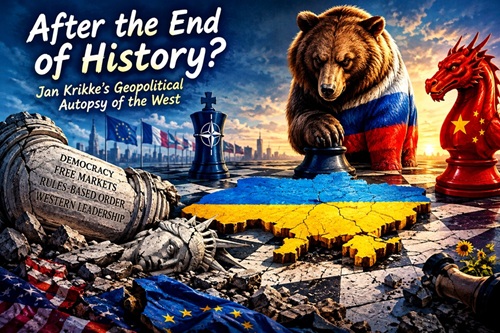 Introduction: The end of an illusion, or the beginning of an excuse?Jan Krikke's “After the End of History” offers a sweeping interpretation of the war in Ukraine: the conflict has exposed the failure of the post-Cold War assumption that liberal democracy, free markets and Western-led institutions would gradually bring the world into a common political and economic order. The West underestimated Russia's capacity to resist, misunderstood China's rise and overestimated its own ability to shape the future. Ukraine, in Krikke's telling, has become the graveyard of Western triumphalism. There is considerable merit in this diagnosis. The belief that economic integration would reliably produce political convergence was always too optimistic. Sanctions are not magic weapons, military alliances can generate insecurity as well as deter aggression, and the distribution of global economic power has changed substantially. The United States and Europe cannot simply assume that their preferred institutions and values will prevail because they regard them as superior. But Krikke's argument becomes less convincing when it moves from diagnosing Western misjudgments to explaining the war itself. His narrative places considerable weight on NATO expansion, Western ideological overconfidence and the failure to accommodate Russian security concerns. In doing so, it risks allowing a valid critique of Western policy to become an incomplete account of Russian responsibility, Ukrainian agency and the choices that actually produced the invasion. The central problem is not that Krikke criticizes the West. It is that his account sometimes treats the failure of Western expectations as though it were the principal explanation for the catastrophe in Ukraine. Those are different propositions. The West may have misunderstood the emerging world order without thereby becoming the author of Russia's decision to wage a full-scale war against its neighbor. 1. Fukuyama's mistake was real—but Krikke overstates what it explainsKrikke opens with Francis Fukuyama's famous thesis that liberal democracy had emerged as the ultimate ideological victor of the Cold War. In his reconstruction, the West came to regard economic liberalization, democratic government and integration into Western institutions as mutually reinforcing processes that would eventually draw the world together. This was indeed an overconfident assumption. Market economies do not automatically produce liberal democracies, and economic interdependence does not eliminate strategic rivalry. China is the obvious counterexample: its integration into the global economy did not result in the political convergence many Western policymakers anticipated. Russia, meanwhile, did not become a stable liberal democracy after the Soviet collapse. But Fukuyama's thesis was never quite the simplistic prediction that armed conflict would disappear or that every country would rapidly adopt Western institutions. His argument concerned the long-term ideological appeal of liberal democracy, not the end of geopolitical competition as such. Krikke therefore risks making Fukuyama a convenient symbol for a much broader Western failure. The fact that history has not ended does not establish that liberal democracy has lost its normative appeal, any more than the survival of authoritarian regimes establishes their long-term superiority. There is also a crucial distinction between the failure of a prediction and the failure of an ideal. Liberal democracy may be imperfectly implemented, strategically compromised or temporarily weakened without becoming an obsolete political project. The West's problem is not necessarily that it believed in democracy too much. It may instead have assumed that the spread of democracy could be managed through economic incentives and institutional enlargement without sufficient attention to security, political legitimacy and the reactions of authoritarian powers. That is a more precise criticism than declaring the liberal moment dead. 2. NATO expansion: a contributing factor is not a complete explanationKrikke's strongest and most contentious argument concerns NATO enlargement. He recalls George Kennan's warning against expansion, Vladimir Putin's 2007 Munich speech and the 2008 Bucharest declaration that Ukraine and Georgia would eventually become NATO members. He argues that Western policymakers dismissed Russian objections and failed to appreciate the security implications of moving a military alliance toward Russia's borders. This argument deserves serious consideration. NATO's 2008 declaration was strategically consequential: it offered Ukraine a future membership promise without providing a clear timetable or the protection that actual membership would have entailed. Such ambiguity could encourage Ukrainian aspirations while simultaneously intensifying Russian fears. Western policymakers could reasonably have asked whether this arrangement made Ukraine safer or more vulnerable. They could also have pursued a more imaginative European security architecture, combining deterrence with arms control and negotiated assurances. However, Krikke's account slides too easily from the proposition that NATO expansion contributed to Russian insecurity to the implication that Western policy created the war. These are not equivalent claims. Russia's security concerns may help explain its conduct, but they do not establish that invasion was necessary, inevitable or justified. States routinely face developments they dislike without acquiring a right to conquer their neighbors. Moreover, Ukraine is not merely a geographical buffer between larger powers. It is a political community whose citizens have their own preferences about national independence, alliances and political institutions. There is a particularly revealing contradiction in the way the NATO argument is sometimes framed. If Ukraine's possible membership in NATO was a legitimate matter of Russian security concern, why should Ukraine's own security concerns about Russia carry less weight? The asymmetry becomes clearer when we consider what happened after 2014. Russia annexed Crimea and intervened in the Donbas conflict. The full-scale invasion followed in February 2022. These actions themselves helped strengthen the argument among Ukrainians and other European states that Russian power posed a direct threat to their independence. The causal relationship therefore runs in both directions. NATO enlargement contributed to Russian threat perceptions; Russian coercion and military aggression increased the perceived value of NATO membership among countries that feared Moscow. Krikke's narrative gives considerable attention to the first dynamic and insufficient attention to the second. The relevant question is not whether Western policy made mistakes. It plainly did. The question is whether those mistakes adequately explain the decisions made by the Kremlin. They do not. 3. The missing Ukrainian perspectiveOne of the most striking features of Krikke's essay is that Ukraine appears primarily as the location where competing geopolitical projects collide. The country is presented as the victim of a failed Western strategy and as the battlefield on which the post-Cold War order is being dismantled. Yet Ukrainians are not simply objects of Russian security calculations or Western strategic ambitions. Their political choices matter. Their resistance matters. Their understanding of Russian intentions matters. And their desire to determine their own future cannot be reduced to the geopolitical calculations of Washington, Brussels or Moscow. Krikke acknowledges Ukrainian resistance, describing it as central to the conflict and as a force that has compelled the West to confront the limits of its assumptions. That is an important recognition. But he does not fully incorporate Ukrainian agency into his larger explanation. Consider the implications of his argument. If NATO expansion was the West's fatal error, then Ukraine's tragedy appears principally as the consequence of Western overreach. Yet if Russia's leaders sought to prevent Ukraine from escaping their sphere of influence, the conflict also concerns the limits of Russian imperial ambition. These interpretations are not mutually exclusive. Western strategic miscalculations and Russian imperial objectives can coexist in the same causal explanation. The challenge is to examine their respective contributions rather than allowing one to eclipse the other. Nor does recognizing Ukrainian agency require romanticizing Ukraine's government or ignoring corruption, political divisions, far-right elements or controversial wartime policies. A country can have serious domestic problems and still possess a legitimate right to resist foreign conquest. The ultimate test of any proposed settlement is therefore not simply whether it accommodates the interests of great powers. It is whether it offers Ukraine a viable future in which its independence and security are not merely temporary concessions granted by its stronger neighbors. 4. Sanctions failed to collapse Russia—but what follows from that?Krikke identifies the failure of Western economic coercion as another major miscalculation. Russia's economy did not collapse under sanctions, and Moscow redirected substantial energy exports toward markets in Asia, particularly India and China. Economic relations with Beijing also deepened. The broad point is sound. Western policymakers underestimated Russia's ability to adapt, and sanctions did not deliver the rapid political or economic breakdown that some predicted. But Krikke's account risks treating economic survival as proof of strategic success. Sanctions are not necessarily designed to produce an immediate economic collapse. Their effects may include raising transaction costs, restricting access to technology and finance, degrading particular industries, limiting future growth and complicating military production. Their overall effectiveness must be judged against their objectives, their costs and the counterfactual of what would have happened without them. A country can continue functioning while paying a substantial price. Conversely, sanctions can impose costs without achieving their political aims. Both propositions can be true. The same caution applies to Russia's pivot toward Asia. Finding alternative customers demonstrates adaptability, but it may also increase dependence on a narrower set of powerful trading partners. A relationship in which Russia increasingly relies on China for markets, industrial inputs and diplomatic support need not be an unambiguous Russian victory. China may benefit from Russia's strategic predicament precisely because Moscow has fewer alternatives. Krikke is right to reject the simplistic expectation that Western economic power would automatically compel Russian compliance. But he should also resist the opposite simplification: that surviving sanctions means the policy has failed in every meaningful respect or that Russia has emerged in a stronger strategic position. The relevant question is comparative. What has Russia gained, what has it lost, and what costs will persist beyond the immediate conflict? 5. China and the limits of Western economic supremacyKrikke's discussion of China is one of the more persuasive parts of the essay. The global economy that Western policymakers hoped would spread liberal values has also strengthened a formidable industrial and technological competitor. China has used access to international markets, investment and technology to develop manufacturing capacity and improve its strategic position. Meanwhile, European industries face intense competition in areas such as electric vehicles, batteries and solar technology. The lesson is important: economic integration does not necessarily produce political convergence, and trade relationships do not guarantee geopolitical loyalty. Yet Krikke's argument would be stronger if he distinguished between the success of globalization as an economic process and the failure of Western assumptions about its political consequences. China's rise does not demonstrate that global trade itself was a mistake. Nor does it establish that Western prosperity was necessarily dependent on permanent geopolitical supremacy. The problem was the belief that the West could integrate other powers into a common economic system without having to accommodate their growing capabilities or defend its own industrial and technological strengths. There is also a question of reciprocity. China has benefited enormously from international markets while maintaining a political system fundamentally different from Western liberal democracy. Western companies and governments also benefited from that arrangement, at least in the short and medium term. This was not simply something China did to the West. It was a relationship sustained by decisions made on both sides. Krikke's critique is most convincing when it targets the assumption that markets would neutralize political rivalry. It is less convincing if interpreted as an argument that the West's economic openness was itself the principal cause of its current predicament. 6. Did the Ukraine war destroy the liberal international order?Krikke's headline thesis is that the post-Cold War liberal order has been laid to rest in Ukraine. His conclusion is more qualified: what has died is not the entire liberal international order but the illusion that it could expand indefinitely without encountering resistance. The qualification matters. NATO remains in existence, the European Union continues to function, and liberal democratic institutions have not simply disappeared. The United States may be less reliable as an ally, but its political direction can change again. Russia's economic and diplomatic turn toward Asia does not guarantee that the emerging international order will remain stable or that China's influence will grow without limits. What has certainly weakened is the expectation of an uncomplicated, Western-led convergence. But there is a danger in describing this development as though it were an objective historical verdict on liberalism itself. An international order is not the same thing as the values it claims to embody. A particular institutional arrangement can fail because it was badly designed, insufficiently inclusive, inconsistently applied or unable to respond to changing power relations. That does not automatically invalidate the principles of political freedom, democratic accountability or international law. Indeed, the invasion of Ukraine exposes a fundamental tension in the emerging multipolar order. If the world becomes more multipolar, does that mean smaller countries gain greater freedom to choose their political futures? Or does it mean that regional great powers acquire greater freedom to impose their preferences on weaker neighbors? Multipolarity describes a distribution of power. It does not, by itself, provide a moral or political blueprint. A world in which Washington, Moscow and Beijing each dominate their respective spheres of influence might be less Western-centered, but it would not necessarily be more peaceful, democratic or just. The decisive issue is not whether the international system becomes multipolar. It is whether that system can prevent powerful states from treating their neighbors as subordinate territories. 7. Europe: the price of strategic dependenceKrikke argues that Europe is paying heavily for its ideological tunnel vision. The loss of inexpensive Russian gas contributed to higher energy costs, while European governments increased defense spending and faced political and fiscal pressures. The resulting economic dislocation has helped fuel support for nationalist parties. Europe deserves criticism for its previous dependence on Russian energy and for failing to prepare adequately for the possibility of a major security rupture with Moscow. Germany's industrial model, in particular, benefited from access to relatively inexpensive Russian gas while relying on an assumption of continued economic interdependence. That assumption proved dangerously fragile. But Krikke's description risks treating Europe's economic costs as evidence that its political response to the invasion was misguided. The two questions need to be separated. A policy can be costly without being unjustified. Deterring aggression, protecting allies and preserving a system in which borders cannot be changed by force all carry economic and military costs. Whether those costs are proportionate, whether the burden is distributed fairly and whether the policy has a realistic path toward its objectives are legitimate subjects of debate. Europe's challenge is to support Ukraine while developing a more sustainable security and industrial strategy of its own. This includes energy diversification, stronger defense capabilities, greater technological competitiveness and diplomatic channels that remain open even during severe confrontation. Strategic autonomy should not mean simply distancing Europe from Washington or accommodating Moscow. It should mean developing the capacity to make independent judgments, including the capacity to disagree with allies when necessary. Krikke is right that Europe cannot indefinitely rely on assumptions inherited from the immediate post-Cold War period. But strategic realism requires recognizing the costs of both action and inaction. 8. The danger of hindsight masquerading as realismKrikke's essay has a coherent narrative: Western triumphalism led to NATO expansion; expansion intensified Russian insecurity; sanctions failed to break Russia; China benefited from the changing balance of power; and Trump accelerated the collapse of the old order. The narrative is plausible in several respects. Its weakness is that it makes a complicated historical process appear more linear and predictable than it actually was. The fact that Russian officials warned against NATO expansion does not prove that a different Western policy would have prevented the invasion. The fact that sanctions failed to produce the expected outcome does not prove that the original strategy was irrational. The fact that China has benefited from the conflict does not prove that Beijing engineered or controlled the historical process that produced it. A serious geopolitical analysis must distinguish between warnings that were justified, predictions that proved correct and causal explanations that remain uncertain. It must also consider alternatives. What would have happened if NATO had stopped expanding? Would Russia have accepted an independent Ukraine oriented toward the European Union but outside NATO? Would a formal neutrality agreement have secured Ukraine's future, or would Moscow have continued to seek political control over Kyiv? What security guarantees could Western governments realistically have offered, and what would they have required from Russia in return? These are not rhetorical questions. They are the counterfactuals necessary to evaluate Krikke's central argument. His essay raises the right strategic questions but does not adequately establish that the answers lead to a single conclusion about Western responsibility. Conclusion: Beyond Western triumphalism—and beyond great-power fatalismJan Krikke's “After the End of History” is a useful corrective to the assumption that Western economic power, democratic institutions and military alliances would inevitably produce a world organized around Western preferences. The war in Ukraine has exposed serious errors in Western strategy, the limits of economic coercion and the dangers of treating geopolitical resistance as a temporary obstacle to historical progress. But the essay's explanatory framework is incomplete. By emphasizing NATO expansion, Western overconfidence and the failure of economic integration to moderate Russia, Krikke gives insufficient weight to Russian agency and Ukrainian independence. He sometimes approaches the conflict as a strategic failure of the West rather than as a war in which a sovereign country has been invaded by a much more powerful neighbor. A more convincing account would recognize that Western mistakes and Russian aggression are not mutually exclusive explanations. It would acknowledge that NATO policy could have been more prudent without treating Russia's invasion as an inevitable response. It would recognize that sanctions can fail to achieve their immediate aims without concluding that they have no strategic effect. And it would understand that the decline of Western predominance does not automatically confer legitimacy on the powers challenging it. The most important lesson of the war may therefore be different from the one Krikke emphasizes. History has not ended, but neither has it become a mere contest among great powers in which smaller nations must accept whatever settlement their neighbors devise. The post-Cold War order was flawed. Its institutions were not always consistent with its ideals, and its leading powers often confused their own interests with universal progress. Those failures deserve scrutiny. Yet the alternative cannot simply be a world in which spheres of influence replace the principle of sovereign equality. That would be less a correction of Western hubris than a return to an older and more brutal conception of international politics. The end of Western triumphalism should not mean the end of critical judgment. If the war in Ukraine teaches us anything, it is that power must be understood realistically—but never mistaken for a right to rule others.
Widget is loading comments...
|