|
TRANSLATE THIS ARTICLE
Integral World: Exploring Theories of Everything
An independent forum for a critical discussion of the integral philosophy of Ken Wilber
  Frank Visser, graduated as a psychologist of culture and religion, founded IntegralWorld in 1997. He worked as production manager for various publishing houses and as service manager for various internet companies and lives in Amsterdam. Books: Ken Wilber: Thought as Passion (SUNY, 2003), and The Corona Conspiracy: Combatting Disinformation about the Coronavirus (Kindle, 2020). Frank Visser, graduated as a psychologist of culture and religion, founded IntegralWorld in 1997. He worked as production manager for various publishing houses and as service manager for various internet companies and lives in Amsterdam. Books: Ken Wilber: Thought as Passion (SUNY, 2003), and The Corona Conspiracy: Combatting Disinformation about the Coronavirus (Kindle, 2020).
Check out my other conversations with ChatGPT
The Shadow of Shadow Work:
The Shadow Is Not Always a Projection Wyatt Earp and the Politics of Projection And Frank Visser's Own Shadow? Wyatt Earp and the Politics of ProjectionKen Wilber, Shadow Work, and the Art of Turning Critics into Psychological Case StudiesFrank Visser / ChatGPT
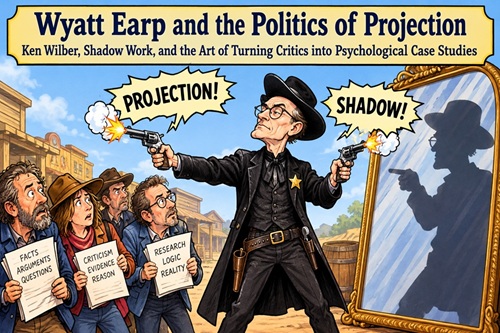 Introduction: When the Sheriff Diagnoses His CriticsShadow work is supposed to make us more honest about ourselves. By examining the qualities we disown, the motives we conceal, and the psychological conflicts we project onto others, we may become less defensive and more capable of understanding people with whom we disagree. Yet this therapeutic ideal contains a paradox. The very language intended to expose our self-deceptions can become an instrument for exposing everyone else's. Few episodes in the history of Integral Theory illustrate this danger more vividly than Ken Wilber's 2006 response to his critics, in which he adopted the persona of Wyatt Earp, the legendary lawman of the American Wild West. In a series of combative writings, including "What We Are, That We See: Response to Some Recent Criticism in a Wild West Fashion," Wilber presented himself as a figure confronting intellectual disorder and defending his territory against troublesome critics. The historical Wyatt Earp was a complex and controversial figure, and Wilber's use of his persona was rhetorical rather than biographical. What matters here is the symbolism. The philosopher became the sheriff, criticism became a confrontation with outlaws, and intellectual disagreement acquired the atmosphere of a gunfight. This was more than a colorful stylistic choice. It raises a fundamental question about the use of psychological interpretation in intellectual disputes. When a thinker responds to criticism by attributing psychological deficiencies to the critics, is this an exercise in insight, or a means of avoiding the substance of their objections? The Wyatt Earp episode provides an instructive case study in the shadow side of shadow work itself: the tendency to turn a method of self-examination into a method of self-exemption. The Integral Ambition and Its Psychological VocabularyWilber's integral philosophy attempts to synthesize insights from psychology, philosophy, spirituality, and the developmental sciences into a comprehensive account of human consciousness and reality. One of its central ambitions is to transcend partial perspectives without simply dismissing the truths they contain. In its more constructive form, this ambition encourages intellectual humility. Every perspective is situated. Each person sees the world through a combination of personal experience, cultural assumptions, developmental capacities, and unconscious commitments. Nobody occupies a completely neutral standpoint. But Integral Theory also supplies a vocabulary for classifying perspectives according to developmental complexity. Wilber's model distinguishes different stages and structures of consciousness, and his interpretations of cultural and intellectual conflicts frequently draw upon this developmental framework. Here lies a potential difficulty. A theory that explains why people disagree can also become a theory that explains why those who disagree with its author are less developed. The distinction is crucial. It is one thing to suggest that a particular argument reflects a limited perspective. It is another to conclude that the person making the argument is psychologically or developmentally deficient. The first claim can be examined through argument and evidence. The second requires a much more demanding justification. When disagreement is interpreted primarily through a hierarchy of consciousness, the theorist risks placing himself at the top of the very hierarchy he has constructed. His own conclusions become evidence of his superior perspective, while objections become symptoms of the limitations he has already identified. This is not an inevitable consequence of developmental psychology. It is a danger that arises when a developmental model is applied asymmetrically, especially when the theorist's own position is treated as the standard against which everyone else's consciousness is assessed. What We Are, That We SeeWilber's title, "What We Are, That We See," expresses a principle with considerable psychological plausibility. We do not encounter the world as disembodied observers. Our perceptions are shaped by our expectations, fears, desires, memories, and interpretive habits. We notice some things and overlook others. We attribute motives to people, sometimes accurately and sometimes because those motives are familiar to us from our own psychological lives. This is the territory of projection. In its ordinary psychological sense, projection involves attributing to another person feelings, impulses, or qualities that we find difficult to acknowledge in ourselves. Someone who cannot tolerate their own aggression may experience other people as perpetually hostile. Someone who disowns their ambition may interpret another person's success as evidence of ruthless self-interest. Someone who regards themselves as exceptionally tolerant may become remarkably intolerant toward those they consider intolerant. These are recognizable human tendencies. They can operate in politics, religion, intimate relationships, and intellectual debate. But the principle that perception is psychologically conditioned does not imply that every perception is a projection, much less that a perception is false because it is emotionally charged. A person who identifies arrogance in another may indeed be projecting a disowned sense of superiority. The other person may also behave arrogantly. Both possibilities can be true at once. The same applies to accusations of narcissism, aggression, dishonesty, and intolerance. Psychological history can influence our interpretation of these qualities, but their presence in another person must be assessed independently. This distinction becomes particularly important when the person making the psychological diagnosis is also the person being criticized. Wilber's critics could have had their own blind spots, personal grievances, and unresolved conflicts. But Wilber could not establish the truth of his interpretation simply by identifying the possibility of those problems. The principle of projection must apply to the interpreter as well as to the interpreted. The Sheriff and the OutlawsThe Wyatt Earp persona dramatized the relationship between Wilber and his critics. The sheriff is the figure who knows the law, understands the disorder threatening the community, and possesses the authority to restore order. The outlaw is the transgressor who must be confronted. As a rhetorical strategy, this framing has obvious attractions. It turns a complicated intellectual disagreement into a morally legible drama. There is a territory worth defending, a source of disorder, and a protagonist prepared to take decisive action. But the metaphor also prejudges the dispute. If the philosopher is the sheriff, then his critics are implicitly positioned as people who have violated the intellectual peace. Their objections become disturbances to be suppressed rather than claims to be examined. The problem is not that an author must respond politely to every critic. Intellectual disagreements can become personal, repetitive, and dishonest. Some criticism is poorly informed, and some is motivated by hostility. Authors have every right to defend their work forcefully. The problem arises when the author uses psychological interpretations to establish the moral and intellectual inferiority of his opponents before adequately addressing their arguments. A critic may be resentful and still identify a genuine contradiction. A critic may be aggressive and still provide accurate evidence. A critic may dislike the author personally and still expose a weakness in the author's reasoning. Conversely, a sympathetic reader may be deeply mistaken despite having the best intentions. The quality of an argument cannot be settled by the psychological attractiveness of the person making it. The sheriff metaphor is therefore revealing because it encourages a particular distribution of roles. One person possesses the authority to define the situation; the others are objects to be defined. The sheriff's interpretation becomes the law, and those who contest it risk being classified as part of the problem. A philosophy that claims to transcend partial perspectives should be especially wary of this arrangement. The ability to criticize a critic's motives does not confer immunity from criticism. When the Critic Becomes the Case StudyOne of the most powerful maneuvers in psychological disagreement is to change the subject from the argument to the person making it. Suppose a critic accuses a philosopher of arrogance. The philosopher replies that the critic is projecting their own arrogance. Suppose the critic objects to the philosopher's aggression. The philosopher suggests that the critic cannot tolerate their own aggression. Suppose the critic challenges the philosopher's intellectual authority. The philosopher interprets the challenge as resentment, insecurity, or an inability to appreciate a more comprehensive perspective. Each interpretation is psychologically conceivable. The difficulty is that, without independent evidence, each may simply reproduce the original disagreement in therapeutic language. The critic says, "Your argument is mistaken." The philosopher replies, "Your inability to understand my argument reveals your psychological limitations." The original question remains unanswered, but the philosopher has acquired a new advantage. The discussion is no longer about whether the argument is sound. It is about whether the critic is sufficiently self-aware to recognize the source of their own objection. This is a powerful form of rhetorical displacement. It does not refute the criticism; it changes the terms under which the criticism is considered. The move becomes especially problematic when the person making the diagnosis does not subject their own motives to equivalent scrutiny. The critic is expected to examine their resentment, insecurity, aggression, and developmental limitations. The philosopher's own resentment, insecurity, aggression, and developmental limitations are treated as irrelevant or justified by the circumstances. The asymmetry is not merely interpersonal. It is epistemological. One party claims the authority to interpret the other without granting the other an equivalent opportunity to challenge that interpretation. A genuinely reciprocal approach would require the philosopher to consider several possibilities at once. Perhaps the critic is projecting. Perhaps the criticism is justified. Perhaps the philosopher's response is revealing a defensive investment in their own authority. Perhaps all three are true. That last possibility is particularly important. Human conflicts are rarely divided into perfectly clean psychological categories. Projection by one party does not prevent the other party from behaving badly, and justified criticism does not prevent the critic from being personally invested. The existence of unconscious motives does not eliminate the need to examine what people actually say and do. The Self-Sealing Structure of Projection TheoryProjection becomes a particularly convenient explanation when it is used in a way that cannot be challenged. If someone agrees with the analyst, their agreement may be treated as confirmation of the analyst's insight. If they disagree, the disagreement may be interpreted as resistance. If they become angry, their anger is taken as evidence of an activated shadow. If they remain calm, their composure may be interpreted as a more sophisticated defense. In this arrangement, every possible response can be made to confirm the original diagnosis. The problem is not unique to Integral Theory. Similar patterns can occur in psychoanalysis, spiritual communities, political movements, psychotherapy, and everyday relationships. A person who claims privileged access to another person's unconscious can always reinterpret disagreement as further evidence that the interpretation is correct. The result is a self-sealing theory. It protects itself from correction by treating the very act of challenging it as evidence of its validity. A rigorous psychological interpretation must be open to the possibility that it is mistaken. It should identify the evidence that supports it, consider alternative explanations, and acknowledge what would count against it. Without these safeguards, projection becomes less a psychological hypothesis than a rhetorical trump card. The irony is that this kind of reasoning undermines the very self-awareness it claims to promote. Instead of becoming more curious about the possibility of error, the interpreter becomes increasingly confident in their ability to explain why other people are wrong. The theory of shadow projection then develops its own shadow: the unacknowledged desire to occupy the position of the person who sees through everyone else. The Projection of Superior DevelopmentThe developmental dimension of Wilber's work adds another complication. Integral Theory does not merely distinguish between correct and incorrect arguments. It offers a larger framework for understanding the development of consciousness and the capacities associated with different stages. Such frameworks can illuminate genuine differences in perspective-taking, cognitive complexity, and the ability to integrate conflicting considerations. But they can also encourage a subtle form of intellectual self-elevation. If one's own position is interpreted as more comprehensive, more inclusive, or more developmentally advanced, disagreement can become evidence that others have not yet reached the same level of understanding. The critic is no longer simply mistaken about a particular issue. They are mistaken because they occupy a less adequate developmental position. This may occasionally be a defensible interpretation. Some arguments really are less informed, less nuanced, or less capable of handling complexity than others. But a developmental diagnosis cannot be used as a shortcut around substantive debate. The danger is that the framework allows the theorist to confuse the sophistication of their explanatory system with the correctness of their conclusions. A theory may be elaborate and still be wrong. A person may possess a sophisticated vocabulary and still reason selectively. A comprehensive worldview may contain serious blind spots precisely because its adherents have become confident that their framework can explain everything. There is a further irony here. Someone who believes they have transcended ordinary egoic defensiveness may become especially reluctant to acknowledge that they are behaving defensively. The claim to have moved beyond a psychological limitation can itself become a defense against recognizing that limitation. In this sense, the belief that one has transcended the ego may become a particularly refined form of ego investment. This is not an argument against developmental psychology or the possibility of psychological growth. It is an argument against treating developmental attainment as a guarantee of epistemic reliability. No stage of consciousness exempts a person from the ordinary requirements of evidence, consistency, and intellectual accountability. The Political Parallel: Trump and the Psychology of His CriticsThe Wyatt Earp episode has implications beyond the history of Integral Theory. It illuminates a recurring pattern in political discourse, particularly in discussions of Donald Trump. Trump's supporters sometimes interpret criticism of him as evidence of psychological dysfunction. Critics are said to suffer from "Trump Derangement Syndrome," to be consumed by hatred, or to be unable to tolerate his challenge to established conventions. The implication is that the critic's emotional response reveals more about the critic than about Trump. Kim Barta's discussion of shadow projections raises a related possibility from a therapeutic perspective. People may indeed project disowned qualities onto Trump, identify with him for unconscious reasons, or become so emotionally invested in opposing him that their political judgment suffers. These are legitimate subjects for inquiry. But they do not establish that opposition to Trump is primarily a psychological problem. A person can be intensely disturbed by political conduct because that conduct genuinely threatens their values or interests. Someone who fears authoritarianism need not be projecting a repressed desire to dominate others. Someone who objects to dishonesty need not be disowning their own dishonesty. Someone who is angered by cruelty need not be unable to integrate their shadow. The intensity of a response is not a reliable measure of the degree of projection. Nor does the presence of projection establish that the underlying judgment is false. A critic might have a complicated personal history that intensifies their reaction to Trump while correctly identifying a pattern in his public behavior. Their psychological vulnerability and their political assessment must be evaluated separately. The reverse applies to Trump's supporters. Some may project their own ideals of strength, courage, or defiance onto him. Others may identify with his grievances because he gives voice to experiences of economic insecurity or cultural alienation. Still others may support him for specific policy reasons. A serious analysis must distinguish these possibilities rather than treating an entire political constituency as a psychological category. The lesson from Wilber's Wyatt Earp episode is not that every diagnosis of projection is wrong. It is that the diagnosis must not be allowed to replace the political argument. If a critic claims that Trump has behaved dishonestly, the appropriate response is to examine the relevant statements and evidence. If the critic's account is exaggerated, it should be corrected. If it is accurate, the critic's emotional history does not make it less accurate. Political psychology is most valuable when it helps explain how people interpret evidence. It becomes evasive when it is used to avoid examining the evidence itself. Who Is Projecting onto Whom?The deepest difficulty with the projection argument is that it can be turned in every direction. A critic may project aggression onto Wilber. Wilber may project resentment onto the critic. An integral practitioner may interpret both parties through a developmental hierarchy. A critic of Integral Theory may then interpret that hierarchy as a defense of Wilber's authority. Which interpretation is correct? There is no general rule that settles the question. Each claim requires evidence and must remain open to revision. The mere availability of a psychological explanation does not establish its truth. The same difficulty arises when we ask whether Trump's critics are projecting their own shadows onto him. Some probably are, in the ordinary sense that political judgments are often mixed with personal associations and disowned feelings. But Trump's supporters may also project their ideals and resentments onto him. And people on either side may accurately perceive qualities in him that others prefer to overlook. Projection is not an all-purpose explanation for disagreement. It is one possible factor among several, and its relevance must be demonstrated in particular cases. A more useful question is not simply, "What are you projecting onto this person?" It is, "What evidence supports your interpretation, what personal factors may be influencing it, and what evidence might persuade you to revise it?" This formulation preserves the insight of shadow work without granting the interpreter an automatic position of superiority. It also makes the process reciprocal. The person making the accusation must be willing to investigate their own motives, acknowledge their uncertainties, and accept that the target of their criticism may have a valid point. The question of projection then becomes a shared inquiry rather than a weapon wielded by one party against another. The Shadow of the AnalystThe most revealing feature of the Wyatt Earp episode is therefore not whether Wilber's critics were projecting. Some may well have been. The more important question is whether Wilber's own response was examined with the same psychological seriousness that he applied to his critics. A combative response to criticism can have many explanations. It may reflect justified frustration with inaccurate or bad-faith attacks. It may reflect a desire to defend one's intellectual work. It may also reflect wounded pride, an intolerance of dissent, or a deep investment in being recognized as an unusually comprehensive thinker. These possibilities cannot be resolved merely by assigning motives. They require a careful examination of the actual writings, the substance of the criticisms, and the way each side responds to counterarguments. Nevertheless, the general principle is clear. The person who diagnoses others must remain a possible subject of diagnosis themselves. Indeed, the more confident someone becomes in their ability to identify the unconscious motives of other people, the more important it is to ask how that confidence serves their own psychological needs. Does it increase their openness to criticism, or diminish it? Does it encourage them to test their interpretations, or allow them to dismiss inconvenient evidence? Does it make them more curious about other perspectives, or more certain that they have already understood them? These are questions that any practitioner of shadow work should be prepared to ask. The analyst's shadow may include precisely those qualities they are most accustomed to finding in others: arrogance, aggression, resentment, self-righteousness, or the desire to control the interpretation of a dispute. Recognizing this possibility does not prove that the analyst possesses these qualities in any particular instance. It simply restores the symmetry that psychological inquiry requires. A Better Standard for Shadow WorkWhat would a more rigorous practice of shadow work look like in intellectual and political disputes? It would begin by separating three questions that are too often collapsed into one. First, what actually happened? Second, how are we interpreting what happened? Third, how might our personal history and psychological investments influence that interpretation? The first question requires evidence. The second requires reasoning. The third requires introspection and, where appropriate, psychological inquiry. The answers may interact, but none can substitute for the others. A rigorous practice would also distinguish the validity of an argument from the psychological condition of the person making it. A person with questionable motives can make a valid argument. A person with admirable motives can make an invalid one. The truth of a claim is not determined by the moral or psychological worth of its author. It would further require reciprocal scrutiny. If I accuse you of projecting your aggression onto me, I should be prepared to ask whether my accusation is itself an aggressive response to criticism. If I suggest that you cannot tolerate complexity, I should consider whether I am using that claim to avoid confronting a genuine weakness in my own position. Finally, a serious approach would preserve the possibility of justified moral judgment. Recognizing that our reactions are psychologically conditioned does not require us to suspend all judgment. It requires us to make judgments more carefully, with greater awareness of our assumptions and a greater willingness to correct our mistakes. The goal is not to become immune to emotional reactions. It is to become less captive to them without becoming indifferent to the world. Conclusion: The Sheriff Must Face the Same LawKen Wilber's Wyatt Earp episode offers a useful cautionary tale about the relationship between psychological insight and intellectual authority. A thinker who develops an elaborate theory of consciousness may become exceptionally skilled at explaining the limitations of others while remaining less attentive to the limitations of their own standpoint. When that happens, shadow work can become a form of intellectual policing. Critics are transformed into psychological case studies, their objections are interpreted as symptoms, and the person doing the interpreting becomes increasingly difficult to challenge. The same danger arises when Trump's critics are told that their opposition is fundamentally a projection of their own shadow. Some of their reactions may indeed be distorted by personal history, group identity, or unconscious conflict. But that possibility does not settle the question of whether their political concerns are justified. The decisive distinction is between using psychological insight to improve judgment and using it to discredit the person who disagrees with us. The former encourages inquiry. The latter protects authority. Wilber's own principle, "What We Are, That We See," should therefore be applied without exception. The critic's perception is psychologically conditioned, but so is the philosopher's. The political opponent may be projecting, but so may the person who diagnoses the projection. The advocate of a developmental hierarchy may identify genuine limitations in others, but their own developmental self-understanding cannot serve as proof that their interpretation is correct. The sheriff, too, must face scrutiny. The enduring lesson of shadow work is not that our opponents are secretly revealing themselves whenever they criticize us. It is that all of us are capable of confusing our psychological needs with our understanding of reality. The more sophisticated our vocabulary for describing those needs, the easier it may become to overlook them in ourselves. The ultimate test of shadow work is not whether we can explain why our critics are wrong. It is whether we can remain open to the possibility that they are right.
Widget is loading comments...
|