|
TRANSLATE THIS ARTICLE
Integral World: Exploring Theories of Everything
An independent forum for a critical discussion of the integral philosophy of Ken Wilber
  Frank Visser, graduated as a psychologist of culture and religion, founded IntegralWorld in 1997. He worked as production manager for various publishing houses and as service manager for various internet companies and lives in Amsterdam. Books: Ken Wilber: Thought as Passion (SUNY, 2003), and The Corona Conspiracy: Combatting Disinformation about the Coronavirus (Kindle, 2020). Frank Visser, graduated as a psychologist of culture and religion, founded IntegralWorld in 1997. He worked as production manager for various publishing houses and as service manager for various internet companies and lives in Amsterdam. Books: Ken Wilber: Thought as Passion (SUNY, 2003), and The Corona Conspiracy: Combatting Disinformation about the Coronavirus (Kindle, 2020).
Check out my other conversations with ChatGPT
Schools of Psychology:
Transpersonal Psychology Parapsychology Integral Psychology Archetypal Psychology Depth Psychology Depth Psychology Under ScrutinyThe Unconscious, the Symbolic, and the Limits of InterpretationFrank Visser / ChatGPT
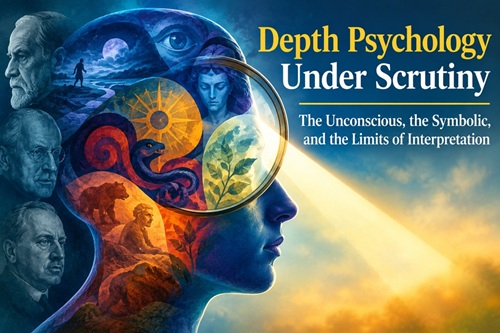 Introduction: The Depths of the MindDepth psychology is one of the most ambitious traditions in modern psychology. It begins with a deceptively simple proposition: human beings do not fully understand the forces that govern their own behavior. Beneath conscious intentions lie unconscious motives, forgotten experiences, emotional conflicts, fantasies, defenses, and patterns of attachment that can shape our lives without our awareness. What we say about ourselves, on this view, is only part of the story. The tradition emerged principally through the work of Sigmund Freud, Carl Gustav Jung, and Alfred Adler, although their theories diverged considerably. It subsequently expanded through object relations theory, attachment-informed psychoanalysis, ego psychology, self psychology, existential and humanistic approaches, and various forms of contemporary psychodynamic psychotherapy. Outside clinical psychology, its influence has extended into literary criticism, cultural studies, the interpretation of religion, art, mythology, and the broader understanding of human motivation. Depth psychology's historical achievement is difficult to deny. It helped undermine the flattering image of human beings as transparent, rational agents who know why they do what they do. It drew attention to repression, emotional conflict, childhood experience, defensive behavior, and the ways people unconsciously reproduce familiar relational patterns. Many of these concerns remain central to contemporary psychological practice. Yet the intellectual legacy of depth psychology is considerably more ambiguous than its cultural influence might suggest. Its central insight—that much of mental life is not immediately accessible to consciousness—does not automatically validate the elaborate theories that have been constructed around it. The existence of unconscious processes is well established in contemporary psychology. The existence of a Freudian unconscious organized around particular psychosexual conflicts, a Jungian collective unconscious populated by archetypes, or an Adlerian struggle for superiority requires separate arguments and different kinds of evidence. The central question is therefore not whether the mind has depths. It plainly does. The question is how reliably depth psychology has mapped them, how well its theories withstand empirical scrutiny, and whether its most influential interpretations have sometimes been mistaken for discoveries. Freud: The Founding Genius and the Problem of EvidenceSigmund Freud transformed the understanding of human motivation. His insistence that symptoms, dreams, slips of the tongue, and apparently irrational behaviors might have psychological meanings helped establish the unconscious as a serious subject of investigation. His clinical attention to shame, desire, ambivalence, resistance, and the persistence of childhood relationships gave psychology a vocabulary for experiences that conventional accounts of rational behavior often neglected. Freud's lasting contribution is not necessarily the correctness of his entire theoretical system. It is the recognition that people can be motivated by processes they neither recognize nor consciously endorse. Modern research on implicit cognition, automatic emotional responses, motivated reasoning, and nonconscious information processing provides multiple reasons to take this general proposition seriously. But Freud's particular explanation of unconscious motivation is a different matter. His theories of infantile sexuality, the Oedipus complex, psychosexual development, repression, and the interpretation of dreams were developed within a conceptual framework that often exceeded the available evidence. Some of his claims were broad enough to accommodate contradictory observations, while others relied on clinical interpretations that were difficult to test independently. The problem becomes especially apparent when interpretations are treated as self-validating. If a patient accepts an interpretation, the analyst may regard the response as confirmation. If the patient rejects it, that rejection can be interpreted as resistance. Such a framework risks insulating itself from criticism: agreement confirms the theory, while disagreement becomes further evidence for it. This is not a problem unique to psychoanalysis, but it is particularly consequential for a method that claims privileged access to unconscious meanings. A theory that can explain every possible response after the fact has little power to distinguish a correct interpretation from an imaginative mistake. Freud's clinical observations should not be dismissed wholesale. Nor should his historical importance be confused with empirical confirmation. His work helped create the modern language of psychological depth, but many of his more specific explanations remain controversial, unsupported, or superseded by alternative accounts. The proper legacy of Freud is therefore selective rather than devotional. His questions often remain valuable even where his answers do not. Jung: From Personal Unconscious to Cosmic SymbolismCarl Gustav Jung expanded the scope of depth psychology beyond Freud's emphasis on sexuality and personal conflict. He proposed that the psyche contains not only a personal unconscious but also a collective unconscious, expressed through archetypes that recur in myths, religious traditions, dreams, fairy tales, and cultural narratives. Jung's appeal is understandable. His psychology takes seriously the symbolic richness of human experience and the possibility that psychological development involves more than the elimination of symptoms. His concepts of individuation, the shadow, the persona, and the integration of conflicting aspects of the personality have influenced psychotherapy, spirituality, the arts, and popular culture. The shadow, in particular, offers a useful framework for examining traits that people deny or disown in themselves. Jung's insistence that psychological maturity involves confronting uncomfortable aspects of one's character can encourage self-examination rather than self-idealization. His account of the persona likewise illuminates the tension between social roles and private experience. The difficulties arise when Jung's symbolic language is elevated into a universal explanatory system. What precisely is an archetype? Is it an inherited psychological structure, a predisposition to organize experience in certain ways, a recurring narrative pattern, or a metaphysical principle? Jung's writings move among these possibilities, and the resulting ambiguity makes it difficult to determine exactly what the theory predicts. The recurrence of similar symbols across cultures is not, by itself, evidence for an inherited collective unconscious. Human beings share bodily structures, emotional capacities, developmental challenges, social needs, and recurring encounters with birth, death, danger, sexuality, and authority. Similar symbolic patterns could arise from these common conditions, from cultural transmission, or from convergent processes of storytelling and meaning-making. To establish a specifically Jungian explanation, one would need evidence that discriminates it from these alternatives. The widespread appearance of a mother figure, a trickster, a hero, or a descent into darkness does not settle the question. Jungian interpretation also faces the problem of symbolic flexibility. A dream, myth, or religious image can often be interpreted in several ways, each made persuasive through an appropriate narrative. Such interpretations may illuminate an individual's experience, but their persuasive quality does not establish that the proposed archetype exists as an independently operating psychological structure. Jung's work is therefore strongest when treated as a vocabulary for exploring symbolic experience and weakest when its suggestive metaphors are presented as discoveries about the universal architecture of the mind. The distinction between psychological usefulness and scientific truth is essential here. Adler and the Social Dimensions of the PsycheAlfred Adler offers a useful counterpoint to both Freud and Jung. His individual psychology emphasized feelings of inferiority, compensation, social interest, and the ways people organize their lives around perceived shortcomings and aspirations. He placed greater emphasis on social relationships and purposive behavior than on Freud's account of unconscious sexual conflict. Adler's approach can be valuable because it draws attention to the goals, strategies, and interpersonal patterns through which people attempt to manage insecurity. A person who constantly seeks recognition, for example, may be responding to a persistent sense of inadequacy rather than simply expressing an obvious desire for status. Yet Adler's concepts also require careful handling. If nearly any ambition can be interpreted as compensation for inferiority, the explanation risks becoming too flexible. If a person's behavior is interpreted through a presumed life goal that the person has not acknowledged, the analyst must explain how that goal was identified and how the interpretation might be disproved. Adler's emphasis on social context, belonging, and the organization of personal goals nevertheless points toward a more general lesson: psychological explanations become more credible when they can be connected to observable behavior, developmental history, interpersonal circumstances, and competing hypotheses rather than relying exclusively on inferred hidden motives. What Does It Mean to Discover an Unconscious Motive?The term unconscious covers several different phenomena, and much confusion arises when they are treated as interchangeable. Contemporary cognitive science recognizes numerous processes that operate without conscious awareness. People can acquire habits, form rapid judgments, respond emotionally to cues, and process information without being able to report the underlying mechanisms. Memory retrieval is selective, attention is limited, and the conscious explanation people offer for their decisions may differ from the processes that actually influenced them. These findings support a broad conception of unconscious mental activity. They do not establish that the unconscious is a single, coherent domain with a hidden symbolic language, nor that every unexplained behavior has a deeper psychological meaning. The distinction matters because the unconscious is sometimes treated as a universal explanatory solvent. If a person behaves generously, the generosity may be interpreted as a disguised attempt to gain approval. If the person behaves selfishly, the selfishness may be interpreted as compensation for insecurity. If the person denies either interpretation, the denial may be taken as evidence of repression. The result is a system in which the interpreter can always produce another explanation. But the ability to generate an explanation is not the same as the ability to identify the correct one. A defensible theory of unconscious motivation should specify what evidence supports a proposed motive, what alternative explanations are plausible, and what findings would count against the interpretation. It should also distinguish an unconscious process that can be experimentally demonstrated from a hidden narrative inferred through clinical judgment. This distinction does not require psychology to abandon interpretation. Human behavior is complex, and not every meaningful psychological hypothesis can be reduced to a simple laboratory experiment. It does require interpreters to acknowledge uncertainty and to avoid presenting plausible stories as established facts. Depth psychology's most important claim—that conscious self-understanding is incomplete—survives this scrutiny. Its more ambitious claims about the contents and structure of the unconscious must be assessed individually. The Problem of Clinical InterpretationTraditional depth psychology often gives the trained interpreter a central role in uncovering meanings that the patient cannot recognize independently. The therapist listens for recurring patterns, contradictions, omissions, emotional reactions, fantasies, and relational dynamics. Through interpretation, the patient may come to understand previously confusing experiences. Such work can be valuable. People do not always recognize the patterns that shape their relationships, and an attentive therapist may notice connections that the individual has overlooked. A carefully explored interpretation can offer a new perspective on persistent difficulties. However, clinical insight is not infallible. Therapists have expectations, theoretical commitments, personal biases, and incentives to find patterns. Patients, meanwhile, may be influenced by suggestion, the desire to please, the authority of the therapist, or the relief that comes from receiving a coherent explanation. A compelling account can become persuasive without being accurate. This is especially important when interpretations concern memories of childhood, alleged repression, family dynamics, or hidden motives attributed to other people. Memories are reconstructive, and confidence does not guarantee accuracy. A therapist who encourages a patient to discover a predetermined narrative can unintentionally reinforce mistaken beliefs. A responsible depth-oriented practice must therefore remain open to the possibility that an interpretation is wrong. It should not treat resistance as automatic confirmation, assume that every symptom conceals a symbolic message, or confuse emotional intensity with evidence. Nor should therapeutic change be treated as proof of an entire theoretical system. A patient may improve because the therapist provides empathy, attention, structure, hope, or an opportunity to reflect on difficult experiences. Improvement may also result from changes in behavior and relationships that are not specific to a theory of unconscious conflict. The relevant question is not simply whether a patient benefited from therapy. It is whether the treatment produces reliable benefits, for whom, under what conditions, and through which mechanisms. Those questions demand more than the therapist's retrospective conviction that a deep interpretation was correct. Contemporary Psychodynamic Therapy: A More Defensible LegacyA critical assessment of depth psychology must distinguish its historical theories from the contemporary clinical practices that have developed from them. Psychoanalysis, in its classical form, is not identical to psychodynamic psychotherapy as it is practiced today. Many contemporary therapists have retained an interest in unconscious processes, emotional defenses, early relationships, and recurring interpersonal patterns while abandoning or substantially revising older theoretical commitments. This distinction is important because the empirical status of psychodynamic psychotherapy has improved considerably. A major umbrella review published in World Psychiatry in 2023 examined meta-analyses of randomized controlled trials involving adults with depressive, anxiety, personality, and somatic symptom disorders. It concluded that psychodynamic therapy had substantial empirical support, with high-quality evidence for certain conditions and moderate-quality evidence for others. The review also found evidence that its effectiveness can be comparable to that of other established psychotherapies. A 2025 systematic review and meta-analysis of experiential dynamic therapies likewise reported beneficial outcomes across several diagnostic categories, while noting substantial variation between studies and a need for more rigorous research. These findings complicate the familiar caricature of psychoanalysis as an entirely unscientific enterprise. Psychodynamic therapy cannot reasonably be dismissed as ineffective simply because some of its historical founders advanced speculative theories. Contemporary treatments can be evaluated on their own merits, and some have met demanding standards of empirical assessment. Nevertheless, evidence that a therapy works does not necessarily demonstrate that its original theoretical explanation is correct. A treatment informed by psychodynamic ideas might help patients because it encourages emotional awareness, improves interpersonal understanding, strengthens the therapeutic alliance, or facilitates the reconsideration of habitual responses. These benefits do not establish the truth of every claim about repression, psychosexual development, unconscious symbolism, or the interpretation of dreams. This is a general problem in psychotherapy research. Different therapeutic approaches can produce comparable improvements despite offering incompatible explanations of psychological distress. The therapeutic relationship, patients' expectations, opportunities for emotional expression, and the acquisition of new ways of responding may contribute to outcomes across theoretical schools. The next challenge for psychodynamic research is therefore not merely to demonstrate that treatment works, but to identify which components are effective, which patients benefit most, and whether specifically psychodynamic mechanisms contribute something beyond factors shared with other therapies. The contemporary clinical tradition deserves to be judged by its empirical achievements. Its more speculative intellectual heritage does not receive an automatic scientific endorsement in the process. Depth Psychology and the NeurosciencesOne of the recurring ambitions of depth psychology has been to connect its account of the hidden mind with a more comprehensive understanding of human nature. Contemporary neuroscience provides opportunities for such connections, but also imposes important constraints. Modern research investigates memory consolidation, emotional learning, implicit processing, cognitive control, threat detection, habitual behavior, and the effects of early experience on later development. These fields provide increasingly detailed accounts of how processes outside conscious awareness influence behavior. They also reveal that psychological functions are distributed across interacting neural systems rather than necessarily organized according to the neat conceptual architecture of classical psychoanalysis. Some connections between psychoanalytic concepts and contemporary neuroscience are plausible. Emotional experiences can influence behavior without being consciously remembered. People can avoid situations associated with distress without knowing precisely why. Defensive responses can reduce awareness of uncomfortable feelings. Early relationships can shape expectations about later relationships. But the resemblance between a modern finding and an older psychoanalytic concept does not prove that the latter anticipated the former in a scientifically significant sense. Broad concepts such as unconscious conflict can be retrospectively aligned with many different discoveries. The more precisely a historical theory specifies a mechanism, the more meaningful it becomes to ask whether that mechanism has actually been demonstrated. The same caution applies to attempts to give Jungian archetypes a neurological foundation. Human beings may possess evolved predispositions for recognizing faces, responding to caregiving, detecting threats, and learning social roles. Such predispositions could help explain why certain symbolic motifs recur across cultures. They do not, without additional evidence, establish the existence of a collective unconscious containing universal archetypal structures. Nor does the discovery that particular experiences involve specific neural systems prove that those experiences are reducible to a single biological explanation. Psychology operates at multiple levels of analysis, from neural mechanisms to individual learning and social relationships. A satisfactory explanation may require several levels at once. Neuroscience is therefore neither a simple vindication of depth psychology nor its automatic refutation. It provides independent constraints on psychological theories and requires them to become more precise about the mechanisms they propose. The decisive question is whether a theory can connect its concepts to identifiable processes and generate findings that would be unlikely if the theory were wrong. Merely translating traditional terminology into neuroscientific language does not accomplish this. The Therapeutic Usefulness of Myths and MetaphorsDepth psychology's influence extends far beyond the clinic. Its concepts have become part of the vocabulary through which people interpret themselves and their relationships. We speak of projecting our insecurities onto others, confronting our shadows, repeating childhood patterns, or acting out unresolved conflicts. Such language can be useful even when its historical theoretical associations are uncertain. A metaphor may illuminate an experience without describing a literal psychological mechanism. Calling an aspect of oneself a shadow can encourage someone to acknowledge an unwanted trait. Describing a recurring relationship as a repetition of an earlier pattern can direct attention toward familiar expectations and responses. Thinking of individuation as the integration of conflicting aspects of personality can provide a meaningful framework for personal development. The danger arises when metaphors become reified—when a useful way of talking about experience is treated as proof of an independently existing structure in the mind. Consider the Jungian shadow. It can serve as a shorthand for traits, impulses, or feelings that a person finds difficult to acknowledge. But the explanatory work is being done by identifiable psychological phenomena: avoidance, shame, self-deception, social conditioning, and the difficulty of accepting certain aspects of oneself. Invoking the shadow does not necessarily add a separate causal explanation. The same applies to archetypes. A hero's journey may provide a compelling narrative for a person's transition through adversity. But the narrative's usefulness does not establish that the psyche contains an inherited heroic template directing personal development. This distinction is particularly important in popular psychology, where concepts from Freud and Jung are often combined with mythology, spirituality, self-help, and personal-growth practices. The resulting frameworks can be stimulating and emotionally resonant. They can also become so flexible that almost any experience can be incorporated into them. Depth psychology is at its most defensible when it treats symbolic interpretations as invitations to reflection rather than authoritative diagnoses of hidden reality. A metaphor should help a person investigate experience, not dictate what that experience must mean. Depth Psychology and the Spiritualization of the PsycheThe most expansive versions of depth psychology sometimes move beyond psychological interpretation toward metaphysical claims. Jung's writings on religion, alchemy, synchronicity, and the symbolic relationship between psyche and world have encouraged readers to interpret psychological development as part of a larger spiritual process. In some settings, Jungian psychology has consequently become a bridge between psychotherapy and esoteric spirituality. Dreams are treated as messages from a deeper order; synchronicities are interpreted as meaningful connections between inner and outer events; archetypes become principles that organize not merely the mind but the universe itself. These interpretations can be meaningful as personal or religious commitments. Their status changes, however, when they are presented as scientific discoveries. The fact that a coincidence feels significant does not demonstrate that it was arranged by a transpersonal intelligence. The experience of encountering an archetypal image does not establish that the image originates in a universal metaphysical source. Psychological significance and external causation are different questions. Humans are extraordinarily capable of detecting patterns, constructing narratives, and assigning meaning to events. These capacities are indispensable to ordinary life, but they can also generate compelling connections where no special causal relationship exists. A psychological theory that takes the meaningfulness of an experience as evidence for its metaphysical interpretation risks confusing the experience with an explanation of its origin. The distinction matters because the authority of psychology can lend unwarranted credibility to spiritual claims. A therapeutic concept may acquire an aura of scientific legitimacy through its association with the unconscious, archetypes, or psychological integration, even when the additional metaphysical conclusions have not been independently established. None of this requires psychology to exclude religion from its subject matter. Religious experiences, rituals, beliefs, and symbolic systems are legitimate objects of psychological investigation. What must be resisted is the assumption that explaining the psychological importance of a religious experience establishes the truth of its supernatural interpretation. Depth psychology can investigate why spiritual ideas are compelling, how they shape identity, and what functions they serve. Whether those ideas disclose a reality beyond ordinary psychological processes is a separate question. The Commercial Afterlife of Depth PsychologyDepth psychology has survived not only as a clinical tradition but also as a cultural industry. Jungian typologies, archetypal coaching, dream interpretation, personality systems, and mythological approaches to personal development remain influential. They offer people a vocabulary for understanding themselves that is often richer and more narratively satisfying than conventional diagnostic categories. Yet popularity is not evidence of validity. The appeal of a psychological system may depend partly on its ability to make ordinary experiences feel profound, to offer a coherent account of personal difficulties, or to place an individual's life within a larger story. Personality typologies illustrate the problem. Jung's ideas helped inspire influential systems of psychological classification, but the popularity of such systems does not establish their scientific reliability. A typology may feel remarkably accurate because its descriptions are broad, its categories invite selective identification, or users interpret ambiguous statements in personally meaningful ways. The same issue affects many forms of archetypal coaching and dream interpretation. Their practitioners may offer insightful observations, but the accuracy of an interpretation needs to be distinguished from the confidence with which it is presented. There is also a risk that psychological difficulties will be overinterpreted. Sometimes a persistent problem does involve unresolved emotional conflict or a recurring relational pattern. Sometimes it is better explained by a current social predicament, a learned habit, a medical condition, an economic constraint, or a combination of factors. The promise of hidden depth can distract attention from ordinary causes that are less dramatic but more consequential. A responsible psychological practice should therefore be willing to move between interpretations and levels of explanation. Not every problem requires a mythological narrative, and not every difficulty conceals an undiscovered truth about the self. Depth psychology's cultural influence remains substantial precisely because it offers meaning as well as explanation. Its challenge is to preserve the former without exaggerating the latter. What Remains of Depth Psychology?The historical movement called depth psychology is not a single unified science. It is a family of traditions sharing an interest in unconscious motivation, emotional conflict, personal history, symbolic experience, and the limits of conscious self-knowledge. Some of its branches have developed into empirically supported clinical practices; others retain a largely interpretive, philosophical, or spiritual orientation. This diversity makes sweeping judgments misleading. It would be wrong to dismiss all psychodynamic psychotherapy because Freud's original theories were speculative. It would be equally wrong to regard the success of contemporary psychodynamic treatments as confirmation of Jung's collective unconscious or every other doctrine associated with the tradition. The most enduring contributions of depth psychology are better understood as questions and research programs than as a completed map of the psyche. Why do people repeat patterns that frustrate them? How do early experiences influence later relationships? Why do people defend beliefs and identities against uncomfortable evidence? How do emotions influence decisions that appear rational? What can be learned from dreams, fantasies, and recurring patterns of thought? These are legitimate questions. Their answers, however, must remain open to psychological research, alternative explanations, and correction. The future of depth psychology depends partly on its willingness to separate its most productive insights from its more ambitious theoretical claims. The former can survive without the latter. We do not need to accept the Oedipus complex as a universal developmental law to investigate the influence of family relationships. We do not need to posit a collective unconscious to study recurring cultural motifs. We do not need to treat every symptom as a disguised message to recognize that emotions and behavior can be difficult to understand. A more scientifically disciplined depth psychology would acknowledge that the unconscious is not a single hidden chamber waiting to be explored by a privileged interpreter. It is a convenient umbrella term for a range of processes whose mechanisms, functions, and relations to consciousness must be investigated separately. Such a psychology would retain the ambition to understand people in their complexity while relinquishing the temptation to turn every complexity into confirmation of a favored theory. Conclusion: Depth Without MystificationDepth psychology began as a challenge to the superficiality of accounts that treated people as fully conscious, rational, and transparent to themselves. Its insistence that human motivation is often hidden helped change the intellectual landscape of the twentieth century. Its influence on psychotherapy, culture, literature, and personal reflection remains considerable. But the discovery of psychological depth does not confer unlimited explanatory authority on those who claim to interpret it. The unconscious is not a blank cheque for speculation. The richness of a dream does not guarantee the correctness of its interpretation, the recurrence of a myth does not prove the existence of an archetype, and the therapeutic usefulness of an idea does not establish its universal truth. The contemporary status of depth psychology is consequently mixed but not bleak. Psychodynamic psychotherapy has established a credible empirical position for several common mental disorders. Research into implicit cognition, emotional learning, attachment, and nonconscious processing continues to illuminate aspects of mental life that earlier depth psychologists were right to emphasize. At the same time, many classical psychoanalytic propositions remain disputed, while expansive Jungian and spiritual interpretations often exceed what the available evidence can establish. The appropriate response is neither wholesale rejection nor nostalgic rehabilitation. It is discrimination. We should retain what can be supported, revise what remains plausible but uncertain, and abandon claims that survive primarily through interpretive flexibility or metaphysical commitment. The mind undoubtedly has depths. But depth is not itself an explanation, and mystery is not evidence. The task of psychology is not to make the unconscious infinitely profound. It is to understand, as precisely as possible, the processes that make human beings less transparent to themselves than they imagine.
Widget is loading comments...
|