|
TRANSLATE THIS ARTICLE
Integral World: Exploring Theories of Everything
An independent forum for a critical discussion of the integral philosophy of Ken Wilber
  Frank Visser, graduated as a psychologist of culture and religion, founded IntegralWorld in 1997. He worked as production manager for various publishing houses and as service manager for various internet companies and lives in Amsterdam. Books: Ken Wilber: Thought as Passion (SUNY, 2003), and The Corona Conspiracy: Combatting Disinformation about the Coronavirus (Kindle, 2020). Frank Visser, graduated as a psychologist of culture and religion, founded IntegralWorld in 1997. He worked as production manager for various publishing houses and as service manager for various internet companies and lives in Amsterdam. Books: Ken Wilber: Thought as Passion (SUNY, 2003), and The Corona Conspiracy: Combatting Disinformation about the Coronavirus (Kindle, 2020).
Check out my other conversations with ChatGPT From Mythos to Logos and BeyondThe Search for a Third Story of MeaningFrank Visser / ChatGPT
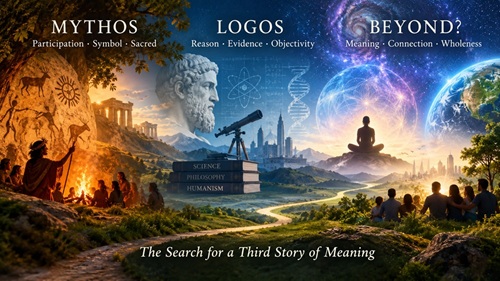 Introduction: Has Modernity Outgrown Religion, or Is Religion Reinventing Itself?One of the great disputes in the history of religion concerns the relationship between meaning and knowledge. For most of human history, people encountered the world through stories, rituals, symbols, myths, and sacred narratives that connected their personal lives to a larger cosmic order. With the development of philosophical reflection, scientific inquiry, and modern critical thought, another mode of understanding gained prominence: the attempt to explain the world through observation, argument, evidence, and reason. What had once been experienced as sacred became, increasingly, an object of investigation. This transition is often described as the movement from mythos to logos. Mythos refers not simply to false stories but to a mode of participation in which symbols, narratives, and communal practices disclose the significance of existence. Logos refers to reflective, analytical, and increasingly objective modes of understanding that distinguish the knower from what is known. The distinction is not absolute: myths can contain rational insights, and scientific explanations can carry profound existential significance. Nevertheless, the contrast captures an important historical transformation. The controversy begins when we ask what has been lost in this transition. Did rationality liberate humanity from an enchanted but largely unexamined world, or did it sever our connection to the sources of meaning? Can modern people recover symbolic depth without surrendering critical intelligence? And is there a third way beyond both traditional religion and secular rationalism? A remarkable variety of thinkers have answered these questions by proposing a third phase of cultural or spiritual development. Some call it a second naivety, others a second simplicity, a postcritical faith, a participatory worldview, or an integral consciousness. In contemporary post-integral circles, the ambition often becomes even more expansive: to recover a sense of cosmic meaning after modernity has dismantled the certainties of traditional religion. Yet the proposed solutions differ considerably. For some, the third phase means a more sophisticated appreciation of myth and symbol. For others, it means mystical realization beyond the rational mind. For still others, it involves an evolutionary universe that is once again understood as inherently meaningful. These proposals share a dissatisfaction with a purely disenchanted world, but they do not agree on what, if anything, should replace it. The central question is whether we can recover the human capacity for symbolic participation without turning that recovery into a new metaphysical doctrine. 1. Mythos and Logos: Two Ways of Encountering the WorldThe distinction between mythos and logos has a long intellectual history, although its modern use often compresses several different developments into a single narrative. Ancient Greek thinkers already distinguished mythological narratives from forms of rational argument, but myth and reason continued to coexist throughout antiquity. The development of philosophy did not simply abolish mythology, just as the rise of modern science did not eliminate religious belief. Nevertheless, the distinction is useful because it identifies two different orientations toward reality. Mythos embeds human beings in a meaningful world. A river may be a source of life, a divine presence, a boundary between worlds, or an ancestral symbol. These meanings are not necessarily experienced as interpretations imposed upon a neutral object. They belong to the world as it is lived and inhabited by a community. Logos, by contrast, encourages us to distinguish the river's physical properties from the meanings attributed to it. We investigate its geological origins, chemical composition, hydrology, and ecological functions. Such knowledge can be tested, corrected, and progressively refined. The river becomes an object of knowledge rather than simply a participant in a sacred order. This transformation has enormous advantages. It enables us to distinguish natural processes from supernatural explanations, challenge inherited authorities, and develop reliable knowledge about the world. It also undermines the unquestioned authority of many traditional cosmologies. A sacred narrative may remain culturally important even after its account of the physical universe has become scientifically untenable. But the transition also creates an existential problem. Knowing what a river is made of does not automatically tell us what it means to us. A scientific description of a forest does not exhaust its aesthetic, emotional, cultural, or moral significance. The disenchanted world may be more accurately understood while appearing less inherently meaningful. The mistake is to assume that these two kinds of knowledge must be mutually exclusive. Scientific objectivity does not prevent us from experiencing awe, beauty, attachment, or reverence. Nor does the presence of meaning establish that the universe itself possesses intentions or spiritual purposes. The challenge is to distinguish the reality of human meaning from claims about the cosmic foundations of that meaning. This distinction will become crucial in evaluating the proposed third phase. 2. The Secularization of Meaning: The Modernist ResponseThe secular interpretation of the transition from mythos to logos begins with a straightforward proposition: the decline of traditional religious authority need not entail the decline of meaning itself. Human beings can relinquish supernatural explanations without relinquishing moral commitment, aesthetic experience, solidarity, or the search for a worthwhile life. The Enlightenment did not produce a single, uniform philosophy of secular existence. Some Enlightenment thinkers remained religious, others embraced forms of deism, and still others developed increasingly naturalistic interpretations of humanity. What united many of them was the conviction that inherited authority should be subjected to critical examination rather than accepted merely because it was ancient or sacred. In this perspective, reason is not simply a destructive force. It is also a means of emancipation. It permits us to challenge oppressive traditions, reconsider inherited moral rules, and distinguish claims that deserve belief from claims that survive only through social conformity. The scientific worldview replaces supernatural explanations not because nature has become less interesting, but because it has become more intelligible. Secular humanism develops this argument into a positive philosophy of life. Human flourishing, ethical responsibility, intellectual curiosity, and solidarity can provide meaning without requiring a cosmic purpose built into the universe. A life need not have been designed by a transcendent intelligence to matter to the person living it or to those whose lives it touches. This position also challenges a common assumption in religious critiques of modernity: that meaning must originate outside humanity to be genuine. We do not generally regard friendship as meaningless because it lacks a supernatural foundation. Nor does the fact that human beings evolved through natural processes render compassion, creativity, or justice illusory. Explaining how our capacities arose does not automatically invalidate the values we develop through them. The secular humanist therefore questions the premise that modernity has created a meaning crisis that only a spiritual reconstruction can solve. Modern societies may experience alienation, loneliness, social fragmentation, or a weakening of inherited communal bonds. But these are not necessarily consequences of losing access to a cosmic source of meaning. They may also arise from economic insecurity, social inequality, individualism, technological change, or the erosion of institutions that once sustained community. The secular response is not necessarily to recover the old myths or invent new ones. It may be to build better societies, cultivate deeper relationships, create more meaningful forms of work, and develop ethical commitments that survive the disappearance of supernatural guarantees. The important qualification is that logos alone does not supply a complete way of life. Scientific knowledge tells us much about what exists and how it works, but it cannot, by itself, determine all our ethical priorities. Rational deliberation can inform our values without mechanically producing a single universally agreed-upon answer to every moral question. Secular humanism is therefore not simply the worship of reason. At its best, it combines critical inquiry with the human capacities for imagination, empathy, art, and shared purpose. Its distinctive claim is that these capacities do not need to be anchored in a metaphysical cosmic story to be legitimate. 3. The Second Naivety: Returning to Myth Without Returning to SuperstitionNot everyone accepts that the modern transition can be understood as a straightforward victory of rationality over superstition. A different tradition argues that modernity has gained something indispensable while also losing something valuable: an immediate, participatory relationship with symbols and narratives. One influential formulation is Paul Ricoeur's idea of a second naivety. The phrase captures the possibility of returning to religious symbols after they have been subjected to critical interpretation. The first naivety is the relatively unreflective acceptance of a symbolic world. The second follows the recognition that myths have histories, that scriptures require interpretation, and that religious traditions can be challenged by historical scholarship, psychology, and science. The return is therefore not a restoration of innocence. It is a renewed engagement made possible by the loss of innocence. Consider the biblical story of the Garden of Eden. A first-naive reading might treat it as a literal account of the origin of humanity, complete with a historical first couple and a primordial fall. A critical reading investigates its literary construction, ancient Near Eastern context, theological purposes, and incompatibilities with evolutionary biology. A second-naive reading may then recover its symbolic significance as a story about shame, self-consciousness, responsibility, alienation, and the human desire to escape the conditions of finite existence. Something meaningful survives the rejection of literalism. Indeed, critical interpretation can sometimes deepen the meaning of a narrative by revealing dimensions obscured by an exclusively factual reading. This is a valuable insight, but it requires an important distinction. Recovering a symbol's significance does not establish the historical truth of the story or the metaphysical reality of the world it depicts. We can appreciate the Garden of Eden as a profound cultural narrative without concluding that humanity underwent a supernatural fall from an originally perfect state. The same applies to myths of death and rebirth, cosmic order, divine justice, and the unity of existence. They may articulate recurring features of human experience, provide powerful resources for moral reflection, or express psychological and cultural patterns. Their importance need not depend on their literal truth. The danger arises when symbolic recovery quietly becomes ontological restoration. A thinker may begin by saying that the world can be experienced as if it were sacred and end by asserting that the universe is sacred in a literal, metaphysical sense. The first is a claim about human experience and interpretation. The second is a claim about the fundamental nature of reality. They require different arguments. A second naivety can therefore be understood in at least two ways. In its more modest form, it is a mature capacity to participate in symbolic meaning without confusing symbols with scientific descriptions. In its stronger form, it becomes a renewed belief that the symbols disclose a transcendent reality that critical reason cannot adequately comprehend. The first possibility is compatible with secular humanism. The second reopens the debate about metaphysics. 4. Beyond Myth and Reason: The Mystical ProposalA more radical approach argues that both mythos and logos remain confined to ordinary mental consciousness. Mythic religion interprets existence through stories and sacred images; rationality examines those interpretations from a critical distance. Mysticism, according to this view, offers access to a mode of awareness that precedes or transcends the ordinary subject-object division. The mystical proposal is not simply that we should return to the symbolic world of our ancestors. It is that we should transform the consciousness through which we encounter the world. Through meditation, contemplation, prayer, or other disciplines, practitioners report experiences of unity, ego-transcendence, boundlessness, or a diminished distinction between self and world. Such experiences deserve serious consideration as human phenomena. They can be psychologically powerful, emotionally transformative, and ethically consequential. They may alter a person's sense of identity, reduce fear, intensify compassion, or provide a profound feeling of connectedness. But what follows from them? The interpretation of mystical experience is notoriously variable. One person understands unity as communion with a personal God, another as realization of Brahman, another as the recognition of emptiness, and another as a temporary alteration of the brain's ordinary self-processing. The experiences may share phenomenological features without establishing a common metaphysical explanation. The crucial distinction is between experiencing something as ultimate and demonstrating that it is metaphysically ultimate. Intensity, certainty, and transformative power are not equivalent to independent evidence about the structure of the universe. Mysticism can thus be interpreted as an expansion of human experience without being treated as a new source of infallible knowledge. This does not require dismissing contemplative traditions. It requires examining their claims with the same care applied to other claims about reality. The metaphysical danger becomes especially pronounced when the limits of ordinary conceptual thought are taken as evidence for a transcendent domain. From the fact that language cannot fully capture an experience, it does not follow that the experience reveals a reality beyond nature. Human experience often exceeds our ability to describe it, but indescribability is not proof of supernatural origin. The mystical proposal raises an important question: does transcending ordinary cognition reveal a deeper reality, or does it disclose possibilities of human consciousness that our everyday habits usually conceal? These explanations are not equivalent, and the first does not follow automatically from the second. A defensible third phase may therefore involve a more reflective relationship with experience, including contemplative experience, without assuming that mystical states provide privileged access to the ultimate furniture of the cosmos. 5. Ken Wilber's Integral Solution: The Transition from Mythos to Logos as Pro-SpiritKen Wilber's treatment of religion in A Sociable God (1983) offers a particularly ambitious interpretation of this landscape. Rather than seeing the development of rationality as a simple retreat from religion, Wilber argues that the transition from mythic to rational consciousness can represent a deeper development of spirituality itself. His argument depends on a distinction between religion's developmental forms and what he regards as its more enduring spiritual possibilities. Mythic religion belongs to a particular stage of consciousness. It often takes sacred narratives literally, identifies the divine with the beliefs of a particular community, and interprets the world through inherited cosmologies. Rationality challenges these limitations, exposing contradictions and expanding the scope of ethical concern beyond the boundaries of the tribe. On this account, the rational critique of myth need not be anti-religious. It can be pro-Spirit, provided Spirit is understood as something that transcends the mental structures through which people conceptualize it. The development of critical reason can clear away inadequate representations of the sacred and prepare the ground for more encompassing forms of spiritual realization. Wilber's approach belongs to a broader developmental vision in which archaic, magic, mythic, mental, and transpersonal modes of consciousness occupy different positions in an evolutionary spectrum. The integral aspiration is not to choose one mode and discard the others indiscriminately, but to preserve valuable capacities while overcoming the limitations of earlier forms. This is the logic commonly summarized as "transcend and include." A mature consciousness would not have to become literalistic again to appreciate myth, nor abandon rationality to engage in spiritual practice. It could understand myths symbolically, reason critically, and participate in contemplative disciplines without confusing the different kinds of knowledge involved. There is a genuine strength in this approach. It rejects the false choice between an unquestioning return to traditional religion and an impoverished view of modern life in which only instrumental reasoning counts as legitimate. It also recognizes that a person's intellectual development and spiritual practices need not follow the same trajectory. Yet Wilber's solution introduces a substantial difficulty. His defense of Spirit is not merely a recommendation to cultivate meaningful experiences. It is embedded in a larger account of consciousness, development, and reality. The claim that rationality can become pro-Spirit depends on what Spirit actually means and on whether the proposed developmental hierarchy can be justified. If Spirit means the human capacity to experience unity, reflect on existence, and transcend narrow self-interest, the claim is relatively accessible. These capacities can be investigated psychologically, philosophically, and culturally. If Spirit refers instead to a transpersonal or ultimate reality that consciousness progressively discloses, the claim becomes metaphysical. One must then explain why the experience of transcendence warrants that interpretation and how competing interpretations can be assessed. Wilber's framework risks making the answer depend on its own developmental map. If mythic believers are classified as developmentally limited, rational critics as occupying an intermediate stage, and mystical interpreters as possessing a more encompassing perspective, then disagreement can be reinterpreted as evidence of the critic's developmental limitations. The theory may thereby protect its central claims from precisely the criticism that rationality makes possible. A further complication concerns the relationship between individual spiritual development and cultural evolution. A modern person can engage in sophisticated scientific reasoning while retaining conventional religious beliefs; another can be entirely secular while displaying extraordinary moral sensitivity and contemplative depth. Historical change does not proceed along a single ladder, and neither individuals nor societies fit neatly into a universal sequence of stages. Wilber's central insight remains worth preserving: the critique of myth need not entail the rejection of everything historically associated with religion. But his stronger conclusion—that rational development points toward a transmental spiritual reality—requires an argument that cannot be supplied by developmental classification alone. To show that people can develop beyond literalistic religion is not yet to show that the destination is Spirit. 6. Secular Humanism Versus Integral Spirituality: What Counts as Meaning?At this point, the disagreement becomes clearer. Secular humanists and integral spiritual thinkers can agree that meaning involves more than the accumulation of factual knowledge. Both can value art, ethical commitment, emotional depth, relationships, and experiences of wonder. Their disagreement concerns whether these dimensions require a spiritual foundation. For the secular humanist, meaning is something that emerges within the lives of conscious beings and their relationships with one another and the world. It is neither trivial nor illusory because it is humanly generated. Language, music, friendship, justice, and scientific discovery are products of human history, yet their historical and natural origins do not make them less significant. For the integral spiritualist, this account may appear incomplete. Human meanings are embedded in a larger reality whose evolutionary development, depth, or interiority cannot be adequately captured by an exclusively material description. Spirituality is proposed as a way of recognizing this wider context, rather than merely assigning subjective values to an otherwise indifferent universe. But this disagreement often conceals several distinct questions. Does the universe have an objective purpose? Does human consciousness possess features that are not reducible to physical processes? Can spiritual practices produce valuable transformations? Can people live meaningful lives without religious beliefs? These questions do not have to receive the same answer. Someone can believe that contemplative practices are beneficial while rejecting the existence of a cosmic consciousness. Someone can regard the universe as objectively real and astonishing without believing that it is evolving toward a spiritual goal. Someone can embrace secular humanism while appreciating the symbolic richness of religious traditions. The most problematic move occurs when the existence of a human need for meaning is treated as evidence that the universe must possess meaning in the same sense. That inference is not self-evident. It is possible that our capacity for meaning evolved because it helped social organisms coordinate, cooperate, plan, and sustain relationships. The fact that this capacity now allows us to reflect on the universe does not establish that the universe itself has a corresponding purpose. Nor does the natural origin of meaning imply that all meanings are equally defensible. We can distinguish humane from destructive commitments, informed from delusional beliefs, and sustainable from self-defeating ways of life. Ethical and intellectual criticism remain possible without appealing to a cosmic hierarchy of consciousness. The real question, then, is not whether life can be meaningful without metaphysics. It plainly can be for many people. The more difficult question is whether a secular account can adequately acknowledge the full range of human experience, including the desire for transcendence, without dismissing those experiences as mere illusions. A mature secularism should not need to deny the experience of the sacred. It needs only to distinguish that experience from the claim that a supernatural or transpersonal reality has thereby been demonstrated. 7. Post-Integral Thought: The Third Story ReturnsThe search for a third phase has acquired renewed momentum in post-integral and metamodern circles. These approaches often begin with dissatisfaction on two fronts. Traditional religion seems unable to recover its former authority after scientific and historical criticism, while a strictly disenchanted modern worldview appears unable to satisfy enduring needs for belonging, orientation, and a sense of significance. Postmodern criticism complicates matters further by challenging universal narratives and exposing the historical and cultural assumptions embedded in supposedly neutral accounts of reality. Yet deconstruction does not automatically generate a livable alternative. Once inherited certainties have been dismantled, people still have to decide what to care about, how to live together, and how to understand their place in the world. Metamodernism is one response to this predicament. In some of its forms, it combines modern commitments to inquiry and progress with postmodern awareness of uncertainty, contingency, and the limitations of grand narratives. Rather than choosing between complete belief and complete disbelief, it seeks a position capable of moving between sincerity and irony, commitment and self-criticism. In religious and spiritual contexts, this can lead to what might be called a third story. The first story is traditional religious cosmology, in which the world is embedded in a divinely or cosmically ordered reality. The second is the modern naturalistic story, in which the universe is explained without recourse to supernatural purpose and meaning is understood primarily through human life and culture. The third seeks to recover a sense of cosmic participation after the critical lessons of modernity and postmodernity have been absorbed. Some contemporary proposals emphasize new myths, rituals, and communal practices. Others draw on ecological thinking, contemplative traditions, theories of consciousness, or accounts of the evolutionary development of life. Still others seek a synthesis of science, philosophy, psychology, and spirituality into a worldview that can provide both personal meaning and collective orientation. These projects should not be treated as a single doctrine. Some are primarily concerned with rebuilding social cohesion through shared practices. Others are more ambitious, suggesting that reality itself possesses dimensions of interiority, creativity, or spiritual significance that modern materialism has overlooked. A recent strand of metamodern religious thought explicitly argues for the emergence of new religious forms that integrate science, art, culture, shared narratives, and communal practices. The ambition is not necessarily to restore an established religion, but to develop forms of collective meaning capable of addressing contemporary alienation and social fragmentation. This is a significant development because it recognizes that religion has never consisted solely of propositions about supernatural beings. It also provides rituals, collective identities, moral vocabularies, narratives of belonging, and practices that connect individuals to communities. Even if traditional religious explanations lose credibility, these social and existential functions do not simply disappear. Yet the move from the need for shared meaning to the need for a new religion is not inevitable. Secular institutions, democratic practices, civic traditions, artistic communities, and ecological movements can also provide belonging and orientation. A third story need not be religious simply because the first story was. More importantly, a story's social usefulness does not establish its truth. A cosmic narrative might inspire solidarity and ecological responsibility while making claims about the universe that remain unsupported. Conversely, a scientifically defensible worldview might be communicated in ways that fail to inspire or unite people. We should not confuse these two problems. The strongest post-integral proposals will therefore be those that distinguish the creation of meaningful cultural forms from the discovery of metaphysical truths. They can experiment with symbols, rituals, and narratives while remaining open about which claims are poetic, which are ethical, which are empirical, and which remain speculative. The third story becomes less convincing when it claims to have overcome modernity by restoring cosmic meaning without explaining how that meaning is known. 8. The Central Ambiguity: Does Meaning Belong to the Universe or to Our Relationship with It?The debate over the third story ultimately turns on an ambiguity in the word meaning. It can refer to significance as experienced by human beings, to the purpose of an action or institution, to the interpretation of a symbol, or to an alleged intention built into the universe itself. These meanings are related, but they are not interchangeable. When we say that a friendship is meaningful, we do not ordinarily mean that the laws of physics have assigned it a purpose. When we describe a landscape as sacred, we may be expressing a profound relationship to a place, a cultural inheritance, or a religious conviction. None of these uses necessarily implies that sacredness is a fundamental physical property of the landscape. The situation changes when cosmic meaning is introduced. If the universe is said to be evolving toward greater consciousness, that is no longer simply an expression of human significance. It is a claim about the direction of cosmic evolution. If evolution is described as Spirit's attempt to know itself, a further claim has been added: the evolutionary process supposedly has an underlying spiritual purpose. Such claims require independent justification. The fact that the universe has produced conscious organisms capable of contemplating their origins is remarkable, but it does not establish that the universe was heading toward this outcome. Evolutionary processes can generate increasing complexity under particular conditions without having a predetermined destination. Nor does the existence of human consciousness demonstrate that consciousness is the ultimate aim of cosmic development. The same caution applies to claims that the universe is inherently creative, self-transcending, or oriented toward ever-greater wholeness. These expressions may serve as evocative descriptions of certain evolutionary patterns. They become metaphysical assertions when they are presented as explanations of why the universe develops as it does. A third story must therefore answer a question that is frequently left unresolved: is cosmic meaning being discovered, or is it being created? If it is created, the project may be a legitimate exercise in cultural imagination, ethical commitment, and collective self-understanding. If it is discovered, we need to know what evidence supports the discovery and what observations might count against it. The distinction matters because a meaningful narrative can be valuable without being cosmologically true. A story about humanity's responsibility to protect the biosphere does not need to be grounded in the belief that the universe intends to produce ecological wisdom. Its justification can rest on the vulnerability of living systems, the dependence of human societies on ecological conditions, and our ethical responsibilities toward other beings. There is no need to diminish the emotional or symbolic power of such a vision. The point is to prevent its power from being mistaken for evidence of its metaphysical truth. 9. A More Defensible Third Phase: Critical ParticipationMust we therefore choose between the mythic participation of traditional religion and the detached objectivity of scientific reason? Not necessarily. The distinction itself becomes misleading when it suggests that human beings must inhabit one mode of knowing at the expense of the other. We can recognize that our lives are always situated within networks of meaning. We inherit languages, symbols, institutions, and narratives that shape what we notice and what we value. We can also recognize that these inheritances are historically contingent, open to revision, and sometimes deeply mistaken. Critical participation would begin by acknowledging both facts. It would neither treat inherited symbols as literal descriptions of reality nor dismiss them simply because they are symbolic. It would ask what they communicate, what experiences they organize, what values they express, and what consequences follow from their use. Consider the idea of humanity as part of a larger ecological community. This vision can be expressed through scientific accounts of evolutionary kinship, ecological interdependence, and the dependence of human life on other organisms. It can also be expressed through poetry, ritual, art, and narratives that encourage a sense of belonging to the natural world. The scientific and symbolic dimensions are complementary without being identical. Scientific knowledge constrains our understanding of ecological processes. Symbolic expression helps us relate emotionally and ethically to what we know. Neither needs to be reduced to the other. The same principle applies to experiences of awe. Astronomy can explain stellar evolution and the origins of the chemical elements from which our bodies are formed. A person can experience this knowledge as deeply moving, even as a source of existential reorientation. The emotional significance does not undermine the science, and the science does not invalidate the emotion. This approach offers something like a second naivety without requiring a return to supernatural beliefs. We can recover a sense of wonder after abandoning the assumption that wonder must reveal a hidden cosmic intention. We can cultivate reverence without claiming that the object of reverence possesses a supernatural essence. We can engage in contemplative practices without treating their subjective effects as proof of an ultimate spiritual reality. But critical participation also imposes limits. Symbols can inspire, but they can also manipulate. Rituals can sustain communities, but they can also reinforce exclusion. Cosmic narratives can encourage ecological responsibility, but they can also justify authoritarian hierarchies or portray dissenters as spiritually inferior. Their effects must be evaluated rather than assumed to be beneficial simply because they are called integral, sacred, or evolutionary. The third phase should therefore be understood less as a guaranteed stage of human development than as an intellectual and cultural possibility: the attempt to combine critical knowledge with meaningful participation. It would preserve the achievements of logos while refusing to make analytical detachment the sole measure of a worthwhile life. It would appreciate mythos without confusing its symbolic richness with factual accuracy. And it would remain open to transformative experiences without presupposing that they disclose a metaphysical realm. Such a position would be neither a return to primitive belief nor an automatic ascent into mystical truth. It would be a more reflective way of inhabiting a world that we can understand scientifically, interpret symbolically, and value ethically. 10. Does Secular Modernity Really Need to Be Transcended?One final question deserves more attention than it usually receives in discussions of the meaning crisis. What if the rational, secular phase is not merely a necessary but ultimately incomplete transition toward a more spiritual worldview? What if many of its achievements are themselves sufficient foundations for a meaningful life? The language of developmental transcendence can make modernity appear like a stage that humanity must eventually outgrow. Traditional religion supplies the first story, modern rationality the second, and integral spirituality the third. The resulting narrative is attractive because it gives history a direction and promises to reconcile competing worldviews at a higher level. But this is precisely where the developmental story risks reproducing the structure of the religious narratives it seeks to overcome. Once history is interpreted as a movement toward increasingly comprehensive consciousness, the theory begins to resemble a secularized version of salvation history. The promised destination may no longer be heaven or union with God, but a transpersonal, integral, or metamodern condition in which the divisions of previous stages are supposedly resolved. There is nothing wrong with believing that human beings can develop intellectually, morally, or emotionally. The problem is treating a particular developmental narrative as an established account of humanity's ultimate direction. Modernity has not simply displaced myth with reason. It has created institutions that allow competing beliefs to coexist, methods for correcting errors, protections for individual freedom, and forms of cooperation across cultural and religious boundaries. These achievements remain imperfect and vulnerable, but they are not merely obstacles to a higher spiritual synthesis. They are conditions that make open inquiry and pluralistic coexistence possible. Nor is the secular world necessarily devoid of wonder. The evolutionary history of life, the emergence of consciousness, the vastness of the cosmos, and the fragility of human existence can inspire profound feelings of awe without requiring a belief that the universe has a spiritual agenda. The absence of a predetermined cosmic purpose does not make the world empty of significance. Indeed, acknowledging that meaning is not guaranteed may deepen our sense of responsibility. If there is no cosmic authority that will ultimately rectify injustice, human beings must take responsibility for the institutions and relationships through which justice is pursued. If the biosphere has no predetermined destiny toward which it is evolving, its preservation becomes no less urgent. And if our lives are finite, the time we have with others may become more precious rather than less. Secular humanism is not necessarily a temporary resting place between traditional religion and a future spiritual awakening. It can be a mature and enduring position in its own right. This does not mean that secular societies have solved the problems of meaning, community, or existential anxiety. They have not. But the existence of these problems does not demonstrate that a return to cosmic metaphysics is the solution. The task may instead be to develop richer secular cultures, strengthen social bonds, create more humane institutions, and cultivate the arts and practices through which people explore the significance of their lives. The rational phase need not be the final word on human experience. But neither is it necessarily an intermediate stage awaiting its spiritual replacement. Conclusion: Beyond the Myth of a Guaranteed Third StoryThe movement from mythos to logos has transformed humanity's relationship with the world. Traditional religious narratives have lost some of their authority as literal explanations, while scientific inquiry and critical reason have expanded our understanding of nature and history. Yet the human need for meaning, belonging, symbolic expression, and existential orientation has not disappeared. The responses to this situation range from secular humanism to Ricoeur's second naivety, from mystical transcendence to Wilber's integral developmental framework, and from contemporary post-integral proposals to new forms of metamodern religion. Each highlights something important. Secular humanism reminds us that meaning need not depend on supernatural foundations. The second naivety shows how symbolic depth can survive critical interpretation. Mystical traditions draw attention to neglected dimensions of human experience. Integral and metamodern approaches emphasize the possibility of combining critical reflection with renewed participation in shared narratives and practices. Their differences, however, should not be obscured by the common language of integration or transcendence. Recovering the meaning of a symbol is not the same as discovering a cosmic purpose. Experiencing unity is not the same as proving that the universe is spiritually unified. Developing new cultural narratives is not the same as discovering that evolution has a predetermined direction. The third story remains an open possibility, not an established stage of history. Its value will depend on whether it can address the existential limitations of modern life without abandoning the intellectual standards that made the modern critique of religion possible. Perhaps the most promising outcome is not a return to cosmic certainty, but a more mature form of participation: one in which we can experience wonder without demanding supernatural explanations, cherish myths without mistaking them for science, and pursue meaning without assuming that the universe has already supplied it. We need not choose between a world that is meaningful because a cosmic intelligence designed it and a world that is meaningless because it did not. Meaning can arise through the lives of conscious beings, their relationships, their creative achievements, and their responsibility toward the world they inhabit. The transition from mythos to logos need not end in disenchantment, and the recovery of mythos need not end in metaphysics. The real challenge is to retain the depth of human participation while preserving the freedom of critical inquiry. The future of meaning may depend less on discovering a third cosmic story than on learning how to live richly without needing one.
Widget is loading comments...
|