|
TRANSLATE THIS ARTICLE
Integral World: Exploring Theories of Everything
An independent forum for a critical discussion of the integral philosophy of Ken Wilber
  Frank Visser, graduated as a psychologist of culture and religion, founded IntegralWorld in 1997. He worked as production manager for various publishing houses and as service manager for various internet companies and lives in Amsterdam. Books: Ken Wilber: Thought as Passion (SUNY, 2003), and The Corona Conspiracy: Combatting Disinformation about the Coronavirus (Kindle, 2020). Frank Visser, graduated as a psychologist of culture and religion, founded IntegralWorld in 1997. He worked as production manager for various publishing houses and as service manager for various internet companies and lives in Amsterdam. Books: Ken Wilber: Thought as Passion (SUNY, 2003), and The Corona Conspiracy: Combatting Disinformation about the Coronavirus (Kindle, 2020).
Check out my other conversations with ChatGPT A Sociable God RevisitedA Critical ReviewFrank Visser / ChatGPT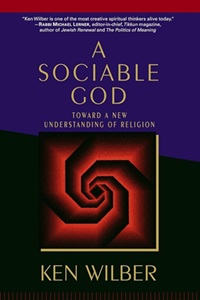
A critical review of A Sociable God has to situate it carefully within Ken Wilber's early “spectrum of consciousness” phase. It is a short, ambitious, and in many ways revealing book: less polished than his later works, but already containing the structural assumptions—and liabilities—that would define his entire project. A Programmatic Sociology Built on PsychologyWilber's stated aim is strikingly bold: to provide a “transpersonal sociology” that can adjudicate between authentic and inauthentic religion. He does this by importing his developmental psychology into the social domain. Human consciousness unfolds through hierarchical stages—archaic, magical, mythic, rational, and transpersonal—and cultures, religions, and movements are expressions of these stages. This move is conceptually elegant but methodologically problematic. It assumes that interior psychological structures can be cleanly mapped onto collective phenomena. In effect, sociology becomes derivative of psychology, and both become subordinated to a metaphysical developmental ladder. The result is less a sociological theory than a speculative grand narrative imposed on social reality. The Central Claim: A Hierarchy of ReligionsThe core of the book is Wilber's attempt to distinguish between “legitimate” religion (which stabilizes a given level of development) and “authentic” religion (which promotes transformation to higher levels). This framework allows him to do something few sociologists would dare: rank religions. Mystical traditions are placed at the top, mythic traditions in the middle, and magical or regressive movements at the bottom. The intention is partly pragmatic—Wilber was reacting to phenomena like Jonestown and wanted criteria to distinguish healthy spirituality from pathological cults. But the price of this ambition is steep. The hierarchy rests on two highly contestable assumptions: First, that developmental stages are universal, discrete, and vertically ordered. Second, that mystical experience provides epistemic access to “higher” realities rather than simply different subjective states. Without these assumptions, the entire evaluative structure collapses. Teleology Disguised as DevelopmentOne of the most persistent criticisms—already visible in early reception—is Wilber's implicit teleology. His model treats evolution (psychological and cultural) as directional, moving from “lower” to “higher” forms in a quasi-inevitable ascent. Critics have pointed out that this misappropriates evolutionary language. Biological and cultural evolution are not goal-directed processes; they do not aim at “higher consciousness.” Yet Wilber's framework repeatedly suggests precisely that, turning development into a ladder culminating in nondual realization. This is not a minor issue. It transforms what should be a descriptive model into a normative metaphysics—one that smuggles spiritual ideals into the structure of reality itself. Selective Use of EvidenceWilber's interdisciplinary reach is impressive—he draws on developmental psychology, anthropology, religious studies—but the integration is uneven. Sources are often recruited to support a pre-existing framework rather than critically evaluated within their own disciplinary contexts. As critics have noted, this can amount to cherry-picking or relying on outdated models when they fit the theory. The book's confidence in constructing a “science of spirituality” is therefore not matched by methodological rigor. The sociological dimension, in particular, remains thin. Concrete social processes—institutions, power dynamics, historical contingencies—are largely bypassed in favor of abstract typologies. The Problem of Mystical PrivilegePerhaps the deepest issue lies in Wilber's treatment of mysticism. Figures like Meister Eckhart or al-Hallaj are treated as empirical data points for higher stages of consciousness, effectively forming the evidential basis for his hierarchy. This move is philosophically loaded. It assumes that: Mystical experiences are reliable indicators of ontological truths These truths are cross-culturally consistent They represent a higher form of knowing None of these claims are argued in detail; they are largely presupposed. As a result, the entire edifice risks circularity: mystical states are real because they represent higher stages, and we know they are higher because they disclose deeper reality. An Early Blueprint—Both Insightful and FlawedTo its credit, A Sociable God contains genuinely stimulating ideas. The distinction between different functions of religion (stabilizing vs. transformative) is analytically useful. The attempt to integrate psychology and sociology is ambitious. And Wilber's insistence that religion cannot be reduced to pathology or illusion remains a legitimate corrective to reductive secular theories. However, the book is better read as a blueprint than a finished theory. Even sympathetic readers note that it lacks the structural sophistication of Wilber's later AQAL framework and feels conceptually underdeveloped. More importantly, its foundational assumptions—developmental hierarchy, teleological evolution, and the epistemic privilege of mysticism—are precisely the elements that have drawn sustained criticism across Wilber's entire corpus. ConclusionA Sociable God is a revealing early statement of Wilber's intellectual project: a sweeping attempt to unify psychology, sociology, and spirituality into a single developmental framework. Its strength lies in its ambition and integrative vision. Its weakness lies in the speculative metaphysics that underwrite that vision. What presents itself as a “science of religion” ultimately functions more as a philosophical theology in disguise—one that ranks worldviews according to a preordained ladder of consciousness. Whether one finds this illuminating or deeply problematic will depend largely on whether one accepts that ladder in the first place. If not, the whole structure looks less like a sociological breakthrough and more like an elegantly constructed metaphysical belief system. Widget is loading comments...
|