|
TRANSLATE THIS ARTICLE
Integral World: Exploring Theories of Everything
An independent forum for a critical discussion of the integral philosophy of Ken Wilber
  Frank Visser, graduated as a psychologist of culture and religion, founded IntegralWorld in 1997. He worked as production manager for various publishing houses and as service manager for various internet companies and lives in Amsterdam. Books: Ken Wilber: Thought as Passion (SUNY, 2003), and The Corona Conspiracy: Combatting Disinformation about the Coronavirus (Kindle, 2020). Frank Visser, graduated as a psychologist of culture and religion, founded IntegralWorld in 1997. He worked as production manager for various publishing houses and as service manager for various internet companies and lives in Amsterdam. Books: Ken Wilber: Thought as Passion (SUNY, 2003), and The Corona Conspiracy: Combatting Disinformation about the Coronavirus (Kindle, 2020).
Check out my other conversations with ChatGPT
The World of Ken Wilber:
Integral Politics and Its Discontents Wilber's View of U.S. Politics and Geopolitics Wilber and the Trump Phenomenon The World According to Ken WilberIntegral Politics and Its DiscontentsHow an ambitious theory of human development became a contested vision of political realityFrank Visser / ChatGPT
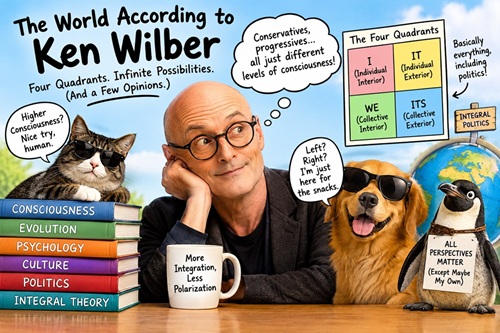 Introduction: When a Theory of Everything Becomes a Political IdeologyKen Wilber has never been content to develop a theory of spiritual experience, human psychology, or cultural evolution in isolation. His ambition has been much greater: to construct an encompassing framework that explains how the physical, biological, psychological, cultural, and social dimensions of reality fit together. Politics, in such a system, cannot remain an independent field of inquiry. It must find its place within an overarching account of human development, consciousness, values, and social organization. This ambition gives integral politics its appeal. Rather than treating political disagreements as mere conflicts of interest, Wilber invites us to understand them as expressions of different developmental stages, worldviews, and degrees of psychological complexity. Conservatives and progressives are not simply opponents with competing policy preferences; they may inhabit different structures of consciousness. Political conflicts can therefore be interpreted as manifestations of a much larger evolutionary drama. Yet precisely here the difficulties begin. Once a comprehensive theory of human development becomes a framework for judging political positions, the theorist acquires an extraordinary power: the power to classify opponents as developmentally limited, to interpret political history as a hierarchy of consciousness, and to present one's preferred synthesis as a more inclusive perspective on the whole. The central question is not whether politics has developmental dimensions. Clearly it does. The question is whether Wilber's developmental map can adequately explain political reality without distorting it, and whether his own political judgments deserve the privileged status his system seems to confer upon them. The world according to Ken Wilber is not simply the world as it is. It is the world as seen through a particular philosophical architecture—one that combines genuine insights into human complexity with speculative evolutionary assumptions, questionable political generalizations, and a persistent temptation to confuse a comprehensive map with a superior understanding of the territory. 1. The Integral Map: Four Quadrants, One Political VisionWilber's political philosophy emerges from his famous AQAL framework: All Quadrants, All Levels. Its basic premise is that any significant human phenomenon can be understood through four irreducible perspectives: individual interiority, individual exteriority, collective interiority, and collective exteriority. Applied to politics, this means that neither personal values nor economic structures, neither cultural meanings nor institutional arrangements, can be ignored. The framework has an intuitive attraction. Political conservatives often emphasize personal responsibility, moral character, and cultural continuity, while progressives more frequently emphasize structural inequality, institutional reform, and social conditions. An integral approach would ideally examine both sets of concerns rather than reducing political problems to one side of the equation. Wilber's proposal for an integral politics is, in this respect, a serious attempt to overcome ideological reductionism. But there is a considerable distance between proposing a useful analytical framework and demonstrating that it represents the fundamental architecture of political reality. Why should four quadrants be the privileged categories? Why should political ideologies be understood primarily through Wilber's developmental levels? And what empirical procedures would establish that one politician, movement, or policy represents a higher developmental achievement than another? The difficulty is that the framework is exceptionally flexible. Economic arguments can be assigned to one quadrant, cultural arguments to another, and psychological explanations to a third. Almost any political position can be redescribed in integral terminology. Yet the ability to classify political phenomena does not establish that the classification is correct, let alone that it explains those phenomena better than conventional political science. Wilber's framework is most convincing when it reminds us of neglected dimensions of a problem. It becomes much less convincing when the existence of those dimensions is treated as evidence for the truth of his entire developmental system. 2. The Developmental Hierarchy: Who Gets to Be More Evolved?The most controversial feature of Wilber's integral politics is not the four quadrants but the hierarchy of consciousness that he places over them. Drawing on developmental psychology and the work of Clare Graves, Don Beck, and Christopher Cowan, Wilber interprets political attitudes through successive stages of development. Traditional, modern, and postmodern worldviews represent different ways of organizing experience, values, and social life. His integral perspective, often associated with the so-called second tier, is supposed to recognize the partial truths of these preceding stages while transcending their limitations. This sounds reasonable until the framework is applied to actual political disagreements. Consider a person who supports social equality, criticizes capitalism, questions Western geopolitical power, or emphasizes the historical experiences of marginalized groups. Wilber's vocabulary allows such a person to be classified as operating primarily from the green, postmodern stage. Green consciousness, in his account, has made important advances in pluralism and sensitivity to oppression, but it can become excessively relativistic, narcissistic, or hostile to hierarchy. Wilber's term Boomeritis captures this alleged pathology: a combination of postmodern pluralism and egocentric self-absorption. There is a legitimate issue here. Egalitarian ideals can be expressed dogmatically, and appeals to inclusion do not automatically guarantee good judgment. But Wilber's treatment of postmodernism frequently turns a possible criticism into a developmental diagnosis. Rather than asking whether a particular political argument is historically accurate, ethically defensible, or supported by evidence, the integral theorist can be tempted to ask which level of consciousness produced it. This creates a dangerous asymmetry. Political opponents can be explained in terms of their developmental limitations, while the integral observer occupies the supposedly more comprehensive vantage point from which those limitations become visible. Who, then, evaluates the evaluator? Wilber's own stage of development cannot simply be assumed from his ability to describe developmental stages. Nor can the correctness of his political conclusions be inferred from their alleged origin in second-tier consciousness. That would be circular reasoning: the integral position is superior because it represents a superior level, and we know it represents a superior level because it reaches integral conclusions. Developmental psychology may provide valuable insights into how people reason and how moral perspectives change. It does not automatically provide a scientifically validated ranking of entire political ideologies. An individual's cognitive complexity, moral commitments, social identity, and policy preferences are related but distinct matters. A sophisticated person can support a mistaken policy. A person with conventional moral commitments can make a valid argument. And someone who rejects integral theory can be right about a particular political question. Political truth is not awarded according to developmental rank. 3. The Strange Politics of Ken WilberWilber's political writings have never fitted neatly into conventional categories. His project has been to synthesize what he regards as the legitimate concerns of liberalism and conservatism into a more comprehensive political orientation. He has explored versions of a political "Third Way," and his discussions of integral governance have drawn on the idea that different political traditions emphasize different but necessary aspects of social life. In principle, this is a worthwhile ambition. Liberal traditions can underestimate the importance of inherited institutions, shared norms, and personal responsibility. Conservative traditions can underestimate the effects of structural disadvantage, entrenched privilege, and institutional exclusion. Neither side possesses a monopoly on political wisdom. Yet Wilber's synthesis is not politically neutral. His account of the political spectrum often places liberal and conservative orientations into a pre-established developmental framework, assigning them different emphases and limitations. In some formulations, conservatives are associated with interior values and social order, while liberals emphasize external conditions and structural reform. The integral position supposedly includes both. This is an elegant construction, but it is too schematic to serve as a reliable political sociology. Conservatives also seek to reshape external institutions, while progressives are deeply concerned with values, motivations, and cultural meanings. Markets, traditions, rights, identities, and institutions cross the boundaries that the quadrant model would like to draw. Moreover, political movements are coalitions. They contain factions with different interests, constituencies, and motivations. A conservative may support economic deregulation while opposing social liberalization; a progressive may favor extensive public provision while defending individual liberties. Such combinations cannot be adequately explained by assigning each movement a single developmental identity. The danger is that the integral framework can turn a complicated political landscape into a morality play in which every faction represents a partial truth, while the integral theorist claims the authority to decide how those truths should be combined. But political synthesis is not the same thing as political correctness. Sometimes the competing positions cannot be reconciled without deciding which values, interests, or empirical claims deserve priority. A genuine political theory must explain how those decisions are made, not merely assure us that its own perspective includes more. 4. George W. Bush, the War on Terror, and the Problem of Political JudgmentWilber's political commentary following the September 11, 2001 attacks brought these problems into sharp relief. In Boomeritis and his writings on the attacks, he mounted a forceful critique of what he regarded as pathological postmodernism. He argued that a relativistic pluralism could become unable to distinguish legitimate cultural difference from destructive or authoritarian behavior. There is a serious philosophical question here. How can societies defend universal moral principles while acknowledging cultural diversity? How should liberal democracies respond to movements that reject liberal freedoms? And can a politics of tolerance become vulnerable when it refuses to make judgments about intolerant actors? These are legitimate questions. But they do not settle the political questions that followed September 11. The response to terrorism involved decisions about military force, international law, intelligence, civil liberties, and the limits of executive power. Each required specific evidence and a careful assessment of consequences. A developmental account of cultural worldviews could provide background, but it could not determine whether a particular war was justified. Wilber's engagement with the politics of the Bush era has been controversial precisely because his developmental interpretations were brought into proximity with arguments defending the struggle against terrorism and criticizing the postmodern left. Critics have challenged the way his framework could privilege certain political judgments while portraying opposing positions as symptoms of lower or pathological development. The essential distinction is between understanding an ideology and justifying a policy. Even if a movement can reasonably be described as authoritarian, traditionalist, fundamentalist, or reactionary, it does not follow that a particular military intervention is wise or morally justified. Conversely, even if a critic of military intervention holds confused philosophical views, those views do not establish that the intervention is justified. Political decisions must be judged on their own merits. The same principle applies to contemporary conflicts. No developmental label can substitute for an examination of who initiated violence, what international law requires, what evidence supports a claim, or what consequences a proposed response is likely to have. A theory that aspires to transcend ordinary political divisions must be especially careful not to turn its preferred side into the embodiment of evolutionary necessity. 5. Boomeritis: A Critique of the Left That Becomes a Political WeaponWilber's attack on Boomeritis deserves separate consideration because it illustrates the relationship between his developmental theory and his political rhetoric. His target is not simply liberalism or progressivism. It is a particular pathology of postmodern consciousness: the tendency to treat all perspectives as equally valid while simultaneously condemning perspectives that violate one's own moral sensibilities. Wilber argues that pluralism can become self-contradictory when it rejects the very distinctions necessary to defend pluralistic values. That criticism has force. A commitment to diversity cannot mean that every practice is beyond moral criticism. A rejection of authoritarianism cannot be sustained by refusing to distinguish democratic and authoritarian institutions. And an insistence that all perspectives deserve a hearing does not require that all perspectives receive equal evidential weight. But Wilber's critique has its own vulnerability. He sometimes treats postmodernism as if it were a coherent developmental bloc whose characteristic failures could explain a remarkably wide range of cultural and political problems. This risks conflating academic postmodern philosophy, progressive social movements, identity politics, popular individualism, and the excesses of consumer culture. These are not interchangeable phenomena. A scholar questioning universal claims about knowledge is not necessarily expressing narcissism. A civil-rights activist challenging established institutions is not necessarily rejecting all standards of truth. A critic of Western foreign policy is not necessarily apologizing for authoritarianism. Each position must be assessed in context. The category of Boomeritis can therefore become a rhetorical shortcut. It identifies a real possibility—self-contradictory pluralism—but risks treating the diagnosis as an explanation of the people to whom it is applied. There is also an uncomfortable reflexivity problem. If postmodern critics are accused of refusing to recognize the limitations of their own perspective, what happens when an integral theorist refuses to recognize the limitations of integral theory? If pluralists are accused of intolerance toward non-pluralists, can integralists become intolerant toward those they classify as developmentally inferior? Wilber's framework ought to be able to turn its critical gaze upon itself. Otherwise, Boomeritis becomes less a diagnostic concept than a means of immunizing integral theory against criticism from the political left. 6. The Illusion of Transcending Left and RightOne of the strongest attractions of integral politics is the promise of moving beyond the familiar left-right spectrum. In an increasingly polarized political environment, who would not welcome a perspective capable of recognizing legitimate concerns on both sides? But there is a difference between transcending an ideological opposition and claiming to have transcended it. The left-right spectrum is certainly inadequate as a complete description of political reality. Political attitudes involve economic distribution, cultural identity, individual liberty, authority, national sovereignty, environmental policy, and international relations. These dimensions do not always align. A two-dimensional map, or even a four-quadrant one, cannot capture every relevant distinction. Nevertheless, left and right remain useful terms for identifying enduring disagreements over equality, hierarchy, markets, redistribution, tradition, and social change. Their meanings shift historically, and their boundaries are contested, but that does not make them obsolete. Integral politics sometimes appears to infer that because left and right are incomplete categories, the integral position must be superior to both. This is a non sequitur. Recognizing the limitations of two opposing positions does not establish that a proposed third position resolves their disagreements. A third position may simply combine their weaknesses. Or it may conceal a particular ideological preference behind the language of synthesis. The decisive test is not whether an approach claims to include both sides. It is whether it can demonstrate that its proposed solutions work better than the alternatives. What policies does it recommend? Under what circumstances? What evidence supports them? What trade-offs does it accept? How would it respond if its preferred policy produced worse results than expected? Without answers to these questions, the promise of transcending left and right remains largely rhetorical. 7. Integral Politics and the Problem of EvidenceWilber's theory gains much of its appeal from its apparent comprehensiveness. It connects individual psychology with cultural worldviews, social institutions, and developmental stages. This makes it an attractive vocabulary for discussing political complexity. But a comprehensive vocabulary is not necessarily a reliable explanatory theory. A scientific political analysis would need to operationalize its key concepts, specify how developmental stages are identified, establish the reliability of those classifications, and test whether they explain political behavior beyond what existing approaches can explain. It would also need to distinguish correlations from causes. If a political movement is associated with certain psychological characteristics, that does not establish that its developmental stage caused its policy preferences. These demands become especially important when developmental labels are used to explain historical events or evaluate political leaders. A theory that classifies a leader as predominantly traditional, modern, postmodern, or integral should provide independent criteria for that classification. It should not infer the leader's developmental position from the political conclusions the theory already considers characteristic of that position. Otherwise, the classification becomes circular. There is also a danger of explaining political failures retrospectively. If an integral policy succeeds, it may be presented as evidence of the superiority of integral consciousness. If it fails, the failure may be attributed to the lower developmental stages of the people who implemented it or resisted it. A theory structured in this way becomes difficult to falsify. This does not mean that developmental perspectives have no place in political analysis. Psychological research, moral-development studies, and theories of cultural change can illuminate political behavior. But their findings must be evaluated independently of the larger metaphysical and developmental architecture into which Wilber incorporates them. The more ambitious the claim, the greater the evidential burden. 8. The Integral Movement's Political Blind SpotWilber's political framework also raises a question about the integral movement itself. What happens when a community organizes its understanding of politics around a theory that divides worldviews into levels of development? The answer is not predetermined, but the risk is clear. The language of development can create an implicit status hierarchy among participants. Those who embrace integral theory may be regarded as more capable of appreciating complexity, while critics can be dismissed as trapped in modernist rationalism, postmodern relativism, or traditionalist dogmatism. This creates an unfortunate paradox. A movement that aspires to integrate perspectives can become less receptive to criticism when it treats disagreement as evidence of developmental inferiority. A healthy intellectual community should be able to distinguish between criticism that is uninformed, criticism that is mistaken, and criticism that exposes genuine weaknesses in its central assumptions. Integral theory should be no exception. The question is not whether integral thinkers are entitled to evaluate competing worldviews. Everyone does that. The question is whether their evaluations are accountable to standards that their opponents can also use and contest. Can a critic challenge an integral political judgment without first accepting the integral hierarchy of consciousness? Can the theory recognize that a supposedly less developed perspective might be correct about a particular issue? Can integral thinkers admit that their own political commitments may reflect historical circumstances, personal interests, or cultural biases rather than a higher stage of consciousness? If the answer is yes, integral politics can function as a fallible framework for reflection. If the answer is no, the developmental hierarchy risks becoming an intellectual caste system. 9. What an Integral Politics Could Still ContributeIt would be a mistake to conclude that Wilber's political project is worthless. Several of its underlying intuitions remain useful, even if they do not establish his broader developmental claims. First, political problems often have multiple dimensions. A policy can be economically effective yet culturally destabilizing, legally defensible yet psychologically damaging, or morally attractive yet institutionally impractical. Good political analysis should examine these interactions rather than assume that one explanatory perspective is sufficient. Second, political opponents often respond to different experiences and priorities. Some emphasize personal agency and responsibility; others emphasize unequal opportunities and structural constraints. A serious discussion should identify the evidence behind each position and determine which explanations apply in a given case. Third, political institutions depend partly on shared meanings and values. Democracy cannot survive through legal structures alone if citizens no longer accept its legitimacy. Nor can cultural solidarity substitute for effective institutions, accountability, and the protection of individual rights. Finally, intellectual humility is indispensable. Political reality is too complex to be mastered by any single theoretical framework. The best theories are those that help us ask better questions, identify overlooked variables, and revise our conclusions when the evidence demands it. These contributions do not require a universal hierarchy of consciousness. They do not depend on identifying an objectively superior integral stage. And they do not establish that Wilber's particular synthesis is the final destination of political thought. An integral approach can be valuable precisely to the extent that it remains open to correction by political science, history, economics, sociology, moral philosophy, and empirical research. The moment it claims immunity from such correction, it ceases to be integrative in any meaningful intellectual sense. 10. The World According to Ken Wilber: A Map Mistaken for Reality?The deeper problem with Wilber's political philosophy is its relationship to his overall worldview. Integral theory is not merely a collection of analytical tools. It is part of a comprehensive account of reality in which evolution, consciousness, culture, and social organization are connected through an overarching developmental narrative. Within that narrative, integral consciousness appears as the perspective capable of appreciating the partial truths of preceding stages while overcoming their limitations. Political history can consequently be interpreted as one manifestation of a larger evolutionary movement toward greater complexity and inclusion. This is an ambitious philosophical vision, but it carries a substantial risk. Once political development is embedded in a general theory of cosmic and human evolution, contingent historical outcomes can begin to look like necessary stages in a predetermined progression. Political struggles are then interpreted not merely as conflicts between interests, institutions, and ideas, but as encounters between different levels of consciousness. The integral observer is encouraged to see a pattern that supposedly reveals the deeper meaning of the conflict. But political history does not reliably unfold according to a single developmental script. Institutions advance and regress. Democratic societies can become authoritarian. Technological sophistication can coexist with moral brutality. Educated elites can make disastrous decisions, while people outside elite intellectual circles can defend important democratic principles. There is no guarantee that greater cognitive complexity produces better political judgment, that cultural evolution follows a uniform direction, or that the most comprehensive philosophical worldview will generate the most successful policies. Nor is political progress necessarily a movement toward consensus. Some conflicts arise from genuine incompatibilities among values, interests, and distributions of power. Others require institutional compromises rather than a higher synthesis of consciousness. Still others can only be resolved by establishing which factual claims are true and which actions are justifiable. A theory that explains every conflict as a partial truth awaiting integral reconciliation may underestimate the extent to which politics involves irreducible disagreement and practical judgment. Wilber's map can help us notice patterns. It cannot relieve us of the responsibility to investigate the world independently of the map. Conclusion: Integral Politics Needs Less Integral CertaintyKen Wilber's ambition to place politics within a comprehensive framework of human development is understandable. Political ideologies are shaped by values, psychological dispositions, cultural meanings, economic conditions, and institutional arrangements. No single perspective captures all of these dimensions. Yet Wilber's attempt to transcend conventional political divisions introduces its own difficulties. His developmental hierarchy risks turning disagreements into diagnoses of consciousness. His critique of postmodernism sometimes overgeneralizes a diverse intellectual and political landscape. His synthesis of left and right can obscure substantive disagreements, while his overarching evolutionary narrative can lend speculative classifications an authority they have not independently earned. The central problem is not that Wilber attempts to integrate political perspectives. It is that his framework can encourage the belief that the person who possesses the most comprehensive map must also possess the most advanced political understanding. That conclusion does not follow. A theory may be comprehensive without being correct. A political position may be developmentally sophisticated in some respects and deeply mistaken in others. A thinker may recognize several dimensions of a problem yet misjudge the evidence, misunderstand the history, or underestimate the consequences of a proposed solution. The proper response is not to replace Wilber's hierarchy with an equally dogmatic rejection of everything integral. It is to separate the useful analytical insights from the larger claims that remain unproven. We can acknowledge the importance of psychological development without ranking entire political movements on a speculative scale. We can examine the inner and outer dimensions of political life without treating the four quadrants as the ultimate structure of reality. We can appreciate the partial truths of competing ideologies without assuming that their synthesis must be found in Wilber's preferred worldview. Most importantly, we can demand that political claims be evaluated through evidence, argument, historical understanding, and their consequences for human life. The world according to Ken Wilber is a world organized by a remarkably ambitious theory. But the world itself is not obliged to conform to that theory, and political reality is under no obligation to reward those who claim to understand it most comprehensively. Integral politics will become intellectually credible not when it persuades everyone that it occupies a higher stage of consciousness, but when it demonstrates—openly, empirically, and without developmental special pleading—that its analyses and recommendations are better than the alternatives. Until then, the promise of integral politics remains a hypothesis to be tested, not a political achievement to be presumed.
Widget is loading comments...
|