|
TRANSLATE THIS ARTICLE
Integral World: Exploring Theories of Everything
An independent forum for a critical discussion of the integral philosophy of Ken Wilber
  Frank Visser, graduated as a psychologist of culture and religion, founded IntegralWorld in 1997. He worked as production manager for various publishing houses and as service manager for various internet companies and lives in Amsterdam. Books: Ken Wilber: Thought as Passion (SUNY, 2003), and The Corona Conspiracy: Combatting Disinformation about the Coronavirus (Kindle, 2020). Frank Visser, graduated as a psychologist of culture and religion, founded IntegralWorld in 1997. He worked as production manager for various publishing houses and as service manager for various internet companies and lives in Amsterdam. Books: Ken Wilber: Thought as Passion (SUNY, 2003), and The Corona Conspiracy: Combatting Disinformation about the Coronavirus (Kindle, 2020).
Check out my other conversations with ChatGPT Eros Rehabilitated by MetaphorJan Krikke, Jim Loving, and the Problem of Explaining EvolutionFrank Visser / ChatGPT
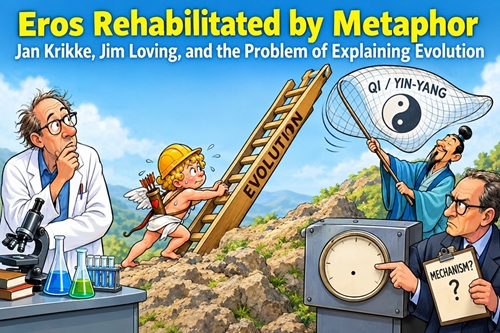 Introduction: When a Critique Becomes a ReconciliationJan Krikke's “The Ladder and the Field: Ken Wilber's Eros, Chinese Qi, and the Physics of Meaning” and Jim Loving's response, “The Ladder and the Field: Reconciling Eros, Qi, and the Polarity Architecture of Reality,” offer an instructive exchange within the integral community. Krikke questions Ken Wilber's attempt to present Eros as a cosmic drive toward greater complexity and consciousness, even comparing it to the fundamental forces of physics. Loving, responding with the assistance of AI, attempts to reconcile Wilber's evolutionary ladder with the field-like, relational worldview associated with Chinese qi and yin-yang cosmology. Both essays are thoughtful attempts to clarify an important philosophical issue: how should we understand the emergence of life, mind, and culture from a universe whose basic physical processes do not appear to pursue any conscious goal? Yet both also illustrate a persistent weakness of integral discourse. The discussion moves too readily from identifying patterns in the world to proposing metaphysical principles that supposedly explain them. Krikke exposes this problem but does not entirely escape the attraction of grand historical and cultural analogies. Loving, meanwhile, responds to the criticism by incorporating it into a more comprehensive metaphysical scheme, without adequately demonstrating that the additional principles are needed. The central question is not whether we should choose a ladder or a field, or whether both images can be reconciled. It is whether either image supplies an explanation of the evolutionary processes under discussion. My argument is that Krikke's critique is substantially stronger than Loving's reconciliation, but that the most productive conclusion goes beyond both: we should distinguish the demonstrable reality of evolutionary emergence from the speculative claim that a cosmic principle called Eros drives it. 1. Krikke's Strongest Point: Eros Is Not Another Physical ForceKrikke begins with a revealing statement from Wilber's Finding Radical Wholeness (2024). Wilber describes Eros, understood as the universe's drive toward greater complexity and consciousness, as “as real a force as gravity, electromagnetism, and the strong and weak nuclear forces.” This is a remarkably ambitious formulation. Gravity and electromagnetism are not merely names for familiar experiences. They belong to mathematical theories that specify how physical systems behave, permit quantitative predictions, and can be tested against observation. The strong and weak interactions likewise occupy defined places in contemporary physics. Their explanatory success does not rest on their being evocative descriptions of what nature seems to be doing. What, by contrast, does Eros contribute to our understanding of evolution? We already know that matter forms stars, that chemical systems can develop into self-replicating systems, that biological evolution produces adaptations, and that natural selection can generate increasingly elaborate forms of organization under particular conditions. These processes involve multiple mechanisms, including physical self-organization, chemical kinetics, heredity, variation, selection, and ecological interaction. None requires us to posit a further force that wants the universe to become more complex. Krikke is therefore right to demand clarification. If Eros is literally a physical force, what are its measurable effects? What mechanism does it operate through? What predictions follow from its existence that would not follow from established physical, chemical, and biological theories? Under what circumstances would we conclude that Eros was absent or that the theory was wrong? These are not hostile questions. They are the ordinary questions one asks of a proposed scientific explanation. Wilber could respond that he uses the word force in a broader philosophical sense. Perhaps Eros is not supposed to be a fifth fundamental interaction but a name for the universe's creative advance toward greater complexity, depth, and consciousness. That interpretation would avoid the most straightforward category mistake. But it would also surrender the rhetorical advantage of comparing Eros directly with the forces of physics. A metaphysical interpretation of evolution cannot acquire scientific credibility merely by borrowing scientific terminology. This is the essential dilemma: the more literally Eros is understood as a causal force, the greater its evidential burden; the more metaphorically it is understood, the less it explains beyond the patterns already described by evolutionary science. 2. The Difference Between Describing a Direction and Explaining ItKrikke's criticism becomes particularly important when we consider Wilber's developmental ladder. Atoms give rise to molecules, molecules participate in the emergence of life, living organisms develop nervous systems, and some organisms acquire the capacities associated with reflective consciousness and culture. In retrospect, this sequence can look like a climb toward greater complexity and interiority. But a sequence is not yet an explanation of its own direction. Suppose we observe that certain evolutionary processes produce new levels of organization. We can describe the resulting hierarchy, investigate the conditions under which transitions occur, and ask why some innovations persist while others disappear. We can also study the historical contingencies that made particular evolutionary pathways possible. None of these investigations establishes that the universe contains an intrinsic tendency toward higher levels. Indeed, evolution does not proceed along a single, universally ascending trajectory. Organisms can become simpler when their environments make simplification advantageous. Parasites lose structures that their hosts supply. Lineages go extinct. Ecosystems undergo collapse. Complex arrangements can be unstable, energetically expensive, or poorly adapted to changing circumstances. Greater complexity is not a universal measure of evolutionary success, and consciousness is not the evident destination of every evolutionary lineage. The emergence of human beings is a genuine historical fact. The proposition that the universe was somehow striving toward beings like us is an additional interpretation of that fact. Loving's response makes the distinction less clear. It argues that directionality is real because matter, life, mind, and culture exhibit an asymmetric sequence of dependencies. Culture requires minds, minds require organisms, and organisms require suitable physical and chemical conditions. But this establishes a dependency relation, not a cosmic drive. A house depends on materials and construction processes; that does not mean the materials were striving to become a house. The distinction matters because it separates an empirically investigable claim about how complex systems arise from a much stronger metaphysical claim about why the universe produces them. Emergence can be real without being the fulfillment of a universal purpose. 3. Does Chinese Qi Offer a Better Explanation?Krikke contrasts Wilber's ladder with the Chinese concept of qi, understood in relation to yin and yang. Where Eros is portrayed as directional and hierarchical, qi is presented as a pervasive, dynamic medium in which complementary tendencies interact. The resulting field metaphor emphasizes relationality, resonance, polarity, and transformation rather than an ascent toward a predetermined goal. This is a useful philosophical contrast. It reminds integral theorists that the world is not merely a succession of developmental stages. Every organism depends on an environment; every mind depends on a body and a social world; every cultural achievement emerges within networks of material and historical conditions. An exclusive emphasis on vertical development can obscure these relationships. Nevertheless, Krikke's comparison requires caution. Chinese qi is not a single, uniform concept shared identically across every Chinese philosophical and medical tradition. Nor is a traditional cosmology equivalent to a modern physical field theory. The fact that both use pervasive, relational concepts does not establish that they describe the same underlying reality. The analogy with electromagnetism is illuminating at a broad conceptual level, but it should not be mistaken for a scientific vindication of qi. Electromagnetic fields are specified mathematically and connected to experimentally established phenomena. Classical Chinese accounts of qi did not supply an equivalent quantitative theory of electromagnetic interactions. Historical similarities in imagery or explanatory ambition do not establish identity of mechanism. Krikke acknowledges this limitation, and rightly so. His argument is strongest when it shows that Wilber's Eros and the Chinese field metaphor embody different philosophical intuitions. It becomes less secure when the comparison risks suggesting that Chinese thought anticipated the conceptual structure of modern physics in a stronger sense than the evidence warrants. We should also resist the temptation to reverse the original hierarchy. If Western thought has sometimes privileged ascent, hierarchy, and transcendence, it does not follow that a field-based worldview is inherently more adequate. Relational explanations can be as vague as developmental ones, and the language of polarity can become just as metaphysically inflated as the language of Eros. The appropriate lesson is not that qi defeats Eros. It is that neither metaphor should be confused with an established causal explanation. 4. Loving's Reconciliation: A More Comprehensive Metaphysics, or an Escape Route?Loving's response proposes that the apparent conflict between Eros and qi can be dissolved by assigning them different explanatory roles. Eros describes vertical directionality across developmental levels, while qi and yin-yang describe the horizontal, relational structure within which development occurs. The ladder and the field, on this account, are complementary dimensions of a single reality. As a conceptual arrangement, this is attractive. Developmental differentiation and relational interdependence are not mutually exclusive. A biological organism develops through time while remaining dependent on exchanges with its environment. A culture can become more complex while remaining structured by tensions between continuity and innovation, individual and collective interests, or stability and change. But the fact that two perspectives can be combined does not establish that their underlying metaphysical claims are true. Loving moves too quickly from a useful distinction between developmental sequence and relational organization to the assertion that both Eros and a universal polarity architecture are real features of the cosmos. Consider the argument that Eros is needed because the sequence from matter to life to mind to culture is not reversible. This is true in the relevant sense: a functioning culture depends on minds, and human minds depend on living organisms. But the asymmetry of dependence does not establish an orienting force. It tells us what conditions are necessary for particular forms of organization, not that the universe is drawn toward those forms. Similarly, the fact that biological, psychological, and cultural systems exhibit opposing or complementary tendencies does not establish that yin-yang represents a universal ontological structure. We can investigate competition and cooperation, excitation and inhibition, stability and change, and organism-environment interactions without assuming that all such relationships instantiate one fundamental polarity principle. Loving's reconciliation thus risks becoming a metaphysical accommodation strategy. Whenever Eros seems inadequate, the field supplies the missing relational dimension. Whenever the field seems unable to explain developmental asymmetry, Eros supplies the direction. The framework is designed to preserve both, but what independent evidence would show that this particular pair of principles is necessary? Without a clear answer, the reconciliation is more comprehensive in vocabulary than in explanation. 5. The Hidden Teleology of “Increasing Depth”One of the most consequential moves in Loving's essay is its claim that the sequence from matter to life to mind to culture involves increasing organizational depth and experiential richness. It argues that a framework that fails to acknowledge this directionality loses something real about the world. Here, a reasonable observation risks becoming a philosophical ranking system. It is hardly controversial that a human brain has capacities absent from a bacterium, or that human culture supports forms of cumulative learning unavailable to most other organisms. The difficulty begins when these differences are placed along a single scale that implicitly makes later forms more valuable, more profound, or closer to the universe's supposed purpose. Complexity, consciousness, organizational integration, adaptability, and moral value are distinct properties. They can be related, but they cannot simply be collapsed into a single developmental measure. An organism can be extraordinarily well adapted without possessing reflective consciousness. A complex society can be technologically advanced while exhibiting profound moral failures. A simpler biological system can persist successfully under conditions in which a more elaborate one cannot. Wilber's developmental scheme does not merely describe differences. It embeds them within a larger narrative of transcendence and inclusion, often interpreted as an unfolding of Spirit. Loving's account preserves this vertical structure while adding a horizontal dimension of polarity. The result may be more balanced than a purely ladder-based metaphysics, but it does not resolve the central question: why should organizational depth be interpreted as the manifestation of a cosmic tendency rather than as the contingent outcome of evolutionary processes? The notion of Eros can easily smuggle teleology into the description of emergence. Once consciousness appears, its existence is taken as evidence that the universe was moving toward consciousness all along. But the endpoint of a historical process does not, by itself, explain the process that produced it. A non-teleological account can fully recognize the extraordinary emergence of life and mind. It need not reduce consciousness to an illusion, deny qualitative differences between organisms, or pretend that all levels of organization are equivalent. It simply refuses to turn the existence of higher-order phenomena into evidence for a universal intention. 6. The Fundamental Problem: What Does Eros Explain?The deepest problem with Eros is not that it cannot be measured in the same way as gravity. Measurement is not the only criterion for meaningful philosophical concepts, and a metaphysical proposal need not automatically be rejected because it is not a physical variable. The more basic issue is explanatory: what does invoking Eros help us understand that we could not otherwise understand? If Eros means that the universe has produced increasingly complex forms in some domains, then it redescribes the pattern it is supposed to explain. If it means that this pattern has an underlying tendency toward greater complexity, then that tendency needs to be specified independently of the observed outcome. If it means that Spirit is somehow active within evolutionary processes, then we need an account of what Spirit contributes causally or conceptually. This is where the distinction between a description and an explanation becomes decisive. Calling the emergence of life an expression of Eros does not tell us how life emerged. Calling the development of consciousness Spirit-in-action does not identify the mechanisms by which nervous systems acquire increasingly sophisticated capacities. Calling novelty a manifestation of cosmic creativity does not explain why some innovations occur, why others fail, or why evolutionary history contains so much waste, extinction, suffering, and dead ends. An explanation should constrain our expectations. It should help us distinguish what would happen if the proposed principle were operative from what would happen if it were not. If Eros is compatible with every possible evolutionary outcome—progress, regression, stasis, extinction, complexity, and simplicity—then it has little discriminatory power. Loving's appeal to Whitehead's creative advance into novelty does not remove this difficulty. Whitehead offers a sophisticated metaphysical account of becoming, possibility, and experience. But philosophical sophistication is not equivalent to independent confirmation. Invoking Whitehead, Peirce, or Aurobindo can place Eros within an intellectual tradition; it cannot by itself demonstrate that Eros is an operative principle of nature. The relevant question is not whether a metaphysics can accommodate evolution. Many metaphysical systems can. It is whether adopting that metaphysics yields explanatory gains that justify its additional assumptions. 7. The Integral Reflex: Absorb the Criticism, Preserve the SystemKrikke and Loving together illustrate a familiar pattern in integral debates. A criticism identifies a genuine weakness in a central concept. Rather than abandoning or substantially revising the concept, the response places it within a larger framework that promises to preserve its insights while addressing the objection. This can be intellectually productive. Theories should be revised in light of criticism, and apparently conflicting perspectives sometimes do illuminate different aspects of a complex subject. The problem arises when reconciliation becomes an automatic response, irrespective of whether the resulting synthesis has earned its explanatory status. Loving does not simply reject Krikke's criticism. He grants the importance of relationality, accepts that Eros can become one-sided, and acknowledges the dangers of treating developmental ascent as the whole story. These are genuine concessions. Yet the central metaphysical commitment remains untouched: Eros continues to name a real directionality in the universe, and polarity continues to function as a fundamental architecture of reality. The result is a framework that becomes harder to challenge because every objection can be interpreted as an indication that another perspective must be added. If hierarchy is criticized, introduce polarity. If polarity appears insufficient, restore hierarchy. If the two conflict, describe the conflict itself as a higher-order polarity. But an integrative theory cannot establish its truth simply by finding a place for every criticism within its own vocabulary. A system that can absorb every objection without risking any central commitment may be conceptually flexible, yet evidentially insulated. A more rigorous response would ask which elements of Wilber's account should be retained, which should be revised, and which should be abandoned. It would distinguish the well-supported claim that evolution has produced new levels of organization from the less-supported claim that these developments express an intrinsic cosmic drive. It would also acknowledge that relationality and developmental sequence can be studied without elevating either into a universal metaphysical principle. Integration is not the art of making every idea fit. It is the discipline of determining which ideas deserve to survive. 8. A Better Alternative: Evolution Without Cosmic EncouragementWhat would a more defensible account look like? It would begin by separating three questions that integral theory tends to bundle together. The first is the scientific question: how do new forms of organization emerge? Here we investigate physical self-organization, chemical processes, biological evolution, natural selection, developmental constraints, and the conditions under which new capacities become possible. These explanations can be incomplete without requiring us to fill the gaps with a cosmic principle. The second is the philosophical question: how should we understand the relationship between different levels of organization? Emergence, dependence, reduction, and the autonomy of higher-level explanations are legitimate subjects of philosophical debate. We can recognize that consciousness depends on living brains without claiming that consciousness was the universe's ultimate objective. We can investigate cultural development without assuming that history is an ascent toward a predetermined spiritual destination. The third is the existential question: what meaning do human beings find in the emergence of life, consciousness, and culture? Here Eros may have a legitimate role as a metaphor for creativity, aspiration, love, or the human experience of participating in something larger than oneself. A person can experience evolution as awe-inspiring without concluding that the universe itself is animated by a longing for transcendence. Keeping these questions distinct does not impoverish our understanding of reality. It prevents answers belonging to one domain from being passed off as solutions to questions in another. Scientific accounts do not settle every existential question, and existential significance does not establish a cosmological mechanism. This approach also leaves ample room for relational thinking. Ecosystems, organisms, brains, and societies are interconnected systems whose properties depend on interactions among their components. We need not choose between a ladder and a field as competing cosmic blueprints. We can investigate hierarchical organization and relational dynamics where they are useful, without treating either metaphor as the final architecture of existence. 9. What Loving Gets Right—and What Remains UnprovenA fair criticism should acknowledge that Loving's response contains an important corrective to simplistic reductionism. Higher-level organization matters. Relational contexts matter. The emergence of consciousness presents genuine philosophical questions, and the history of science does not automatically settle every issue concerning experience, value, or meaning. Loving is also right that a purely horizontal description of relationships would be inadequate if it failed to account for differences in organizational complexity and dependency. There are genuine asymmetries between molecules and living cells, between cells and nervous systems, and between individual cognition and cumulative cultural learning. But none of these observations requires the conclusion that Eros and qi are complementary principles built into reality. The examples establish the importance of studying both organization and interaction; they do not establish a universal metaphysics of vertical and horizontal polarity. This distinction is especially important when Loving invokes the IKB's “Polarity Architecture” and its categories of harmonized and balkanized poles. Such terminology may provide a useful interpretive framework for diagnosing tensions within organizations, cultures, or psychological life. Yet the framework's usefulness in those contexts does not establish its status as a fundamental ontology of the universe. That would require additional arguments and evidence. Likewise, the claim that the field and the ladder “need each other” is stronger than the argument warrants. A developmental sequence can be studied without a universal polarity theory, just as relational dynamics can be investigated without Eros. The two perspectives may be compatible, but compatibility is not necessity. Loving's reconciliation therefore succeeds as an invitation to broaden our perspective, but not as a demonstration of the metaphysical reality of Eros. It turns a sharp criticism into a more accommodating synthesis while leaving the most important evidential question unanswered. Conclusion: The Universe Does Not Need to Want AnythingKrikke's essay is valuable because it challenges Wilber's tendency to place a spiritual interpretation of evolution alongside the forces of physics. His contrast between the ladder and the field draws attention to different ways of conceptualizing order, transformation, and interdependence. Loving's response usefully reminds us that development and relationality need not be mutually exclusive. Yet the reconciliation goes too far when it turns these complementary perspectives into universal principles of reality. The fact that evolutionary history exhibits emergent complexity does not demonstrate an intrinsic cosmic drive toward greater complexity. The fact that systems are relational does not establish a universal polarity architecture. And the fact that a metaphysical framework can accommodate these observations does not show that its additional assumptions are true. The most important distinction is between recognizing a pattern and explaining it. Evolution has produced extraordinary innovations, including life, nervous systems, consciousness, and culture. These developments deserve serious investigation, and their significance need not be diminished by rejecting cosmic purpose. The history of evolution can be remarkable without being directed toward us. If Wilber means Eros as a metaphor for the creative possibilities of existence, he should say so clearly and relinquish the suggestion that it is a force comparable to gravity or electromagnetism. If he means it as a real causal principle, he owes us an account of what it does, how it operates, and what evidence would distinguish its effects from those of established evolutionary processes. Loving cannot remove that obligation by assigning Eros a place in a larger synthesis. The same standard applies to qi. Its historical and philosophical significance deserves examination, but a field metaphor does not become physics through resemblance, and a cosmological tradition does not become an established account of nature through cultural depth. Ultimately, the universe does not need an invisible encouragement system to produce life, mind, or culture. It needs conditions under which such phenomena can emerge, persist, and change. We have made considerable progress in understanding some of those conditions, while many questions remain open. There is no shame in acknowledging those open questions. The mistake is to treat them as invitations to populate the unknown with whatever metaphysical principle our preferred worldview happens to require. Eros may express our wonder at evolution. It may even serve as a symbol of our aspirations. But wonder is not a mechanism, aspiration is not a cosmic law, and a compelling synthesis is not a substitute for an explanation. That is where a critical integral philosophy should draw the line.
Widget is loading comments...
|