|
TRANSLATE THIS ARTICLE
Integral World: Exploring Theories of Everything
An independent forum for a critical discussion of the integral philosophy of Ken Wilber
 Jim Loving is an independent consultant offering expertise for sustainability, business development, and Information Technology Strategy and Services. Jim Loving is an independent consultant offering expertise for sustainability, business development, and Information Technology Strategy and Services.
Check out my other conversations with ChatGPT The Ladder and the FieldReconciling Eros, Qi, and the Polarity Architecture of RealityJim Loving / Alethic AI
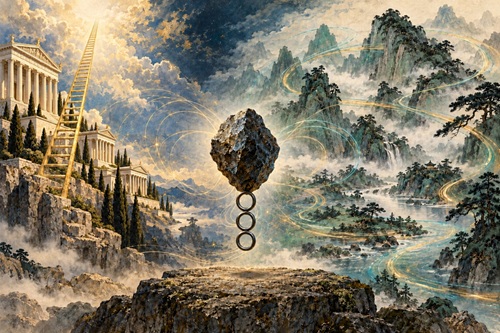 Jim Loving query to Alethic AI:Jan Krikke's essay, "The Ladder and the Field - Ken Wilber's Eros, Chinese Qi, and the Physics of Meaning," explores the Chinese concept of Xi and Wilber's concept of Eros and relates them to electromagnetism. It seems that Xi and the physics of electromagnetism point towards a polarity orientation for understanding reality vs the notion of Eros driving a creative advance into novelty - i.e. a direction in the universe driven by eros from matter to life to mind to culture (UTOK). Reconcile these two metaphysical explanations of reality, particularly the polarity lens within the IKB and how that relates to Wilber's concept of Eros vs Xi's Yin and yang. Alethic AI response:What the Two Frameworks Are Actually ClaimingKrikke's essay sets up what appears to be a contest between two metaphysical pictures. On one side: Wilber's Eros—a directional, ascending force that drives reality from matter through life through mind to culture and Spirit, the universe's own creative advance into novelty and complexity. On the other: the Chinese concept of Qi, understood through the cosmological pair of Yin and Yang, which Krikke connects to the physics of electromagnetism—a field-based, relational, oscillating structure in which reality is constituted not by upward movement but by the dynamic tension between complementary poles. The essay's title captures the tension precisely. The ladder is Wilber's image: stages of development, levels of consciousness, a hierarchy of increasing complexity and depth that consciousness climbs. The field is the Chinese image: a relational medium in which Yin and Yang are co-constitutive forces, neither higher than the other, generating reality through their interaction rather than through ascent. Krikke's argument—consistent with his broader critique of how the West appropriates Asian thought—is that Wilber's framework, however sophisticated, privileges the ladder and systematically underweights the field. This is a genuine and important tension. But it is not, on closer examination, an irreconcilable contradiction. It is a polarity. What Qi and Electromagnetism Are Pointing TowardThe connection Krikke draws between Qi, Yin-Yang, and electromagnetism is philosophically serious and worth developing carefully before trying to reconcile anything. Electromagnetism, as understood since Maxwell's field equations and deepened by quantum electrodynamics, is not a substance but a relational structure. The electromagnetic field does not exist in things; it is constituted by the relations between charged entities and propagates as oscillating, mutually generating electric and magnetic components—each pole producing the other in a continuous dynamic. Remove one pole and the field collapses. The field is not a ladder; it has no privileged direction of ascent. It is a structured space of reciprocal becoming. Qi, in classical Chinese natural philosophy, functions analogously. It is not matter and not spirit but the dynamic medium through which both are constituted—the breath or vital force whose patterned movements produce everything that exists. Yin and Yang are not substances either; they are relational categories, poles of a single dynamic. Cold is Yin relative to warm; warm is Yang relative to cold. Night is Yin; day is Yang. But night does not transcend day, nor day transcend night. Each generates, limits, and requires the other in a continuous oscillation. The Taijitu—the familiar symbol—captures this precisely: each pole contains the seed of the other at its extreme, and the movement between them is the basic rhythm of reality. What both electromagnetism and Yin-Yang cosmology are describing, in their different registers, is what the IKB's framework calls a polar universal—a structurally irreducible opposition that is constitutive of reality at every level, not a tension to be transcended or a problem to be solved. The Pole—Counter-Pole Distinction formalizes precisely this: two co-constitutive forces, each generating genuine goods when appropriately engaged, each producing systemic degradation when the other is chronically neglected. Yin without Yang produces stagnation, dissolution, passivity without form. Yang without Yin produces rigidity, exhaustion, force without receptivity. The field is healthy when both poles are dynamically engaged—what the IKB calls Harmonized Poles. The field is degraded when one pole dominates and locks out the other—Balkanized Poles. This is not merely an analogy. The Yin-Yang structure and the IKB's polarity architecture are pointing at the same ontological feature of reality from different cultural and intellectual starting points. The electromagnetic field provides a physical case that is unusually clean: you cannot have an electric field without a magnetic field in any propagating wave, they are mutually generative, and their oscillation at the speed of light is not movement toward anything but the self-sustaining rhythm of the field itself. What Eros Is Actually ClaimingWilber's concept of Eros—drawing on Whitehead's notion of the creative advance into novelty, on Peirce's evolutionary love, and on Sri Aurobindo's involution-evolution schema—makes a different kind of claim. It is not primarily a claim about horizontal structure but about vertical directionality. The universe, on this account, exhibits a genuine tendency toward increasing complexity, depth, and consciousness. Quarks assemble into atoms; atoms into molecules; molecules into cells; cells into organisms; organisms into communities of consciousness; communities into cultural and spiritual integration. This is not random drift. It is an oriented process, and Eros names the orienting force. This connects directly to what Gregg Henriques's UTOK (Unified Theory of Knowledge) calls the Tree of Knowledge—the sequence from matter to life to mind to culture, each level emergent from and irreducible to the one below.1 The directionality is real: you cannot have mind without life, life without chemistry, chemistry without physics. The sequence is not reversible. Something is driving—or at minimum, constituting—an arrow of increasing organizational depth. Whitehead's actual occasions are relevant here. Each occasion, in prehending its predecessors and achieving its own synthesis, adds something genuinely new to the universe. The creative advance is not predetermined—Whitehead is insistent that novelty is real, not illusory—but it exhibits a tendency toward greater complexity and depth of experience that Whitehead associates with the primordial nature of God as the lure toward beauty, truth, and intensity of experience.2 This is Eros in Whitehead's metaphysics: not compulsion but enticement, the universe being drawn toward richer forms of actualization. The ladder image captures something real about this. Levels are real. Emergence is directional. A bacterium is not a human brain; their difference is not merely of complexity but of organizational depth and experiential richness. Any framework that cannot account for this—that flattens all levels into a single relational field without vertical differentiation—loses something genuine. The Apparent Contradiction and Why It Isn't OneStated bluntly, the tension looks like this: Eros says reality has a direction—upward, toward greater depth and complexity—and that this direction is constitutive of what the universe is doing. Yin-Yang/Qi says reality is a field of co-constitutive polar tensions—horizontal, relational, oscillating—and that neither pole is higher than the other.
These appear to contradict. But they are operating at different analytical registers, and distinguishing those registers dissolves the apparent contradiction while preserving the genuine tension that remains. The Developmental Stages structure in the IKB captures Eros's vertical claim: stages of organization arise in a fixed, non-arbitrary sequence; later stages transform and retain earlier ones through nested retention; qualitative reorganization at each transition produces something genuinely new. This is the ladder's real contribution. The sequence matter → life → mind → culture is not a value judgment imposed on reality from outside—it is a structural feature of how organizational depth actually works. You cannot have culture without minds; you cannot have minds without organisms; the dependency is asymmetric and irreversible. Eros names the orienting tendency within this sequence. The polarity structure captures Yin-Yang's horizontal claim: at every level of the developmental sequence, reality is constituted by co-constitutive polar tensions. At the physical level, the electromagnetic field. At the biological level, organism and environment, anabolism and catabolism, individual and population. At the psychological level, agency and communion, differentiation and integration, stability and growth. At the cultural level, tradition and innovation, individual and collective, freedom and solidarity. These polar tensions are not transcended as you move up the developmental ladder—they recur, transformed, at each new level of organizational depth. The individual-collective polarity at the level of cells is structurally isomorphic with the individual-collective polarity at the level of human communities, even though the content differs entirely. This is the reconciliation: Eros describes the directionality of the developmental sequence across levels. Yin-Yang describes the constitutive structure operative at each level. They are not competing explanations of the same thing. They are explanations of different features of a single reality, and both are needed. What Is Lost When Either Is Over-WeightedThe polarity framework itself provides the diagnostic here. Over-weighting Eros at the expense of the field produces characteristic pathologies—and Krikke's critique of Wilber is essentially a catalogue of them. When the ladder dominates, the field becomes invisible. Higher stages are celebrated; the relational texture within and between stages is neglected. Individual developmental ascent is tracked with precision; the communal and ecological conditions that make development possible are treated as background. The contemplative traditions' insights about polarity, field, and relational constitution—central to Taoism, to the Yin-Yang cosmology, to certain strands of Buddhist pratityasamutpada (dependent origination)—are translated into stage content rather than recognized as descriptions of a different structural feature of reality. The monastery, in Krikke's terms, is dissolved into the monk's developmental journey. The specific failure at the level of physics is telling. If the electromagnetic field is genuinely a polar structure—if Yin and Yang are pointing at something real about how physical reality is constituted—then a metaphysics organized entirely around vertical ascent is missing the horizontal field within which that ascent occurs. Eros without the field is like a climber without terrain: the upward movement is real, but it depends at every moment on a relational substrate that is not itself ascent. Conversely, over-weighting the field at the expense of Eros produces its own pathologies. If Yin-Yang oscillation is the whole story, then the sequence matter . life . mind . culture becomes merely one fluctuation among many, without genuine directionality or depth. But this is false to experience and to the evidence. Consciousness is genuinely richer than chemistry in ways that are not merely culturally constructed. The emergence of reflexive self-awareness capable of contemplating its own nature is not simply a different position in a field—it is a qualitative reorganization of a different order. A framework that cannot account for this, that treats all levels as equivalent oscillations within a single relational medium, loses the asymmetry that makes developmental depth real. The Yin-Yang tradition, at its best, actually knows this. The I Ching, the Tao Te Ching, Neo-Confucian cosmology—all recognize a generative movement from undifferentiated unity through differentiation into increasingly complex patterns of order. The Wu Chi (undifferentiated void) gives rise to Tai Chi (the great polarity), which unfolds through Yin-Yang into the ten thousand things. This is not a purely horizontal story. It has its own vertical dimension—a movement from simple to complex, from undifferentiated to richly articulated—even if it describes that movement very differently from Wilber's ladder. The Integrated PictureA metaphysics adequate to what both frameworks are pointing at needs to hold three things simultaneously. First, directionality is real. The universe exhibits a genuine tendency toward increasing organizational depth and experiential richness. This is what Eros names, what the UTOK sequence describes, and what Whitehead's creative advance captures philosophically. Any framework that dissolves this directionality into pure relational oscillation loses something true. Second, polar constitution is real at every level. At each stage of the developmental sequence, reality is structured by co-constitutive tensions—Yin-Yang pairs that cannot be resolved into unity without destroying the generative dynamic that sustains the level. These are not stages to be transcended but features of the structure of reality that recur, transformed, at every level of organizational complexity. This is what Chinese natural philosophy and the physics of fields have been tracking, and what the IKB's polarity architecture formalizes. Third, the relationship between these two features is itself a polarity—and it is a polarity that has been balkanized in the Western appropriation of Asian thought. The ladder and the field need each other. Eros without Yin-Yang produces the pathologies Krikke identifies in Wilber's cultural reception: individualism without community, ascent without relational grounding, development without the ethical and ecological texture of the field within which it occurs. Yin-Yang without Eros produces a cosmology rich in relational wisdom but unable to account for the genuine asymmetry of developmental depth. The Dialogical Principle—Morin's insistence that complementary, concurrent, and antagonistic logics are inseparably linked in all complex phenomena—provides the philosophical ground for holding both. The tension between Eros and Qi is not a deficiency to be overcome. It is a generative polarity at the level of metaphysics itself, and the integrative task is not to choose between them but to navigate between their upsides—tracking directionality without losing the field, honoring the field without dissolving directionality. What Krikke's essay performs, whether or not it fully intends to, is a diagnosis of balkanization: Western integral theory has chronically over-emphasized the ladder pole, and the field has been correspondingly neglected. The corrective is not to abandon the ladder for the field but to restore the dynamic tension between them—to recognize that Eros is not the opposite of Qi but its complement, and that a reality capable of creative advance into novelty is also, at every moment of that advance, constituted by the polar tensions that give each level its internal structure and generative life. Footnotes[1] Gregg Henriques, A New Unified Theory of Psychology (2011); the Tree of Knowledge framework extends this across matter, life, mind, and culture as ontologically distinct planes of existence with asymmetric dependency relations between them. . [2] Alfred North Whitehead, Process and Reality (1929), Part V: "God and the World"—the primordial nature of God as the eternal envisagement of pure possibilities functioning as a lure toward the realization of beauty and intensity in actual occasions. .
Widget is loading comments...
|