|
TRANSLATE THIS ARTICLE
Integral World: Exploring Theories of Everything
An independent forum for a critical discussion of the integral philosophy of Ken Wilber
  Frank Visser, graduated as a psychologist of culture and religion, founded IntegralWorld in 1997. He worked as production manager for various publishing houses and as service manager for various internet companies and lives in Amsterdam. Books: Ken Wilber: Thought as Passion (SUNY, 2003), and The Corona Conspiracy: Combatting Disinformation about the Coronavirus (Kindle, 2020). Frank Visser, graduated as a psychologist of culture and religion, founded IntegralWorld in 1997. He worked as production manager for various publishing houses and as service manager for various internet companies and lives in Amsterdam. Books: Ken Wilber: Thought as Passion (SUNY, 2003), and The Corona Conspiracy: Combatting Disinformation about the Coronavirus (Kindle, 2020).
Check out my other conversations with ChatGPT
The Lists of Ten:
The 10 Things Ken Wilber Got Wrong The 10 Things Ken Wilber Got Right The 10 Things Frank Visser Got Wrong The 10 Things Frank Visser Got Right The 10 Things Ken Wilber Clearly Got RightA Critical Appreciation of Ken WilberFrank Visser / ChatGPT
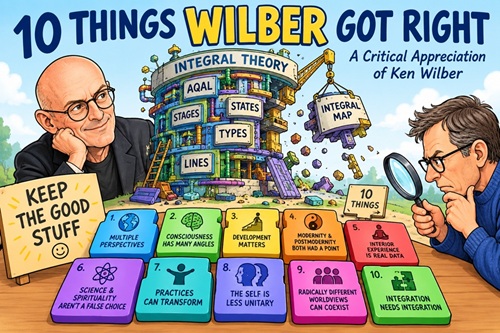 Ken Wilber is easy to criticize. After several decades of increasingly elaborate theorizing, there is no shortage of concepts to question, distinctions to sharpen, claims to reject, or metaphysical extrapolations to bring back down to earth. And I have done my share of that. But criticism becomes intellectually cheap if it turns into blanket dismissal. Wilber did not become influential merely because he was a gifted self-promoter, nor because thousands of readers somehow failed to notice the weaknesses in his system. He identified a number of genuine problems in contemporary thought, and some of his solutions—however debatable their ultimate formulation—were remarkably prescient. So, as a companion piece to my list of ten things Wilber clearly got wrong, here is the other side of the ledger. The point is not that Wilber was right about everything. Far from it. Nor does getting an important insight right automatically validate the larger Integral Theory architecture in which he placed it. Quite often Wilber's strongest insights survive better when separated from his metaphysics. Here are ten things I think he clearly got right. 1. Reality is not exhausted by a single perspectivePerhaps Wilber's most enduring contribution is his insistence that human beings routinely confuse a partial perspective with the whole of reality. The modern intellectual landscape is full of such reductions. The physical sciences can describe objective structures and processes with extraordinary precision, but they do not thereby give us a complete account of subjective experience. Psychology can investigate consciousness, but psychological descriptions do not replace biology. Sociology can explain social patterns, but society cannot simply be reduced to individual psychology. Phenomenology can describe lived experience, but it cannot substitute for neuroscience. Wilber's famous four-quadrant framework was an attempt to institutionalize this pluralism: interior and exterior, individual and collective. The framework itself has been criticized, and rightly so. The quadrants can become an overly neat grid imposed on a much messier reality. But the underlying warning remains sound. A human being is simultaneously a biological organism, a subjective experiencer, a social participant and a cultural being. Ignoring any one of these dimensions produces a distorted picture. That is a useful corrective to reductionism, even if we do not accept every detail of Integral Theory. 2. Consciousness deserves to be studied from more than one angleWilber was also right to challenge the assumption that consciousness can be adequately understood by looking only at third-person brain activity. This does not mean that consciousness is some mysterious substance floating outside the brain. Nor does it require a metaphysical "Spirit." It simply means that there is something scientifically and philosophically distinctive about first-person experience. If I study someone's brain scan, I learn something about their brain. If I study their reported experience, I learn something about what that experience is like. These are not necessarily competing descriptions. They are different kinds of information. Wilber's insistence that contemplative and phenomenological data should not automatically be dismissed was therefore valuable. His mistake, in my view, comes later, when legitimate first-person data are sometimes treated as if they automatically establish a particular metaphysical interpretation of those data. Meditation can reveal interesting features of consciousness. It does not by itself prove a cosmic Self. But the original challenge—to take subjective experience seriously—is entirely legitimate. 3. Development mattersWilber was right that human beings and cultures develop. This may sound obvious today, but it remains surprisingly controversial whenever developmental models threaten someone's preferred worldview. Children do not merely accumulate more information. Their cognitive and emotional capacities change. Their ability to take perspectives changes. Their moral reasoning changes. Their sense of self changes. And something similar can happen at the cultural level. Wilber understood that the difference between traditional, modern and postmodern worldviews cannot be explained simply by saying that one group possesses more facts than another. The groups can inhabit different interpretive structures. Whatever one thinks of Spiral Dynamics, Gebser, Loevinger, Cook-Greuter, Kegan or Wilber's own developmental formulations, the general insight is difficult to deny: human beings can change the structure through which they interpret reality. That is an important contribution. It also provides one of the strongest foundations for a genuinely post-integral theory—one that can retain developmental thinking without turning stages into a cosmic hierarchy. 4. Modernity and postmodernity each saw something the other missedWilber was particularly good at identifying the limitations of both modernism and postmodernism. Modernity gave us science, individual rights, democracy, technological progress and unprecedented material prosperity. But modernity could also become scientistic, reductionistic and insensitive to cultural difference. Postmodernism exposed the hidden assumptions behind claims to universal truth. It drew attention to language, culture, power and standpoint. But it could also slide into relativism, fragmentation and suspicion of reason itself. Wilber's "pre/trans" and "quadrant" analyses were partly attempts to navigate this collision. Again, the terminology can be cumbersome. But the basic diagnosis remains useful. We do not have to choose between Enlightenment reason and postmodern sensitivity to context. A mature worldview should be capable of incorporating what each discovered while resisting their characteristic excesses. That remains one of the central challenges of contemporary intellectual life. 5. Interior experience is real data—even when its interpretation is wrongThis distinction deserves emphasis because it separates one of Wilber's strongest insights from some of his weaker conclusions. People really do have profound mystical experiences. They experience unity, boundlessness, timelessness, ego dissolution, interconnectedness, luminosity and transcendence. These experiences occur across cultures and historical periods. Wilber was right not to dismiss such experiences as mere nonsense simply because they are difficult to fit into a materialist vocabulary. But the fact that an experience is genuine does not settle what caused it or what it means. A person may genuinely experience a sense of cosmic unity without thereby discovering that the universe literally consists of one metaphysical Self. Wilber occasionally moves too quickly from phenomenology to ontology. Yet his refusal to reduce all mystical experience to pathology or superstition was an important corrective. The experience deserves investigation even when the interpretation remains open. 6. We need more than either science or spiritualityWilber's lifelong argument against the false choice between science and spirituality was, at its best, exactly right. Science is extraordinarily good at investigating publicly observable structures and causal processes. But human beings also care about meaning, values, ethics, existential orientation and transformative practices. A civilization cannot live by physics alone. At the same time, spirituality cannot be granted exemption from critical inquiry simply because it deals with ultimate questions. The productive position is therefore neither "science explains everything" nor "science misses the really important stuff." It is to ask which questions different methods are equipped to answer. This is perhaps where Wilber's idea of an "integral methodological pluralism" remains most promising. Different kinds of questions may require different forms of disciplined inquiry. The challenge is to prevent methodological pluralism from becoming metaphysical pluralism by default. 7. Spiritual practices can have genuine transformative effectsWilber was also right to emphasize practice. One does not understand meditation merely by reading about meditation. One does not understand psychotherapy merely by reading theories of psychotherapy. And one does not understand contemplative traditions simply by comparing their doctrines. Practices change people. Meditation can affect attention and emotional regulation. Psychotherapy can alter patterns of thought and behavior. Exercise changes the body and often the mind. Ritual can restructure social relationships and personal identity. Wilber's emphasis on "practice" therefore represents one of the healthier elements of his project. The mistake would be to assume that because a practice works, the cosmology historically attached to that practice must also be true. Yoga does not prove Vedanta. Meditation does not prove Buddhism's metaphysics. A transformative experience does not automatically validate the explanatory system surrounding it. But the transformative potential itself is real and worth studying. 8. The self is less unitary than common sense suggestsWilber was right to destabilize the everyday notion of a single, homogeneous self. Modern psychology, neuroscience and cognitive science have independently developed increasingly sophisticated pictures of the mind as a collection of interacting processes rather than a little homunculus sitting somewhere inside the skull. Our thoughts, emotions, memories, impulses, identities and narratives do not always point in the same direction. We can observe ourselves thinking. We can change habits. We can experience conflicting motivations. We can temporarily lose our ordinary sense of self during meditation or under other circumstances. The contemplative traditions noticed some of this long before modern psychology did. Wilber's attempt to connect contemplative insights with developmental psychology was therefore intellectually fruitful, even where his synthesis became too ambitious. The self is not as simple as it feels. That insight is now part of mainstream psychological and cognitive discussion. 9. Different people can inhabit radically different worldviewsWilber's notion of "worldspace" can sometimes become unnecessarily technical, but it points toward an important fact: people do not merely disagree about conclusions. They can disagree about what counts as a plausible question, a legitimate explanation or even an obvious fact. A medieval Christian, a nineteenth-century materialist and a twenty-first-century postmodern academic do not simply possess different opinions. They operate within different conceptual environments. This helps explain why arguments so often fail to persuade. One person says, "Where is the evidence?" Another replies, "You cannot measure this kind of truth." The first thinks the second is evading the issue. The second thinks the first has adopted an impoverished epistemology. Wilber was right to notice that disagreements sometimes occur at the level of frameworks rather than propositions. But this insight should not become an escape hatch from criticism. Saying that someone inhabits a different worldspace does not make their claims immune to evidence. The existence of different perspectives makes dialogue more difficult—and more necessary. 10. We need an integration of knowledge, not merely more knowledgeFinally, Wilber was right about the problem that motivated his entire enterprise. Modern knowledge has become extraordinarily specialized. Physics, biology, neuroscience, psychology, sociology, economics, anthropology and the humanities have all developed their own methods, vocabularies and professional communities. This specialization has produced enormous intellectual gains, but it also creates fragmentation. We know more and more about increasingly narrow domains while struggling to see how the pieces fit together. Wilber's ambition to construct a larger map was therefore understandable—and, in a certain sense, admirable. The problem was never that he wanted too much integration. The problem was that he sometimes supplied the integration himself, converting a useful comparative framework into a comprehensive metaphysical system. That distinction matters. We need integration. But integration should not mean forcing everything into one theory. Sometimes the right answer is a genuine synthesis. Sometimes it is a carefully maintained plurality of perspectives. And sometimes the correct response is simply to admit that we do not yet know how the pieces fit together. An integral worldview should be capable of saying all three. The Wilber Worth KeepingAfter decades of reading, criticizing and arguing with Wilber, I have become increasingly convinced that the most interesting question is not whether Integral Theory is "true" or "false." It is: what survives when the metaphysical superstructure is removed? Quite a lot, as it turns out. The importance of multiple perspectives survives. The reality of development survives. The distinction between first-person and third-person knowledge survives. The value of contemplative practice survives. The insight that modernity and postmodernity each contain partial truths survives. The complexity of the self survives. The need for cross-disciplinary integration survives. Even the basic intuition behind an "integral" approach survives: reality is too complicated to be adequately described from one angle. This is why dismissing Wilber altogether would be a mistake. His great achievement was not discovering Spirit, Eros or a cosmic evolutionary ladder. Those claims remain much more controversial. His great achievement was recognizing that no single intellectual lens is sufficient for understanding human beings and their world. That insight has become so familiar that we can forget how ambitious it once was. And perhaps that is the best fate an intellectual contribution can have: its most useful ideas eventually become so obvious that people stop remembering who first insisted on them. Beyond WilberThere is an irony here. The best way to honor Wilber may ultimately be to move beyond Wilber. Integral Theory does not need to remain permanently attached to every proposition its founder made. A living intellectual tradition should be capable of distinguishing its durable insights from its historical baggage. We can retain developmental thinking without assuming a cosmic hierarchy. We can take mystical experience seriously without treating it as proof of metaphysical Spirit. We can practice methodological pluralism without declaring every perspective equally valid. We can integrate subjective and objective knowledge without inventing an ontological substance called consciousness. We can seek a larger picture without pretending that we have already found the final map. In other words, Wilber's most valuable legacy may not be Integral Theory as a finished system. It may be the impulse toward integration itself. That impulse is worth keeping. The rest should remain open to revision.
Widget is loading comments...
|