|
TRANSLATE THIS ARTICLE
Integral World: Exploring Theories of Everything
An independent forum for a critical discussion of the integral philosophy of Ken Wilber
  Frank Visser, graduated as a psychologist of culture and religion, founded IntegralWorld in 1997. He worked as production manager for various publishing houses and as service manager for various internet companies and lives in Amsterdam. Books: Ken Wilber: Thought as Passion (SUNY, 2003), and The Corona Conspiracy: Combatting Disinformation about the Coronavirus (Kindle, 2020). Frank Visser, graduated as a psychologist of culture and religion, founded IntegralWorld in 1997. He worked as production manager for various publishing houses and as service manager for various internet companies and lives in Amsterdam. Books: Ken Wilber: Thought as Passion (SUNY, 2003), and The Corona Conspiracy: Combatting Disinformation about the Coronavirus (Kindle, 2020).
Check out my other conversations with ChatGPT
The Lists of Ten:
The 10 Things Ken Wilber Got Wrong The 10 Things Ken Wilber Got Right The 10 Things Frank Visser Got Wrong The 10 Things Frank Visser Got Right Ten Things Ken Wilber Gets Clearly WrongA Critical Inventory of the Integral LegacyFrank Visser / ChatGPT
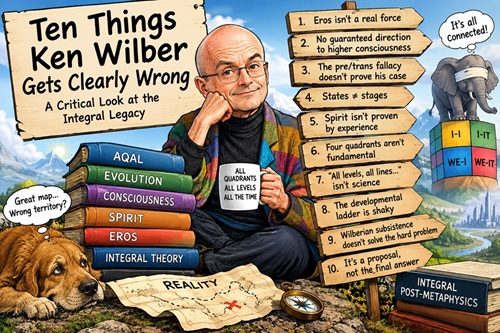 Ken Wilber has spent decades constructing one of the most ambitious philosophical systems of our time. He has tried to integrate developmental psychology, evolutionary theory, contemplative traditions, systems theory, neuroscience, cultural history, and a wide range of spiritual teachings into a single framework. The result is impressive in scope, often illuminating in its comparisons, and occasionally genuinely brilliant. But scope is not accuracy, and synthesis is not evidence. Wilber's system has accumulated so many conceptual layers that it can sometimes become difficult to distinguish what is empirically established, what is a reasonable philosophical interpretation, what comes from contemplative experience, and what is simply Wilber's own metaphysical speculation. Once these layers are disentangled, a number of claims that have acquired something like canonical status within the integral community turn out to be much less secure than they appear. The following are ten cases where Wilber is not merely offering a controversial interpretation. He is either demonstrably mistaken, conceptually confused, or making claims that go substantially beyond what the evidence warrants. This is not an argument that Wilber's entire project should be discarded. On the contrary: precisely because integral theory remains interesting, it is worth identifying where it needs correction. 1. Evolution Does Not Need ErosPerhaps the most conspicuous example is Wilber's concept of Eros. Wilber has repeatedly described evolution as driven by a principle of self-transcendence and self-organization. In Finding Radical Wholeness, he goes further and describes Eros as an "actual force," comparing its reality with gravity, electromagnetism, and the nuclear forces. This is an extraordinary claim. There is no independent scientific evidence for a cosmic force called Eros. Gravity has a mathematical description, makes quantitative predictions, has measurable effects, and fits into a remarkably successful physical theory. Electromagnetism has equations, experimental signatures, and technological applications. The nuclear forces likewise belong to well-established physical theories. What does Eros predict? Nothing that could not already be explained by evolutionary biology, developmental dynamics, self-organization, thermodynamics, chemistry, ecological interaction, or ordinary selection processes. This is the central problem. Calling evolution "Eros" does not explain evolution. It merely gives a metaphysical name to a pattern that has already been observed. Evolution produces increasing complexity in some lineages, but it also produces parasites, degenerations, extinctions, simplifications, evolutionary dead ends, and extraordinary amounts of waste. Natural selection has no intrinsic commitment to greater complexity, higher consciousness, or spiritual realization. Wilber is therefore on much firmer ground when he describes evolution as sometimes producing increasing complexity than when he turns that observation into a cosmic principle of Eros. The simplest explanation is also the least metaphysical one: evolutionary systems change because of variation, inheritance, selection, drift, developmental constraints, ecological interactions, and historical contingency. No cosmic Eros is required. 2. Evolution Has No Guaranteed Direction Toward Higher ConsciousnessWilber's developmental vision rests heavily on the idea that evolution has a direction. Matter gives rise to life, life to mind, mind to higher mind, and eventually to transpersonal and nondual realization. As a developmental metaphor, this can be inspiring. As a description of evolution itself, it is much harder to defend. Biological evolution has no known endpoint. There is no evolutionary law saying that organisms must become progressively more conscious. There is no biological scale on which Homo sapiens occupies a predetermined rung immediately below some future transhuman or spiritual super-organism. Indeed, much of evolutionary history points in the opposite direction. Evolution is profoundly contingent. Species disappear. Complex structures evolve and subsequently vanish. Lineages simplify when simplification is advantageous. Evolution repeatedly finds local solutions rather than marching toward a universal destination. Wilber's developmental hierarchy therefore risks committing a subtle equivocation. Human developmental processes can exhibit directionality without biological evolution as a whole possessing the same directionality. A child develops toward adulthood. That does not mean the entire biosphere is developing toward God. The distinction matters. Once psychological development is projected onto cosmic evolution, a useful developmental model becomes a metaphysical story about the universe. 3. The Pre/Trans Fallacy Does Not Explain Everything Wilber Wants It to ExplainWilber's pre/trans fallacy was one of his most influential contributions. The basic warning is legitimate: irrational states should not automatically be confused with transrational states merely because both lie outside ordinary rational consciousness. But Wilber gradually turned this useful distinction into something much more ambitious. The problem is that "pre-rational" and "trans-rational" are not themselves sufficient explanations of spiritual phenomena. They can easily become classificatory labels applied after the fact. Someone has a mystical experience. Wilber can say it is trans-rational. Someone has a magical belief. He can say it is pre-rational. Someone combines both? Developmental analysis sorts the components into different stages. But where is the independent criterion? The danger is circularity. A developmental hierarchy determines in advance which experiences count as higher, and then those experiences are used as evidence for the hierarchy. The pre/trans distinction is therefore useful as a warning against category mistakes, but it does not establish the reality of higher stages. Nor does it prove that contemplative states represent evolutionary advances rather than particular forms of altered cognition, attention, emotion, self-representation, or cultural interpretation. Wilber was right to warn against romanticizing everything non-rational. He went too far when he treated his developmental interpretation as the obvious solution. 4. States of Consciousness Are Not the Same Thing as Stages of DevelopmentWilber has long emphasized the distinction between states and stages. This is one of the more useful refinements in his later work. Yet his larger framework continues to blur the two. Meditative and mystical traditions provide abundant evidence that human beings can enter radically different states of consciousness. But the existence of such states does not automatically establish corresponding permanent stages of psychological development. A person can experience a profound mystical state without becoming permanently wiser, more ethical, or more developmentally complex. History provides plenty of examples of spiritually accomplished people who nevertheless exhibit ordinary human weaknesses, authoritarian tendencies, sexual misconduct, narcissism, tribalism, or intellectual rigidity. The assumption that deeper states can be progressively integrated into higher stages is plausible. It is not guaranteed. This distinction also undermines a common integral move: treating mystical realization as evidence for a developmental hierarchy. The fact that consciousness can enter a particular state tells us something about the repertoire of human consciousness. It does not, by itself, tell us where that person belongs on a developmental ladder. Wilber's framework is strongest when states and stages are carefully separated. It becomes weakest when the existence of extraordinary states is recruited as evidence for the superiority of the integral worldview. 5. "Spirit Is Real" Does Not Follow From Spiritual ExperienceWilber's treatment of Spirit presents a related problem. There is a perfectly respectable phenomenological claim: People experience something they interpret as Spirit. There is a much stronger metaphysical claim: Spirit exists as an ontological feature of reality. The first claim has abundant evidence. The second does not. Mystical experience is real as experience. People report unity, boundlessness, timelessness, selflessness, sacred presence, nonduality, and profound interconnectedness. These experiences deserve serious study. But experience alone does not settle ontology. A person experiencing an optical illusion genuinely experiences something. The reality of the experience does not establish the reality of the perceived object. Likewise, the experience of an infinite Self does not establish the existence of a metaphysical Self underlying the universe. Wilber sometimes seems to move too quickly from phenomenology to ontology. Because Spirit can be directly experienced, he treats Spirit as something ontologically real. But "directly experienced" and "independently existing" are not synonyms. This is especially problematic when Spirit is subsequently invoked to explain evolution, consciousness, morality, creativity, and mystical realization. The same entity begins doing too many explanatory jobs. At that point Spirit risks becoming an integral version of an all-purpose explanatory principle. And an explanation that explains everything can easily end up explaining nothing. 6. The Four Quadrants Do Not Constitute Four Fundamental Domains of RealityThe AQAL framework's four quadrants are among Wilber's most recognizable contributions: interior-individual, exterior-individual, interior-collective, and exterior-collective. As a heuristic, this is useful. As a map of reality's fundamental structure, it is much harder to justify. There is an important difference between saying: "When studying a phenomenon, we should consider subjective, behavioral, cultural, and social perspectives." and saying: "Reality itself is fundamentally structured into four quadrants." The first is methodological advice. The second is ontology. The problem becomes especially acute when Wilber argues that all phenomena must be understood through all four dimensions. This sounds comprehensive, but comprehensiveness can become a liability when the categories are treated as ontologically fundamental. Why exactly four? Why these four? Are they genuinely independent dimensions of reality, or are they convenient distinctions made by human observers? A biological organism has subjective and objective aspects. It also participates in social and ecological systems. But that does not demonstrate that the universe itself is divided into four ontological quadrants. The quadrants are better understood as perspectives or analytical dimensions than as four pieces of cosmic furniture. That modest interpretation preserves much of their usefulness while avoiding a metaphysical burden they cannot carry. 7. "All Levels, All Lines, All States, All Types" Does Not Automatically Make a Theory ScientificWilber's later formulations increasingly emphasize complexity: levels, lines, states, types, quadrants, developmental streams, worldviews, and so forth. This gives integral theory extraordinary descriptive flexibility. But flexibility is not the same as scientific validity. A framework capable of accommodating virtually any observation risks becoming difficult to falsify. If a person behaves conventionally, that can be explained by their developmental stage. If they suddenly have a mystical experience, that can be explained by their state. If their personality contradicts their stage, types or lines can explain the discrepancy. If their culture behaves differently, the collective quadrant enters the picture. If historical circumstances intervene, the system can incorporate those as well. The framework becomes increasingly difficult to defeat because it can continually introduce another variable. This is precisely where Wilber's ambition becomes his weakness. A genuinely scientific theory does not merely accommodate complexity. It makes risky predictions that could turn out to be wrong. Integral theory has produced many interesting distinctions, but relatively few decisive predictions that would force the theory to succeed or fail empirically. The result is a sophisticated interpretive framework rather than a mature scientific theory. There is nothing wrong with that—provided we stop pretending that the distinction does not matter. 8. The Integral Developmental Ladder Is Far Less Secure Than Its Presentation SuggestsWilber's developmental models draw from thinkers such as Piaget, Kohlberg, Loevinger, Graves, Kegan, Cook-Greuter, and others. He has made a serious effort to synthesize these traditions. But synthesis does not erase their disagreements. Developmental psychology does not possess one universally accepted ladder of consciousness culminating in Second Tier, Third Tier, or nondual realization. There are competing models, methodological disputes, cultural differences, problems of measurement, questions about stage structure, and substantial debate about whether development is genuinely stage-like at all. Wilber's writing can nevertheless give the impression that a broadly established developmental staircase exists and that his integral model simply completes it. That is misleading. The further upward one travels in the hierarchy, the more speculative the territory becomes. The empirical basis for conventional developmental stages is much stronger than the evidence for highly elaborate transpersonal stages. This creates a serious epistemological problem. Wilber sometimes presents the lower and higher portions of the ladder with a similar rhetorical confidence, even though their evidential foundations are radically different. We should not treat a well-researched developmental stage and a proposed "Third Tier" of spiritual development as if they had comparable scientific status. They do not. 9. "Wilberian Subsistence" Does Not Solve the Problem of Reality Before ConsciousnessWilber's later metaphysics becomes particularly intricate when dealing with the relation between potentiality, manifestation, consciousness, and perception. Here the language of "subsistence" and "existence" can create an impression of philosophical precision while leaving the fundamental problem unresolved. Suppose something exists potentially but does not manifest until the appropriate conditions—including the relevant mode of consciousness—are present. What exactly existed beforehand? If the answer is that the thing existed as a potentiality, then we still need an account of what makes that potentiality real. If the answer is that it existed only relative to a particular worldspace, then the theory risks sliding toward idealism. If the answer is that every holon already possesses interiority or proto-consciousness, then Wilber has adopted a form of pan-interiorism or panpsychism. But none of these moves solves the basic philosophical question. They relocate it. Wilber's appeal to intrinsic interiority is especially important here. It avoids the crude claim that consciousness suddenly appears out of completely inert matter. But it does so by putting some form of interiority into the foundations of reality. That may be a legitimate philosophical position. It is not an empirical discovery. And it certainly should not be presented as though the problem of consciousness has thereby been solved. 10. The Biggest Mistake: Treating Integral Theory as the Culmination Rather Than a ProposalThe deepest problem may not be any individual claim. It is Wilber's recurring tendency to treat the integral framework as the framework that finally puts everything together. This is understandable. The entire project is driven by synthesis. Wilber wants to reconcile science and spirituality, individual and collective, interior and exterior, development and states, East and West. But integration has a built-in temptation: once enough perspectives have been included, the resulting framework can begin to look comprehensive enough to be mistaken for complete. It isn't. A map can become larger without becoming more accurate. Integral theory has accumulated distinctions at an impressive rate. But every additional distinction creates another question: What is its empirical basis? How is it measured? What would disprove it? Is it descriptive, normative, phenomenological, or metaphysical? Is it borrowed from another discipline or independently established? These questions become increasingly important as Wilber's system moves from synthesis into ontology. The integral framework should therefore be understood not as the final architecture of reality but as one ambitious interpretive proposal among others. That change of attitude would actually strengthen integral theory. It would make it possible to preserve what is useful without defending every metaphysical commitment that has accumulated around it. What Remains After the Ten Corrections?It would be easy to read these criticisms as an argument that Wilber has contributed nothing of value. That would be wrong. Wilber's insistence that reality cannot be adequately described from a single perspective remains valuable. His distinction between states and stages is important. His criticism of reductionism has force. His interest in developmental psychology helped introduce developmental thinking to audiences that might otherwise have remained within conventional spiritual frameworks. His comparative work has brought together traditions that are too often studied in isolation. The problem begins when a useful heuristic is promoted into an ontology, when a phenomenological report becomes metaphysical evidence, when developmental models become a cosmic ladder, or when a poetic description of evolution becomes a claim about an actual force called Eros. This suggests a possible post-Wilberian integral project. Keep the perspectives. Keep the developmental research. Keep the distinction between states and stages. Keep the serious study of contemplative experience. Keep the cross-disciplinary ambition. But remove the unnecessary metaphysics. Evolution does not need Eros. Consciousness does not need Spirit as an explanatory substance. Mystical experience does not prove a Universal Self. Four quadrants do not have to be the architecture of the cosmos. Development does not have to culminate in an integral elite. And the universe does not have to be secretly heading toward enlightenment in order for human beings to become wiser. That last point may be the most liberating. We do not need a cosmic guarantee that consciousness is evolving toward something higher in order to take human development seriously. We can study how organisms evolved without assuming that evolution has a spiritual purpose. We can study consciousness without assuming that it is the manifestation of Spirit. We can study meditation without assuming that mystical experience reveals the ultimate structure of reality. We can study human development without turning developmental stages into levels of cosmic being. In short, we can retain the integral impulse without retaining integral metaphysics. That may be the real beginning of a post-integral era. Not the rejection of Wilber. The demythologization of Wilber. And perhaps that is the most integral thing one could do with his work: include it, transcend it—and correct it where the evidence demands correction.
Widget is loading comments...
|