|
TRANSLATE THIS ARTICLE
Integral World: Exploring Theories of Everything
An independent forum for a critical discussion of the integral philosophy of Ken Wilber
  Frank Visser, graduated as a psychologist of culture and religion, founded IntegralWorld in 1997. He worked as production manager for various publishing houses and as service manager for various internet companies and lives in Amsterdam. Books: Ken Wilber: Thought as Passion (SUNY, 2003), and The Corona Conspiracy: Combatting Disinformation about the Coronavirus (Kindle, 2020). Frank Visser, graduated as a psychologist of culture and religion, founded IntegralWorld in 1997. He worked as production manager for various publishing houses and as service manager for various internet companies and lives in Amsterdam. Books: Ken Wilber: Thought as Passion (SUNY, 2003), and The Corona Conspiracy: Combatting Disinformation about the Coronavirus (Kindle, 2020).
Check out my other conversations with ChatGPT The Archtheoretical EscapeA Reply to IAM's Response to 'The Great Meaning Rescue'Frank Visser / ChatGPT
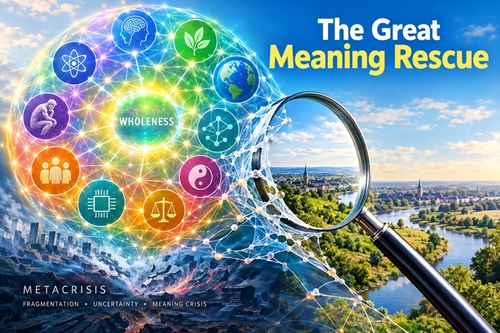 Jim Loving and Alethic AI have now responded to my skeptical review of the Institute of Applied Metatheory (IAM), and I welcome the attempt. Their response is considerably more interesting than a defensive dismissal would have been. Indeed, it contains a number of striking concessions. The authors acknowledge the “grandiosity problem,” admit an “operational credibility gap,” concede that IAM did not originate the meaning-crisis diagnosis, and agree that its public voice sometimes “oversells” what it has actually demonstrated. Those are not trivial concessions. They go directly to several of the concerns raised in my original essay. But then comes the remarkable move: having conceded that the institutional rhetoric gets ahead of the evidence, the response largely protects the underlying philosophical architecture from the same criticism. The institutional voice, we are told, may be inflated, but “the philosophical architecture is sound.” The real problem, I am told, is that my essay “lands on the packaging but slides off the content.” That is the part I would like to examine. Because perhaps I did not miss the content. Perhaps the content is precisely where the problem becomes more interesting. The Concessions Are Already SignificantLet us begin with what IAM's response gets right. It explicitly agrees that IAM's language can suggest that integrative metatheory is not merely useful but somehow necessary for civilizational survival. It agrees that the organization can give the impression that the meaning crisis requires IAM's particular synthesis. It admits that “the leap from 'integrative metatheory is relevant to this condition' to 'IAM is positioned to rescue us from it' is a rhetorical move that outpaces the argument.” That is very close to the central criticism of my original essay. The response also acknowledges that many IAM initiatives remain “more programmatic than operational.” Again, this was one of my main objections. IAM has accumulated an impressive vocabulary of projects, initiatives, indexes, journals, knowledge bases and research programs. But the existence of an impressive architecture of projects does not establish that those projects have produced correspondingly impressive knowledge. The response itself says that IAM's credibility “ultimately depends on closing that gap through demonstrated outputs rather than through more sophisticated framing of the mission.” Exactly. We agree. So far, so good. But notice what happens next. The concessions are largely confined to the voice and presentation of IAM. The deeper theoretical claims are then declared to be “philosophically serious,” “sound,” “defensible,” and “genuinely useful.” That is where the real debate begins. “Sound” Is Not an ArgumentThe response says: “The philosophical architecture is sound.” But what does that mean? A philosophical architecture is not made sound by being elaborate, internally coherent, or populated by sophisticated thinkers. It becomes intellectually persuasive by successfully answering questions that competing frameworks cannot answer as well. My original essay did not argue that IAM should not exist, that its contributors are unintelligent, or that its various component traditions are worthless. Quite the opposite. I explicitly acknowledged the value of critical realism, complexity theory, developmental psychology, process thought and other approaches. The question was—and remains—much simpler: What does their integration actually give us that we did not have before? That question has still not been answered. The response says that Integrative Metatheory 2.0 operates at an “archtheoretical” level and investigates relations among metatheories. Fine. That is a legitimate subject of inquiry. But legitimacy is not achievement. One can study the relations among theories without producing a theory that explains anything better. One can map conceptual similarities without discovering previously unknown causal mechanisms. One can identify recurring structural patterns without demonstrating that those patterns constitute fundamental features of reality. And one can construct a highly sophisticated vocabulary for comparing theories without actually solving the problems those theories were designed to address. The crucial distinction is between having a higher level of description and having a higher level of explanation. IAM has demonstrated the former much more readily than the latter. The Archtheoretical MoveThis is where the concept of the “archtheoretical” level becomes particularly interesting. The argument seems to run roughly like this: there are several mature metatheories—Critical Realism, Integral Theory, Complex Thought, Unified Theory of Knowledge, Metarealism and others. They overlap in certain ways but disagree in others. Therefore we need a higher-order inquiry into the relations among them. Perhaps invariant structural features can be identified. Perhaps those invariants can provide principles for integration and adjudication. That is certainly a reasonable research question. But notice what has happened. We have moved one level upward. Instead of asking whether Critical Realism explains something better than Integral Theory, or whether developmental theory explains something better than either, we now ask what they have in common. This can be useful. But there is an obvious danger: commonality is not necessarily truth. Suppose ten different theories all distinguish wholes from parts. That does not establish that “wholeness” is a fundamental ontological principle. Suppose ten theories recognize emergence. That does not establish that emergence has a direction. Suppose ten theories distinguish levels of organization. That does not establish that reality is developmental. Suppose ten theories acknowledge multiple perspectives. That does not establish “perspectival completeness.” Suppose ten theories discuss complexity. That does not establish that complexity is increasing historically. The archtheoretical level can therefore generate something quite valuable: a comparative vocabulary. But that is not yet a metaphysics, a causal theory, or a science. And it certainly isn't yet a demonstrated solution to the metacrisis. The Meta-Framework ProblemThere is an old philosophical temptation here that Integral Theory has never entirely escaped. When individual theories disagree, build a framework that contains them all. Wilber did this spectacularly with AQAL. If psychology, sociology, biology, spirituality and cultural theory all seemed to capture different aspects of reality, AQAL could provide the larger container in which they could coexist. IAM has learned an important lesson from that history. It is less interested in declaring a single master theory and more interested in pluralistic integration. That is progress. But the basic problem has not disappeared. It has moved up one level. The question is no longer: Does AQAL explain everything? It becomes: Does the metatheory that compares metatheories explain anything that those metatheories could not explain themselves? And now we have a potentially infinite regress. Why stop at metatheory? Why not meta-metatheory? If the answer is that the archtheoretical level is the level at which the relevant invariants become visible, then we need to see those invariants and demonstrate their usefulness. This is not a semantic objection. It is a methodological one. The higher the level of abstraction, the easier it becomes to discover similarities. But the easier it becomes to discover similarities, the greater the danger that the similarities become artifacts of abstraction. At a sufficiently high level, almost every theory starts looking like every other theory. “Invariants” Need to Be Shown, Not AnnouncedIAM's response says that the real conversation should concern whether there are “invariant structural features” across mature integrative metatheories. Agreed. So show us. Which features? How were they identified? What competing features were rejected? How is an invariant distinguished from a recurring metaphor? What would count as evidence against it? Can two metatheories disagree so fundamentally that IAM concludes that no integration is possible? Can IAM's archtheoretical analysis produce a result that is genuinely surprising to practitioners of the component theories? Can it tell us that one particular metatheory is wrong about something important? Can it establish that an apparent commonality is superficial? Can it generate a prediction? Can it generate an intervention that works better than one derived from the component theories? Until such questions are answered, “invariant structural features” remains a promising research program rather than an established discovery. That distinction matters enormously. An AI Output Is Not an Empirical TestThe response makes another intriguing claim. Alethic AI can supposedly demonstrate what the archtheoretical vantage point discloses, and “every substantive analytical output Alethic AI produces is, in effect, an empirical test of the archtheoretical claim.” This is where I think IAM needs to be particularly careful. An AI-generated analysis is not an empirical test merely because it is analytical. If Alethic AI produces an elegant comparison of five metatheories, it demonstrates that Alethic AI can produce an elegant comparison of five metatheories. It does not demonstrate that the underlying integrative framework is true. If the system discovers a conceptual pattern, the pattern may be real—or it may reflect the categories encoded in its knowledge base. If it finds a common structure, that common structure may be fundamental—or it may be a consequence of asking the system to search for common structures. If the system repeatedly confirms the architecture from which it was constructed, we have to ask a very basic epistemological question: Is the machine discovering the framework, or is the framework discovering itself through the machine? That is not a criticism unique to Alethic AI. It is a general problem with knowledge systems. An AI trained, structured, prompted or retrieved through a particular conceptual architecture will naturally be exceptionally good at seeing the world through that architecture. That is not necessarily a defect. But it is not independent validation either. The Circularity ProblemThere is therefore a deeper problem with the proposed self-correction mechanism. IAM suggests that Alethic AI can test whether IAM itself is practicing the epistemic reflexivity demanded by Integrative Pluralism. Excellent. But who determines whether the AI's assessment is correct? The system's knowledge architecture? The IAM researchers? Independent researchers? External empirical evidence? Other AI systems? If Alethic AI tells IAM that IAM is epistemically humble, does that constitute evidence of epistemic humility? Obviously not. And if Alethic AI tells IAM that IAM is insufficiently humble, that is interesting—but it still does not establish the diagnosis independently. The system remains embedded within the very intellectual ecosystem it is being asked to evaluate. This is a classic problem of reflexivity: the observer is part of the system being observed. Reflexivity is valuable. But reflexivity does not magically produce objectivity. The “Meaning Crisis” Is Still Doing Too Much WorkThe response also tries to rescue the meaning-crisis argument by making a subtler claim. IAM is not saying that it will personally give meaning to unhappy individuals. Rather, it argues that the absence of integrative frameworks at the civilizational level contributes structurally to conditions in which meaning collapse occurs. That is certainly more modest. But now we need evidence. Does the absence of integrative metatheory actually cause meaning collapse? Or do people experience meaninglessness for a much more ordinary collection of reasons—social isolation, economic insecurity, loss of community, family breakdown, declining religious participation, changing work patterns, political alienation, technological disruption, mental-health problems, mortality awareness, or simply the perennial human struggle to construct a meaningful life? And even if worldview fragmentation contributes to some of these problems, how much does it contribute? This is where the distinction between an attractive explanation and a demonstrated explanation becomes crucial. The fact that a phenomenon can be interpreted through a particular theoretical lens does not establish that the lens identifies its primary cause. This was one of my original objections to the metacrisis discourse. “Everything is interconnected” is true. But everything being interconnected does not mean that everything has the same explanation. The Metacrisis Can Become UnfalsifiableIAM's response says that its treatment of the metacrisis is structurally serious. Perhaps it is. But seriousness is not the same thing as discriminating power. A concept becomes scientifically or philosophically useful when it helps us distinguish possibilities. Suppose a society experiences ecological collapse. IAM can say that this reflects failures of institutions, worldview, sensemaking, coordination and cultural development. All plausible. But suppose the society avoids ecological collapse. Can IAM explain that too? Perhaps successful adaptation demonstrates integrative capacity. Failure demonstrates fragmentation. Success confirms the theory. Failure confirms the theory. This is precisely where the metacrisis concept needs careful operationalization. A framework that can explain both outcomes is not necessarily useless. But it must identify conditions under which one outcome should be expected rather than another. Otherwise we have interpretation rather than explanation. That is the standard I would like to see applied to all grand integrative theories—including my own arguments. “On Its Own Terms” Is Not EnoughThe response criticizes me for failing to engage IAM “on its own terms.” This sounds reasonable until one asks what “on its own terms” means. Should a new framework be evaluated according to the assumptions built into that framework? Partly, yes. One needs to understand a theory before criticizing it. But ultimately every ambitious theory has to be evaluated against standards that it does not get to define entirely for itself. Creationists cannot say, “You must evaluate creationism on its own terms.” Astrologers cannot say, “You haven't understood astrology unless you accept astrological categories.” Psychoanalysts cannot simply define every possible objection as resistance. And Integral Theory cannot declare that its critics have missed the point because they have not adopted its preferred ontological vocabulary. A framework may indeed establish new concepts. But those concepts must eventually answer to evidence, logical coherence, explanatory competition and practical consequences. “On its own terms” is the beginning of criticism, not the end of it. The Real Test: Can IAM Lose?Here, I think, lies the most productive challenge for IAM. Can IAM lose? Can its methodology produce a result that is genuinely damaging to one of its cherished assumptions? Can it conclude that developmental complexity is not progressive? Can it discover that more complex cultures are not more humane? Can it discover that integrative worldviews sometimes produce worse decisions than specialized approaches? Can it demonstrate that fragmentation is occasionally beneficial? Can it discover that secular pluralism solves some problems better than worldview integration? Can it conclude that a particular spiritual or metaphysical interpretation is simply unnecessary? Can it discover that there is no emerging “integrative worldview”? Can it conclude that the metacrisis concept is too vague to be useful? Can it publish such findings prominently? If the answer is yes, then IAM begins to look genuinely interesting. If the answer is no, then its epistemic pluralism may be functioning less as an instrument of discovery than as a sophisticated language for confirming integration. That is the test I would like to see. Integration Is Not InnocentThere is another assumption hiding in the IAM response: that integration is generally something we should want more of. But why? Integration can be beneficial. It can also be harmful. An ecosystem requires differentiation as well as connection. A scientific discipline requires specialization as well as interdisciplinarity. A democratic society benefits from disagreement. A brain does not function because every neuron does the same thing. An immune system depends upon discrimination, not merely integration. Indeed, one of the central lessons of complexity theory itself is that wholes depend upon differentiated parts. So “integration” cannot simply be treated as a universally positive developmental direction. Sometimes the problem is fragmentation. Sometimes the problem is insufficient differentiation. Sometimes the problem is excessive coupling. Sometimes the problem is excessive centralization. Sometimes the problem is that two systems have been integrated that should have remained separate. The integrative impulse therefore requires its own limits. Otherwise “integration” becomes like “progress”: something everyone approves of until somebody asks what exactly is being integrated, in whose interests, according to what criteria, and toward what end. The Ghost of Wilber Still LingersIAM has undoubtedly moved beyond several features of classical Wilberian Integral Theory. The language is more pluralistic. Critical realism has become more important. Empirical measurement is taken more seriously. The organization is less centered on a single charismatic theorist. Different intellectual traditions are invited into conversation. These are real developments. But the family resemblance remains unmistakable. There is still a large-scale diagnosis of civilizational fragmentation. There is still an appeal to greater integration. There is still a developmental vocabulary. There is still an interest in increasing complexity. There is still a search for deeper structures beneath apparently disconnected phenomena. There is still an attraction to wholeness. There is still a tendency to interpret historical developments as evidence of an emerging transformation. And there is still the temptation to move from empirical observations about complexity and development to much larger claims about meaning, value, consciousness and the direction of history. In other words, some of the metaphysical vocabulary has been replaced by metatheoretical vocabulary. But replacing “Spirit” with “emergence,” “Eros” with “development,” or “AQAL” with “archtheory” does not automatically solve the underlying evidential problem. A conceptual upgrade is not necessarily an epistemic upgrade. What Would Convince Me?This is not an argument for abandoning IAM. It is an invitation to make its claims testable. Show us a case in which IAM's integrative method produces a solution that a conventional multidisciplinary team would probably have missed. Show us a problem in which the archtheoretical analysis generates a genuinely novel insight. Show us an intervention derived from Integrative Metatheory that demonstrably works better than established alternatives. Show us a developmental hypothesis that could have turned out false—and then tell us whether it survived testing. Show us a case in which IAM's own framework was revised because evidence contradicted it. Show us a case in which the result of an investigation was: integration was not the answer. That would impress me far more than another vision document. It would also answer the central question of my original essay. From Rescue Narrative to Research ProgramIronically, IAM's own response contains the recipe for becoming more convincing. It says the organization should “produce intellectual outputs—analyses, assessments, framework comparisons, applied cases—that demonstrate what integrative metatheory at the archtheoretical level actually yields.” Exactly. Do that. And stop telling us in advance that the architecture is sound. Let the outputs demonstrate it. Stop telling us that the metacrisis requires an integrative response. Show us where integration changes the diagnosis. Stop telling us that the archtheoretical level reveals invariant structures. Show us the invariants. Stop telling us that Alethic AI constitutes an empirical test of the framework. Design genuinely independent tests. Stop telling us that IAM represents a new stage of integrative thinking. Let history decide whether it does. This would turn IAM from a promising intellectual movement into something much more interesting: a research program capable of discovering that its own assumptions are wrong. The Difference Between a Map and a DiscoveryThere is, finally, a distinction that I think sits at the heart of this entire discussion. IAM is very good at making maps. It maps metatheories. It maps worldviews. It maps levels. It maps complexity. It maps relationships among conceptual systems. It maps the metacrisis. It maps the meaning crisis. And now, with Alethic AI, it can presumably map these maps at unprecedented speed. But a map is not automatically a discovery. A map can organize knowledge beautifully while remaining dependent upon the knowledge it organizes. And sometimes the most important intellectual achievement is not producing a larger map. It is discovering that the territory does not conform to the map. That is the standard I would like to see IAM embrace. The Challenge RemainsSo I appreciate the response from Jim Loving and Alethic AI. It is serious, self-critical in places, and considerably more interesting than a simple rebuttal. But it does not yet answer my central criticism. Indeed, it sharpens it. IAM acknowledges that its rhetoric can outrun its evidence. It acknowledges that some of its initiatives remain programmatic. It acknowledges that its distinctiveness has to be demonstrated rather than asserted. Excellent. Then let us proceed from there. The real issue is no longer whether IAM has an impressive intellectual architecture. It plainly does. The issue is whether archtheory adds explanatory power or merely another layer of conceptual organization. That is an empirical and philosophical question, not a matter of institutional branding. And there is a wonderfully simple way to resolve it. Don't rescue us. Don't persuade us that the world needs IAM. Don't tell us that the metacrisis demands an integrative worldview. Don't tell us that the future is becoming more whole. Show us something we could not see before. Then show us how we know it is true. And, most importantly, show us that your method is capable of discovering that it is wrong. That would be a genuinely integral achievement.
Widget is loading comments...
|