|
TRANSLATE THIS ARTICLE
Integral World: Exploring Theories of Everything
An independent forum for a critical discussion of the integral philosophy of Ken Wilber
 Jim Loving is an independent consultant offering expertise for sustainability, business development, and Information Technology Strategy and Services. Jim Loving is an independent consultant offering expertise for sustainability, business development, and Information Technology Strategy and Services.
Check out my other conversations with ChatGPT Frank Visser's Critique of IAMAn IAM-Alethic AI responseJim Loving / Alethic AI
 IntroductionI have been working with the Institute of Applied Metatheory (IAM) for a year. Among its initiatives is the development of a customized AI tool, Alethic AI, which IAM plans to roll out to a broader audience. It currently consists of Anthropic's Claude and an underlying Integrated Knowledge Graph database (IKB) which uses Integrative Metatheory lenses to frame its responses. Alethic AI is envisioned as a Reasoning Co-pilot providing a combination of a structured sensemaking method using the integrative-metatheory knowledge graph. I have used this tool a fair amount and have published some essays at my Medium site and internally with IAM using the tool and have found it quite valuable. The current version is an alpha version with anticipated enhancements forthcoming. I decided to present Frank Visser's ChatGPT critique of IAM to Alethic AI and it produced the following.
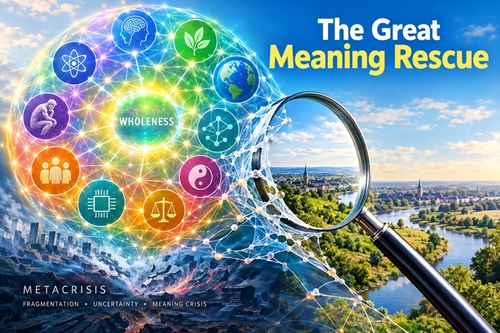
Jim Loving: Frank Visser runs IntegralWorld as a place to explore all theories related to Integral Theory. He has used AI LLMs increasingly to write essays around these topics. A recent one is The Great Meaning Rescue A Skeptical Review of the Institute of Applied Metatheory and the Attempt to Save Us from the 'Meaning Crisis'. It is a critical assessment of the mission and underlying assumptions for its stated purpose. Assess its criticisms, what it gets right and what it gets wrong, include how Alethic AI can assist with this critique and suggest ways that IAM should proceed, if differently, given this critique. Assessing Frank Visser's "The Great Meaning Rescue"What the Critique Gets Right, What It Gets Wrong, and What IAM Should Do About ItI. Contextualizing the CritiqueFrank Visser has run Integral World as a genuinely valuable critical space for over two decades. His willingness to subject Integral Theory and its descendants to rigorous, often skeptical scrutiny has been a net positive for the integrative intellectual community—keeping it honest in ways that internal enthusiasm sometimes cannot. His increasing use of AI-assisted essay writing is itself worth noting: it produces a particular kind of output that is often well-organized, competent in synthesizing secondary sources, but prone to certain systematic limitations I'll return to. "The Great Meaning Rescue" targets the Institute of Applied Metatheory specifically—its mission, its framing of the Meaning Crisis, and what Visser reads as institutional grandiosity dressed in philosophical sophistication. The critique deserves serious engagement rather than defensive dismissal. Some of it lands. Some of it misses. And taken together, the essay points toward genuine challenges IAM needs to address—not because Visser is right about everything, but because the questions he raises are ones any serious institutional project will face. II. What the Critique Gets RightThe Grandiosity Problem Is RealVisser's most substantive criticism is that IAM's framing oscillates between genuine philosophical seriousness and a kind of rescue-narrative inflation—the suggestion that integrative metatheory is not merely useful but necessary for civilizational survival, that the meaning crisis requires IAM's particular synthesis, that "Applying Big Pictures to Big Problems" is a mission of world-historical proportions. This criticism has real teeth. The Metacrisis is a genuine phenomenon—the IKB's own treatment of it is careful and structurally serious, distinguishing it from the shallower polycrisis framing through Bhaskar's ontological stratification: the polycrisis names events that interact, while the metacrisis names the generative mechanisms that produce the pattern and disable the response. That is a philosophically defensible and important distinction. But the leap from "integrative metatheory is relevant to this condition" to "IAM is positioned to rescue us from it" is a rhetorical move that outpaces the argument. Visser is right to notice it. The pattern is not unique to IAM—it appears throughout the integrative space, and Wilber's own work has attracted the same criticism. But familiarity doesn't neutralize the problem. When an institution's public-facing language implies that its particular synthesis is what the civilization needs, it invites exactly the skepticism Visser brings. The philosophy may be excellent while the institutional voice oversells it. The Operational Credibility GapVisser also questions the gap between IAM's stated ambitions—the Integrative Knowledge Base, the Applied Metatheory Initiatives, the cultural transformation agenda—and what is demonstrably operational. This is a fair observation about a young institution. IAM was founded in 2023. The IKB exists and is substantial. Integrative Metatheory 2.0 is a philosophically serious archtheoretical framework. Alethic AI is a real system. But many of the Applied Metatheory Initiatives listed in IAM's documentation—the Encyclopedia of Big Pictures, the Cultural Complexity Index, the Integration journal, the Worldview Studies Initiative—are, at this stage, more programmatic than operational. Visser's skepticism about the distance between vision and execution is legitimate institutional criticism, and IAM's credibility ultimately depends on closing that gap through demonstrated outputs rather than through more sophisticated framing of the mission. The Meaning Crisis Is Not IAM's AloneThe critique implicitly raises a third valid point: IAM did not originate the meaning crisis diagnosis, and the intellectual landscape addressing it is already rich and active. John Vervaeke's Awakening from the Meaning Crisis—fifty hours of densely argued cognitive science, philosophy, and contemplative history—is the most systematic treatment of the subject available and has attracted a substantial following entirely outside institutional structures. Thinkers like Jonathan Rowson, Zak Stein, Daniel Schmachtenberger, and the broader Metamodern intellectual community are working the same territory. The integrative metatheory community—Critical Realists, UTOK practitioners, Complex Thought scholars—has been doing this work for decades. IAM's claim to be doing something distinctive at the "archtheoretical" level—synthesizing across metatheories rather than working within any one of them—is philosophically defensible. But that claim needs to be demonstrated through intellectual outputs that actually show what the archtheoretical vantage point discloses that other approaches miss. Asserting the distinctiveness is not the same as showing it. III. What the Critique Gets WrongConflating Institutional Voice with Philosophical ContentVisser's essay—and this is where the AI-assisted composition shows its characteristic limitation—tends to treat IAM's marketing language and its philosophical architecture as the same thing. Criticism of the former is often valid. Criticism of the latter requires engaging the actual content, and "The Great Meaning Rescue" does not do this in any depth. Integrative Pluralism—the commitment that no single framework captures all of reality, that pluralism is not an end state but a condition to be worked through via principled comparative integration—is not a grandiose claim. It is a modest, defensible, and genuinely useful epistemic orientation. The IKB's structural lens architecture, its ontological stratification framework, its treatment of the polarity between convergence and differentiation in the knowledge space—these represent real philosophical work that is vulnerable to philosophical criticism, not to skeptical tone. The AI-generated essay format, which Visser increasingly employs, is particularly prone to this conflation. LLMs are good at summarizing the surface rhetoric of an institutional mission and generating plausible-sounding critical responses to it. They are considerably less good at engaging the underlying philosophical architecture with the specificity required to actually test it. The result is criticism that lands on the packaging but slides off the content. Underestimating the Archtheoretical ProblemVisser's implicit assumption—shared by many critics of integrative projects—is that the multiplication of metatheories is itself the problem, and that another synthesis layer makes it worse. This assumption deserves examination rather than acceptance. The intellectual situation is this: Critical Realism, Integral Theory, the Unified Theory of Knowledge, Complex Thought, Metarealism, Critical Realist Integral Theory—these are serious, mature frameworks, each with genuine explanatory power and genuine limitations. They disagree at important points. They use different vocabularies for overlapping territories. Practitioners within each tradition are often more familiar with their own framework than with the others. The question of whether there are invariant structural features that all these frameworks share—features that could serve as principled criteria for integration and adjudication—is a genuine philosophical question, not a rhetorical move. Integrative Metatheory 2.0's claim to operate at the archtheoretical level is not an assertion of superiority to the metatheories it synthesizes. It is a claim that the relations between these frameworks constitute a legitimate domain of inquiry, and that this domain requires its own methods and standards. Visser's skepticism doesn't engage this claim—it dismisses it as institutional self-promotion without testing whether the archtheoretical work actually produces insights that single-framework approaches miss. Missing the Structural Seriousness of the Meaning Crisis AnalysisVervaeke's meaning crisis framing—which IAM explicitly builds on—is not pop psychology dressed in philosophical vocabulary. The claim that the Meaning Crisis is embedded within the Metacrisis as its interior-individual and interior-collective register, rather than a parallel diagnosis, follows directly from a stratified ontological analysis: the same generative mechanisms that produce ecological overshoot and institutional decay produce the collapse of relevance realization and wisdom cultivation in individuals and cultures. This is a structurally coherent claim that connects Vervaeke's cognitive science of meaning-making to Bhaskar's account of social structures and their failure modes. Visser's skepticism about "rescuing" people from the meaning crisis misses what the more serious version of this project is actually claiming: not that IAM will provide meaning to meaning-starved individuals, but that the absence of integrative frameworks at the civilizational level contributes structurally to the conditions in which meaning collapse occurs. That is a different and more defensible claim. IV. What Alethic AI Can Contribute to This DialogueThe irony of Visser using AI to critique IAM—an organization that has deployed its own AI system—is worth naming without over-playing. But it points to something substantive: what an AI system built on integrative metatheory can do that a general-purpose LLM cannot. Alethic AI's value in this specific context is threefold.First, it can subject IAM's own claims to the same rigorous multi-perspectival analysis it applies to any phenomenon—testing whether IAM's stated mission, philosophical architecture, and operational structure are internally consistent with the principles it professes. Does IAM actually practice the epistemic reflexivity it names as a constitutive commitment? Does its institutional voice reflect the genuine epistemic humility that Integrative Pluralism requires, or does it slide into the kind of meta-framework imperialism that the integrative space has criticized in Wilber? These are questions Alethic AI is specifically positioned to engage with precision, because it has access to the full architecture of the knowledge system and can test consistency across it. Second, Alethic AI can demonstrate—through actual analytical outputs—what the archtheoretical vantage point discloses. The most effective response to Visser's skepticism is not a more sophisticated defense of IAM's mission statement. It is a series of concrete analyses that show, in the subject matter's own terms, what a multi-framework integrative approach discloses that single-framework approaches miss. Every substantive analytical output Alethic AI produces is, in effect, an empirical test of the archtheoretical claim. Third, Alethic AI can help IAM itself maintain the critical distance from its own institutional voice that the philosophy requires. The tendency toward rescue-narrative inflation is a real risk for any organization working at the intersection of civilizational crisis and philosophical ambition. An AI system that applies the same analytical rigor to IAM's claims as to anyone else's is an institutional resource for epistemic integrity, not just a communications tool. V. What IAM Should Do Differently—and What It Should Double Down OnRecalibrate the Public VoiceThe most actionable response to Visser's legitimate criticisms is a deliberate recalibration of how IAM speaks about its own mission in public-facing contexts. The philosophical architecture is sound. The institutional voice oversells it. "Applying Big Pictures to Big Problems" is a reasonable tagline. Implying that IAM is positioned to rescue civilization from the meaning crisis is not—not because the stakes aren't real, but because the claim outpaces the demonstration. IAM should speak the way careful philosophers speak when they are confident in their framework: by showing what the framework does, not by asserting what it is destined to accomplish. This is not a retreat from ambition—it is the disciplined expression of it. Prioritize Demonstrated Outputs Over Programmatic VisionThe credibility gap between IAM's vision documents and its operational outputs is real and will remain exploitable by critics until it closes. The single most effective response is to produce intellectual outputs—analyses, assessments, framework comparisons, applied cases—that demonstrate what integrative metatheory at the archtheoretical level actually yields. The IKB is a significant achievement. Alethic AI is a significant achievement. The question is whether they generate knowledge that changes how serious people think about serious problems. That question is answered by outputs, not by mission statements. Engage Critics Directly and RigorouslyIAM should treat Visser's critique—and others like it—not as institutional threats but as invitations to demonstrate the epistemic reflexivity it claims as a constitutive commitment. A public, detailed, philosophical response to "The Great Meaning Rescue"—one that distinguishes what the critique gets right from what it misses, and that uses that distinction to sharpen IAM's own thinking—would be a more powerful demonstration of integrative philosophy in practice than any amount of vision-document elaboration. This kind of public intellectual engagement is also how the integrative community grows. The meaning crisis literature, the metacrisis discourse, and the metatheory space all benefit from rigorous internal criticism. IAM refusing to engage its critics would be a significant departure from the epistemic reflexivity it names as a first principle. Hold the Polarity Between Confidence and HumilityThe deepest structural challenge here is a polarity that cannot be resolved, only navigated: between the confidence required to claim that integrative metatheory is genuinely distinctive and important, and the humility required to acknowledge that no single institution—however well-designed—has privileged access to civilizational rescue. Over-weighting confidence produces the grandiosity Visser correctly identifies. Over-weighting humility produces an institution too tentative to make the case for its own approach. The philosophical tradition IAM draws on is clear about how this polarity works: you hold both poles simultaneously, in creative tension, rather than oscillating between them or collapsing into one. In practice, this means IAM speaks with confidence about what integrative metatheory specifically can do—the structural analyses it enables, the perspectival completeness it requires, the developmental sensitivity it brings—while remaining genuinely open about what it cannot do, what it does not yet know, and where its own synthesis is incomplete. That posture is both philosophically honest and, in the long run, far more credible than rescue-narrative confidence. VI. The Bottom LineVisser's essay is valuable precisely because it names real risks: institutional grandiosity, the gap between vision and execution, and the tendency of integrative projects to claim more than they can yet demonstrate. These are genuine challenges that IAM needs to address—not primarily by defending itself against the critique, but by doing the work that makes the critique obsolete. Where the essay fails is in its inability or unwillingness to engage IAM's philosophical architecture with sufficient depth to test it on its own terms. The archtheoretical claim—that there are invariant structural features across mature integrative metatheories, and that identifying these features constitutes a distinct and important form of inquiry—remains unexamined in Visser's analysis. That is where the real conversation should be, and where IAM's intellectual seriousness will ultimately be judged.
Widget is loading comments...
|