|
TRANSLATE THIS ARTICLE
Integral World: Exploring Theories of Everything
An independent forum for a critical discussion of the integral philosophy of Ken Wilber
  Frank Visser, graduated as a psychologist of culture and religion, founded IntegralWorld in 1997. He worked as production manager for various publishing houses and as service manager for various internet companies and lives in Amsterdam. Books: Ken Wilber: Thought as Passion (SUNY, 2003), and The Corona Conspiracy: Combatting Disinformation about the Coronavirus (Kindle, 2020). Frank Visser, graduated as a psychologist of culture and religion, founded IntegralWorld in 1997. He worked as production manager for various publishing houses and as service manager for various internet companies and lives in Amsterdam. Books: Ken Wilber: Thought as Passion (SUNY, 2003), and The Corona Conspiracy: Combatting Disinformation about the Coronavirus (Kindle, 2020).
Check out my other conversations with ChatGPT Boekestijn & De Wijk and the New World OrderHow the Dutch geopolitical podcast understands the transition from Western dominance to multipolarityFrank Visser / ChatGPT
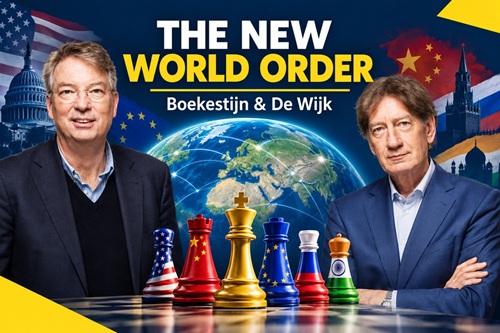 The phrase “New World Order” is the organizing concept of the Dutch podcast Boekestijn & De Wijk. But in their usage it does not designate a secret blueprint or a finished alternative system. It refers to a fundamental transformation in the distribution of global power: the weakening of the post-1945 Western-dominated order, the rise of China and the renewed importance of Russia, India and other powers, and the resulting emergence of a more competitive and potentially unstable international system. The podcast, presented by historian Arend Jan Boekestijn and international-relations scholar Rob de Wijk under the moderation of Hugo Reitsma, explicitly describes itself as an exploration of the new world order and its consequences for Europe and the Netherlands. Their associated book asks the central question directly: are we moving toward a multipolar world, and, if so, who will be on “our side”? That makes their perspective worth examining on its own terms. What exactly do they mean by a new world order? What has happened to the old one? And what kind of world do they think is emerging? The end of the postwar orderThe starting point is the extraordinary geopolitical position of the United States after 1945. The Second World War left the United States with enormous economic, military and technological advantages. The institutions created or consolidated in the postwar period—NATO, the Bretton Woods institutions and a broad network of alliances and international rules—were embedded in a world in which American power was indispensable. After the collapse of the Soviet Union in 1991, that imbalance became even greater. For a brief period the United States stood without a genuine peer competitor. The great historical mistake, from the perspective of Boekestijn and De Wijk, would be to assume that this situation was permanent. Their concept of the New World Order begins precisely with the recognition that the distribution of power is changing. China has accumulated enormous economic and technological capabilities. Russia remains a major military and nuclear power. India is acquiring increasing economic and geopolitical weight. The European Union possesses enormous economic resources but struggles to convert them into unified strategic power. Meanwhile, the United States itself is increasingly questioning the burdens associated with maintaining the old Western order. The result is not simply “the decline of the West.” It is a change from unipolarity toward a much more complicated distribution of power. China is the central challengeChina occupies a particularly important place in De Wijk's thinking. His earlier book De nieuwe wereldorde was subtitled Hoe China sluipenderwijs de macht overneemt—“How China is gradually taking over power.” The argument was that China's economic and technological rise could eventually enable Beijing to reshape the international order itself. De Wijk identified developments such as the financial crisis, American protectionism, Brexit, European nationalism and cooperation between China and Russia as factors that could accelerate the relative decline of Western dominance. This is more than a conventional prediction that China will become richer. The important question is what economic power becomes when combined with technology, military capability, industrial capacity and geopolitical ambition. China's position in global manufacturing, its importance in critical supply chains and its growing technological capabilities give Beijing forms of leverage that are quite different from the military power associated with the old Cold War. The New World Order is therefore also an industrial and technological order. Who produces the chips? Who controls critical minerals? Who possesses the manufacturing capacity? Who controls important trade routes? Who develops artificial intelligence? Who can impose economic costs on whom? These questions are increasingly inseparable from military strategy. From one dominant power to several major powersThe podcast's more recent discussions make the multipolar character of their analysis especially explicit. One recent episode describes a possible five-power configuration involving the United States, China, the European Union, India and Russia—a fragile “pentarchy.” The same discussion links this transformation to historical cycles of hegemonic competition and to struggles over chips, raw materials and trade routes. This is a very different world from the relatively simple bipolarity of the Cold War. During the Cold War, two superpowers dominated the system. After 1991, the United States enjoyed a period of exceptional predominance. The emerging system has neither simplicity. There are several centers of power, but they do not form permanent blocs. India can cooperate with Russia while maintaining important relations with the United States. Europe can be allied with America while simultaneously being economically dependent on China. Russia can cooperate strategically with China while remaining an independent great power with its own interests. This makes the new order inherently more fluid. Multipolarity does not mean that everyone has equal power. It means that no single power can organize the entire system without taking several other major powers into account. Russia and the return of geopoliticsRussia represents another major element in their analysis. The Russian invasion of Ukraine demonstrated, among other things, that territorial power politics had not disappeared. The assumption that economic interdependence would gradually make major war obsolete proved too optimistic. For Boekestijn and De Wijk, Russia is therefore not simply an unpleasant remnant of the Cold War. It remains an important military power with nuclear weapons, natural resources, geographic depth and the capacity to disrupt European security. But Russia's significance is also changing because of its relationship with China. Recent podcast discussions emphasize how Chinese support for Russia can contribute to a broader transformation of the international system, while simultaneously giving China strategic advantages. This produces an important feedback loop. Western pressure on Russia pushes Moscow toward Beijing. Closer Russian-Chinese cooperation increases the strategic challenge facing the West. That challenge encourages further Western cooperation. And further Western pressure can reinforce Russian dependence on China. The result is not necessarily a formal Russia-China alliance comparable to NATO. It is something more fluid: a convergence of interests among powers that have reasons to resist American predominance. Europe: economic giant, geopolitical question markThis is where the podcast becomes particularly relevant to Dutch and European readers. Europe has enormous economic resources. But economic size is not automatically geopolitical power. A country—or a political union—may have a huge GDP and still be dependent on other powers for energy, technology, raw materials, military protection or critical infrastructure. The podcast repeatedly returns to this problem. One recent discussion emphasizes European dependence on China for critical raw materials and the vulnerability that this creates. At the same time, Europe remains heavily dependent on the United States in security matters. Europe therefore occupies an awkward position between the two major poles. It is economically intertwined with China. It is militarily tied to the United States. It has major interests in Russia and the wider Eurasian landmass. And yet it lacks the unified strategic capabilities of a conventional great power. This explains why De Wijk increasingly argues that Europe must become a geopolitical actor in its own right. His forthcoming America and Us, for example, explicitly argues that Europe should respond to the changing American relationship by developing greater strategic independence and acting as a geopolitical actor in its own right. This does not necessarily mean abandoning America. It means being capable of acting when American interests and European interests diverge. Interdependence has become a weaponOne of the most important changes in their worldview concerns economic interdependence. The optimistic globalization narrative assumed that countries deeply dependent upon one another would have powerful incentives to avoid conflict. But dependence works both ways. If one country controls a crucial component, mineral, technology, energy source or market, that dependence can become political leverage. China's position in critical minerals is therefore not simply an economic issue. Neither are European dependence on foreign energy supplies or American control over important financial infrastructures. Economic globalization has not abolished geopolitics. It has expanded the number of instruments through which geopolitics can be conducted. Trade policy becomes foreign policy. Technology policy becomes security policy. Industrial policy becomes military policy. The boundaries between economics and strategy become increasingly difficult to maintain. Technology becomes geopoliticsThis is particularly obvious with semiconductors and artificial intelligence. The old geopolitics was heavily concerned with oil, steel, shipping lanes and military bases. The new geopolitics still cares about those things, but it adds chips, data, computing power, rare earths, telecommunications infrastructure and AI. The podcast's own description of the emerging world order explicitly places technology alongside security, demography, resources, climate and social stability as factors shaping the future. This is an important broadening of geopolitical analysis. A semiconductor factory can be as strategically important as an oil field. A shipping route can be as important as a military base. A technological dependency can become a security vulnerability. And a country's industrial capacity can determine how quickly it can replenish weapons, infrastructure and technological systems during a conflict. The New World Order is therefore not simply a diplomatic rearrangement. It is also a competition over the material infrastructure of modern civilization. The return of spheres of influenceAnother implication is the revival of something many Europeans thought belonged to the past: spheres of influence. The post-Cold War European imagination placed considerable emphasis on sovereign equality, international institutions and the gradual expansion of a common rules-based order. Great-power politics operates differently. Large powers are concerned with neighboring territories, buffer zones, strategic access and military positioning. Russia's behavior toward Ukraine demonstrates this brutally. China's concerns about Taiwan demonstrate it in another form. American strategic concerns about the Western Hemisphere and the Indo-Pacific belong to the same broader logic of geographical power. This does not make these policies morally equivalent or legally equivalent. It simply means that geography continues to constrain great powers, despite decades of globalization. The map still matters. Is this a return to the nineteenth century?There is nevertheless a danger in describing everything as a return to classical great-power politics. The world of 2026 is not the world of 1890. Nuclear weapons fundamentally constrain direct conflict between major powers. Global supply chains make complete economic separation extraordinarily costly. International institutions remain important. Multinational corporations have enormous influence. Cyberwarfare and AI have created strategic domains that earlier great powers could not have imagined. And the United States, China, Europe, India and Russia are not simply five equivalent “countries” competing on a single chessboard. Their economic structures, alliances, demographics, political systems and geographical situations are radically different. So the emerging world order should not be understood as a simple restoration of the past. It is better understood as a new form of great-power competition under conditions of unprecedented technological and economic interdependence. The uncertainty is the pointOne of the more sensible aspects of the Boekestijn-De Wijk approach is that they do not claim to know exactly what the new order will look like. The associated book explicitly stresses that the future is uncertain, while arguing that future developments emerge partly from trends already visible in the present. That is an important distinction. A geopolitical analysis should not be confused with a prophecy. The relevant question is not: “What will the world look like in 2040?” It is: “Which current trends are strong enough that we should take their possible consequences seriously?” China's technological rise is one such trend. The relative redistribution of economic power is another. European strategic dependence is another. The return of military competition is another. And the growing importance of the Global South is another. Exactly how these trends interact remains uncertain. The New World Order is really an old questionThere is an irony here. The expression New World Order sounds as if something unprecedented is happening. But the fundamental question is extremely old: Who has power, and how is that power distributed? What is new is the particular configuration. The United States remains extraordinarily powerful but no longer operates in a world without serious competitors. China has become a global economic and technological power. Russia remains militarily significant. India is increasingly important. Europe possesses enormous resources but faces difficult questions about strategic autonomy. The result is a world in which power is dispersed without necessarily being balanced. That distinction is crucial. A multipolar world can be more pluralistic, but it can also be more unstable. More actors have greater freedom of action, but more actors also have the ability to obstruct one another. There is no guarantee that multipolarity produces harmony. The Dutch problemFor the Netherlands, this is not an abstract intellectual debate. A small, highly open trading country is particularly exposed to changes in the international system. Dutch prosperity depends upon international trade, European integration, maritime infrastructure, technological networks and a stable security environment. The Dutch question is therefore not simply whether the United States or China will “win.” It is how a relatively small European country can preserve room for maneuver when the major powers themselves have less room for compromise. That makes European cooperation strategically important in their analysis. The Netherlands cannot become a superpower. But Europe collectively has economic, technological, demographic and military resources that can give it considerable geopolitical weight—provided those resources can be coordinated. The alternative is dependence without much influence. From the American world to a contested worldThe deepest theme running through Boekestijn and De Wijk is therefore not the disappearance of the West. It is the disappearance of Western exclusivity. The West remains enormously powerful. American universities, technology companies, financial markets, military capabilities and alliances remain major sources of global influence. Europe remains one of the world's largest economic blocs. But the West can no longer assume that its preferences automatically become the preferences of the international system. That is the real significance of the New World Order. It is a transition from a world in which one geopolitical center could exercise disproportionate influence toward a world in which several centers possess enough power to say no. And that produces the central strategic dilemma of the coming decades. The question is not simply whether China will replace America. It is whether the world will settle into a relatively stable multipolar balance—or whether competition among several great powers will generate increasingly dangerous cycles of confrontation. Boekestijn and De Wijk's contribution is to insist that we should take that structural transformation seriously. Their New World Order is therefore not a mysterious destination waiting at the end of history. It is the name for a geopolitical transition already underway: from American predominance toward contested multipolarity, from globalization as an integrating force toward globalization as a source of strategic vulnerability, and from the assumption that economics could replace power politics toward the uncomfortable recognition that economics, technology, geography and military power have become parts of the same geopolitical game. The old order is not necessarily dead. But it is no longer alone. Appendix: Joseph Dillard and the New World Order
Multipolarity as geopolitical transition—and as a challenge to Western self-understandingThe geopolitical picture presented by Boekestijn & De Wijk has an interesting counterpart on Integral World in the writings of Joseph Dillard. Both approaches start from a broadly similar observation: the period in which the United States and its Western allies enjoyed overwhelming global predominance is giving way to a more plural and competitive international system. But they draw rather different intellectual consequences from that observation. For Boekestijn & De Wijk, the central question is primarily geopolitical: what happens when the distribution of power changes? For Dillard, the question is also epistemological: what happens when the West is no longer able to assume that its own interpretation of the world is the world's interpretation? That distinction is important. Dillard's argument is not simply another version of the geopolitical realism found in the Dutch podcast. He turns the transition to multipolarity into a critique of Western perspective itself. From Western hegemony to pluralityDillard's most explicit formulation occurs in his essay Why 500 Years of Western Global Dominance is Fading Away. He describes the unipolar phase that culminated around 1990 as coming to an end and sees the emerging system as “more pluralistic, competitive, and regionally organized.” He is careful to distinguish this from the collapse of Western civilization. In his account, the West remains powerful in areas such as AI, semiconductors, universities, finance and military alliances. The change is therefore relative: Western predominance is declining as other centers of power become stronger. This is close to the basic premise of Boekestijn & De Wijk. Their “New World Order” likewise refers to a redistribution of power rather than to the disappearance of the West. China, Russia, India and other actors acquire greater weight, while Europe has to operate in a world in which American power can no longer be treated as the sole organizing principle. The difference emerges in what each side regards as the most significant consequence. Boekestijn & De Wijk tend to translate multipolarity into questions of military capability, economic strength, technological dependence, energy, resources, alliances and European strategic capacity. Dillard adds another layer: the West must also learn to see itself as one civilization among several rather than as the implicit center of the international system. That is why the language of “Western blind spots” occurs so frequently in his work. The West as a provincial worldviewDillard's Blind Spots of the Western World View makes this argument explicitly. He asks whether Western intellectuals sometimes mistake the assumptions of their own civilization for universal truths. His examples concern Russia, China and Iran, but the broader target is the tendency to interpret international events exclusively through Western conceptual categories. His proposed corrective is multi-perspectivalism. Russian, Chinese and Iranian actors should not simply be understood as defective versions of Western actors who have failed to embrace liberal modernity. They possess their own historical memories, political traditions, cultural assumptions and conceptions of national interest. Dillard argues that these perspectives need to be understood from the inside as well as judged from outside. This fits naturally with his larger Integral vocabulary. The world is not adequately described by adopting one privileged perspective and then treating alternative perspectives as errors. Geopolitics becomes an arena in which different collective worldviews interact. There is a potentially useful insight here. International relations are not conducted between abstract rational actors alone. States have histories, identities, narratives and memories. What looks like irrationality from one perspective can appear perfectly intelligible from another. Understanding that does not require accepting the actor's interpretation as correct. It simply means distinguishing understanding a worldview from endorsing it. That distinction is particularly important in discussions of Russia and Ukraine. Russia: security dilemma or imperial project?Here the contrast between Dillard and Boekestijn & De Wijk becomes especially visible. Dillard's writings on Ukraine emphasize the realist concept of the security dilemma. In A Realist Perspective on Putin's Calculations and Western Provocations, he argues that NATO expansion, Western support for Ukraine and the changing security environment around Russia need to be incorporated into any explanation of Russian behavior. He presents the Russian invasion as something that cannot be understood adequately by treating Russian actions in isolation from the preceding strategic environment. This does not, in itself, establish that Russia's interpretation of events is correct, nor does explaining Russian motives amount to justifying the invasion. Those are separate questions. Dillard, however, places considerably more explanatory weight on the Western side of the security dilemma than many mainstream Western accounts do. His argument can therefore be represented schematically: Western account: Russian aggression → Western response → increased Western security measures. Dillard's realist account: Western expansion and pressure → Russian perception of encirclement → Russian response → Western counter-response. The same historical sequence can consequently be narrated in radically different ways depending upon where one begins the causal chain. This is precisely where Dillard's insistence on perspective-taking becomes relevant. His recurring question is not simply “What did Russia do?” but also “How did Russia understand what was happening?” But perspective is not exculpationThis distinction should be maintained particularly carefully in an Integral World discussion. To say that NATO expansion contributed to Russian threat perceptions is a descriptive claim about a security dilemma. It does not establish that the invasion of Ukraine was legally or morally justified. Likewise, acknowledging Western policies that Russia interpreted as threatening does not eliminate Ukrainian agency or Russian responsibility for decisions taken by the Russian government. Dillard's own formulation sometimes moves rapidly from explanation toward a broader interpretation in which Western policy is portrayed as having generated or substantially accelerated the conflict. His essay explicitly presents itself as a counter-argument to a more Russia-critical interpretation and argues that Western actions helped create the strategic circumstances in which the war occurred. That makes his position substantially different from merely saying, “Both sides have perspectives.” His argument is that the Western perspective has been systematically overrepresented in the interpretation of the conflict. That is a stronger claim. China: rival, alternative or corrective?The same pattern appears in Dillard's treatment of China. He does not regard China's rise merely as the appearance of another great-power competitor. It also challenges the assumption that Western political and economic arrangements constitute the natural destination of modernization. In Blind Spots of the Western World View, Dillard argues that Western observers have repeatedly expected economic development in China to produce political liberalization along Western lines. The persistence and adaptation of the Chinese political system therefore represents, in his account, a challenge to Western assumptions about the relationship between economic modernization and political development. This is an important difference from the more strategic language of Boekestijn & De Wijk. Their concern is primarily what China's economic, technological and military rise means for the distribution of global power. Dillard is more interested in what China's rise tells us about the provinciality of Western developmental assumptions. China becomes, in other words, not merely a competitor but a comparative case. The question changes from: How should the West respond to China's rise? to: What does China's rise reveal about assumptions the West has made about modernity? That is a distinctly Integral question. Europe at the crossroadsThe European dimension produces another revealing contrast. Boekestijn & De Wijk treat Europe primarily as a geopolitical actor that has to adapt to changing circumstances. Europe possesses enormous economic resources but has traditionally depended heavily on the United States for security and remains exposed to external economic and technological dependencies. Dillard goes further. In Why Europe's Future Lies in Eurasia, he argues that Europe's geography, energy needs, resources and trading relationships make closer connections with Russia, China and the wider Eurasian region strategically important. That is not merely a description of multipolarity; it is a substantive argument about the direction Europe should take. Here it is useful to distinguish the empirical premise from the policy conclusion. The empirical premise is that Europe occupies a geographically distinctive position between the Atlantic and Eurasian worlds and has substantial economic interests extending eastward. The policy conclusion—that Europe's future should therefore be oriented toward Eurasia—is Dillard's interpretation of what those circumstances imply. It should not be confused with a neutral description of the emerging world order. Where Dillard adds something genuinely differentDillard's most distinctive contribution to this discussion is therefore not simply his sympathy for multipolarity. It is his insistence that multipolarity has a cognitive dimension. A unipolar world can encourage a particular kind of intellectual provincialism. If one political and economic model appears overwhelmingly successful, it becomes easy to mistake its success for universality. The institutions, values and narratives of the dominant power can become invisible precisely because they appear normal. The emergence of other centers of power disrupts that assumption. China asks whether capitalism necessarily produces liberal democracy. Russia asks whether European security can be organized without taking Russian security perceptions into account. Iran challenges assumptions about the relationship between religion, nationalism and modern statehood. The Global South complicates the assumption that Western sanctions and diplomatic positions will automatically command worldwide support. Dillard's “polycentrism” is intended to make these alternative perspectives intellectually visible. Integral World has in fact featured his broader work on polycentrism and multi-perspectivalism for several years, including essays specifically devoted to the Ukraine crisis and Western groupthink. Where the two perspectives convergeDespite their differences, Boekestijn & De Wijk and Dillard share several important premises. Both reject the idea that the post-Cold War distribution of power will continue indefinitely. Both regard China as central to the transformation of the international system. Both see Russia as an important independent power rather than merely an extension of a Western security narrative. Both recognize that military power, economics, technology, geography and resources cannot be separated cleanly in contemporary geopolitics. Both see Europe as facing a problem of strategic adaptation. And both understand multipolarity as a condition in which several major powers possess enough resources to resist being incorporated into another power's preferred order. The difference lies less in their description of the transition than in their interpretation of its meaning. Two ways of reading the New World OrderThe contrast can therefore be put in deliberately simple terms. Boekestijn & De Wijk ask: How does Europe remain an effective geopolitical actor when the international system becomes multipolar? Dillard asks: What happens to Western assumptions when the international system becomes genuinely multipolar? The first question is primarily strategic. The second is primarily perspectival. The first asks how power is distributed. The second asks how power shapes perception. The first treats the New World Order as a changing geopolitical environment. The second treats it partly as a challenge to Western self-understanding. Neither question eliminates the other. In fact, they can be read as complementary. A country can miscalculate another country's behavior because it misunderstands the distribution of power, but it can also miscalculate because it misunderstands how another society interprets its own history and interests. The Integral danger: from Western exceptionalism to reverse exceptionalismThere is, however, a danger on the other side. Once the Western perspective has been successfully decentered, it is tempting to assume that the previously neglected perspectives must therefore be more accurate. But that does not follow. Russia can have legitimate security concerns and still make disastrous strategic decisions. China can represent a genuine alternative to Western political development without every feature of the Chinese system being thereby validated. Iran can have a distinctive historical perspective without every Iranian interpretation of international events being correct. Dillard himself acknowledges some of these qualifications. His discussion of Western blind spots explicitly notes authoritarianism, economic vulnerabilities, human-rights concerns and other problems in Russia, China and Iran. This is crucial because multi-perspectivalism is not the same thing as multi-perspectival relativism. If every worldview is treated as equally correct simply because every worldview has its own internal coherence, the method defeats itself. We have merely replaced Western exceptionalism with a marketplace of competing exceptionalist narratives. A genuinely comparative approach would ask the same questions of every power center: What evidence supports its claims? What interests shape its narratives? What historical experiences does it emphasize? What facts does it neglect? What contradictions exist between its stated principles and its behavior? That standard has to apply to Washington, Brussels, Beijing, Moscow and Tehran alike. The deeper significance of Dillard's interventionThis makes Dillard an interesting counterpart to Boekestijn & De Wijk. The Dutch geopolitical perspective describes a world in which power is becoming more distributed. Dillard adds that perspective is becoming more distributed as well. That may ultimately be the more profound cultural consequence of the New World Order. The end of Western predominance is not simply a matter of China acquiring more economic power or Russia retaining military power. It also means that Western interpretations of history, international law, modernization, democracy, sovereignty and legitimacy increasingly compete with other interpretations. The intellectual challenge is consequently twofold. The West has to learn to operate in a world in which it is no longer the only major center of power, while observers outside the West have to resist the temptation to interpret every Western failure as proof that their own alternative worldview is correct. That is where Dillard's polycentrism becomes most useful—and where it requires the greatest discipline. The New World Order does not necessarily mean the replacement of one hegemonic worldview by another. It may instead mean learning to inhabit a world in which several powerful civilizations, political systems and historical narratives coexist, compete and influence one another. And that, more than the mere rise and fall of individual powers, is the real intellectual challenge posed by multipolarity.
Widget is loading comments...
|