|
TRANSLATE THIS ARTICLE
Integral World: Exploring Theories of Everything
An independent forum for a critical discussion of the integral philosophy of Ken Wilber
  Frank Visser, graduated as a psychologist of culture and religion, founded IntegralWorld in 1997. He worked as production manager for various publishing houses and as service manager for various internet companies and lives in Amsterdam. Books: Ken Wilber: Thought as Passion (SUNY, 2003), and The Corona Conspiracy: Combatting Disinformation about the Coronavirus (Kindle, 2020). Frank Visser, graduated as a psychologist of culture and religion, founded IntegralWorld in 1997. He worked as production manager for various publishing houses and as service manager for various internet companies and lives in Amsterdam. Books: Ken Wilber: Thought as Passion (SUNY, 2003), and The Corona Conspiracy: Combatting Disinformation about the Coronavirus (Kindle, 2020).
Check out my other conversations with ChatGPT From Six Questions to OneA Critical Review of Joseph Dillard's Alternative to Big HistoryFrank Visser / ChatGPT
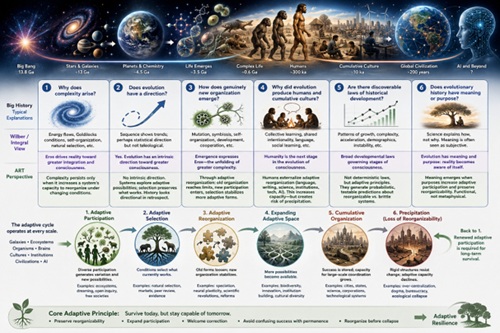
Joseph Dillard's latest response to my overview of the six major questions confronting Big History is interesting for a reason that is both its principal strength and its principal weakness. Rather than answering the six questions within the framework in which they were posed, Dillard proposes to replace them with a single question: not “How does complexity, direction, novelty, humanity, historical regularity, or meaning arise?” but “How do organized systems remain capable of reorganizing themselves?” That shift is intellectually provocative. It also illustrates a recurring problem with grand theoretical frameworks: the proposed solution to excessive theoretical ambition can itself become another master principle. Dillard's essay, written with ChatGPT, presents Adaptive Reorganization Theory (ART) as a corrective to both Wilberian developmentalism and conventional Big History. Its central claim is that “adaptive reorganizability” is more fundamental than complexity, development, consciousness, or even evolution. Systems survive, according to ART, not because they continually climb toward greater complexity or higher developmental stages, but because they retain the capacity to reorganize when circumstances change. There is something genuinely valuable here. But Dillard's response also demonstrates that replacing one organizing metaphor with another does not automatically produce a stronger explanatory theory. Dillard correctly identifies a real problemThe strongest part of Dillard's argument is his criticism of developmentalism. My six-question essay deliberately put Wilber's evolutionary metaphysics alongside the more scientifically cautious traditions of Big History. One of the central concerns was precisely the temptation to turn a historical sequence into a developmental hierarchy. The fact that complexity, life, intelligence and culture appeared successively does not establish that the universe was “trying” to produce them. Nor does the fact that some human capacities historically appeared later establish that they are therefore intrinsically superior. Dillard sharpens this criticism effectively. A highly complex system can become brittle. A sophisticated bureaucracy can become incapable of responding to changing circumstances. A scientific paradigm can accumulate enormous explanatory success and nevertheless become resistant to anomalous evidence. A civilization can reach extraordinary levels of technological development while simultaneously losing its capacity for institutional correction. Dillard is therefore right that “development” and “adaptability” are not synonymous. This is an important corrective to Wilber. It also connects with one of the deepest problems in developmental theories generally: the tendency to identify the endpoint of a developmental sequence with the criterion of successful adaptation. ART reverses this relationship. A supposedly “higher” system is not necessarily better if it is less capable of learning, correcting itself and responding to its environment. That is a useful insight. Indeed, I would go further: “reorganizability” could become a valuable concept in discussions of political institutions, scientific communities, organizations and civilizations. The ability of a system to generate corrective feedback may be considerably more important than its location on a developmental ladder. But this does not yet make ART a theory of Big History. The first problem: Dillard changes the questionsThe most fundamental difficulty is methodological. My six questions were deliberately designed to remain distinct: Why does complexity arise? Does evolution have direction? How does novelty emerge? Why did humans develop cumulative culture? Are there discoverable historical regularities? Does evolution possess meaning or purpose? The essay explicitly argues that these questions belong partly to different explanatory domains. Cosmology, thermodynamics, chemistry, biology, evolutionary theory, anthropology, cultural evolution, history and philosophy contribute different pieces of the explanation. The conclusion therefore proposes a “layered Big History” rather than a single master theory. Dillard nevertheless characterizes the six questions as if Big History treats them as “independent philosophical puzzles” and then proposes to reveal the “deeper concern” supposedly underlying all of them. That is not quite what the original essay says. In fact, the original essay explicitly warns against precisely this reduction. Its concluding argument is that the six questions should be connected without being collapsed into a single explanatory principle. This makes Dillard's response somewhat ironic. He criticizes Big History and Wilber for looking for master principles, while introducing adaptive reorganization as the principle that supposedly underlies complexity, direction, emergence, humanity, historical regularity and meaning. He has not really answered the six questions. He has proposed that they are all manifestations of another question. That is an interesting philosophical move, but it is not the same thing. From Eros to reorganizabilityDillard's most explicit target is Wilber's evolutionary Eros. Here he is on much firmer ground. Wilber's Eros is supposed to explain the persistent appearance of greater complexity, consciousness and integration. But as my Big History essay argued, there is a large difference between observing evolutionary creativity and establishing a causal principle of cosmic creativity. Dillard removes the metaphysical problem by simply dispensing with Eros. That is an improvement. But ART then faces a problem of its own. If adaptive reorganization is supposed to explain the history of galaxies, organisms, civilizations and artificial intelligence, what exactly is the status of “adaptation” at each of these levels? A bacterium clearly adapts in an evolutionary sense. An organism has physiological and behavioral mechanisms that respond to environmental conditions. A corporation can reorganize itself. A government can reform its institutions. But does a galaxy adapt? Does a star reorganize itself because environmental feedback demands it? If the answer is no, then ART cannot straightforwardly function as a universal theory of Big History. If the answer is yes, Dillard needs to specify what “adaptation” means when applied to nonliving systems. This is not a trivial semantic issue. It determines whether ART is a theory of biological and cultural adaptation or a universal metaphysics of organization. Dillard is trying to occupy both positions simultaneously. “Adaptive reorganization” risks becoming another master principleThere is a revealing passage near the end of my original essay: “Almost every grand theory of evolution risks introducing a master principle.” I mention energy-rate density, Goldilocks conditions, self-organization, the adjacent possible, Eros and increasing complexity as examples. The warning is that once a concept becomes sufficiently broad, it can accommodate almost anything. Dillard's ART runs precisely this risk. • Mutation becomes adaptive reorganization. • Symbiosis becomes adaptive reorganization. • Learning becomes adaptive reorganization. • Dreaming becomes adaptive reorganization. • Scientific revolutions become adaptive reorganization. • Constitutional reform becomes adaptive reorganization. • Artificial intelligence becomes adaptive reorganization. But what explanatory work is being done by the common label? If mutation, symbiosis, learning, institutional reform and scientific revolutions are already recognized as very different mechanisms, saying that they are all instances of “adaptive reorganization” may identify a family resemblance without explaining why any particular transition occurred. This is the same distinction that my essay made concerning Wilber's Eros. A metaphorical unity is not necessarily causal unity. Dillard correctly criticizes Eros for being too broad to explain the mechanisms of novelty. But unless ART specifies conditions under which adaptive reorganization should occur, it risks becoming a more secular version of the same explanatory strategy. Selection and reorganization are not as easily separated as Dillard suggestsDillard makes an important distinction between selection and reorganization. Selection, he argues, preserves configurations that work, whereas reorganization generates new possibilities. This is suggestive, but evolutionary biology makes the distinction considerably messier. Natural selection does not merely preserve finished configurations. Selection can itself alter developmental trajectories, ecological relationships, gene frequencies and the structure of populations. Conversely, processes generating novelty do not necessarily exist independently of selection. Developmental bias, mutation, recombination, symbiosis, niche construction and selection interact. Dillard is therefore in danger of constructing a neat conceptual division where evolutionary reality is considerably more entangled. The stronger formulation would be that evolutionary systems contain interacting processes of variation, generation, stabilization, selection and reorganization. “Reorganization” may be a useful higher-level description of some of these processes, but it does not automatically replace them as an explanation. That distinction matters enormously if ART wants to position itself as a corrective to Big History rather than simply as a philosophical vocabulary laid over it. The “precipitation” problemDillard introduces another interesting term: “precipitation.” A successful organization eventually becomes rigid. The very structures that once generated adaptive success become obstacles to further adaptation. This is intuitively plausible and potentially useful. But the theory currently appears to define precipitation retrospectively. When an organization succeeds, it is adaptive organization. When it later becomes rigid, it has precipitated. When it successfully reorganizes, that is adaptive sublimation. The danger is circularity. How do we determine in advance that a system has entered precipitation? How much rigidity is too much? How much reorganizability is sufficient? What measurable variables distinguish adaptive organization from maladaptive organization? And most importantly: can ART predict when a system will reorganize successfully rather than merely explain afterward why it did? Dillard claims that ART generates empirically testable propositions, which is encouraging. He proposes, for example, that systems preserving adaptive participation should remain reorganizable longer and that organizations mistaking temporary success for permanent adequacy should become increasingly brittle. These are testable in principle. But they are still closer to research hypotheses than to established laws. The difficult work would consist in operationalizing “adaptive participation,” “reorganizability,” “brittleness” and “corrective participation” well enough that competing researchers could measure them independently. That is precisely where a promising conceptual framework must eventually leave philosophy and enter empirical science. The most interesting idea: corrigibilityThere is nevertheless a particularly strong idea buried in ART: corrigibility. Dillard repeatedly emphasizes the capacity of systems to receive corrective feedback and change themselves before external pressures force collapse. This applies naturally to organizations, political systems, scientific institutions and AI. This may actually be more promising than the larger cosmic claims. Consider science. A healthy scientific institution is not one that has reached the highest “stage.” It is one that possesses mechanisms for detecting and correcting error. Consider democracy. Its strength need not lie in the developmental altitude of its citizens but in institutionalized mechanisms of feedback, contestation, revision and peaceful transfer of power. Consider AI. The relevant question may indeed be less “Is AI conscious?” than “Can an AI system recognize error, respond to correction and remain under meaningful human control?” Here ART touches a contemporary concept that is arguably more concrete than its broader evolutionary language: adaptive systems need mechanisms of error detection and correction. That is a genuinely valuable contribution. But ART does not answer the question of human uniquenessDillard's answer to the fourth Big History question is that humanity “externalized adaptive reorganization itself.” Language, writing, science, markets and legal institutions allow adaptive information to be stored outside individual brains and transmitted across generations. This is one of the stronger sections of the essay. But again, it is not really an alternative to the Big History literature so much as a reinterpretation of it. David Christian's collective learning, Michael Tomasello's shared intentionality, Joseph Henrich's cultural evolution and related approaches already explain much of what Dillard is pointing toward. My original essay explicitly discussed these mechanisms. Dillard's contribution is to redescribe them under the heading of adaptive reorganization. That may be useful theoretically. But a redescriptive framework becomes explanatory only when it generates predictions that the underlying theories do not. Otherwise ART is functioning as an umbrella concept rather than a competing theory. The answer to historical laws is promising but incompleteDillard is also right to resist deterministic historical laws. Human societies are reflexive systems. They learn. They respond to theories about themselves. They change their institutions deliberately. Historical actors are not particles obeying fixed equations. The original essay made essentially the same point in discussing cliodynamics and the work of Grinin, Korotayev and Turchin. Historical regularities may be probabilistic rather than deterministic. Dillard's proposed adaptive principles could potentially contribute to this research. But again, the crucial question is empirical. Can ART predict which institutional arrangements will remain resilient? Can it predict when bureaucratic complexity will become maladaptive? Can it predict when decentralization will outperform centralization? Can it predict when a scientific paradigm is approaching “precipitation”? Can two researchers independently measure reorganizability and reach similar conclusions? Until such questions are answered, ART remains a promising conceptual research program rather than a demonstrated general theory. That is not a dismissal. It is simply the appropriate scientific status to assign it. The weakest move: making meaning functionalThe sixth question exposes a more serious philosophical problem. Dillard says that ultimate cosmic purpose is metaphysical and therefore outside empirical investigation. So far, so good. He then proposes that meaning is a “functional property” of adaptive systems. Purposes that preserve adaptive participation become meaningful in a functional sense; purposes that suppress participation become maladaptive. But something important has happened here. The question “Does evolution possess meaning?” has quietly been transformed into “What kinds of purposes promote adaptive capacity?” Those are not the same question. If I ask whether the universe has meaning, telling me that certain organizational purposes are adaptive does not answer me. Indeed, Dillard's functional account risks confusing value with viability. A purpose can be extraordinarily adaptive and still be morally objectionable. A totalitarian regime may be highly effective at preserving itself. A parasite can be superbly adapted to its host. A cancer is an extraordinary example of cellular survival and proliferation precisely at the expense of the larger organism. Adaptation is not synonymous with value. This is a crucial limitation of any attempt to derive meaning from evolutionary success. Dillard's strongest position would therefore be a modest one: adaptive reorganizability may provide a useful account of functional purpose, while existential meaning remains an open philosophical question. That would be entirely defensible. Trying to make ART answer the meaning question makes the framework weaker. Dillard's critique of Wilber is stronger than his critique of Big HistoryThere is an interesting asymmetry in the essay. As a critique of Wilber, Dillard is often persuasive. The distinction between development and adaptability is useful. The criticism of developmental hierarchy is well taken. The warning that Integral itself must remain corrigible is especially important. Dillard is also right that AQAL is primarily a multidimensional mapping framework and that describing perspectives is not necessarily the same as explaining processes of change. But as a critique of Big History, the argument is much less convincing. Big History does not need a single adaptive principle. In fact, the version I presented explicitly argues against one. It proposes a layered explanatory architecture precisely because different levels require different mechanisms. Dillard is therefore attempting to solve a problem that Big History, at least in its more sophisticated forms, already recognizes. This makes his essay less a refutation of the six questions than a proposal for looking at them through a different conceptual lens. The irony of the master principleThere is an amusing irony here. Wilber says: evolution is driven by Eros. Some Big Historians say: complexity and energy flows provide the key. Dillard says: adaptive reorganizability is the deeper principle. My own conclusion was: perhaps we should stop looking for one principle altogether. In that sense, Dillard's essay unintentionally strengthens the case for the pluralistic position. The history of the universe may genuinely consist of multiple explanatory regimes. Thermodynamics does not become biology. Natural selection does not become cultural evolution. Cultural evolution does not become macrohistory. And none of these automatically becomes a theory of meaning. There may be deep structural analogies among them without there being one mechanism underneath them all. This is perhaps the most important lesson of Big History. What Dillard adds to the six questionsNevertheless, Dillard's response should not be dismissed. It adds a useful seventh question: “How does an organized system preserve its capacity to reorganize?” That question cuts across all six of the original questions. Complexity raises the problem of rigidity. Evolution raises the problem of adaptability. Novelty raises the problem of reorganization. Human culture raises the problem of institutionalized learning. Historical laws raise the problem of resilience. Meaning raises the problem of whether our purposes expand or contract our capacity to adapt. Seen this way, ART is best understood not as a replacement for Big History but as a conceptual overlay on it. And that is actually consistent with Dillard's own concluding claim that ART should be a “corrective rather than a replacement.” I would accept that formulation. A useful corrective, but not yet a theory of everythingDillard's response is therefore simultaneously insightful and overambitious. Its insight is that development, complexity and sophistication should not be confused with adaptive success. Its strongest concept is not cosmic evolution but reorganizability: the capacity of a system to receive corrective feedback, abandon successful but obsolete arrangements and generate new organizational possibilities. Its weakness is that ART currently risks becoming exactly what it criticizes: a master principle sufficiently general to accommodate almost everything. If mutation, symbiosis, learning, dreaming, institutional reform, scientific revolutions and AI are all manifestations of adaptive reorganization, we still need to know what causes each process, under what conditions it occurs, how it differs from other processes, and how ART can make predictions that competing theories cannot. That is the scientific test that remains. The best outcome, therefore, is not to choose between Big History and ART. Big History provides the empirical and interdisciplinary map. ART potentially supplies a useful question about resilience, feedback and organizational rigidity. Evolutionary biology supplies mechanisms of variation and selection. Cultural evolution explains cumulative learning. Historical sociology investigates recurring patterns in human societies. Complexity theory investigates self-organization and emergent dynamics. Philosophy asks what, if anything, the entire story means. No single framework needs to swallow all the others. And that brings us back to the central lesson of the original six questions. The intellectual temptation is always to discover the one principle behind everything. Dillard has made a compelling case that “development” is not that principle. But he has not yet demonstrated that “adaptive reorganization” is. Perhaps the more mature position is even more modest: the universe has produced systems capable of organization, adaptation, learning, selection and reorganization, but the relationships among these processes may be more interesting—and more scientifically defensible—than any single theory that claims to reduce them to one. In that respect, Dillard has not closed the Big History debate. He has added a very interesting seventh question to it.
Widget is loading comments...
|