|
TRANSLATE THIS ARTICLE
Integral World: Exploring Theories of Everything
An independent forum for a critical discussion of the integral philosophy of Ken Wilber
 Dr. Joseph Dillard is a psychotherapist with over forty year's clinical experience treating individual, couple, and family issues. Dr. Dillard also has extensive experience with pain management and meditation training. The creator of Integral Deep Listening (IDL), Dr. Dillard is the author of over ten books on IDL, dreaming, nightmares, and meditation. He lives in Berlin, Germany. See: integraldeeplistening.com and his YouTube channel. He can be contacted at: joseph.dillard@gmail.com Dr. Joseph Dillard is a psychotherapist with over forty year's clinical experience treating individual, couple, and family issues. Dr. Dillard also has extensive experience with pain management and meditation training. The creator of Integral Deep Listening (IDL), Dr. Dillard is the author of over ten books on IDL, dreaming, nightmares, and meditation. He lives in Berlin, Germany. See: integraldeeplistening.com and his YouTube channel. He can be contacted at: joseph.dillard@gmail.com
SEE MORE ESSAYS WRITTEN BY JOSEPH DILLARD
Check out my other conversations with ChatGPT Big History from the Perspective of Adaptive Reorganization TheoryJoseph Dillard / ChatGPT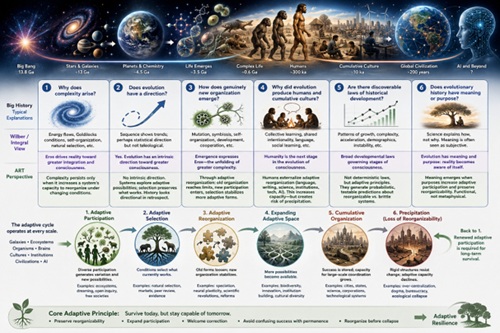 Before answering the six questions of Big History, it is helpful to recognize that Adaptive Reorganization Theory (ART) begins from a different starting point. Most Big History approaches ask why the universe has produced increasing complexity, increasingly sophisticated forms of organization, and eventually human civilization. Wilber's Integral Theory goes further by interpreting this apparent trajectory as evidence of an intrinsic evolutionary impulse toward greater consciousness and integration. ART neither rejects these observations nor embraces their metaphysical interpretation. Instead, it proposes that the most fundamental phenomenon is neither complexity nor development but adaptive reorganizability. Across every scale—from biological evolution to civilizations and artificial intelligence—the central question is not whether systems become more complex, but whether they retain the capacity to reorganize themselves in response to changing reality. This seemingly modest shift changes the answer to each of Big History's six central questions. Why Does Complexity Arise at All?Big History generally points to thermodynamics, energy flows, Goldilocks conditions, self-organization, and natural selection as complementary explanations. Wilber interprets increasing complexity as evidence of Eros, an intrinsic drive toward greater integration and consciousness. ART accepts that complexity repeatedly emerges throughout cosmic and biological history but denies that complexity itself is the primary explanatory variable. Complexity has no adaptive value simply because it is complex. It persists only when it increases the capacity of a system to reorganize under changing conditions. Many increases in complexity are adaptive because they permit greater flexibility, richer forms of coordination, or more effective responses to novel circumstances, yet many equally impressive increases in complexity become liabilities. Highly bureaucratic governments, elaborate corporate hierarchies, over-specialized scientific paradigms, and excessively interconnected technological systems often become increasingly rigid precisely because they have become more complex. From the perspective of ART, complexity is therefore instrumental rather than directional. The important question is not whether complexity increases but whether reorganizability increases along with it. When complexity supports adaptive reorganization it becomes an asset. When it inhibits adaptive reorganization it becomes what ART calls precipitation: successful organization that has become too rigid to respond effectively to changing conditions. Does Evolution Have Direction?The second question concerns direction. Looking backward across cosmic history, the sequence from elementary particles to galaxies, living organisms, consciousness, language, and civilization strongly suggests movement toward ever greater organization. Wilber interprets this pattern as evidence for an inherent evolutionary direction. Many Big Historians acknowledge statistical trends while rejecting teleology. ART offers a different interpretation altogether. Adaptive systems continually explore possibility spaces generated by changing environments and internal variation. Evolution has no intrinsic direction in the sense of aiming toward predetermined outcomes. To do so would limit the variability and potential generative reformulations of nature, the result of which would be to inevitably limit evolutionary possibilities. Adaptive selection preserves configurations that function under existing conditions, while adaptive reorganization expands the range of configurations that become possible in the future. These are distinct processes. Selection explains why certain organizations survive. Reorganization explains how new possibilities become available. Apparent direction arises retrospectively because unsuccessful adaptive experiments disappear from history while successful ones accumulate. The resulting sequence appears progressive even though it reflects continual experimentation constrained by reality rather than movement toward a predetermined destination. Evolution is therefore neither purposive nor random. It is an ongoing process of constrained adaptive exploration. How Do New Forms Emerge?Contemporary evolutionary theory offers numerous mechanisms: mutation, recombination, symbiosis, developmental processes, niche construction, self-organization, cooperation, and cultural transmission. ART accepts all of these while asking what they have in common. It proposes that each represents a particular instance of adaptive reorganization. Major evolutionary innovations consistently follow a recognizable pattern. Existing organization reaches the limits of its adaptive effectiveness. Previously stable structures become partially destabilized. New forms of participation enter the system through processes as diverse as mutation, cooperation, learning, dreaming, or institutional innovation. Adaptive selection then stabilizes those reorganizations that prove more functional than their predecessors. This same sequence appears repeatedly throughout natural and cultural history. Independent cells reorganize into multicellular organisms. Neural networks reorganize into increasingly sophisticated brains. Language reorganizes social learning. Scientific revolutions reorganize inherited paradigms. Constitutional governments reorganize political authority. Artificial intelligence may eventually reorganize cognitive participation itself. Mutation, symbiosis, dreaming, scientific inquiry, play, and cultural innovation therefore become diverse mechanisms through which the deeper principle of adaptive reorganization operates.
How Do We Explain Humanity's Uniqueness?The fourth question concerns humanity and cumulative culture. Big History generally explains humanity's uniqueness through collective learning, shared intentionality, language, imitation, cooperation, and cultural evolution. ART agrees that these developments distinguish humans from every other known species, but interprets their significance somewhat differently. Humanity became evolutionarily distinctive because it externalized adaptive reorganization itself. Language stores organizational knowledge beyond individual memory. Writing preserves adaptive discoveries across generations. Science institutionalizes methods for correcting error. Markets coordinate distributed experimentation. Legal systems preserve successful organizational arrangements while allowing revision. Artificial intelligence extends this process still further by participating directly in information processing and problem solving. Each innovation increases civilization's capacity to reorganize beyond the limits of biological evolution alone, yet this achievement contains an inherent paradox. Every successful system of stored organization gradually becomes increasingly rigid. Institutions, traditions, bureaucracies, scientific paradigms, and technological infrastructures accumulate successes while simultaneously becoming resistant to the very reorganization that originally made them successful. Cumulative culture therefore solves one adaptive problem while gradually creating another. Human civilization advances by increasing its capacity to store successful organization, but it simultaneously increases the danger of precipitation. This explains why periods of extraordinary success are often followed by adaptive crises rather than indefinite progress. Does History Exhibit Discoverable Laws?Big History increasingly seeks statistical regularities through demographic models, technological acceleration, complexity measures, and macrohistorical analysis. ART welcomes this effort but distinguishes between deterministic laws and adaptive principles. Human societies differ fundamentally from physical systems because they continually modify their own organizational rules in response to changing circumstances. Consequently, historical regularities are unlikely to resemble the universal laws of physics. Instead, ART proposes probabilistic adaptive principles that generate empirically testable predictions. Systems that preserve adaptive participation should remain reorganizable longer than systems that suppress corrective participation. Organizations that mistake temporary success for permanent adequacy should become increasingly brittle over time. Expanding adaptive space should improve adaptive selection. Identity structures that resist corrective participation should progressively diverge from external reality. Dream interviewing, reflective inquiry, and other methods that expand adaptive participation should measurably increase behavioral flexibility. Artificial intelligence functioning as an additional participant rather than an unquestioned authority should outperform either humans or AI operating alone. These propositions do not function as historical narratives but as hypotheses capable of empirical investigation and potential falsification. Does Evolution Possess Meaning or Purpose?Here ART deliberately separates two issues that are often conflated. Whether the universe possesses ultimate purpose is a metaphysical question that lies beyond empirical investigation. Whether adaptive reorganization possesses functional significance is an empirical question. ART therefore refrains from claiming that evolution unfolds toward a predetermined spiritual destination while equally rejecting the conclusion that meaning is merely subjective invention. Meaning emerges whenever adaptive systems organize themselves around purposes that increase adaptive participation and preserve reorganizability. Purposes that progressively narrow participation, shorten temporal horizons, suppress corrective feedback, or rigidify identity ultimately undermine adaptive capacity regardless of how compelling they appear. Purposes that continually expand participation, facilitate correction, and preserve reorganizability become increasingly adaptive. Meaning therefore becomes neither an intrinsic property of the universe nor an arbitrary human projection. It becomes a functional property of adaptive systems themselves. Big History Questions As Different Expressions of a Single Adaptive ProblemBig History asks why complexity increases, whether evolution has direction, how novelty emerges, why humanity appeared, whether history displays lawful regularities, and whether the entire process possesses meaning. It approaches these as independent philosophical puzzles. ART suggests that each question reflects a deeper concern: how organized systems preserve the capacity to reorganize before changing conditions render their previous successes maladaptive. Complexity becomes organized adaptive capacity. Apparent direction becomes the historical accumulation of successful adaptive selection. Emergence becomes adaptive reorganization. Humanity becomes the externalization of adaptive reorganization through language, culture, institutions, and technology. Historical regularities become recurring patterns in the preservation or loss of reorganizability. Meaning becomes participation in processes that maintain adaptive capacity over time. Rather than replacing Big History, Adaptive Reorganization Theory offers a unifying adaptive framework within which its diverse findings can be interpreted. Big History excels at identifying the major transitions that have shaped the universe and at explaining many of the mechanisms responsible for those transitions. ART asks a different question: what common adaptive dynamic underlies them all? Its answer is not increasing complexity, energy flow, information, or cosmic purpose, but the continual tension between organization and reorganizability. Every adaptive system, from galaxies and ecosystems to civilizations and artificial intelligence, faces the same enduring challenge. It must become organized enough to survive while remaining reorganizable enough to adapt before the organization that once guaranteed success becomes the very source of failure. That shift in emphasis transforms Big History from a story of increasing complexity into a general theory of adaptive resilience. SEE ALSOTo learn more about Adaptive Reorganization Theory (ART), see AdaptiveReorganizationTheory.com.
Widget is loading comments...
|