|
TRANSLATE THIS ARTICLE
Integral World: Exploring Theories of Everything
An independent forum for a critical discussion of the integral philosophy of Ken Wilber
  Frank Visser, graduated as a psychologist of culture and religion, founded IntegralWorld in 1997. He worked as production manager for various publishing houses and as service manager for various internet companies and lives in Amsterdam. Books: Ken Wilber: Thought as Passion (SUNY, 2003), and The Corona Conspiracy: Combatting Disinformation about the Coronavirus (Kindle, 2020). Frank Visser, graduated as a psychologist of culture and religion, founded IntegralWorld in 1997. He worked as production manager for various publishing houses and as service manager for various internet companies and lives in Amsterdam. Books: Ken Wilber: Thought as Passion (SUNY, 2003), and The Corona Conspiracy: Combatting Disinformation about the Coronavirus (Kindle, 2020).
Check out my other conversations with ChatGPT Adaptive Reorganization Theory as a Corrective to Integral DevelopmentalismA Critical Review of Joseph Dillard's New ART ApproachFrank Visser / ChatGPT
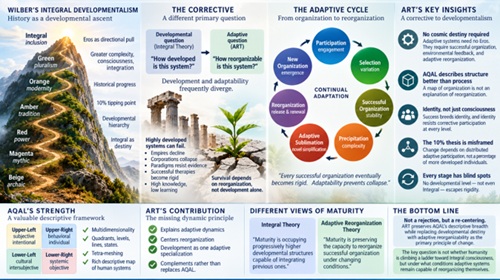
Joseph Dillard's new essay, “Adaptive Reorganization Theory as a Corrective to Integral Developmentalism,” is an interesting development in his increasingly systematic attempt to move beyond Ken Wilber's developmentalism. It is also revealing because Dillard does not simply criticize Wilber this time. Instead, he proposes a competing organizing principle: not development, consciousness, complexity, or Eros, but “adaptive reorganizability.” The essay is explicitly presented as a response to my review of Wilber's Revolutionary Social Transformation. Dillard regards that review as methodologically strong because it questions Wilber's transformation of descriptive developmental distinctions into metaphysical claims. His objection is that even this critique remains too much within Wilber's conceptual universe. The more fundamental question, he argues, is not whether development is real, but whether development deserves to occupy the central explanatory position at all. That is a promising move. But Dillard's proposed alternative is considerably less developed than his criticism of Wilber. ART currently looks less like a fully articulated theory than like a useful meta-principle around which a theory might eventually be constructed. From developmental altitude to adaptive reorganizabilityDillard's central distinction is simple and potentially powerful. Wilber asks: “How developed is this system?” Dillard asks: “How reorganizable is this system?” The distinction matters. A highly sophisticated institution can become rigid. A corporation can accumulate enormous expertise and subsequently become incapable of responding to technological disruption. A scientific paradigm can become increasingly elaborate while becoming less receptive to anomalous evidence. A political movement can become ideologically sophisticated while becoming incapable of self-correction. Dillard therefore argues that development and adaptability can diverge. This is probably the strongest idea in the essay. It attacks one of the perennial problems of developmental theories: the tendency to confuse complexity, sophistication or developmental altitude with adaptive fitness. A later stage may be more complex than an earlier one and yet be less capable of responding to a particular environment. This point also fits remarkably well with evolutionary thinking. Evolution does not reward organisms for being “higher.” It rewards, in the limited and contingent sense relevant to natural selection, reproductive success in particular environments. Simplification can be adaptive. Loss can be adaptive. Specialization can be adaptive. Extinction can be the consequence of changing environmental conditions rather than a failure to climb a developmental ladder. Dillard is therefore right to attack the implicit equation: more developed = more adaptive = better. Those are three different propositions, and Wilber often moves between them too easily. But “reorganizability” is not yet an explanationHere, however, the argument begins to run into trouble. Dillard repeatedly presents adaptive reorganization as if naming it solves the explanatory problem. But it doesn't. The obvious next question is: what produces adaptive reorganization? The essay identifies three processes: “successful organization,” “environmental feedback,” and “adaptive reorganization.” But the third term is essentially the phenomenon that needs explaining. Why does one organization reorganize successfully while another does not? What mechanisms determine the difference? How much organizational inertia is optimal? What makes a system capable of detecting environmental feedback? How does it distinguish signal from noise? What determines whether feedback is incorporated, rejected, or neutralized? What institutional structures facilitate reorganization? What prevents endless reorganization from destroying accumulated functionality? These are precisely the questions that a substantive theory of adaptation would need to answer. In that sense, ART currently risks replacing Wilber's “Eros” with a more respectable-sounding black box. Wilber says that evolution is somehow pulled toward greater complexity and consciousness. Dillard says that systems reorganize when adaptive conditions require it. The latter is much more empirically defensible, but it remains incomplete until the mechanisms are specified. “Adaptive reorganization” is an excellent research question. It is not yet an adequate theory. Dillard's best criticism of Wilber: adaptation does not imply hierarchyThe essay becomes particularly effective when it applies this insight to developmental hierarchy. Dillard proposes an adaptive cycle: Participation ? Selection ? Successful Organization ? Precipitation ? Adaptive Sublimation ? Reorganization ? New Organization. The terminology is somewhat unnecessarily elaborate, but the underlying idea is sound. Every successful solution can eventually become a constraint. What works under one set of conditions can become maladaptive under another. Success produces investment, institutionalization and identity, and these can subsequently produce rigidity. This is a genuinely important corrective to Integral developmentalism. The implication is that there is no final stage at which a system has permanently solved the problem of adaptation. Even an “Integral” institution can become rigid. Even a supposedly post-conventional worldview can become dogmatic. Even people who pride themselves on being exceptionally open-minded can become identified with their openness. Dillard has been making versions of this argument for years. His concept of “psychological geocentrism” similarly argues that people tend to mistake their own perspective for the center of reality, and that this tendency can persist regardless of education or developmental sophistication. ART gives that earlier insight a more general systems-theoretical formulation. And this is where Dillard potentially has something genuinely original to contribute to the Integral debate. The problem with “precipitation” and “sublimation”Unfortunately, Dillard's terminology sometimes obscures rather than clarifies the argument. He says that “precipitation” generates complexity and “sublimation” generates novel simplification. But why call these processes precipitation and sublimation? In chemistry and physics, these terms already have reasonably specific meanings. Their use here is metaphorical. That is not necessarily illegitimate, but it creates an unnecessary burden of definition. The reader has to learn a new vocabulary for phenomena that could initially be described much more simply as consolidation, differentiation, simplification, destabilization and reorganization. This is particularly unfortunate because one of the problems with Integral Theory is already its enormous proliferation of specialized terminology. A genuinely useful alternative should ideally reduce conceptual inflation rather than reproduce it in a new vocabulary. Dillard is strongest when he says something straightforward such as “successful systems can become rigid.” He is weaker when this becomes “every adaptive success eventually precipitates excessively and requires adaptive sublimation.” The latter sounds theoretical without necessarily being more explanatory. AQAL as map, ART as processAnother interesting claim is that AQAL describes structure better than process. Dillard says that AQAL provides an extraordinarily broad map of perspectives, developmental levels, lines, states and quadrants, but does not explain how successful organizations become capable of reorganizing themselves. He therefore characterizes AQAL as “adaptive architecture” and ART as “adaptive dynamics.” This is a useful distinction, but Dillard may be understating what AQAL actually attempts to do. Wilber's Integral Theory is certainly not merely a static taxonomy. Developmental stages, transformation, transcend-and-include, differentiation and integration, tetra-meshing and evolutionary processes are all intended to describe change. The problem is not that Wilber has no theory of process. The problem is that his process theory frequently becomes teleological. That distinction is important. The criticism should therefore not be: “AQAL describes structure; ART explains process.” It would be more accurate to say: “AQAL describes processes through a developmental and often teleological framework, whereas ART attempts to describe change without assuming a universal developmental direction.” That is a much stronger claim. It identifies the actual philosophical difference. The evolutionary advantage of ARTThis is where ART could potentially connect much more fruitfully with contemporary evolutionary theory than Integral Theory has traditionally done. Dillard writes that direction can emerge retrospectively from repeated adaptive success without requiring a predetermined destination. That is a significant improvement over Wilber's formulation of Eros. There is no need to posit an intrinsic cosmic tendency toward greater consciousness. Complexity can arise because particular configurations happen to be stable or reproductively successful under particular conditions. Apparent directionality can emerge from cumulative selection without implying that evolution “knows” where it is going. But Dillard should push this argument much further. He currently uses “adaptive” almost as a universal solvent. Evolutionary biology already has an enormous literature on variation, selection, drift, niche construction, developmental constraint, robustness, evolvability, plasticity, modularity, self-organization and major transitions in individuality. ART would become much more interesting if Dillard explicitly situated it within that literature. Otherwise, there is a danger that “adaptive reorganization” becomes a philosophical abstraction hovering above evolutionary biology rather than a theory that engages it. The 10 percent thesis: a useful reframingDillard is particularly persuasive in his treatment of Wilber's famous “10 percent” thesis. Wilber has suggested that when a sufficient proportion of a population reaches a higher developmental level, social transformation can become possible. Dillard argues that this gets the causal relationship backwards. What matters is not simply how many individuals occupy a higher developmental stage, but whether a society possesses mechanisms that allow adaptive feedback and reorganization to propagate through the system. This is a much more interesting way of thinking about social transformation. A society does not necessarily change because enough people become “Integral.” It may change because its institutions become capable of processing information, correcting errors, incorporating dissent, experimenting, learning and revising policies. That shifts the explanatory focus from developmental psychology to institutional design. Democratic feedback, scientific peer review and distributed intelligence are therefore potentially more important than the developmental altitude of the individuals participating in them. That is a strong challenge to Integral elitism. But again, Dillard needs to be careful. These institutions are not automatically adaptive. Democracies can become dysfunctional. Peer review can become conservative. Markets can generate enormous path dependencies. Distributed intelligence can amplify collective stupidity. AI can magnify rather than correct human biases. So the real research question is not merely which institutions produce adaptive reorganization, but under what conditions they do so. That would be the next step for ART. The most interesting idea: adaptability without developmental exceptionalismThe essay's most provocative implication is that nobody gets permanently promoted out of the adaptive game. Dillard explicitly applies this to ART itself: “including Adaptive Reorganization Theory itself.” That self-application is important. Integral Theory has always had a peculiar vulnerability: it can criticize virtually every worldview as partial while positioning itself as the framework capable of integrating them all. “Integral” therefore risks becoming the final privileged perspective. Dillard's framework potentially avoids this trap because it defines success not as reaching a superior worldview but as maintaining the capacity for correction. That is a substantially more modest criterion. And modesty is precisely what a post-metaphysical theory of development needs. Yet ART risks becoming another master principleThere is an irony here. Dillard criticizes Integral Theory for putting development at the center of everything. But ART may be tempted to put adaptability at the center of everything instead. That would reproduce the same structural problem at a lower metaphysical temperature. What if not everything is best understood in terms of adaptation? Art, play, contemplation, love, curiosity, scientific inquiry and moral commitment cannot necessarily be reduced to “reorganizability.” Even biological evolution itself contains processes that cannot be straightforwardly characterized as conscious or purposive adaptation. There is also a danger in making adaptability the supreme criterion. A dictatorship can be extraordinarily adaptive. An invasive pathogen can be extraordinarily adaptive. A corporation that relentlessly adapts to consumer demand can nevertheless produce socially disastrous outcomes. Adaptability answers the question: “What allows a system to persist or transform under changing conditions?” It does not answer: “Should this system persist?” That distinction matters enormously. Wilber's problem is that he sometimes smuggles “higher” into “more complex.” Dillard must avoid smuggling “better” into “more adaptive.” The essay's relation to Dillard's larger projectThis essay makes considerably more sense when read against Dillard's broader body of work. His earlier writing has repeatedly challenged Integral Theory's emphasis on self-development, mystical experience, hierarchy and psychological “heliocentrism,” while advocating polycentrism and experiential multi-perspectivalism. More recently, he has explicitly questioned whether development should be treated as evolution's highest value. ART therefore isn't an isolated invention. It is an attempt to provide a general theoretical foundation for a criticism Dillard has been developing for years. That gives the essay coherence. But it also reveals its current weakness: Dillard has accumulated many powerful corrective concepts—polycentrism, psychological geocentrism, adaptive reorganization, phenomenological multi-perspectivalism—but the relationships among them remain insufficiently formalized. Are they components of one theory? Different methodological tools? Complementary hypotheses? Metaphors? Or competing explanatory frameworks? ART could provide the organizing architecture, but Dillard has not yet demonstrated that it does. A particularly revealing feature: the AI collaborationThe essay is explicitly labeled “Joseph Dillard / ChatGPT,” and Integral World notes that it contains AI-generated content. That matters intellectually, rather than merely editorially. The essay has the recognizable strengths of AI-assisted theoretical writing: unusually clean conceptual symmetry, rapid reframing, repeated contrasts, memorable formulations and an impressive ability to integrate ideas across a long-running conceptual vocabulary. But some of its weaknesses are also characteristic: concepts can acquire an appearance of theoretical solidity before their empirical status has been established. The progression from “development” to “adaptation” to “reorganization” is rhetorically convincing, but the actual causal machinery remains underdeveloped. In other words, the essay is very good at showing why ART might be a better conceptual lens than developmentalism. It is less successful at demonstrating that ART is already a scientific or explanatory theory. That distinction should be preserved. Does Dillard have a point?Yes—quite a substantial one. The strongest point is that Wilber's developmental hierarchy should not be treated as the master variable for explaining historical or social transformation. Developmental altitude does not guarantee adaptability, and complexity does not guarantee resilience. The second strong point is that evolution does not need a predetermined destination. Dillard's emphasis on retrospective rather than prospective directionality provides a useful alternative to Wilber's Eros without requiring a wholesale rejection of emergence, complexity or developmental change. The third is methodological: social transformation may depend more on feedback and institutional corrigibility than on the percentage of individuals occupying a supposedly higher stage. These are serious contributions. But ART is not yet demonstrated as a theory. At present it is better described as a promising theoretical orientation. Is it relevant today?Very much so. In fact, the essay may be more relevant than some of Dillard's earlier critiques because it addresses a question that has become increasingly difficult for developmental Integral Theory to avoid: what happens when supposedly “higher” systems fail? The contemporary world offers abundant examples of technologically sophisticated but institutionally brittle systems, highly educated populations exhibiting extreme polarization, complex organizations incapable of learning from failure, and movements whose commitment to a sophisticated worldview makes them less—not more—open to correction. The important distinction is therefore not simply between lower and higher. It is between systems that can learn and systems that cannot. That is a much harder distinction to dismiss. VerdictDillard's new essay is one of his more promising recent contributions to the Integral debate. Its central move—shifting the question from developmental altitude to adaptive reorganizability—is both intelligible and potentially important. It exposes a genuine weakness in Wilber's tendency to associate higher development with greater evolutionary or social value. But the essay should not yet be mistaken for a finished alternative theory. ART currently supplies a compelling criterion, a useful vocabulary and a provocative research agenda. It does not yet supply a sufficiently precise account of the mechanisms by which reorganization occurs, the conditions under which it succeeds, the difference between adaptation and mere persistence, or the normative criteria by which adaptive systems should be evaluated. Perhaps the most interesting conclusion is therefore a deliberately modest one: Dillard has not yet replaced Wilber's developmental theory. He has identified a dimension that Wilber's developmentalism badly needs to take seriously. And that may actually be more valuable. The decisive question for Integral Theory may not be whether humanity is moving upward through stages. Nor is it whether Eros is pulling the Kosmos toward greater depth. It may simply be whether a system can learn that its current way of organizing itself no longer works—and reorganize before reality makes the decision for it. That is a much less grandiose proposition than Wilber's evolutionary metaphysics. It is also, at least in principle, a proposition that can be investigated empirically.
Widget is loading comments...
|