|
TRANSLATE THIS ARTICLE
Integral World: Exploring Theories of Everything
An independent forum for a critical discussion of the integral philosophy of Ken Wilber
 Dr. Joseph Dillard is a psychotherapist with over forty year's clinical experience treating individual, couple, and family issues. Dr. Dillard also has extensive experience with pain management and meditation training. The creator of Integral Deep Listening (IDL), Dr. Dillard is the author of over ten books on IDL, dreaming, nightmares, and meditation. He lives in Berlin, Germany. See: integraldeeplistening.com and his YouTube channel. He can be contacted at: joseph.dillard@gmail.com Dr. Joseph Dillard is a psychotherapist with over forty year's clinical experience treating individual, couple, and family issues. Dr. Dillard also has extensive experience with pain management and meditation training. The creator of Integral Deep Listening (IDL), Dr. Dillard is the author of over ten books on IDL, dreaming, nightmares, and meditation. He lives in Berlin, Germany. See: integraldeeplistening.com and his YouTube channel. He can be contacted at: joseph.dillard@gmail.com
SEE MORE ESSAYS WRITTEN BY JOSEPH DILLARD
Check out my other conversations with ChatGPT Adaptive Reorganization Theory as a Corrective to Integral DevelopmentalismJoseph Dillard / ChatGPT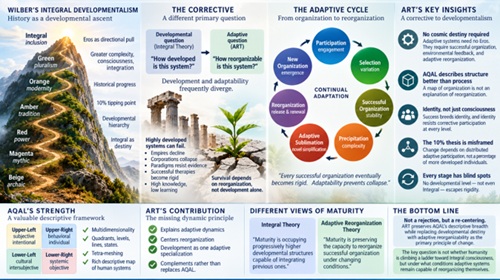 Frank Visser's review of Ken Wilber's Revolutionary Social Transformation is among the strongest critiques of Wilber that has appeared in recent years because it criticizes Wilber on methodological rather than ideological grounds. It does not reject developmental psychology, Integral Theory, or AQAL outright. Instead, it argues that Wilber repeatedly transforms useful descriptive distinctions into comprehensive metaphysical claims. The essay is careful, historically informed, and generally fair. It recognizes Wilber's genuine contributions while questioning whether his larger conclusions actually follow from the evidence. However, from the perspective of Adaptive Reorganization Theory (ART), the deepest limitation of the review is that it remains largely inside Wilber's own conceptual universe. It asks whether development possesses direction, whether Integral represents a higher stage, whether Eros exists, whether the 10 percent tipping point is empirically justified, and whether AQAL is falsifiable. These are worthwhile questions, but ART suggests that they are not the most fundamental ones. The more basic question is not whether development is real but whether development itself is the correct explanatory principle. Development Is Not the Primary VariableThroughout both Wilber's booklet and Visser's critique, history is interpreted primarily through the lens of developmental depth. Wilber believes societies succeed because they evolve toward higher stages of consciousness. Visser questions whether this progression is empirically justified and whether it risks becoming a self-confirming metaphysics. ART shifts the discussion to an entirely different level. The primary adaptive question is not, “How developed is this system?” It is, “How reorganizable is this system?” These are not equivalent. Highly developed systems routinely fail. Large corporations collapse despite decades of accumulated expertise. Scientific paradigms resist evidence. Empires decline precisely at the height of their sophistication. Successful therapies become rigid schools. Highly educated individuals become incapable of learning. None of these failures necessarily involve developmental regression. They involve loss of adaptive reorganizability. Development and adaptability frequently diverge. The Missing Principle: Adaptive ReorganizationVisser correctly observes that Wilber organizes virtually everything around developmental depth. ART proposes that development is only one possible adaptive specialization. Adaptive systems survive not because they continually become more developed but because they continually reorganize successful organization when changing environments require it. This distinction changes almost every historical question. Instead of asking whether the Roman Empire reached a higher developmental stage than earlier civilizations, ART asks why its previously successful organizational structures eventually became incapable of reorganizing. Instead of asking whether modern democracies are becoming more Integral, ART asks whether they remain capable of adaptive correction despite ideological polarization. Instead of asking whether AI is becoming increasingly conscious, ART asks whether AI systems remain corrigible under changing conditions. Development becomes one adaptive outcome rather than the engine of adaptation itself. Direction Versus OpennessOne of Visser's strongest criticisms concerns Wilber's concept of Eros. He argues that Wilber transforms historical contingency into cosmic destiny. Evolution appears to possess an intrinsic direction toward greater complexity, consciousness, and integration. ART neither accepts nor rejects Eros because it does not require it. Adaptive systems need no cosmic attractor. They require only three observable processes:
Direction emerges retrospectively from repeated adaptive success rather than prospectively from an intrinsic pull. Evolution therefore appears directional only after successful reorganizations have accumulated over long periods. The appearance of progress need not imply predetermined destiny. Complexity is often adaptive and sometimes simplification is adaptive. Sometimes decentralization is adaptive and sometimes consolidation is adaptive. Sometimes extinction is adaptive. Adaptive success depends upon environmental fit rather than movement toward any universal developmental endpoint. This replaces teleology with continual adaptive testing. AQAL Describes Structure Better Than ProcessVisser praises AQAL's multidimensionality while questioning its explanatory power. ART would sharpen this criticism. AQAL excels at describing organizational dimensions. It describes perspectives, developmental levels, lines, states, and quadrants. It maps complexity remarkably well, but maps of organization are not explanations of reorganization. The central adaptive mystery is not how systems are organized; it is how successful organizations become capable of reorganizing themselves before failure forces collapse. While AQAL largely describes adaptive architecture, ART attempts to explain adaptive dynamics. The two are therefore complementary rather than mutually exclusive. The Developmental Ladder Becomes an Adaptive CycleVisser worries that Wilber inevitably recreates hierarchy. ART largely dissolves this problem. Developmental levels become only one possible form of successful precipitation. Every adaptive achievement eventually becomes increasingly rigid as every adaptive success eventually risks becoming tomorrow's adaptive trap. The adaptive cycle therefore becomes:
↓ Selection ↓ Successful Organization ↓ Precipitation ↓ Adaptive Sublimation ↓ Reorganization New Organization
“Precipitation” is the generation of complexity. “Sublimation” is the generation of novel simplification. The issue is no longer whether Orange is superior to Amber or Integral superior to Green. The issue is whether each organizational pattern remains reorganizable. A highly reorganizable traditional community may outperform a rigid Integral organization. An adaptable scientific institution may outperform a highly conscious but organizationally inflexible movement. Adaptability replaces hierarchy as the primary evaluative criterion. Identity Rather Than ConsciousnessWilber's model assumes that consciousness develops. ART focuses instead on identity. Identity naturally organizes around successful adaptive structures. The more successful an identity becomes, the more strongly it identifies with its own organization. Eventually organization becomes identity. Identity then resists corrective participation. This process explains ideological rigidity across every developmental level. In humans, ART calls it “psychological geocentrism.” Fundamentalists, scientists, progressives, conservatives, and Integral theorists become rigid. No developmental stage possesses immunity because rigidity emerges from adaptive success itself. This is one of ART's most important departures from developmental psychology. Psychological geocentrism is not a lower-stage phenomenon. It is a universal adaptive tendency. Why the 10 Percent Thesis Misses the PointVisser questions Wilber's claim that when roughly ten percent of a population reaches a higher developmental stage, society transforms. ART suggests that the question itself is misframed. History does not primarily change because a certain percentage of individuals become more developed. History changes when mechanisms of adaptive participation become sufficiently distributed that systems can reorganize themselves more rapidly than environments change. There are multiple pathways to adaptive reorganization: Scientific peer review, competitive markets, constitutional government, distributed intelligence, democratic feedback, artificial intelligence, Integral Deep Listening. These are not primarily developmental achievements; they are adaptive participation technologies. Their importance lies not in raising consciousness but in increasing reorganizability. The unit of analysis shifts from individuals to adaptive systems. The Real Weakness of Integral TheoryVisser argues that AQAL explains almost everything after the fact. ART would make a different criticism. Integral Theory often mistakes adaptive success for developmental superiority. Modernity appears superior because it generated extraordinary technological success. Pluralism appears superior because it corrected many modern excesses. Integral appears superior because it promises to integrate previous stages, but adaptive history repeatedly demonstrates that every successful organization eventually generates its own adaptive blind spots. No developmental level escapes this process, not even Integral. The adaptive question therefore becomes, “How does Integral itself remain corrigible?” That question is largely absent from Wilber's work. ART as a Corrective Rather Than a ReplacementThis does not mean AQAL should be abandoned; quite the contrary. Wilber's quadrants remain among the most sophisticated descriptive frameworks available for analyzing human systems. His insistence that subjective, behavioral, cultural, and systemic dimensions continually interact remains enormously valuable. His concept of tetra-meshing captures something real about multidimensional adaptation. What ART supplies is the missing dynamic principle. Quadrants become domains of participation and development becomes one possible adaptive specialization. Complexity becomes one adaptive strategy and consciousness becomes one organizational variable. None occupies the explanatory center. Adaptive reorganization becomes the central process that explains why successful systems continue adapting—or cease to do so. From Development to ReorganizabilityPerhaps the deepest difference between Integral Theory and Adaptive Reorganization Theory concerns the nature of maturity itself. For Wilber, maturity largely consists in occupying progressively higher developmental structures capable of integrating previous ones. For ART, maturity consists in preserving the capacity to reorganize successful organization under changing conditions. One definition emphasizes where a system stands while the other emphasizes what a system can still become. This difference has profound implications. It means that no civilization, institution, scientific paradigm, religion, political movement, corporation, psychotherapy, or philosophy—including Adaptive Reorganization Theory itself—ever graduates from the adaptive process. Every successful organization eventually precipitates excessively and every identity eventually mistakes its map for reality. Every adaptive system requires continual corrective participation. That is not a defect of development; it is the price of adaptive success itself. Seen in this light, ART is less a rejection of Wilber than a re-centering of his project. It preserves AQAL's extraordinary descriptive breadth while replacing developmental destiny with adaptive reorganizability as the primary principle of change. Instead of asking whether humanity is climbing a ladder toward Integral consciousness, ART asks a more empirically tractable question: under what conditions do adaptive systems remain capable of reorganizing themselves? That shift does not eliminate development; it places development within the broader and more fundamental dynamics of adaptation.
Widget is loading comments...
|