|
TRANSLATE THIS ARTICLE
Integral World: Exploring Theories of Everything
An independent forum for a critical discussion of the integral philosophy of Ken Wilber
  Frank Visser, graduated as a psychologist of culture and religion, founded IntegralWorld in 1997. He worked as production manager for various publishing houses and as service manager for various internet companies and lives in Amsterdam. Books: Ken Wilber: Thought as Passion (SUNY, 2003), and The Corona Conspiracy: Combatting Disinformation about the Coronavirus (Kindle, 2020). Frank Visser, graduated as a psychologist of culture and religion, founded IntegralWorld in 1997. He worked as production manager for various publishing houses and as service manager for various internet companies and lives in Amsterdam. Books: Ken Wilber: Thought as Passion (SUNY, 2003), and The Corona Conspiracy: Combatting Disinformation about the Coronavirus (Kindle, 2020).
Check out my other conversations with ChatGPT
Harris' Integral Geopolitics Part 1: The West isn't Western Part 2: International Relations Theory Part 3: Complex Pluralism Part 4: The Developmental Ethical Imperative Integral GeopoliticsDevelopmental Theory Meets the Hard Reality of World PoliticsRay Harris's Four-Part Attempt to Make Integral Politics More Politically LiterateFrank Visser / ChatGPT
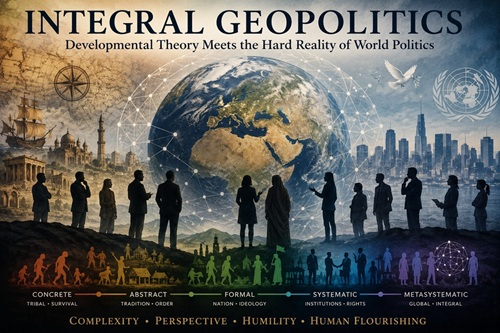
Ray Harris's four-part Integral Geopolitics series is an attempt to construct a developmental and morally informed framework for thinking about international politics: first by questioning the category of “the West,” then by surveying international-relations theory, then by mapping political conflict onto developmental stages, and finally by proposing a “developmental ethical imperative” as a normative criterion for judging societies. The result is intellectually ambitious, often stimulating, and in several respects genuinely useful. It also illustrates a recurring problem within integral theorizing: a framework designed to accommodate complexity can become an instrument for placing competing positions into a developmental hierarchy. Harris is at his strongest when he uses integral ideas to widen the field of inquiry. He is less convincing when he treats developmental categories as if they could reliably adjudicate the cognitive and moral status of actual political actors. That distinction is important, especially because Harris himself repeatedly argues that integral thinking requires openness, intellectual humility, and resistance to ideological self-confirmation. His essays therefore contain the ingredients of an excellent critique of integral geopolitics, but they do not always apply their own methodological standard consistently. 1. “The West” as a Historical ConstructionThe first essay, The West Isn't Western, attacks the idea that “Western civilisation” represents a self-contained cultural tradition. Harris's historical narrative is deliberately centrifugal. Greek culture is presented not as an exclusively Western inheritance but as part of a Hellenistic world extending deep into Asia; Greek and Indian intellectual traditions interacted; Christianity developed in the Middle East; Islamic scholarship transmitted and developed Greek and Indian knowledge; the Renaissance itself involved the westward movement of Greek learning after the fall of Constantinople; and European modernity was subsequently transformed by encounters with the Americas and the wider world. The central point is sound and important. Civilisations are not sealed containers. Mathematics, philosophy, science, technologies, religions, artistic forms and political institutions have historically crossed borders, been appropriated, transformed and returned in altered forms. Harris is particularly effective in stressing that what is casually called “Western science” is the cumulative product of many civilisations rather than an exclusively European achievement. He also makes a useful political point. The fact that capitalism, modern science or liberal institutions developed in historically specific European circumstances does not make them ontologically “Western.” Nor does opposition to contemporary Western power automatically constitute opposition to everything historically associated with Europe. His observation that parts of the Western left sometimes rhetorically relocate themselves outside “the West” while retaining many intellectual traditions that originated within it is provocative, but worth considering. The difficulty is that Harris sometimes replaces one simplification with another. The claim that the Renaissance was “in essence” another migration of eastern ideas westward is rhetorically effective, but historically too narrow. The Renaissance was not simply an eastern-to-western transfer. Greek texts had already been preserved and transmitted through Byzantine, Islamic and Latin Christian traditions; Italian city-states developed distinctive economic and institutional conditions; and European intellectual developments emerged from an interaction of inherited and newly available materials. Harris's broader thesis does not require reducing the Renaissance to a single causal mechanism. The same caution applies to his treatment of “the West” itself. It is perfectly reasonable to argue that Western civilisation is internally plural and historically porous. It is another matter to conclude that the category is therefore meaningless. “The West” can function as a historical, geopolitical and institutional category even if it is not a culturally pure one. NATO, the European Union, the United States, Canada, Australia and New Zealand, for example, form identifiable political networks without implying that their cultures constitute an isolated civilisation. So Harris's strongest claim is not that “the West” does not exist, but that it should not be reified. That is a more defensible and more interesting proposition. 2. The Mearsheimer Question: Harris's Strongest ContributionThe second essay, International Relations Theory, is probably the strongest of the four because Harris takes a genuinely useful step: instead of treating the Russia-Ukraine conflict as a contest between competing political narratives, he introduces the conceptual vocabulary of international-relations theory. His distinction between realism, liberalism, Marxism and constructivism is necessarily schematic, but it establishes something that integral discussion often neglects: there is already an academic discipline devoted specifically to explaining international conflict. Harris's criticism of Mearsheimer is also more sophisticated than a simple dismissal of realism. He notes that offensive realism treats states primarily in terms of power, security and structural incentives, whereas constructivism adds identity, narrative, status and historically constructed interests. His discussion of Richard Ned Lebow is particularly relevant here: if status and recognition explain a substantial amount of interstate conflict, security cannot simply be assumed to exhaust the motivations of states. This is exactly where an integral perspective can potentially contribute something worthwhile. The question is not whether realism is “wrong” and constructivism is “right,” but whether different explanatory levels capture different dimensions of the same phenomenon. Harris is also right to object to the habit of treating Mearsheimer's interpretation as though it were simply synonymous with “realism.” His own essay points out that offensive realism is one theoretical position among several, and that critics have raised substantial questions about the application of Mearsheimer's theory to Ukraine. Contemporary scholarship likewise distinguishes Mearsheimer's particular version of offensive realism from other realist approaches and has questioned whether his Ukraine argument follows consistently from the theory he developed. Still, Harris occasionally overstates the case. Saying that “Mearsheimer is the minority position” does not by itself establish that his interpretation is mistaken. Minority positions can be correct. Nor does the existence of liberal and constructivist alternatives automatically confer superiority on them. A genuinely integral treatment should compare explanatory successes and failures rather than treating theoretical pluralism as evidence that the more developmental or multidimensional theory is necessarily closer to truth. There is a deeper irony here. Harris criticizes parts of the integral community for selecting Mearsheimer because he confirms what they had already decided. But an equivalent danger exists on the other side: rejecting Mearsheimer because his interpretation appears morally or politically distasteful would be the same error in reverse. The appropriate integral principle is therefore not “don't be Mearsheimerian,” but “don't allow your preferred moral conclusion to determine which causal theory you are willing to consider.” That is very close to Harris's own ideal of what he later calls “open scepticism”: positions should remain provisional, claims should be tested, and moral principles should be applied consistently. 3. From Pluralism to Developmental HierarchyThe third essay, Complex Pluralism, is where Harris's project becomes substantially more controversial. Here he introduces Michael Commons's Model of Hierarchical Complexity and attempts to correlate levels of cognitive complexity with forms of political organisation. Concrete, abstract, formal, systematic and metasystematic stages become progressively more capable of coordinating complexity. Harris then associates these levels with increasingly sophisticated forms of law, democracy, governance and conflict resolution. There is an attractive insight here. Political problems really do differ in complexity. A tribal conflict, a constitutional dispute and a transnational ecological problem cannot be understood or managed by precisely the same cognitive tools. Institutions also differ in their capacity to coordinate competing interests. Harris is therefore onto something when he argues that political development involves not merely different values but increasing capacities for perspective-taking and systemic coordination. His discussion of narrative is particularly good. Human beings do not simply process political facts as detached information; they interpret events through stories concerning identity, threat, injustice, betrayal and belonging. Empirical reality and narrative construction interact constantly in political life. The problem arises when this useful insight becomes a developmental taxonomy of political people. Harris writes that metasystematic thinkers are a small minority and suggests that political influence therefore depends on these cognitively more complex individuals operating through institutions. He also links higher developmental stages to greater cognitive ability and, quite explicitly, to IQ ranges. That is a much stronger claim than the argument requires. There is a legitimate relationship between cognitive ability and certain kinds of complex reasoning. But turning that relationship into a ladder running from concrete people at one end to metasystematic people at the other risks creating exactly the kind of intellectual hierarchy that integral theory is notorious for generating. It becomes especially problematic when political disagreements can be redescribed as evidence of developmental inferiority. The empirical status of Kohlberg's stage theory itself is also much less secure than Harris's confident language suggests. Kohlberg's work was enormously influential, but its strict stage model has long been criticized on methodological, cultural and theoretical grounds. Later reviews have questioned whether moral reasoning really develops through the discrete, invariant sequence originally proposed, and whether the highest stages can legitimately be treated as universal markers of maturity. This does not make developmental psychology useless. Quite the opposite. But it means that a framework such as Harris's should be treated as a heuristic model rather than a psychometric sorting machine. There is also an internal contradiction worth noting. Harris himself says that people behave differently under different circumstances and that trauma, social conditioning, neurological differences and ideology complicate developmental models. That qualification is important. But it weakens any straightforward inference from a political position to a cognitive stage. A person can reason at extraordinary complexity in one domain and exhibit extraordinary tribalism in another. Intellectual sophistication and moral wisdom are not the same variable. 4. The Culture Wars and the Problem of Stage DiagnosisHarris's discussion of American culture wars illustrates both the usefulness and danger of his developmental model. He sees a conflict between conventional moral reactions and postconventional values concerning sexuality, gender and identity. He also criticizes “cancel culture” and points out that supposedly progressive actors can themselves become intolerant. This is one of the better passages because Harris refuses a simplistic left-versus-right moral polarity. His argument that movements committed to liberation can reproduce forms of conformity and censorship is perfectly compatible with a developmental perspective. So is his observation that political factions tend to fragment into ever narrower identity groups. But the stage vocabulary can become too convenient. Once one side is described as “conventional” and another as “postconventional,” the argument risks becoming circular: the preferred position is postconventional because it is more inclusive, while it is more inclusive because it occupies the postconventional stage. The developmental label then becomes an honorific rather than an independently established explanation. A truly integral analysis would therefore have to leave open the possibility that developmental complexity occurs on all sides. A conservative may perceive a genuine problem that a progressive abstraction overlooks; a progressive may identify an injustice invisible to a traditionalist; and both may nevertheless construct narratives that selectively protect their own identities. Complexity does not automatically reside in the political centre, nor does moral development map neatly onto contemporary ideological positions. Harris sometimes comes close to saying exactly this, which makes the stronger developmental claims unnecessary. 5. From Developmental Psychology to an Ethical PrincipleThe fourth essay, The Developmental Ethical Imperative, is in some ways the most interesting because Harris finally moves from diagnosis to normative philosophy. His central principle is straightforward: “the highest ethical principle is enabling people to achieve their full potential,” and this applies universally to every individual. That is a powerful reformulation of a recurring integral intuition. Instead of asking merely whether a society is prosperous, democratic or traditionally legitimate, we ask whether its institutions expand or constrict human possibilities. Harris then identifies physical, material, psychological, ideological, political and developmental barriers to human flourishing. The argument broadens the developmental project beyond individual psychology into public policy. Clean water, education, healthcare, social mobility, freedom of expression, political stability and access to cultural institutions become part of the infrastructure of human development. This is perhaps the most convincing practical implication of the entire series. His discussion of the Nordic social democracies is also revealing. Harris does not argue that they are perfect; he argues that by a variety of measures they have been unusually successful in combining security, welfare, equality, education, health, freedom and opportunity. This gives his version of integral politics a welcome empirical direction. Instead of simply proclaiming that an integral society would be “more evolved,” Harris asks what actual institutional arrangements appear to help people flourish. Yet even here caution is needed. A collection of international rankings cannot by itself establish that one civilisation has reached a higher developmental stage. Different indices measure different things, and cross-national comparisons are sensitive to definitions, time periods and methodological choices. Harris is aware of this to some extent, calling his country cases “low resolution snapshots.” The most defensible conclusion is therefore not that Nordic societies are developmentally superior, but that they provide important empirical cases for examining which institutional arrangements tend to expand human capabilities. That is already a substantial claim. 6. Human Rights: Universalism Without Cultural ArroganceHarris's final discussion of human rights is one of the strongest normative sections of the series. He rejects the idea that concern for women's rights, freedom of expression or individual autonomy should automatically be dismissed as “Western values.” He points out that resistance to oppression has appeared in many civilisations and that reform movements frequently emerge from within the societies being criticized. This is an important corrective to crude cultural relativism. At the same time, the universalist position has to be handled carefully. The existence of universal human capacities and needs does not eliminate historical and cultural differences in how those needs are interpreted or institutionally realised. The challenge is to distinguish universal moral principles from particular Western policy preferences. Harris's own developmental imperative actually points toward such a distinction. Its most persuasive form is not “the West has discovered the highest values,” but “every individual should have the opportunity to develop their capacities, and no tradition should automatically be exempt from criticism when it prevents that.” That is a considerably stronger argument. 7. What Harris Gets Right About Integral PoliticsTaken as a whole, the four essays make an important contribution to the discussion within the integral community because Harris refuses to treat integral theory as merely a vocabulary for describing one's existing political convictions. His most valuable recurring theme is epistemic discipline. Integral people, he insists, are not immune to propaganda, disinformation, ideological identification or confirmation bias. That point deserves particular emphasis. The integral movement sometimes assumes that because a person can distinguish multiple perspectives, they have thereby transcended partisanship. But perspective-taking is not the same as accuracy. A person can construct an extremely elaborate, multi-perspectival narrative that remains empirically mistaken. Harris is right that integral practice must therefore include falsifiability, evidence, willingness to revise one's position, and symmetrical moral standards. His formulation of “open scepticism” is a useful counterweight to both naïve idealism and cynical relativism. He is also right to insist that international conflicts cannot be reduced to a single level. Material interests, security dilemmas, national identities, historical memories, political institutions, leaders' psychology and competing narratives may all matter simultaneously. That is genuinely integral in spirit. 8. Where the Series Becomes Less ConvincingThe central weakness is that Harris sometimes tries to make his own developmental framework do too much work. The first problem is the tendency to equate complexity with developmental superiority. A more complex explanation is not necessarily a more accurate one. Sometimes a simple explanation really is correct. The second is the temptation to diagnose political positions developmentally. Once one's opponents become “preconventional,” “conventional,” or victims of lower-stage cognition, disagreement can be dismissed rather than investigated. The third is the underdeveloped relationship between empirical political science and integral developmental theory. Harris brings the two together, but the bridge is sometimes asserted rather than demonstrated. A realist theory of international relations does not become “stage 1 or 2” merely because it emphasises security and self-interest. Realist scholars can employ extraordinarily sophisticated reasoning while working within a theory that deliberately brackets moral psychology. And finally, there is the problem of ideology. Harris is exceptionally alert to ideological capture among Mearsheimer supporters and among parts of the left, but his own normative commitments are visible too: liberal democracy, human rights, social democracy, pluralism and individual autonomy form the unquestioned gravitational centre of his model. Those are defensible commitments. But calling them the ethical expression of higher development does not remove them from the realm of normative argument. An integral thinker should be especially wary here. The moment one's preferred political values are identified with “higher development,” the framework acquires a built-in immunity to criticism. Conclusion: A Useful Beginning, Not a Finished Integral GeopoliticsRay Harris's Integral Geopolitics should therefore be read neither as a definitive theory of international politics nor as a failed application of integral theory. It is better understood as an ambitious first attempt to connect several domains that are too often kept apart: international-relations theory, developmental psychology, moral philosophy, political institutions, historical narratives and human flourishing. Its most valuable contribution is methodological. Harris reminds the integral community that being “integral” does not consist in finding a sophisticated framework that confirms one's preferred politics. It requires engaging competing theories, distinguishing explanation from moral judgment, checking one's assumptions against evidence, and applying moral principles symmetrically. His critique of the uncritical reception of Mearsheimer is strongest precisely where it makes this demand. His historical argument that “the West” should not be treated as a homogeneous civilisational actor is similarly valuable, provided it is stated as a critique of reification rather than as the claim that the category has no legitimate historical or geopolitical meaning. The developmental component is more problematic. Kohlberg, Commons and related stage models can provide suggestive metaphors for thinking about increasing complexity, perspective-taking and institutional sophistication. They become much less secure when used to classify actual political actors, correlate developmental stages too directly with IQ, or explain ideological disagreement as a symptom of cognitive inferiority. The empirical and theoretical literature on Kohlberg alone gives ample reason for caution. Perhaps the deepest lesson of the four essays is therefore one that slightly exceeds Harris's own conclusions. An integral geopolitics should not primarily be a theory for identifying which side is at the higher stage. It should be a discipline for preventing premature closure. The real test of integral political thinking is not whether it can explain why they are less developed than we are. It is whether it can explain how intelligent, morally serious and differently situated people can arrive at conflicting interpretations of the same historical reality—and then determine, through evidence and argument, where those interpretations succeed and where they fail. That would be a genuinely integral geopolitics: not a hierarchy of political camps, but a method for keeping the hierarchy of complexity from becoming another hierarchy of certainty.
Widget is loading comments...
|