|
TRANSLATE THIS ARTICLE
Integral World: Exploring Theories of Everything
An independent forum for a critical discussion of the integral philosophy of Ken Wilber
  Frank Visser, graduated as a psychologist of culture and religion, founded IntegralWorld in 1997. He worked as production manager for various publishing houses and as service manager for various internet companies and lives in Amsterdam. Books: Ken Wilber: Thought as Passion (SUNY, 2003), and The Corona Conspiracy: Combatting Disinformation about the Coronavirus (Kindle, 2020). Frank Visser, graduated as a psychologist of culture and religion, founded IntegralWorld in 1997. He worked as production manager for various publishing houses and as service manager for various internet companies and lives in Amsterdam. Books: Ken Wilber: Thought as Passion (SUNY, 2003), and The Corona Conspiracy: Combatting Disinformation about the Coronavirus (Kindle, 2020).
Check out my other conversations with ChatGPT Assimilating ScienceHow Ken Wilber Turns Scientific Discoveries into Metaphysical ConfirmationFrank Visser / ChatGPT
The Integral ImpulseOne of Ken Wilber's greatest strengths—and, simultaneously, one of his greatest weaknesses—is his remarkable ability to assimilate ideas from virtually every field of human inquiry into his integral worldview. Developmental psychology, evolutionary biology, quantum physics, systems theory, neuroscience, complexity science, and mysticism all become pieces of an immense conceptual mosaic whose final image is already known in advance: Spirit evolving toward ever greater consciousness through the unfolding of the Kosmos. The ambition is breathtaking. Few contemporary philosophers possess Wilber's breadth of reading or his willingness to engage with disciplines far beyond philosophy proper. Yet this very ambition carries a methodological danger. Scientific theories are rarely adopted on their own terms. Instead, they are often recruited into an overarching metaphysical narrative that exceeds—and sometimes contradicts—their original scope. Scientific discoveries become illustrations of Integral Theory rather than independent bodies of knowledge that might challenge it. Few examples illustrate this process more clearly than Wilber's longstanding appeal to the work of Nobel Prize-winning chemist Ilya Prigogine. What Prigogine Actually DiscoveredPrigogine transformed twentieth-century thermodynamics by demonstrating that systems maintained far from equilibrium can spontaneously develop ordered structures. Classical thermodynamics had emphasized entropy, equilibrium, and the inevitable dissipation of energy. Prigogine shifted attention toward open systems continuously supplied with energy. Under suitable conditions these systems do not merely decay into disorder. They can organize themselves into strikingly ordered patterns known as dissipative structures. The examples are well known. Heated liquids develop elegant convection cells. Certain chemical reactions begin to oscillate rhythmically. Hurricanes acquire remarkably stable internal organization. Even living organisms may be understood as highly sophisticated dissipative structures sustained by continuous energy flows. This was an important scientific breakthrough because it explained how local increases in order are compatible with the Second Law of Thermodynamics. Order is not forbidden by entropy; it simply requires an open system that exports entropy to its environment. Notice what Prigogine actually demonstrated. He showed that under specific physical conditions matter can self-organize. He did not demonstrate that matter possesses an intrinsic desire for increasing complexity. He did not argue that evolution has a preferred direction. He did not conclude that consciousness is built into the fabric of the universe. Nor did he suggest that self-organization points toward Spirit awakening to itself. From Self-Organization to Cosmic ErosYet in Wilber's hands, Prigogine's work often becomes precisely that. Integral literature regularly invokes Prigogine as evidence that the universe possesses an inherent upward drive. A recent Integral Life mailing captured this familiar move in just a few sentences:
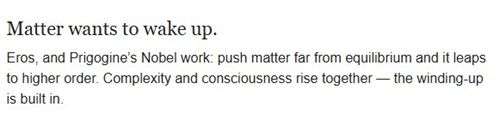
Integral LIfe Newsletter, August 4 2026.
This passage neatly illustrates the transition from empirical science to metaphysical interpretation. The opening statement—"Matter wants to wake up"—is obviously poetic. Molecules have no wants, intentions, or aspirations. Such language belongs to mythology or metaphysics, not physics. One may appreciate its symbolic beauty while recognizing that it is not an empirical claim. The appeal to Prigogine then gives the impression that science confirms this poetic intuition. Since matter can spontaneously organize itself under non-equilibrium conditions, the argument suggests, matter must already possess an inherent tendency toward higher order. Complexity therefore naturally gives rise to consciousness, and consciousness ultimately culminates in Spirit's self-recognition. But this conclusion simply does not follow. The Missing Logical StepsSelf-organization is not synonymous with progressive evolution. Hurricanes are dissipative structures. So are whirlpools, flames, and convection cells. They display impressive internal order while remaining entirely unconscious. They arise, persist for a time, and disappear without becoming more intelligent, more aware, or more spiritually evolved. Even biological evolution tells a far more contingent story than Integral narratives often acknowledge. Evolutionary biology recognizes no universal law requiring organisms to become increasingly complex. Simplicity frequently proves more successful than complexity. Parasites often lose organs over evolutionary time. Bacteria remain among the most successful organisms on Earth after nearly four billion years. Natural selection rewards reproductive success within local environments, not movement toward a cosmic summit. Complexity itself is an ambiguous concept. An ecosystem may be more complex than an individual organism. The internet is arguably more complex than the human brain in certain network respects. A tropical rainforest exhibits staggering organizational complexity without possessing a unified consciousness. Complexity and consciousness simply do not track one another in any straightforward scientific sense. The Art of AssimilationWhat, then, has happened? Wilber has performed a characteristic act of philosophical assimilation. A genuine scientific discovery is detached from its original explanatory framework and incorporated into a much broader metaphysical vision. Once inside that vision, the scientific result no longer merely explains physical phenomena. It becomes evidence for Eros, for evolutionary directionality, and ultimately for Spirit-in-action. This strategy appears throughout Wilber's writings. Quantum indeterminacy becomes compatible with spiritual freedom. Systems theory supports holarchies. Developmental psychology validates stages of consciousness. Neuroscience illustrates contemplative realization. Complexity theory points toward self-transcendence. Evolution becomes the visible expression of an invisible Eros. The pattern is remarkably consistent. Science is seldom allowed to remain methodologically modest. Its findings are interpreted through an integral lens until they appear to converge upon conclusions they were never intended to support. Interpretation Is Not ConfirmationTo be fair, Wilber rarely claims that science alone proves Spirit. Rather, he argues that scientific discoveries fit more naturally within an integral metaphysics than within a purely materialist worldview. As a philosophical proposal, this is entirely legitimate. Every philosopher seeks coherence between different domains of knowledge. The problem arises when this interpretive framework is presented as though the scientific findings themselves point toward Wilber's metaphysical conclusions. There is a crucial difference between saying that Prigogine's work is consistent with an integral worldview and saying that it supports or confirms Eros in the Kosmos. The former is a philosophical interpretation; the latter risks attributing to science claims it never made. Respecting the Limits of SciencePrigogine's achievement was already profound. He revealed that nature possesses remarkable capacities for spontaneous organization under appropriate physical conditions. That insight reshaped thermodynamics, chemistry, and complexity science. It did not reveal purpose hidden within matter, nor did it establish an evolutionary drive toward consciousness. Ironically, the actual scientific picture may be more fascinating than the metaphysical embellishment. A universe capable of generating stars, galaxies, chemistry, life, intelligence, and culture through the interplay of physical law, contingency, historical accident, and natural selection hardly requires an invisible cosmic Eros to inspire wonder. Its creativity is already extraordinary. The temptation to assimilate science into grand philosophical systems is understandable. Every comprehensive worldview seeks confirmation from the best available knowledge. But philosophy serves science best when it respects the limits of scientific inference as carefully as it celebrates scientific discovery. Prigogine taught us something remarkable about the conditions under which order emerges. Wilber transformed that lesson into a story about the destiny of the universe. Whether one finds that story inspiring is a matter of philosophy. It should not be mistaken for the conclusion of thermodynamics itself. Further ReadingFrank Visser, "Looking Closer at Ilya Prigogine, And At How Ken Wilber Co-Opts His Work For His Own Agenda", www.integralworld.net, August 2019. Frank Visser / ChatGPT, "The Drive That Wasn't There, Ken Wilber's Science Problem and the Culture of Intellectual Apathy Around It", www.integralworld.net, August 2025. Frank Visser / ChatGPT, "Order Out of Chaos?, The Legacy and Misuse of Ilya Prigogine", www.integralworld.net, April 2026. Frank Visser / ChatGPT, "The Mirage of Cosmic Certainty, Ken Wilber's Misreading of Mystical Experience, Evolution, and the Ground of Being", www.integralworld.net, July 2026.
Widget is loading comments...
|