|
TRANSLATE THIS ARTICLE
Integral World: Exploring Theories of Everything
An independent forum for a critical discussion of the integral philosophy of Ken Wilber
  Frank Visser, graduated as a psychologist of culture and religion, founded IntegralWorld in 1997. He worked as production manager for various publishing houses and as service manager for various internet companies and lives in Amsterdam. Books: Ken Wilber: Thought as Passion (SUNY, 2003), and The Corona Conspiracy: Combatting Disinformation about the Coronavirus (Kindle, 2020). Frank Visser, graduated as a psychologist of culture and religion, founded IntegralWorld in 1997. He worked as production manager for various publishing houses and as service manager for various internet companies and lives in Amsterdam. Books: Ken Wilber: Thought as Passion (SUNY, 2003), and The Corona Conspiracy: Combatting Disinformation about the Coronavirus (Kindle, 2020).
Check out my other conversations with ChatGPT Order Out of Chaos?The Legacy and Misuse of Ilya PrigogineFrank Visser / ChatGPT
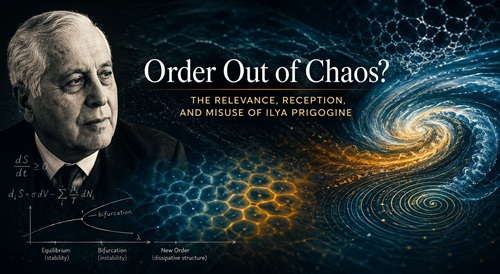
The Scientist of IrreversibilityIlya Prigogine (1917-2003) fundamentally reshaped how science understands time, order, and complexity. Trained as a physical chemist, he was awarded the Nobel Prize in Chemistry in 1977 for his work on nonequilibrium thermodynamics—specifically, the concept of dissipative structures. These are ordered systems that arise and persist under conditions far from equilibrium, sustained by flows of energy and matter. Classical thermodynamics, rooted in the legacy of Isaac Newton and Pierre-Simon Laplace, emphasized equilibrium, reversibility, and deterministic laws. In that framework, time was largely an illusion: the equations worked just as well forward as backward. Prigogine challenged this orthodoxy by insisting that irreversibility—the “arrow of time”—is not merely a statistical artifact but a fundamental feature of physical reality. His work showed that under far-from-equilibrium conditions, systems can spontaneously organize into complex patterns—chemical oscillations, convection cells, even precursors to biological organization. Order, in other words, can emerge from chaos, not in violation of the second law of thermodynamics, but because of it. Dissipative Structures and the Birth of ComplexityThe key innovation in Prigogine's work lies in his mathematical and conceptual treatment of instability. Near equilibrium, systems behave predictably; far from equilibrium, they can reach bifurcation points, where small fluctuations determine the system's future trajectory. This introduces a form of indeterminism into physics—not randomness per se, but sensitivity to initial conditions and historical contingency. This insight helped lay groundwork for what would later be called complexity science, influencing fields as diverse as biology, ecology, and economics. Prigogine's ideas resonated with emerging work on nonlinear dynamics and chaos theory, associated with figures like Edward Lorenz. Importantly, however, Prigogine did not claim that these processes implied purpose, directionality, or teleology in any metaphysical sense. The emergence of order was contingent and local, not the unfolding of a cosmic plan. Academic Reception: Respect with ReservationsWithin mainstream science, Prigogine's contributions are both respected and carefully circumscribed. His work is recognized as a major extension of thermodynamics into nonequilibrium domains, with practical applications in chemistry and physics. However, some physicists have regarded his broader philosophical interpretations with skepticism. His attempts to elevate irreversibility into a foundational principle of physics—rather than a macroscopic consequence of microscopic laws—remain debated. Critics argue that while dissipative structures are real, they do not overturn the underlying time-symmetric nature of fundamental equations such as those in classical mechanics or quantum theory. Moreover, Prigogine's later writings, particularly those co-authored with Isabelle Stengers, adopted a more speculative tone. Works like Order Out of Chaos ventured into philosophy, emphasizing creativity, becoming, and the limits of reductionism. While intellectually stimulating, these extrapolations were not universally embraced within the scientific community. From Science to Metaphysics: The Slippery SlopeIt is precisely this philosophical openness that made Prigogine attractive to alternative thinkers. His language—“order out of chaos,” “creative evolution,” “the end of certainty”—proved irresistible to those seeking scientific validation for metaphysical or spiritual worldviews. In the hands of New Age writers, systems theorists, and integral philosophers, Prigogine's ideas were often inflated into grand narratives about the cosmos evolving toward higher complexity, consciousness, or even divinity. Figures like Ervin Laszlo and Ken Wilber have drawn—sometimes loosely—on complexity science to support notions of cosmic directionality or “Eros in the Kosmos.”[1] This move typically involves a subtle but crucial shift: from descriptive to prescriptive, from local to universal, and from contingent emergence to teleological unfolding. Prigogine's dissipative structures become, in such readings, evidence of an inherent drive toward order, complexity, or consciousness. But this is a category error. The emergence of order in open systems does not imply a universal tendency toward progress or purpose. It merely shows that under certain conditions, energy flows can stabilize patterns. There is no built-in trajectory toward life, mind, or spirit—only the possibility, realized under specific circumstances. Why Misuse HappensThe misuse of Prigogine's work reflects a broader pattern in the reception of scientific ideas. Concepts that challenge reductionism or determinism are often co-opted to support holistic or spiritual narratives. Complexity becomes a synonym for meaning; emergence becomes a proxy for transcendence. Part of the problem lies in the ambiguity of language. Terms like “self-organization” and “creativity” carry metaphorical weight that easily slips into metaphysical interpretation. When Prigogine spoke of nature as “creative,” he meant it in a technical sense—referring to the generation of novel structures under nonequilibrium conditions—not as a conscious or purposeful process. Another factor is the genuine human desire for a meaningful cosmos. Scientific accounts that leave room for novelty and unpredictability can be seen as openings for re-enchantment. But filling those openings with metaphysical speculation often exceeds what the science can support. A Balanced AppraisalPrigogine's legacy is best understood as a disciplined expansion of physical science into the domain of complexity and irreversibility. He helped dismantle the overly static, equilibrium-centered worldview of classical thermodynamics and replaced it with a dynamic, historically sensitive framework. At the same time, his work does not license sweeping metaphysical conclusions. The fact that order can emerge from chaos does not mean the universe is about order, nor that it is guided by any intrinsic purpose. The enduring relevance of Prigogine lies in this tension. He opened the door to a richer understanding of nature—one that includes instability, history, and emergence—without abandoning scientific rigor. That door, however, has often been used as an entry point for ideas that go well beyond its frame. Conclusion: Between Insight and InflationIlya Prigogine remains a pivotal figure in twentieth-century science, not because he solved all the problems of complexity, but because he reframed them. His work invites us to take time, change, and instability seriously—without succumbing to the temptation of metaphysical overreach. In an intellectual landscape where the boundaries between science and speculation are often blurred, Prigogine's legacy serves as both inspiration and caution. The challenge is to preserve the depth of his insights while resisting the urge to turn them into something they were never meant to be. NOTES[1] Ken Wilber, "Some Criticisms of My Understanding of Evolution", December 4, 2007, www.kenwilber.com. The alternative [to reductionistic science] is to see some sort of Eros operating in the universe. It doesn't have to be a metaphysical force, just an intrinsic force of self-organization. As Jantsch put it, evolution is “self-transcendence through self-organization.” This is exactly the point Prigogine was making with dissipative structures, and exactly the point I am making when referring to wings or eyes: they are metaphors and examples for this extraordinary capacity of creative emergence that is intrinsic to the universe (exactly as Whitehead explained it). This blog post is now offline but is quoted in: Frank Visser, "Why Self-Organization is Not a Cosmic Drive", www.integralword.net, December 2017.
Comment Form is loading comments...
|