|
TRANSLATE THIS ARTICLE
Integral World: Exploring Theories of Everything
An independent forum for a critical discussion of the integral philosophy of Ken Wilber
  Frank Visser, graduated as a psychologist of culture and religion, founded IntegralWorld in 1997. He worked as production manager for various publishing houses and as service manager for various internet companies and lives in Amsterdam. Books: Ken Wilber: Thought as Passion (SUNY, 2003), and The Corona Conspiracy: Combatting Disinformation about the Coronavirus (Kindle, 2020). Frank Visser, graduated as a psychologist of culture and religion, founded IntegralWorld in 1997. He worked as production manager for various publishing houses and as service manager for various internet companies and lives in Amsterdam. Books: Ken Wilber: Thought as Passion (SUNY, 2003), and The Corona Conspiracy: Combatting Disinformation about the Coronavirus (Kindle, 2020).
Check out my other conversations with ChatGPT
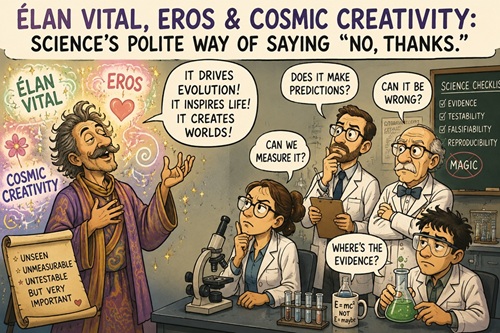
Why Science Will Never Accept Élan Vital, Eros, or Cosmic CreativityAnd why that is not a failure of imaginationFrank Visser / ChatGPT
There is a recurring temptation in the history of philosophy and spirituality: when science seems unable to explain something, introduce a deeper principle that supposedly explains it. Life is too mysterious to be chemistry, so there must be an élan vital. Evolution is too creative to be explained by natural selection, so perhaps there is an evolutionary Eros. Consciousness is too remarkable to emerge from matter, so perhaps creativity is woven into the fabric of the cosmos itself. These ideas can be evocative, inspiring, and philosophically suggestive. They may even point toward genuine mysteries. But there is a reason science will never accept them—at least not in the form in which they are usually proposed. The reason is not that science is unimaginative. It is that science has learned, painfully and repeatedly, that a concept must do more than name a mystery. The seduction of the mysterious forceConsider Henri Bergson's famous concept of élan vital, the "vital impulse" or "life force" that supposedly drives evolution toward greater complexity and novelty. It is an attractive idea. Evolution seems astonishingly inventive. From simple organisms emerge eyes, wings, nervous systems, intelligence, and eventually Beethoven and bacteria arguing about philosophy. Surely, one might think, there must be some underlying creative force pushing life upward. But what exactly does the élan vital do? If it is said to explain why life evolves, then we immediately have to ask: How does it do so? Does it produce mutations? Does it select among them? Does it alter developmental pathways? Does it operate through genes, cells, organisms, populations, or ecosystems? Can its effects be measured? Can we predict what it will do next? If the answer to all these questions is no, then the concept has not actually explained evolution. It has simply given our ignorance a poetic name. "Why did life become more complex?" "Because of the élan vital." "How do you know?" "Because life became more complex." This is not a scientific explanation. It is a re-description. And science is particularly suspicious of explanations that cannot, even in principle, make a difference to what we observe. From vitalism to modern biologyThe history of biology offers a cautionary tale here. For centuries, vitalism seemed plausible. Living organisms appeared fundamentally different from dead matter. They grew, reproduced, regenerated, adapted, and maintained themselves. Surely there had to be some special ingredient that distinguished the living from the nonliving. But the history of biology increasingly showed that many phenomena once attributed to a "life force" could be explained through ordinary physical and chemical processes. Metabolism is chemistry. Heredity is molecular biology. Development involves gene regulation, cell signaling, and physical constraints. Evolutionary adaptation can be understood through variation, inheritance, selection, drift, and other population-level processes. None of this means that we have solved every problem about life. Far from it. The origin of life remains a profound scientific question. The emergence of complex organization is still an area of active research. But the solution to an unsolved problem is not automatically a mysterious principle. The scientific attitude is: We don't yet know. The vitalist attitude tends toward: We don't yet know, therefore there must be a vital force. The difference may look small, but intellectually it is enormous. The first position leaves the door open to discovery. The second closes the door with a metaphysical sign saying "Mystery solved." Eros: the cosmic CupidThe same problem appears with Eros. In Plato, Eros is a profound philosophical principle: desire draws us toward beauty, knowledge, and ultimately the Good. In psychoanalysis, Freud used Eros as a name for the life-preserving and binding tendencies of the psyche. In later evolutionary and spiritual thought, Eros sometimes becomes something much grander: a cosmic impulse toward complexity, integration, consciousness, and transcendence. This is where things become scientifically problematic. Suppose we say that evolution is driven by Eros. What does that mean? If Eros is simply a metaphor for the tendency of organisms to survive and reproduce, then it may be useful—but it adds nothing scientifically. We already have evolutionary biology. If Eros is an actual force, then we need to know what kind of force it is. Does it have a measurable magnitude? Does it operate according to a law? Can we detect it independently of the phenomena it is supposed to explain? Can we predict its effects? Could there be a universe in which Eros is absent, and if so, how would we know? Until such questions can be answered, Eros remains a philosophical metaphor rather than a scientific entity. And this is not a criticism of metaphors. Metaphors can be extraordinarily valuable. They can illuminate patterns that formal theories later explain more precisely. But a metaphor does not become a mechanism simply because we capitalize it. Eros with a capital E is still not a scientific variable. The problem with "creativity"Perhaps the most fashionable version of this idea is cosmic creativity. The universe, we are told, is creative. Life is creative. Evolution is creative. Consciousness is creative. Therefore, creativity must be a fundamental property of reality. There is something undeniably true here. New things really do appear. Evolution produces novelty. Human beings invent. Stars, planets, organisms, languages, technologies, and cultures emerge. But the conclusion does not follow. The fact that novelty exists does not mean that Creativity is a cosmic substance or causal principle. Consider the word "wet." Wetness is real. But we do not need a cosmic substance called Wetness to explain why water behaves as it does. Wetness is an emergent property of interactions among molecules. Likewise, biological creativity may emerge from extraordinarily complex interactions among mutation, recombination, selection, developmental constraints, ecological relationships, and historical contingency. Cultural creativity emerges from brains interacting with other brains, languages, institutions, technologies, and environments. None of this makes creativity unreal. It simply means that a real phenomenon need not correspond to a fundamental force. Science constantly discovers that apparently irreducible qualities can emerge from simpler processes. The mistake is to confuse the reality of a phenomenon with the existence of a special substance responsible for it. Science does not reject mysteryThis point is crucial. Science does not reject mystery. Science is practically built on mystery. Every scientific field contains unanswered questions. What is dark matter? How did life begin? Why is there something rather than nothing? How does subjective experience arise? Why do the laws of nature have the form they do? Science does not respond to these questions by saying, "Nothing mysterious is happening." It responds: We don't know yet. Let's find out. This is one of science's greatest virtues—and one of the hardest disciplines for human beings to accept. We dislike unanswered questions. We want closure. When faced with something extraordinary, we instinctively invent a principle that makes it feel intelligible. That impulse is understandable. But it is precisely the impulse that science has trained itself to resist. The scientific revolution was, in part, a long historical struggle against explanations that seemed satisfying but could not be tested. The planets did not move because they desired perfection. Objects did not fall because they sought their natural place. Disease was not caused by invisible humors. Fire was not produced by phlogiston. Life did not necessarily require a special vital substance. Again and again, science replaced intuitive explanations with mechanistic ones. Not because mechanism explains everything. Because mechanisms can be investigated. The crucial distinction: metaphor versus mechanismThere is, however, a perfectly legitimate place for these concepts. We can say: Evolution is creative. Absolutely. We can say: Human beings experience an eros toward connection, knowledge, beauty, and transcendence. Certainly. We can say: Life displays an extraordinary capacity for self-organization and novelty. Of course. These statements may be philosophically fruitful. The trouble begins when we move from: "Nature is creative" to: "Creativity is a causal force in nature." Or from: "Living beings strive to survive" to: "There is a cosmic life-force that drives evolution." Or from: "Human beings experience desire and attraction" to: "Eros is a metaphysical principle responsible for cosmic evolution." The first statements describe phenomena. The second introduce entities. And once an entity is introduced as a scientific explanation, science quite reasonably asks: Where is the evidence? The unfalsifiability problemThere is an even deeper problem. Suppose evolution produces greater complexity. The Eros theorist says: "This proves the evolutionary force of Eros." Suppose evolution produces mass extinction and simplification. The theorist says: "Eros operates through destruction and renewal." Suppose evolution stagnates. "Eros is temporarily latent." Suppose evolution moves in a completely unexpected direction. "Eros is expressing itself in a new way." At this point, the hypothesis can explain everything. And a hypothesis that can explain everything explains nothing. This is why science values falsifiability. A scientific theory must expose itself to the possibility of being wrong. The more elastic a concept becomes, the less scientific work it can do. "Creativity" can be applied to almost anything after the fact. But unless we can specify beforehand what creativity predicts that competing explanations do not, it remains interpretive rather than scientific. The evolutionary misunderstandingThere is also a persistent misunderstanding behind many appeals to Eros or cosmic creativity. Evolution really does produce remarkable complexity. But evolution does not have to be aiming at complexity in order to produce it. Natural selection has no foresight. It does not know that eyes will eventually appear. It does not anticipate intelligence. It does not have a destination marked "Spirit." The history of life contains enormous amounts of waste, extinction, dead ends, contingency, and catastrophe. Most species that ever existed are extinct. Evolution has repeatedly gone backward as well as forward, depending on what "forward" means. Complexity sometimes increases. Sometimes it decreases. Organisms simplify. Parasites lose genes. Species disappear. Entire lineages terminate. There is no obvious universal arrow pointing toward consciousness. This does not make evolution less astonishing. It makes the astonishing fact that complexity can emerge without a cosmic intention even more interesting. The miracle, if one wants to use that word, may be that we do not need a miracle. The spiritual temptationWhy, then, do philosophers and spiritual thinkers keep returning to these concepts? Because they answer a psychological need. Mechanistic explanations can tell us how something happens while leaving untouched the question of what it means. A scientific account of love does not make love meaningless. An evolutionary account of consciousness does not make consciousness insignificant. A biochemical account of creativity does not make a poem less beautiful. But many people feel that explanation somehow diminishes significance. They therefore introduce a deeper metaphysical principle to restore the sense of wonder. This is understandable—but unnecessary. We do not need a cosmic Eros to appreciate love. We do not need an élan vital to marvel at life. We do not need a metaphysical Creativity to be astonished by evolution. Indeed, there is something more profound in discovering that extraordinary complexity can emerge from processes that contain no conscious intention at all. Science's refusal is a virtueScience will probably never accept élan vital, Eros, or cosmic creativity as explanatory forces unless someone can demonstrate that they have measurable, predictive, causally distinguishable effects. And that is exactly how it should be. If tomorrow someone discovered a genuine new force in nature—call it Eros if you like—science would not reject it because the name sounded mystical. It would ask for evidence. If the force produced measurable effects, generated novel predictions, survived experimental testing, and could not be reduced to known mechanisms, scientists would happily investigate it. Science is not allergic to revolutionary ideas. It is allergic to ideas that cannot be wrong. This is why the concepts of élan vital, Eros, and cosmic creativity occupy an interesting borderland. They can be intellectually valuable as philosophical interpretations, metaphors, or ways of framing existential questions. They can inspire us to notice dimensions of reality that scientific description alone may not capture. But when they are promoted as hidden mechanisms of evolution or nature, they encounter a very good reason for scientific resistance. They have not explained the mystery. They have merely renamed it. And perhaps that is the deeper lesson. The universe may indeed be stranger, more creative, and more astonishing than our current theories can capture. But the scientifically honest response to that possibility is not to invent a cosmic force that guarantees the mystery will come out the way we hope. It is to keep the mystery open. To say: "We don't know. And then, inconveniently, wonderfully, relentlessly—look for answers." It is to keep the mystery open. To say: We don't know. And then, inconveniently, wonderfully, relentlessly— Appendix: How Eros Can Still Be UsedIf science cannot accept Eros as a mysterious cosmic force driving evolution, does that mean the concept should simply be discarded? Not at all. The mistake is not in using the word Eros. The mistake is in asking it to do scientific work that it cannot do. Eros can survive perfectly well—indeed, perhaps more fruitfully—if we stop treating it as a hidden mechanism of the universe and start treating it as a concept for describing patterns of attraction, attachment, desire, and integration. 1. Eros as a psychological conceptThe most obvious use is psychological. Human beings are not merely information-processing organisms. We are creatures of desire. We are attracted to people, ideas, places, images, ideals, and possibilities. We seek connection, intimacy, recognition, beauty, knowledge, and meaning. Calling this constellation of tendencies Eros can be illuminating. It does not explain why attraction occurs in a scientific sense. Psychology, neuroscience, and evolutionary biology can investigate that question. But Eros can name the lived pattern that emerges from these processes. In this sense, Eros is rather like "love" itself. We do not need a Love Force to acknowledge that love is real. 2. Eros as a phenomenological conceptEros can also describe something about how the world appears to us. When we fall in love, discover a new intellectual interest, encounter a work of art, or become fascinated by a scientific problem, the world seems to acquire a new gravitational pull. Certain things suddenly matter more than others. The object of desire appears to "call" us. This does not mean that the object literally emits an invisible force. It means that our experience is structured by attraction. Here Eros becomes a useful phenomenological term: a way of describing the felt directionality of consciousness. The scientist might investigate the neural mechanisms of attraction. The phenomenologist asks what attraction feels like from within. The two approaches need not compete. 3. Eros as a metaphor for creativityEros can also be a powerful metaphor for creativity. Creative acts often involve bringing previously separate elements together. A composer combines sounds. A writer connects ideas. A scientist discovers an unexpected relationship between phenomena. Lovers form a relationship that creates a new social reality. In this sense, Eros can symbolize the generative power of combination. But notice the modesty of the claim. We are not saying: Eros is a cosmic force that makes the universe evolve toward greater complexity. We are saying: The metaphor of Eros helps us think about the human experience of bringing things together and generating something new. That is a perfectly respectable philosophical use. 4. Eros and the emergence of complexityOne can even use Eros metaphorically when talking about nature. Atoms combine into molecules. Molecules form larger structures. Cells cooperate. Organisms form symbiotic relationships. Individuals form families and societies. Human beings form networks of culture and knowledge. At every level, there are processes of association, attraction, cooperation, and integration. Calling this "Eros" can be poetically suggestive. But we should not confuse the metaphor with the mechanism. Chemistry explains molecular bonding. Biology explains symbiosis and cooperation. Evolutionary theory explains selection and inheritance. Sociology investigates social organization. Eros does not replace these explanations. It provides a higher-level interpretation of a recurring pattern. 5. Eros as a philosophical questionThere is perhaps an even more interesting use. Eros can function not as an answer but as a question. Why do human beings desire unity? Why are we attracted to beauty? Why do we seek knowledge? Why do we fall in love? Why do we create? Why do we sometimes experience our lives as oriented toward something beyond immediate survival? Science can investigate many aspects of these questions. But it may not exhaust their philosophical significance. Here Eros becomes a way of asking: What is it about human beings that makes them reach beyond what they already are? That is a legitimate philosophical question, even if the answer is not "because there is a cosmic force called Eros." 6. Eros without teleologyThis may be the most important distinction. Eros does not have to imply that evolution has a predetermined destination. We can recognize directionality without destiny. Human beings have desires. Those desires give our lives direction. But this does not mean that the universe has secretly programmed us to reach a final spiritual state. Likewise, evolution can produce increasing complexity in some lineages without having complexity as its ultimate goal. Eros, properly understood, need not be a cosmic arrow pointing toward Omega. It can simply describe the local experience of being drawn toward something. That is a much more defensible—and perhaps more interesting—idea. 7. The best place for Eros may be between science and poetryPerhaps Eros belongs neither in the laboratory nor in the category of superstition. It belongs in the space occupied by philosophy, psychology, art, and poetry. Science can tell us how attraction works. Psychology can explore what desire does to us. Neuroscience can investigate the brain mechanisms involved. Evolutionary biology can explain why certain forms of attachment may have been adaptive. But none of these accounts makes the word Eros redundant. They simply prevent us from turning it into a pseudo-explanation. Eros can remain what it has always been at its best: a name for one of the deepest features of human existence—the fact that we are not merely here, but that we are continually drawn toward something. The crucial point is therefore not to banish Eros from serious thought, but to demote it from cosmic mechanism to illuminating metaphor and philosophical concept. Science asks: What causes this? Eros asks: What are we drawn toward? Those are different questions. And perhaps the most fruitful dialogue between science and philosophy begins precisely when we stop pretending that they are the same. Appendix 2: How Wilber created confusion around ErosKen Wilber is a particularly interesting case because he takes a concept that can be used fruitfully as a psychological or philosophical metaphor and repeatedly elevates it into something approaching a cosmic explanatory principle. In doing so, he creates precisely the kind of confusion that the main essay warns against. Wilber's use of Eros is closely connected to his larger evolutionary narrative. In his integral framework, evolution is not merely a process of biological change. It is a movement toward increasing complexity, consciousness, interiority, and eventually higher stages of spiritual realization. The universe, in this story, is somehow "going somewhere." Eros is the name Wilber gives to this forward-driving tendency. And that is where the trouble begins. From attraction to evolutionThe original idea of Eros has many legitimate meanings. It can refer to sexual desire, love, attraction, longing, creativity, or the Platonic movement toward beauty and the Good. Wilber takes this rich conceptual history and combines it with a grand evolutionary metaphysics. Eros becomes the force that explains why the universe does not simply remain what it is. Matter becomes life. Life becomes mind. Mind becomes spirit. Spirit becomes increasingly conscious of itself. The resulting picture is undeniably elegant. But elegance is not evidence. The problem is that Wilber's Eros begins to perform a function remarkably similar to Bergson's élan vital: it becomes a name for the mysterious fact that something happens rather than nothing, that complexity increases, and that novelty appears. Instead of asking how these processes occur through known mechanisms, the theory asks us to believe that they are expressions of a deeper evolutionary impulse. The danger is obvious: Eros explains evolution because evolution is the expression of Eros. The explanation becomes circular. The "drive" hidden inside the universeWilber often describes evolution as if it possesses an intrinsic drive toward greater depth and complexity. This is what makes his evolutionary vision attractive to many spiritual seekers. Evolution is no longer a blind process that happened to produce us. It becomes a cosmic adventure in which the universe is progressively waking up to itself. This is a beautiful story. But it is not necessarily a scientific theory. The distinction matters. There is no problem with saying: "I interpret evolution as a movement toward increasing complexity and consciousness." There is a problem when this interpretation is presented as if it reveals an objective force operating within the cosmos. The first is metaphysics. The second begins to sound like science. Wilber frequently moves between these registers without sufficiently marking the transition. The ambiguity of "evolution"Part of the confusion comes from Wilber's use of the word evolution itself. In biology, evolution has a relatively precise meaning. Populations change over generations through mechanisms such as mutation, recombination, natural selection, genetic drift, gene flow, and developmental constraints. In Wilber, "evolution" becomes much broader. It can refer to: biological evolution, psychological development, cultural evolution, spiritual development, increasing complexity, increasing consciousness, increasing interiority, and even the unfolding of Spirit itself. These are not necessarily the same process. When Wilber says that evolution is driven by Eros, therefore, it is not always clear whether he means: biological evolution, or psychological development, or cultural change, or spiritual awakening, or the entire history of the cosmos. The concept becomes so comprehensive that it is difficult to pin down. And once Eros is made responsible for everything, it becomes difficult to test anything. The problem of the arrowWilber's Eros also introduces a strong directional bias into evolution. The cosmos is presented as moving toward greater depth, greater consciousness, greater integration. The lower gives rise to the higher. Matter gives rise to life, life to mind, mind to spirit. This creates an appealing ladder of development. But the actual history of evolution is much messier. Evolution does not proceed in a straight line. Species become extinct. Complex organisms disappear. Simple organisms flourish. Complexity can increase in one lineage while decreasing in another. There is no universal biological law that says evolution must produce consciousness, let alone enlightenment. Wilber's model therefore adds something that Darwinian evolution does not require: an intrinsic direction. Eros supplies the direction. And once Eros supplies the direction, the evolutionary narrative begins to look suspiciously like a cosmic version of the conclusion it was designed to explain. We are here. We are conscious. We are capable of spiritual insight. Therefore, evolution must have been heading here all along. That is a classic case of retrospective teleology. The spiritualization of the evolutionary processWilber's deepest move is to interpret the evolutionary process spiritually. This is where his concept of Eros becomes most powerful—and most problematic. For Wilber, evolution is not merely the production of increasingly complex organisms. It is the gradual manifestation of Spirit in the world. This gives evolution a religious significance. But it also risks turning the history of life into a cosmic morality play. The universe begins in relative unconsciousness and gradually awakens. The story has a protagonist. It has a direction. It has a climax. And, implicitly, it has a preferred outcome. This is profoundly satisfying as mythology. But mythology should not be confused with mechanism. The scientific account of evolution does not need to know where evolution is going because, scientifically speaking, it is not necessarily going anywhere. Wilber's account needs a destination because his larger spiritual philosophy needs one. Eros is what gets us there. The irony of "scientific" integral theoryThis becomes especially ironic because Wilber has often insisted that his integral approach is more comprehensive than conventional science. He wants to include science while also correcting its limitations. Yet his use of Eros illustrates the danger of trying to give science a metaphysical foundation it does not possess. Science can investigate evolution. Science can investigate complexity. Science can investigate consciousness. Science can investigate development. But science does not need to assume that these phenomena are all manifestations of a single cosmic impulse. That is Wilber's philosophical addition. There is nothing wrong with adding it—provided we call it what it is. The problem arises when a metaphysical interpretation is presented as though it were the deeper scientific explanation that conventional science has somehow overlooked. Eros and the "Kosmic" upgradeWilber's capitalization habits contribute to this confusion. Ordinary words acquire extraordinary status: Kosmos. Spirit. Eros. Evolution. Creativity. Once capitalized and placed inside an elaborate metaphysical system, they begin to look like entities. The language itself subtly changes the status of the concepts. "Evolution" is no longer simply a scientific process. It becomes Evolution—a cosmic principle. "Creativity" is no longer something organisms and human beings do. It becomes Creativity—a fundamental property of the Kosmos. "Eros" is no longer simply desire or attraction. It becomes Eros—the universe's mysterious drive toward higher realization. This is rhetorically powerful. But it can also conceal the fact that the original empirical content has disappeared. The larger the concept becomes, the less precisely it can be defined. The better way to use ErosIronically, Wilber's own project might have been stronger if he had made a much more modest claim. He could have said: Human beings experience a profound drive toward connection, meaning, knowledge, beauty, and transcendence. We can call this Eros. This experience has played an important role in religion, philosophy, art, and spirituality. It may also help us understand why human beings repeatedly construct narratives of growth and evolution. That would be fascinating. It would also leave room for biology, psychology, sociology, and neuroscience. Instead, Wilber frequently reverses the direction of explanation: Because human beings experience Eros, Eros must be a fundamental force of the universe. That is a much larger claim. And it does not follow. The final ironyThere is an amusing irony here. Wilber is famous for criticizing reductionism—the tendency to explain higher phenomena entirely in terms of lower-level processes. But his own use of Eros risks committing the opposite error: expansionism. Where the reductionist says: "It's nothing but chemistry." Wilber sometimes seems to say: "It's all Eros." The first may leave out too much. The second may put in too much. Between them lies a more modest position. Life is chemistry, but not merely chemistry in the sense that higher-level organization is irrelevant. Evolution is biological, but its consequences can be studied at psychological and cultural levels. Human beings are organisms, but organisms can fall in love, write poetry, pursue truth, and seek enlightenment. We do not need to choose between reductionism and cosmic mystification. And perhaps this is where Eros can finally be rescued from Wilber's metaphysical ambitions. Eros need not be the hidden engine of evolution. It can be the name we give to a real and fascinating feature of human existence: our tendency to desire, connect, create, integrate, and reach beyond ourselves. That is already quite enough. Indeed, it may be more than enough. Because once Eros is asked to explain the entire universe, it becomes almost impossible to criticize. But once Eros is brought back down to earth—into psychology, culture, art, love, and human aspiration—it becomes something much more interesting: not an explanation of why the universe evolves, but a question about why we so desperately want to believe that it does.
Widget is loading comments...
|