|
TRANSLATE THIS ARTICLE
Integral World: Exploring Theories of Everything
An independent forum for a critical discussion of the integral philosophy of Ken Wilber
  Frank Visser, graduated as a psychologist of culture and religion, founded IntegralWorld in 1997. He worked as production manager for various publishing houses and as service manager for various internet companies and lives in Amsterdam. Books: Ken Wilber: Thought as Passion (SUNY, 2003), and The Corona Conspiracy: Combatting Disinformation about the Coronavirus (Kindle, 2020). Frank Visser, graduated as a psychologist of culture and religion, founded IntegralWorld in 1997. He worked as production manager for various publishing houses and as service manager for various internet companies and lives in Amsterdam. Books: Ken Wilber: Thought as Passion (SUNY, 2003), and The Corona Conspiracy: Combatting Disinformation about the Coronavirus (Kindle, 2020).
Check out my other conversations with ChatGPT Rupert SheldrakeAnd the Revolt Against MechanismFrank Visser / ChatGPT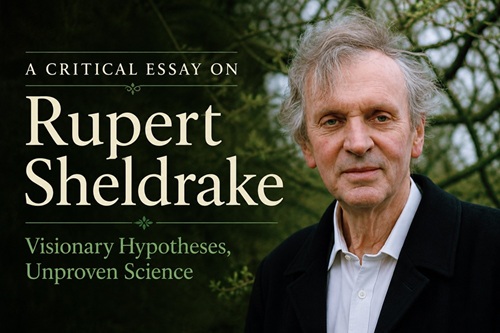 Rupert Sheldrake occupies an unusual position in contemporary intellectual life. He is neither a conventional scientist who occasionally ventures into speculative territory nor a straightforward advocate of paranormal beliefs who dresses them up in scientific language. He is a trained biologist who deliberately crossed the boundaries of orthodox science, and he has spent more than four decades arguing that those boundaries have themselves become ideological constraints. His central idea—that nature possesses a kind of collective memory expressed through “morphic resonance”—has attracted fascination, ridicule, and occasionally serious philosophical interest. Yet the most interesting question about Sheldrake is not simply whether morphic resonance is true. It is whether his critique of conventional science is stronger than the alternative science he proposes. Sheldrake began his career as a thoroughly respectable biologist. He studied at Cambridge, became a Fellow of Clare College, and subsequently worked in plant physiology. His early scientific work concerned plant development and the biochemical processes involved in morphogenesis—the way an organism develops its characteristic form. This background is important because Sheldrake's later heterodoxy did not originate in ignorance of biology. It originated, at least in part, from dissatisfaction with what he regarded as an explanatory gap within it. The central problem was deceptively simple: how do living organisms acquire their remarkably organized forms? Genes, proteins, chemical gradients and cellular interactions undoubtedly contribute to development. But Sheldrake became dissatisfied with the tendency to treat these mechanisms as though identifying the components automatically explained the organization of the whole. He began wondering whether biological form might depend upon fields of organization analogous, in a loose sense, to electromagnetic fields. This eventually led to the hypothesis of formative causation, developed in his 1981 book A New Science of Life. The radical step was the proposal that organisms are influenced not merely by their genes and immediate physical environment but by a collective memory of previous organisms of the same kind. The more often a particular form or developmental pattern occurs, the stronger the corresponding “morphic field” becomes. Similar systems in the future can then resonate with the accumulated history of similar systems. This is a striking idea. It is also the point at which Sheldrake's project moves from an interesting criticism of reductionism to a highly controversial alternative ontology. The Strange Logic of Morphic ResonanceThe concept can be illustrated with a simple example. Suppose rats learn to navigate a particular maze. According to conventional biology, subsequent rats might learn faster because of ordinary processes: genetic selection, changes in experimental conditions, differences in training, environmental effects, or simply accumulated knowledge on the part of the researchers. Sheldrake proposed something much more extraordinary: once rats somewhere in the world have learned the maze, other rats should find it easier to learn the same task, even without any physical connection to the original animals. The information, in effect, would have entered nature's collective memory. Sheldrake has pointed to experiments involving rats and other forms of learning as evidence for this possibility. He has also proposed tests involving crystallization, animal behavior, human learning, and other phenomena. His own research archive contains a considerable number of proposed and reported tests. The intellectual appeal is obvious. Morphic resonance promises to explain phenomena that conventional mechanistic accounts sometimes leave conceptually unsatisfying: biological organization, instinctive behavior, memory, learning, perhaps even aspects of consciousness. It also provides a striking alternative to the idea that the laws of nature are simply eternal mathematical rules imposed upon passive matter. Sheldrake has increasingly suggested that the laws of nature may resemble habits acquired through cosmic history rather than immutable prescriptions existing outside history. That is philosophically provocative. But provocation is not confirmation. From Scientific Heresy to Scientific TheorySheldrake's first book generated extraordinary controversy. Nature published an editorial famously asking whether it was “A Book for Burning?” The rhetoric was excessive, but it reveals something genuine about the reaction his work provoked. There is an important distinction here. Calling Sheldrake's theory ridiculous is not a scientific argument. A genuinely radical hypothesis should not be rejected merely because it sounds strange. Scientific history contains plenty of ideas that initially appeared absurd. The proper question is whether a hypothesis produces precise predictions that survive rigorous testing. On this point Sheldrake deserves more credit than his caricature as a mere paranormalist sometimes allows. He has repeatedly insisted that morphic resonance is an empirical hypothesis. He has designed experiments, published papers, and encouraged independent testing. In one collaboration with the biologist Steven Rose, for example, an experiment was designed in advance, with competing predictions recorded before the experiment began and the experimental worker kept blind to the hypothesis. A 2021 BioEssays article by Alex Gomez-Marin is particularly interesting because it argues that the experimental implications of Sheldrake's hypothesis remain surprisingly underexplored. The article does not establish morphic resonance as true. Indeed, it explicitly notes that the evidence is not overwhelming. But it makes a legitimate methodological point: rejecting an unconventional hypothesis is not the same thing as testing it comprehensively. This is where the Sheldrake controversy becomes genuinely interesting. The Evidence ProblemThe fundamental weakness of Sheldrake's position is that after more than forty years, the evidential situation remains remarkably inconclusive. His hypothesis is enormously ambitious. It proposes a new causal principle operating across biology and potentially chemistry, physics, psychology and consciousness. One would therefore expect progressively stronger evidence as the decades passed. Instead, the evidential case remains largely dependent upon disputed experiments, statistical anomalies, controversial interpretations and phenomena that have not become part of mainstream experimental science. This is particularly problematic because morphic resonance is supposed to have extraordinarily broad consequences. If learning in one population can affect learning in another, if crystallization becomes easier because crystals have previously been formed elsewhere, and if organisms can somehow access information from previous organisms, the effects ought to be detectable under carefully controlled conditions. Yet robust, independently replicated effects of the magnitude required by Sheldrake's theory have not emerged. That does not prove that morphic resonance is impossible. But it changes the epistemic status of the theory. After four decades, “science has not yet tested this properly” becomes increasingly difficult to distinguish from “the evidence does not support it.” The Replication ProblemThis problem becomes especially acute with Sheldrake's research into psychic phenomena. He has investigated telepathy, the sensation of being watched, animals apparently anticipating their owners' return, and related phenomena. He argues that some of these effects deserve serious experimental investigation rather than automatic dismissal. That methodological principle is entirely reasonable. The difficulty comes when intriguing positive results depend heavily upon particular investigators, particular experimental conditions or statistical analyses. Michael Shermer, reviewing Sheldrake's work in Scientific American, highlighted replication problems in research on the sensation of being stared at. Some experiments produced positive results, while others did not perform better than chance. Shermer also raised the possibility of experimenter effects and confirmation bias. This presents a serious dilemma for Sheldrake. If believers consistently obtain positive results while skeptics obtain negative results, there are two possible interpretations. Perhaps the skeptics are somehow suppressing the phenomenon. But that explanation makes the hypothesis increasingly difficult to falsify. Alternatively, the positive results may reflect methodological differences, unconscious cues, experimenter effects, statistical artifacts or selective reporting. The second possibility is methodologically much less exotic and therefore deserves priority until the evidence demonstrates otherwise. The “Science Delusion”Sheldrake's most influential move may ultimately have less to do with morphic resonance than with his critique of scientific materialism. In The Science Delusion, he argues that science has gradually turned a set of methodological assumptions into metaphysical dogmas. He challenges assumptions such as the idea that nature is fundamentally mechanical, that consciousness is entirely produced by the brain, that nature is purposeless, that physical laws are immutable, and that psychic phenomena are impossible by definition. TED subsequently placed a cautionary note around his famous 2013 talk because its scientific advisers believed that several of his “ten dogmas” misrepresented actual scientific practice and that some of his more radical claims lacked adequate evidence. Here Sheldrake is simultaneously right and wrong. He is right that methodological naturalism does not logically entail metaphysical materialism. Science can investigate nature without having proved that matter is the ultimate substance of reality. Likewise, the fact that consciousness is strongly correlated with brain activity does not by itself settle every philosophical question about consciousness. But Sheldrake sometimes slides too easily from “science has not established X” to “therefore X remains a serious alternative explanation.” That does not follow. The failure of one explanation does not automatically strengthen another. If neuroscience cannot yet explain consciousness completely, that does not constitute evidence for morphic fields. If developmental biology has unanswered questions, that does not constitute evidence for collective memory. If physics has unresolved foundations, that does not make telepathy scientifically plausible. This is perhaps the most important logical weakness in Sheldrake's project: he is considerably better at identifying explanatory gaps than at demonstrating that his proposed mechanism fills them. The God-of-the-Gaps Problem in Scientific ClothingSheldrake has rightly objected to being described as someone who simply inserts supernatural explanations wherever science encounters a mystery. He regards morphic resonance as a natural hypothesis, not supernatural intervention. That distinction is important. Nevertheless, a structural similarity remains between his argument and the familiar “God of the gaps” strategy. The argument often proceeds approximately as follows: Science does not completely explain phenomenon X. Therefore the conventional account is inadequate. Therefore a new organizing principle might exist. The new organizing principle is morphic resonance. The first step may be entirely legitimate. The second may sometimes be justified. The third is a reasonable invitation to investigate. But the fourth requires evidence of its own. The danger is that the explanatory gap becomes confused with evidence for the proposed explanation. This is why Sheldrake's rhetoric is often more persuasive than his empirical case. He is exceptionally good at making readers feel the inadequacy of mechanistic explanations. He is much less successful at demonstrating that morphic resonance has crossed the enormous evidential distance between an intriguing possibility and an established scientific theory. The Problem of Theoretical ElasticityThere is another difficulty. Morphic resonance has gradually become an explanation for an extraordinary range of phenomena. Biological form. Memory. Learning. Animal behavior. Human psychology. Telepathy. Instinct. Crystallization. Evolution. Consciousness. The theory's versatility is initially impressive. Eventually, however, versatility becomes a liability. A scientific theory gains explanatory power when it makes specific predictions that competing theories do not make. A theory that can be invoked to explain almost anything risks becoming too flexible. If positive results confirm morphic resonance, that supports the theory; if negative results occur, perhaps experimental conditions interfered with resonance; if skeptics fail to reproduce the effect, perhaps their expectations matter; if the phenomenon appears in a new domain, morphic resonance explains that too. This is precisely the danger identified by critics of Sheldrake's work. Scientific American's discussion of his staring experiments, for example, noted the problem that if both believers and skeptics can produce outcomes that are interpreted as effects of their expectations, the theory becomes increasingly difficult to falsify. A theory can be flexible without being scientific. What matters is whether its flexibility is constrained by predictions that could genuinely prove it wrong. Sheldrake and the ParanormalSheldrake's later career has increasingly brought him into the world of parapsychology. Here his intellectual trajectory becomes more problematic. There is nothing intrinsically illegitimate about investigating supposedly paranormal phenomena. Science does not get to declare a phenomenon impossible simply because it is inconvenient. If telepathy existed, it would be an empirical fact regardless of how uncomfortable it made neuroscientists. But extraordinary claims require extraordinary methodological discipline. This is precisely where Sheldrake's program needs its strongest evidence, not its weakest. If telepathy exists, the demonstration should eventually become so robust that it survives hostile laboratories, preregistration, blinding, independent replication and rigorous statistical scrutiny. It should become progressively harder—not easier—to explain away. That has not happened. Instead, the argument frequently remains trapped at the level of “there are interesting anomalies that deserve investigation.” That may be a perfectly respectable position after a few years of research. After decades, it becomes much less compelling. The Unfairness of the SkepticsYet the opposite extreme is also intellectually unsatisfactory. Some critics have treated Sheldrake as though merely entertaining his ideas were evidence of scientific incompetence. That attitude is counterproductive. Sue Blackmore, herself a participant in early research related to Sheldrake's claims, made an important distinction: Sheldrake was scientifically trained, his ideas were testable in principle, and strange hypotheses should be tested rather than dismissed merely because they sound strange. This is the strongest case for Sheldrake. Science needs people willing to ask questions that respectable scientists would rather avoid. Scientific communities are not perfectly rational machines. Careers, funding, reputations and disciplinary boundaries influence what gets investigated. A hypothesis that threatens established assumptions can indeed encounter resistance. The history of science therefore provides no justification for the argument: Scientists reject this idea, therefore it must be false. But neither does it justify the opposite: Scientists reject this idea, therefore it may be true. Both are sociological arguments masquerading as epistemology. The evidence has to decide. Sheldrake's Deeper ContributionIronically, Sheldrake's greatest contribution may survive even if morphic resonance ultimately fails. He forces an important distinction between science as a method and scientism as a worldview. Science is extraordinarily successful precisely because it disciplines speculation through observation, experiment, mathematical modeling, replication and criticism. But the philosophical interpretation of scientific results is another matter. One can accept evolutionary biology without accepting philosophical materialism. One can accept neuroscience without believing that consciousness has therefore been explained. One can accept physics without assuming that reality must ultimately conform to a mechanistic ontology. Sheldrake is therefore at his strongest when he asks questions such as: Are we entitled to assume that nature is completely mechanistic? Are scientific laws descriptions of regularities or metaphysical necessities? What exactly constitutes an explanation in biology? How much of consciousness remains unexplained? These are legitimate philosophical questions. He becomes weaker when he treats the existence of such questions as indirect evidence for morphic resonance, telepathy or other controversial mechanisms. The Paradox of Rupert SheldrakeThere is a curious paradox at the heart of Sheldrake's career. He began by criticizing conventional biology for confusing descriptions of mechanisms with explanations of organization. Yet his own theory sometimes risks committing the inverse error: replacing an incomplete explanation with a mysterious organizing principle whose own mechanism remains unspecified. Genes are not enough, Sheldrake argues. Therefore: morphic fields. Neural storage cannot explain every aspect of memory. Therefore: morphic resonance. Animals sometimes behave in apparently uncanny ways. Therefore: telepathic connections may exist. But the explanatory burden does not disappear when a new entity is introduced. It merely moves. What is a morphic field? How does it interact with matter? What physical quantity carries the information? How does the resonance propagate? Why does it have the quantitative properties it does? Under what conditions does it fail? How can competing morphic memories interact? What distinguishes genuine resonance from ordinary statistical dependence? Without answers to questions like these, morphic resonance remains more metaphor than mechanism. And metaphor, however suggestive, is not yet science. A Scientific Outsider Worth Taking SeriouslyThe fairest judgment on Sheldrake is therefore neither “visionary genius” nor “pseudoscientific crank.” He is something more interesting: a scientifically trained dissenter whose critique of scientific reductionism is substantially more defensible than the alternative scientific theory he has offered. His insistence that unexplained phenomena deserve investigation is admirable. His criticism of the tendency to confuse methodological naturalism with philosophical materialism is often well taken. His willingness to formulate experiments around controversial ideas distinguishes him from many New Age writers. His critics are not entitled to dismiss him merely because his hypotheses are unconventional. But neither is Sheldrake entitled to treat skepticism as evidence of dogmatism. Four decades is a long time in science. A genuinely revolutionary hypothesis should eventually generate a body of reproducible evidence that compels attention. Morphic resonance has not reached that threshold. The most charitable conclusion is therefore that Sheldrake has identified some real philosophical tensions in contemporary science but has not successfully resolved them. His critique of reductionism opens a door; morphic resonance does not yet provide a convincing destination beyond it. That distinction matters. Perhaps the future will prove Sheldrake right about some aspect of nature's organization. Perhaps some phenomena currently dismissed as impossible will eventually acquire respectable scientific explanations. But if that happens, the winning theories will have to do more than expose the limitations of materialism. They will have to predict, measure, replicate and explain. That is the standard Sheldrake rightly demands of conventional science. It is also the standard by which Sheldrake himself should be judged. Appendix: Isn't Resonance a Mechanism Too?There is an obvious objection to the criticism made above. If I complain that Sheldrake's morphic resonance is “more metaphor than mechanism,” am I not setting an impossibly high standard? After all, resonance is a perfectly respectable mechanism in science. Resonance occurs throughout physics: an oscillating system can transfer energy efficiently to another system when appropriate frequencies coincide. Acoustic resonance explains why instruments produce particular tones; electromagnetic resonance is central to antennas and circuits; molecular and quantum systems display resonant behavior; orbital resonances occur in astronomy. Why, then, should “morphic resonance” be dismissed simply because it invokes resonance? The answer is that resonance itself is not the problem. The problem is what Sheldrake means by it. Resonance is a mechanism—but not by itself an explanationIn established science, resonance is not a mysterious force that makes similar things influence one another. It is a precisely characterized physical phenomenon arising from the properties of interacting dynamical systems. There are identifiable variables: frequencies, amplitudes, phases, coupling strengths, damping, energy transfer and so forth. The systems involved are physically connected in ways that can be described mathematically. The resonance is not merely inferred from the fact that two things are similar. This distinction becomes crucial when we move from ordinary resonance to morphic resonance. Sheldrake's proposal is that a present system can be influenced by previous similar systems because of a “resonance” with their morphic fields. The crucial question therefore becomes: what physically couples the present system to the past systems? If two tuning forks resonate, we can specify the physical pathway through which energy is transferred. If two electrical circuits resonate, we can describe their coupling. If two quantum systems interact, the theory tells us what mathematical structure governs the interaction. But in morphic resonance, the resemblance between systems appears to do much of the explanatory work. Rats resonate with previous rats because they are rats; crystals resonate with previous crystals because they are crystals; organisms resonate with previous organisms of similar form because they belong to the same morphic field. That is not yet a mechanism. It is a proposed principle of similarity-based causation. And this is precisely where Sheldrake's terminology can be misleading. The word “resonance” imports a great deal of scientific credibility from established physics without necessarily importing the physical machinery that makes resonance an intelligible process in physics. The missing middleThe critical question can therefore be reformulated as: What is the missing middle between similarity and causal influence? Suppose a rat in Amsterdam learns a maze. According to morphic resonance, this should somehow alter the morphic field relevant to other rats learning the same maze elsewhere. But what exactly happens? • Does the first rat generate a field? • Does learning modify that field? • What physical property of the rat carries the information? • How does that information propagate? • At what speed? • How does the second rat detect it? • What determines the strength of the effect? • How does distance affect it? • Does shielding matter? • Does the effect decline with time? • How much similarity is necessary? • What happens when two incompatible patterns compete? • And, most importantly, what observation would demonstrate that the proposed resonance is absent? These are not hostile questions. They are precisely the questions that turn a suggestive hypothesis into an experimentally tractable theory. Sheldrake has sometimes responded that morphic fields are not ordinary physical fields and that they may require an extension of our current scientific framework. That is logically possible. Science has repeatedly expanded its conceptual vocabulary. But saying that the proposed field belongs to a new category does not eliminate the requirement to characterize that category. Otherwise “field” becomes a placeholder for “whatever causes the effect.” And “resonance” becomes a placeholder for “whatever connects the two.” The important asymmetryThere is also an important asymmetry between Sheldrake's use of resonance and ordinary scientific usage. In conventional resonance, similarity is a consequence of the dynamics. Two systems resonate because they possess appropriate dynamical characteristics. Their similarity in frequency matters because frequency is part of a causal model. In morphic resonance, by contrast, similarity appears to be what establishes the causal connection in the first place. That reverses the explanatory order. It is not: These systems are dynamically coupled, therefore resonance occurs. It is closer to: These systems are similar, therefore they can resonate. The latter is not necessarily false. But it requires a theory explaining why similarity itself should generate causal coupling. This is the point at which the analogy with ordinary resonance begins to break down. Could morphic resonance nevertheless become a genuine mechanism?Absolutely. Nothing in principle prevents Sheldrake's idea from being developed into one. Imagine, for example, that future research discovered a previously unknown physical interaction whose strength depended upon structural similarity between systems. Suppose the interaction could be measured independently of the phenomena it was originally invoked to explain. Suppose its mathematical properties could be specified, its parameters measured, its effects predicted, and its predictions repeatedly confirmed by independent laboratories. At that point, “morphic resonance” would cease to be merely an evocative concept. It would become a genuine scientific mechanism. Indeed, this is arguably the strongest version of Sheldrake's hypothesis. One need not demand that he reduce everything to currently known physics. One only needs to demand that the proposed new physics eventually behave like physics: it must have measurable properties and generate risky predictions. The difficulty is that this crucial step has never really been completed. A useful comparison: gravityConsider Newton's theory of gravity. Newton famously described gravitational attraction mathematically without knowing the deeper physical mechanism behind it. He could not explain why masses attract one another in the modern sense. Yet gravity was already a remarkably successful scientific theory because it specified how much attraction should occur under given conditions. It generated precise predictions that could be tested against observations. The absence of a deeper mechanism did not prevent Newtonian gravity from being scientifically powerful. This is an important qualification to the criticism of Sheldrake. A theory does not have to provide an ultimate metaphysical explanation before it can be science. Therefore, saying “we don't know what causes morphic resonance” is not, by itself, a decisive objection. The more serious objection is: What quantitative regularities does morphic resonance reliably produce that would allow us to distinguish it from competing explanations? If the answer is sufficiently precise, then the theory can be tested even before its deeper mechanism is understood. If the answer remains vague, however, the problem is not merely that the mechanism is unknown. The problem is that the phenomenon itself has not been established with sufficient robustness. The danger of borrowing scientific vocabularyThis also explains why Sheldrake's language can be both illuminating and problematic. Terms such as field, resonance, memory, information, form and causation have highly developed meanings in different scientific disciplines. Moving them into a new theoretical framework can be legitimate and sometimes extraordinarily fruitful. But the transfer has to be earned. Otherwise a familiar scientific word can function rhetorically rather than scientifically. “Field” sounds more substantial than “influence.” “Resonance” sounds more physical than “similarity.” “Information” sounds more precise than “pattern.” “Memory” sounds more concrete than “persistence of form.” The danger is not deliberate deception. Sheldrake may sincerely be attempting to extend these concepts. The danger is conceptual borrowing without equivalent operational precision. So the criticism should be sharpenedThe original formulation—“morphic resonance is more metaphor than mechanism”—therefore needs qualification. It would be unfair to say that resonance cannot be a mechanism. Of course it can. The sharper criticism is this: Morphic resonance invokes the concept of resonance without yet specifying the physical coupling, mathematical dynamics, measurable variables and boundary conditions that would make it a mechanism in the strong scientific sense. That is a much more defensible objection. And it leaves open the possibility that Sheldrake could ultimately be right. Indeed, this may be the fairest way to understand his scientific challenge. He is not necessarily wrong because he proposes a new kind of field or resonance. He is wrong only if he treats the naming of a possible causal principle as though the causal problem had thereby been solved. The word resonance can name a mechanism. But it cannot substitute for one. And this distinction is especially important in Sheldrake's case because the rhetorical power of his theory lies precisely in making an otherwise mysterious form of influence sound scientifically familiar. The real scientific question begins where the analogy with ordinary resonance ends.
Widget is loading comments...
|