|
TRANSLATE THIS ARTICLE
Integral World: Exploring Theories of Everything
An independent forum for a critical discussion of the integral philosophy of Ken Wilber
  Frank Visser, graduated as a psychologist of culture and religion, founded IntegralWorld in 1997. He worked as production manager for various publishing houses and as service manager for various internet companies and lives in Amsterdam. Books: Ken Wilber: Thought as Passion (SUNY, 2003), and The Corona Conspiracy: Combatting Disinformation about the Coronavirus (Kindle, 2020). Frank Visser, graduated as a psychologist of culture and religion, founded IntegralWorld in 1997. He worked as production manager for various publishing houses and as service manager for various internet companies and lives in Amsterdam. Books: Ken Wilber: Thought as Passion (SUNY, 2003), and The Corona Conspiracy: Combatting Disinformation about the Coronavirus (Kindle, 2020).
Check out my other conversations with ChatGPT
SHORT WILBER VIDEOS: The Authority of the Absolute? The Many Faces of Love The Problem with 'I Amness' The Three Typs of Science The Many Faces of LoveBut One Metaphysics Too Many?A Critical Review of Ken Wilber on the Varieties of LoveFrank Visser / ChatGPT
Love: Spiritual-Platonic vs Sexual-Romantic Love - an exploration between Ken Wilber & Amir Freimann
IntroductionIn this talk, Ken Wilber explores one of the oldest and richest themes in philosophy and spirituality: the nature of love. Rather than reducing love to romance or emotion, he presents it as a multidimensional phenomenon that evolves alongside consciousness itself. Drawing on his familiar Integral framework, Wilber distinguishes several forms of love—ranging from biological attraction and interpersonal affection to compassion, devotional love, and ultimately nondual love, where subject and object dissolve into a single awareness. Few contemporary thinkers attempt such a sweeping synthesis. Wilber deserves credit for rescuing love from both sentimental psychology and reductive biology. Yet the very ambition that makes his account attractive also exposes its weaknesses. His treatment repeatedly blurs the line between descriptive psychology and speculative metaphysics, while presenting a hierarchical model that often appears more certain than the available evidence warrants. Love Beyond RomanceOne of the strongest features of Wilber's presentation is his refusal to identify love exclusively with romantic attachment. Human beings experience many forms of caring: parental love, friendship, altruism, compassion, aesthetic appreciation, devotion, and mystical union. Psychology, philosophy, religion, and literature have all recognized this diversity long before modern neuroscience. Wilber's developmental approach places these forms within an evolutionary framework. Different levels of psychological maturity support different capacities for love. An egocentric individual mainly seeks gratification; an ethnocentric person extends concern to family or tribe; worldcentric consciousness embraces humanity; and nondual realization recognizes all beings as expressions of the same ultimate reality. This developmental perspective has considerable explanatory power. Research in developmental psychology supports the idea that moral concern often broadens over time, while contemplative traditions indeed report profound experiences of universal compassion. Wilber successfully integrates many of these observations into a coherent narrative. The Confusion Between Development and OntologyThe central problem emerges when Wilber quietly moves from describing psychological development to making claims about the structure of reality itself. One may fully accept that meditation can expand compassion or reduce egocentrism without concluding that consciousness literally discovers an Absolute Ground underlying the universe. Yet Wilber frequently treats the latter as the inevitable conclusion of the former. This transition remains philosophically unsupported. Mystical experiences undoubtedly occur. They may be psychologically transformative and deeply meaningful. But whether they reveal ultimate metaphysical truth remains an entirely separate question. Wilber tends to collapse these two questions into one. Instead of saying, "many contemplatives interpret these experiences as revealing ultimate reality," he often speaks as though the interpretation itself has already been established. That assumption deserves much greater scrutiny than it receives. Nondual Love as Ultimate RealityThe climax of Wilber's account is nondual love. Here love ceases to be a relationship between two separate beings. Love becomes the spontaneous recognition that self and other have never truly been separate. This idea has enormous poetic and spiritual appeal. Similar themes appear in Advaita Vedanta, Mahayana Buddhism, Christian mysticism, and Sufism. Yet similarities across traditions do not automatically verify their metaphysical claims. Cross-cultural convergence demonstrates that certain human experiences recur under comparable contemplative practices. It does not prove that these experiences provide privileged access to the fundamental nature of the cosmos. Modern neuroscience increasingly studies mystical experiences without assuming that they reveal external metaphysical realities. Likewise, cognitive science explains why experiences of unity may arise naturally from altered patterns of brain activity. Wilber generally acknowledges neuroscience but rarely allows it to challenge his larger metaphysical conclusions. Love and EvolutionWilber also interprets love as an evolutionary force. Evolution is not merely biological adaptation but an expression of Spirit's movement toward increasing depth, complexity, and integration. Here the familiar difficulties of Integral Theory reappear. Biological evolution, as understood by contemporary evolutionary biology, proceeds through variation, inheritance, selection, genetic drift, developmental constraints, and ecological interaction. No empirical evidence demonstrates that evolution possesses an intrinsic drive toward spiritual realization. Certainly, complexity has increased in some evolutionary lineages. But many equally successful organisms remain extremely simple. Evolution produces parasites alongside philosophers, viruses alongside visionaries. Wilber transforms a descriptive trend into a cosmic purpose. The resulting narrative is inspiring, but inspiration should not be mistaken for scientific explanation. The Hierarchy of LoveWilber consistently organizes forms of love into developmental hierarchies. Hierarchies can be useful. Moral reasoning, cognitive development, and emotional regulation all exhibit developmental patterns supported by empirical research. The problem lies in extending these psychological hierarchies into universal rankings of human worth or spiritual authority. Throughout his career Wilber has occasionally implied that individuals operating from "higher" developmental stages possess correspondingly superior insight into reality. History offers little support for such confidence. Many advanced contemplatives have held contradictory metaphysical beliefs. Highly realized meditation masters disagree profoundly about God, reincarnation, karma, enlightenment, cosmology, and ethics. If mystical realization reliably revealed objective metaphysical truth, such persistent disagreement would be difficult to explain. Instead, contemplative experiences appear to be consistently interpreted through culturally inherited conceptual frameworks. The Missing Role of CultureIronically, Wilber's own AQAL model emphasizes cultural interpretation, yet his discussion of love often underestimates its influence. Love itself varies historically and culturally. Romantic love, companionate marriage, parental affection, sexual ethics, friendship, and devotion have all evolved within specific social contexts. Anthropology shows enormous variation across civilizations. Wilber sometimes acknowledges these differences, but his larger developmental narrative tends to absorb them into a universal spiritual trajectory. This risks flattening genuine cultural diversity into a single evolutionary storyline. The Strength of IntegrationDespite these criticisms, Wilber's synthesis remains intellectually stimulating. Unlike reductionist psychology, he insists that love involves body, mind, emotion, culture, ethics, and spirituality simultaneously. Unlike many religious teachers, he values developmental psychology and attempts to incorporate scientific insights. Unlike many scientists, he refuses to reduce love to neurochemistry alone. His multidimensional perspective captures genuine complexity. Even readers who reject his metaphysics can appreciate his effort to bridge disciplines that too often remain isolated from one another. The Persistent Leap of FaithUltimately, Wilber's account of love succeeds best as an interpretive philosophy rather than a demonstrated theory. Its developmental psychology contains many valuable insights. Its phenomenology of contemplative experience is often illuminating. Its recognition of multiple forms of love reflects genuine human richness. But when these observations become evidence for Spirit evolving through the universe toward Absolute realization, the argument crosses from empirical integration into speculative metaphysics. The transition is not logically compelled. It rests on faith in the epistemic authority of mystical experience. Readers who share that faith will likely find Wilber's vision profoundly compelling. Readers seeking independent philosophical or scientific justification will probably remain unconvinced. ConclusionKen Wilber's discussion of the varieties of love offers a rich, ambitious, and often beautiful vision of human development. His refusal to reduce love to biology or sentimentality is refreshing, and his integration of developmental psychology with contemplative traditions remains one of his enduring strengths. Yet the talk also illustrates a characteristic pattern that runs throughout his work. Psychological insights are gradually transformed into metaphysical certainties without sufficient argument. Experiences of unity become evidence for Absolute Reality. Development becomes cosmic destiny. Hierarchy becomes ontology. Love undoubtedly evolves as human beings mature. Compassion can deepen. Perspective can broaden. Meditation can profoundly reshape consciousness. Whether any of this demonstrates that the universe itself is the unfolding of Spirit remains an open philosophical question—not a settled conclusion. That distinction is precisely where a critical appreciation of Wilber should begin. Appendix: A Secular Model of the Many Aspects of LoveWilber's account of love culminates in the idea that all forms of love are ultimately expressions of Spirit recognizing itself through progressively higher stages of consciousness. A secular perspective need not deny the richness or transformative power of love, but it explains its many manifestations without appealing to an Absolute or cosmic evolutionary purpose. From a secular standpoint, love is not one phenomenon but a family of related capacities that have emerged through biological evolution, psychological development, and cultural history. Different forms of love serve different functions, and each can be studied using the methods of psychology, neuroscience, anthropology, and evolutionary biology. At its most basic level, attachment arises from our evolutionary heritage. Mammalian brains evolved powerful bonding mechanisms that promote parental care, pair bonding, and social cooperation. Hormones such as oxytocin and vasopressin play important roles, but love cannot be reduced to chemistry alone. These biological systems provide the emotional foundation upon which increasingly sophisticated forms of relationship are built. Developmental psychology then shows how love expands alongside cognitive and moral growth. Young children primarily understand relationships in terms of immediate needs and reciprocity. As people mature, they become capable of empathy, perspective-taking, forgiveness, and concern for strangers. These expanding circles of concern require no appeal to Spirit; they reflect the growing complexity of human cognition, emotional regulation, and social learning. Culture adds another layer of diversity. Romantic love, friendship, marriage, filial duty, patriotism, and universal humanitarian concern are all shaped by historical circumstances and social norms. Ancient Greece famously distinguished eros, philia, and agape, while other cultures developed entirely different vocabularies for intimacy and obligation. There is no single universal script for love, only recurring human capacities expressed in culturally specific ways. Modern psychology further distinguishes multiple dimensions of love. Robert Sternberg's influential triangular theory identifies intimacy, passion, and commitment as separable components that combine in different proportions. Attachment theory distinguishes secure, anxious, and avoidant relational styles. Social psychologists examine altruism, compassion, and prosocial behavior without assuming that these necessarily reveal metaphysical truths about the universe.
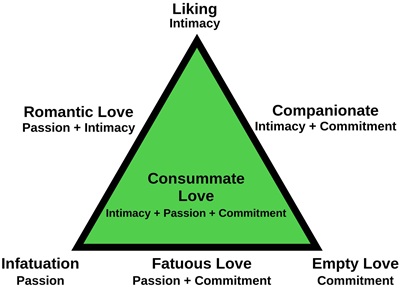
Reaching Consummate Love: Sternberg's Triangular Theory of Love
Even mystical experiences of boundless love can be understood within a secular framework. Meditation, psychedelics, contemplative prayer, and certain spontaneous experiences may temporarily dissolve the ordinary sense of self, producing overwhelming feelings of unity and unconditional compassion. These experiences are psychologically real and often profoundly life-changing. The secular interpretation, however, remains agnostic about their metaphysical significance. Rather than treating them as direct perceptions of ultimate reality, it regards them as altered states of consciousness that people subsequently interpret through their religious or philosophical worldviews. This perspective also avoids placing forms of love into an absolute hierarchy. Compassion is not necessarily "higher" than romantic love, nor parental love more evolved than friendship. Each responds to different human needs and circumstances. A parent risking everything for a child, lifelong friends supporting one another through hardship, lovers building a shared life, and strangers helping victims of disaster all exemplify genuine forms of love. They need not be ranked according to their proximity to a nondual Absolute. Finally, a secular account remains open-ended. It welcomes findings from neuroscience, evolutionary biology, developmental psychology, sociology, and anthropology, recognizing that our understanding of love continues to evolve. Rather than beginning with a comprehensive metaphysical system into which every experience must fit, it builds explanations incrementally from converging evidence. It seeks to explain love as a natural human phenomenon while preserving its emotional depth, moral significance, and existential importance. Ironically, this modesty may itself be a strength. Love loses none of its beauty simply because it is understood as an emergent product of evolution, culture, and consciousness rather than as the self-expression of Spirit. Indeed, recognizing love as a remarkable achievement of biological and cultural evolution can make it seem all the more precious. It is not diminished by being human; it is made more extraordinary by the improbable history that made such capacities possible.
Widget is loading comments...
|