|
TRANSLATE THIS ARTICLE
Integral World: Exploring Theories of Everything
An independent forum for a critical discussion of the integral philosophy of Ken Wilber
  Frank Visser, graduated as a psychologist of culture and religion, founded IntegralWorld in 1997. He worked as production manager for various publishing houses and as service manager for various internet companies and lives in Amsterdam. Books: Ken Wilber: Thought as Passion (SUNY, 2003), and The Corona Conspiracy: Combatting Disinformation about the Coronavirus (Kindle, 2020). Frank Visser, graduated as a psychologist of culture and religion, founded IntegralWorld in 1997. He worked as production manager for various publishing houses and as service manager for various internet companies and lives in Amsterdam. Books: Ken Wilber: Thought as Passion (SUNY, 2003), and The Corona Conspiracy: Combatting Disinformation about the Coronavirus (Kindle, 2020).
Check out my other conversations with ChatGPT
Ken Wilber on MeditationA Summary and Review of Jim Andrews' 2006 critiqueFrank Visser / Grok
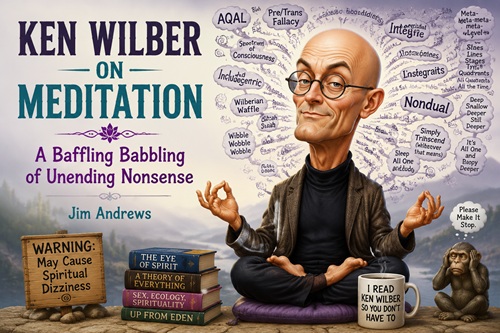 Jim Andrews, a former admirer of Ken Wilber who became critical after reading Geoffrey Falk's work, evaluates Wilber's advocacy of meditation.[1] The essay's stated purpose is not to assess meditation's actual efficacy but to examine the quality, integrity, and consistency of Wilber's (KW's) claims about it. Andrews structures the piece around nine specific concerns, extensively quoting Wilber from books like One Taste, The Eye of the Spirit, A Theory of Everything, Boomeritis, and the Kosmic Consciousness audio series, then critiquing them. Key ConcernsLack of evidence for acceleration claims: Wilber repeatedly asserts that meditation accelerates (but does not skip or alter the sequence of) stages of consciousness development, often citing "abundant evidence," "laboratory research," or "empirical research." Andrews notes Wilber provides little to no specific citations or data for most such statements. Enlightenment timeline vs. personal experience: Wilber suggests 20-25 years (or a lifetime) of conscientious meditation could lead to "the equivalent of enlightenment" (permanent nondual awareness) in this lifetime. Yet he admits he has not achieved it himself (despite decades of practice and a notable but temporary 11-day period) and has not met anyone who has. Inconsistency on "only meditation": Wilber claims meditation is the only thing empirically demonstrated to drive significant vertical stage development (e.g., two stages), yet in the same contexts he endorses other practices (yoga, shamanic voyaging, centering prayer, satsang with teachers, etc.) as also accelerating growth. 4-6. Reliance on flawed TM research (Skip Alexander et al.): Wilber heavily praises Alexander's studies (often linked to Maharishi International University/TM) for showing impressive gains, such as two-stage advances in 3-4 years or 38% of long-term meditators reaching Loevinger's highest ego development stages (vs. ~1-2% in general population). Andrews highlights Wilber's own acknowledgments of "valid criticisms" (bias, inadequate methodology, obliviousness to negative effects) and details methodological issues (e.g., non-random assignment, single raters, selection/expectation bias, extrapolation from prisoners or MIU students, timeframes mismatched in Wilber's summaries). He argues Wilber buries caveats and overstates results. 7. Meditation + community verification as "good science": Wilber presents meditative experience, checked against a community of practitioners, as a valid, scientific-like way to establish spiritual truths. Andrews challenges this as prone to confirmation bias, suggestion, social pressure, self-fulfilling prophecy, and lack of proper controls—comparable to religious conversion processes rather than rigorous science. 8. Maharishi effect: Wilber (via a character in Boomeritis) claims mass meditation reduces crime ("even skeptics admit" it). Andrews finds no supporting evidence for the "skeptics admit" part and notes repeated skeptical debunkings. 9. Downplaying risks: Wilber knows of potential negative effects (from sources like Murphy et al.'s book) but gives minimal warnings despite promoting meditation strongly. Andrews cites reports of anxiety, depression, antisocial behavior, worsened symptoms in vulnerable people, etc., and argues for informed consent. Conclusion in the essay: Andrews contends Wilber's advocacy violates his own stated principles of validity (truth, evidence, attunement to reality, curbing egoic fantasies). He calls it unsubstantiated, inconsistent, misleading, and potentially harmful "baffling babbling." The piece is detailed, quote-heavy, and references sources meticulously (though some links are now dated). EvaluationStrengths:Thorough and evidence-based: Andrews does what he accuses Wilber of not doing—he quotes extensively, provides context, cites specifics (including Wilber's own admissions of problems), and engages directly with the research rather than broad dismissals. This makes it a substantive internal critique of Wilber's integral project. Highlights real issues: Inconsistencies, overreliance on TM-affiliated research with known methodological weaknesses (a common critique in meditation science), selective presentation of data, and insufficient risk disclosure are legitimate concerns. Meditation research is plagued by biases, small samples, expectancy effects, and variable outcomes; claims of dramatic, reliable stage acceleration are not robustly supported in the broader literature. Wilber's grand, sweeping assertions often outpace the evidence. Ethical angle: The call for better warnings about potential adverse effects is responsible, especially given reports of meditation-induced challenges (now better documented in modern psychology as "meditation-related adverse effects"). Weaknesses/Limitations:Tone and scope: The title and rhetoric ("baffling babbling of unending nonsense") are polemical, which may alienate readers open to Wilber's broader ideas. It focuses narrowly on Wilber's promotional claims rather than a balanced view of meditation's benefits (e.g., established effects on stress reduction, attention, well-being in many studies/meta-analyses). Context of 2006: Meditation research has evolved since then (more rigorous RCTs, neuroimaging, recognition of both benefits and risks). Wilber's integral framework has also developed. Andrews' critique stands as a strong snapshot of specific overclaims but isn't the final word on meditation or Wilber's overall thought. Doesn't disprove benefits: As Andrews notes, this isn't an evaluation of meditation itself. Many people report positive transformative effects; the issue is Wilber's evidentiary rigor and universality in framing them within his stage model. Overall assessment: This is a sharp, well-executed skeptical takedown that exposes hype and confirmation bias in Wilber's presentation of meditation as a near-universal accelerator of consciousness evolution. It serves as a useful caution against treating any thinker's assertions as gospel, even (or especially) those advocating "integral" or "post-metaphysical" approaches. Readers interested in Wilber should cross-reference with primary research on meditation and consider both the potentials and pitfalls. The essay underscores a broader point in integral studies: bold theoretical synthesis is valuable, but it requires correspondingly strong empirical grounding. NOTES[1] Jim Andrews, "Ken Wilber On Meditation, A Baffling Babbling of Unending Nonsense", www.integralworld.net, 2006, reposted 2013.
Widget is loading comments...
|