|
TRANSLATE THIS ARTICLE
Integral World: Exploring Theories of Everything
An independent forum for a critical discussion of the integral philosophy of Ken Wilber
  Frank Visser, graduated as a psychologist of culture and religion, founded IntegralWorld in 1997. He worked as production manager for various publishing houses and as service manager for various internet companies and lives in Amsterdam. Books: Ken Wilber: Thought as Passion (SUNY, 2003), and The Corona Conspiracy: Combatting Disinformation about the Coronavirus (Kindle, 2020). Frank Visser, graduated as a psychologist of culture and religion, founded IntegralWorld in 1997. He worked as production manager for various publishing houses and as service manager for various internet companies and lives in Amsterdam. Books: Ken Wilber: Thought as Passion (SUNY, 2003), and The Corona Conspiracy: Combatting Disinformation about the Coronavirus (Kindle, 2020).
Check out my other conversations with ChatGPT True Transcendence or Conceptual Overreach?A Critical Review of Germane Marvel's 'A Diunital Approach to Post-Apocalyptic Consciousness'Frank Visser / ChatGPT
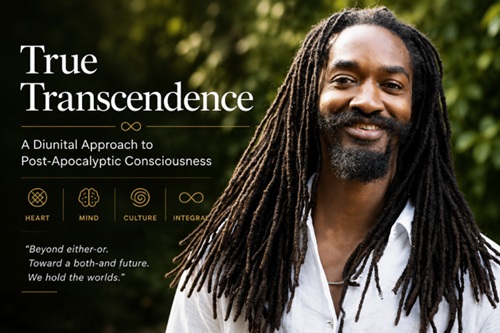 Germane Marvel's True Transcendence is an ambitious attempt to rethink developmental theory, Integral Theory, Spiral Dynamics, metamodernism, and even the philosophical concept of transcendence itself. The essay presents what Marvel calls a “diunital” approach—a both-and mode of cognition that seeks to overcome the dichotomies embedded in Western thought. In doing so, he introduces his own frameworks, the Model of Human Development (MOHD) and the Model of Emergent Relational Complexity (MERC), while arguing that existing developmental systems suffer from Eurocentrism, cognitive bias, and structural blind spots. The result is a fascinating, provocative, and highly original piece. Yet it also illustrates many of the recurring problems that have plagued grand developmental metatheories for decades. The Central ThesisMarvel argues that Integral Theory, Spiral Dynamics, and mainstream metamodernism have all misdiagnosed our present historical condition because they omit a crucial developmental stage: hypermodernism. According to him, contemporary society is neither postmodern nor properly metamodern. Instead, it is characterized by systemic conflicts, hyper-individualization, technological acceleration, and cultural oscillation—all features of hypermodernity. He inserts hypermodernism into the developmental sequence and positions it between postmodernism and what he considers genuine metamodernism. Beyond metamodernism lies an “Integral Stage-State,” defined not primarily by cognition but by a synthesis of heart and mind, subject and object, self and culture. This restructuring of developmental maps is the backbone of the entire essay. A Valuable Critique of Integral TheoryMarvel's strongest contribution is his challenge to the hidden assumptions of Integral Theory and related developmental systems. He argues that many stage models claim universality while relying almost exclusively on Western intellectual traditions. Piaget, Kohlberg, Kegan, Cook-Greuter, Wilber, and others developed their frameworks within what he calls “Eurovision cultures”—Western societies and their colonial extensions. Consequently, their developmental sequences may reflect cultural assumptions rather than universal truths. This criticism deserves serious consideration. Developmental theorists have long wrestled with the problem of cultural bias. Critics have repeatedly pointed out that higher stages often resemble the values of the theorists who created them. Marvel's emphasis on indigenous traditions, African philosophy, Yoruba concepts, and Blackfoot social structures broadens the conversation in productive ways. His discussion of Maslow is particularly interesting. Drawing on recent scholarship about Maslow's observations of the Blackfoot people, Marvel argues that communal self-actualization may be more fundamental than individual self-actualization—a perspective largely absent from mainstream developmental psychology. The Promise of “Diunital” ThinkingMarvel's signature concept is “diunital cognition.” Rather than treating opposites as contradictions that must be transcended, he proposes viewing them as complementary poles held together within a larger unity. He contrasts this approach with Hegelian dialectics and Wilber's “transcend and include” model. At its best, this resembles longstanding ideas found in: • Taoist yin-yang philosophy. • Complementarity in systems thinking. • Dialogical approaches in psychology. • Both-and logic in contemporary complexity theory. The appeal is obvious. Many contemporary conflicts are exacerbated by binary thinking. Marvel's call for a relational mode of cognition that can hold tension without collapsing into either pole has genuine value. His discussion of identity-protective cognition, symbolic life, and ideological capture is also insightful. Drawing on the work of Sylvia Wynter and others, he suggests that people often defend theories because those theories support their identities. This observation applies not only to politics but also to intellectual movements such as Integral Theory itself. The Problem of Endless Stage InflationYet the essay also exhibits a familiar weakness. Marvel criticizes Integral Theory for missing a developmental stage. But he responds by creating additional stages of his own, introducing new interaction categories, new developmental sequences, new realms of reality, new color schemes, and new meta-frameworks. This raises a fundamental question: What evidence establishes that these stages actually exist? The essay frequently claims greater explanatory power and greater falsifiability, yet rarely demonstrates either. Assertions about hypermodernism, metamodernism, plural-integral consciousness, and integral stage-states are largely interpretive rather than empirical. Ironically, Marvel sometimes appears to replicate the very tendency he criticizes in Wilber: constructing increasingly elaborate developmental architectures based on philosophical synthesis rather than systematic evidence. The Return of Spiritual HierarchyMarvel rejects many aspects of traditional Integral Theory, but he preserves one of its deepest assumptions: the notion that humanity progresses toward higher and more integrated forms of consciousness. The language changes, but the structure remains familiar. There are higher stages, lower stages, developmental failures, collapse risks, and more advanced forms of awareness. The destination is no longer Wilber's vision-logic but Marvel's Integral Stage-State. Yet the developmental ladder remains intact. This creates a tension within the project. If the goal is genuinely to move beyond Eurocentric hierarchy, why retain such a strong hierarchical architecture at all? The essay never fully resolves this question. The Critique of HegelOne of Marvel's most controversial arguments is his attack on Hegel. He contends that Hegel never truly resolves dichotomies but merely renames them through “sublation.” According to Marvel, Hegel's dialectic preserves oppositions rather than genuinely integrating them. His own diunital approach is presented as a superior alternative. This critique is provocative but overstated. Hegel scholars would almost certainly object that Marvel is interpreting dialectics too narrowly. Whether one agrees with Hegel or not, the claim that Hegel “never once resolves dichotomy” is difficult to sustain historically or philosophically. Marvel himself acknowledges that this interpretation is contested and explicitly invites criticism on the point. That openness is commendable. A New Integral or Another Integral?Perhaps the most interesting question raised by the essay is whether Marvel has truly escaped the Integral paradigm. He repeatedly positions himself against Wilber, Spiral Dynamics, and mainstream metamodernism. Yet much of his project resembles a classic Integral move: • Construct a grand metatheory. • Reorganize existing developmental systems. • Introduce a more inclusive framework. • Place one's own framework at the highest level. • Critique predecessors as partial and incomplete. This pattern is remarkably familiar. One could argue that Marvel has not abandoned Integral Theory so much as produced a competing version of it—one rooted less in Hegel, Gebser, and Wilber and more in Wynter, Black metamodernism, indigenous perspectives, and relational ontology. ConclusionTrue Transcendence is one of the more intellectually ambitious attempts to rethink developmental theory from outside the conventional Integral orbit. Its strongest contributions are its critique of Eurocentrism, its emphasis on relationality and intersubjectivity, its engagement with indigenous perspectives, and its challenge to simplistic developmental narratives. At the same time, the essay suffers from many of the weaknesses that afflict large-scale metatheoretical projects. It proposes extensive new developmental structures without providing equivalent empirical support. It criticizes stage inflation while introducing additional stages. And despite its rejection of Integral orthodoxy, it often reproduces Integral Theory's characteristic tendency toward ever-expanding conceptual architecture. The most compelling aspect of Marvel's work may not be the specific developmental model he proposes. Rather, it is his insistence that developmental theory itself must confront its cultural assumptions, its philosophical inheritances, and its tendency to mistake particular perspectives for universal truths. Whether his “diunital” alternative ultimately succeeds remains an open question. But it succeeds in forcing that question to be asked.
Widget is loading comments...
|