|
TRANSLATE THIS ARTICLE
Integral World: Exploring Theories of Everything
An independent forum for a critical discussion of the integral philosophy of Ken Wilber
 Germane Marvel is a philopher-poet, musician and facilitator. He co-wrote a five star beatbox musical rendition of Frankenstein with Battersea Arts Centre, which was later featured on the BBC. He's most widely known as a part of Steam Down's live improvised performances since the beginning as a poet, vocalist, host and curator. Germane Marvel is a philopher-poet, musician and facilitator. He co-wrote a five star beatbox musical rendition of Frankenstein with Battersea Arts Centre, which was later featured on the BBC. He's most widely known as a part of Steam Down's live improvised performances since the beginning as a poet, vocalist, host and curator.
True TranscendenceA Diunital Approach to Post-Apocalyptic ConsciousnessGermane Marvel
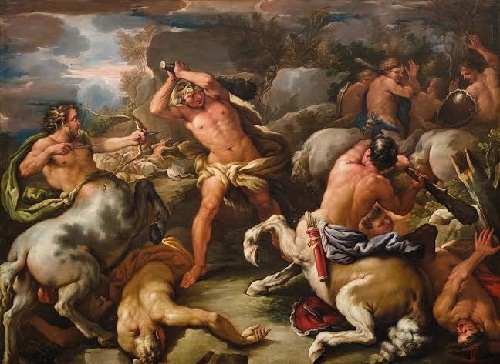
THE BATTLE OF THE CENTAURS
0. SignpostingThis piece has 11 sections including this one. Section 0 is what you're reading now. Sections 1 through 9 make the argument. Section 10 is the bibliography. Section 1 establishes what integral actually means and where the word comes from before Wilber got hold of it. Section 2 makes the structural correction the rest of the piece depends on: hypermodernism is a missing stage, and without inserting it developmental maps are wrong. Section 3 traces what happens to the concept of transcendence across every stage from premodern to metamodern, showing that integral isn't a destination you leap to but a resolution that only makes sense as the culmination of everything before it. Section 4 I exposes the Eurovision cultural bias built into developmental theory as a field and show what it costs us: specifically what it costs us to misread Maslow and miss the Blackfoot inversion of his hierarchy. Section 5 makes argues that the distance between your stage and a state you access has direct consequences for mental health, and that spiritual bypassing produces either nihilism or narcissism depending on which direction the power falls. Section 6 identifies the specific methodological error in Integral Theory, Spiral Dynamics and mainstream metamodernism. A grammatical bias that privileges the cognitive over the relational and present MERC as a falsifiable alternative. In Section 7 I show why vision-logic fails on its own terms, why Hegel's transcend and include is a false dichotomy, and how the Wynter mechanism explains why these frameworks resist correction. Section 8 turns the critique onto my own model, acknowledging the complexity problem, and offer the Gleaning compression as proof of concept that the architecture can be simplified without being lost. Section 9 closes where we opened in section 1: integral is not a destination, it's a process, but this time that claim means something different. Section 10 lists the sources.
1. What's Integral
The Model of Human Development (MOHD) is a descriptive, predictive and prescriptive model of cultural formation, growth and development based on a falsifiable theory of culture. It is descriptive because both the model and its underpinning theory describe the way cultures form and evolve. It is prescriptive and predictive because it both predicts what human culture is moving toward—and the mechanism that drives it—and it prescribes what human culture needs to look like if we are to survive. I have called this predicted/prescribed culture "Integral". Some of you may be familiar with this name. The name 'Integral' was first used by a militant revolutionary turned yoga teacher to describe his style of yoga. His name was Sri Aurobindo. It was then used by a soldier turned scholar, Jean Gebser, to describe his prediction of a new structure of consciousness. Both lived through two world wars and though neither fought in either, both experienced armed violence—Sri engaging in revolution against the British colonial empire, and Jean fighting fascists in the Spanish Civil War. Pretty apocalyptic stuff. After engaging in violence, both men predicted and prescribed a post-apocalyptic form of human consciousness. Both men inspired Ken Wilber and his Integral Theory. If you haven't heard of Integral Theory, it is a model that describes how human consciousness evolves across several stages. It's similar to Spiral Dynamics in that sense. In fact the two were intertwined at one point. In my modelling, Integral is a heart-mind stage-state. It's a way of being that combines the heart and mind into one unit—much like the Yoruba concept of Ori (meaning "head and destiny") is the calabash that holds both the heart and mind. As I wrote in How to Develop Your Consciousness , all stage development is state dependent. However, the integral stage-state is more so. The mind leads us towards the integral stage, and the heart leads us to the integral stage-state. Integral is not a destination. It is a state-based stage that results in the process of embodying all of the above
2. The present day missing stageI have written before in several places that one of the biggest failings of metamodernism, Integral Theory and Spiral Dynamics was that they did not identify the times that we find ourselves in. We're clearly under something other than postmodernism, and yet not quite metamodern. In Spiral Dynamics (SD) and Integral Theory (IT) terms: Green doesn't describe where we are but neither does teal/yellow. This is because all these frameworks miss hypermodernism, and that's why I suggest it fits in at what SD/IT calls yellow/teal. I suggest it is the true plural stage with an interobjective-interobjective (system to system) interaction. As I've written before, hypermodernism was predicted by Borgmann as part of a two way split from postmodernism. The other arm being metamodernism. It was later identified by the Krokers et al as involving oscillations from one pole to the other along the lines of many varying extremes. Lipovetsky wrote about the impacts of this as an intensification leading to hyper-consumption, hyper-individualisation. All of this sounds very familiar, and neither is postmodern or metamodern. This was the reason I started looking at new ways in which to organise and describe stage theory and the development of culture and consciousness. Firstly, they all missed out hypermodernism. Secondly, they all are Eurocentric, which we'll get into later in section 4 and 7. Finally, the reasoning they gave for how and why there stages were generated seemed to be incomplete, esoteric and diffcult to falsify. Spiral Dynamics relies on an oscillation between stable and unstable life conditions, and it's diffcult to reproduce. Integral Theory is even more esoteric borrowing from multiple cognitive development and stage theory systems and never grounding them fully into one generative measure. One such system that metamodernism, spiral dynamics and integral theory all reference is Cook-Greuter's. In short Cook-Greuter created a model of ego development, where ego means the primary trait around which personality is organised. The last stage of this model is referred to as Ironist-Unitive. Unitive refers to unity and is a stage where the individual has transcended dualities that structure everyday experience. The word Ironist comes from Richard Rorty's philosophy as someone who recognises that all vocabularies including their own are contingent and could be redescribed. At this point it's worth noting that I started this leg of my work with the application of diunital, both-and, cognition to the Dichotomous, either-or, foundations of western thought, as per the Black Metamodern Manifesto. By treating these opposing philosophies as complementary in a diunital manner, instead of as antagonists in a dichotomous manner, I established new ground to build stage theories on. In Cook-Greuter's manner I used the diunital philosophy to create the Unitive conditions for new strategies that demands an Ironist approach to pre-existing models. I'm relabelling things with my model because it's more accurate, offers more clarity, more explanatory power and is more falsifiable than the stage theories I've mentioned so far. It's really easy to dismiss something because it's new. Especially if you have spent years working with and learning a model like Integral Theory or Spiral Dynamics, or even mainstream metamodernism. So when some dreadlocked youngster comes and tells you your model is not quite right and here's another with a different colour coding (both Spiral Dynamics and Integral Theory are colour coded) it can be exasperating, frustrating, daunting and cortisol raising. Integral Theory/Spiral Dynamics labels modernism (Orange) as rational and postmodernism (Green) as plural. These are part of what they call the first tier. After comes the second tier and mainstream metamodernism (yellow/teal) has been identified with this stage. This aligns with Cook-Greuters Strategist/Autonomous stage. Metamodern theorists such as Hanzi Freinacht and Brendan's Graham Dempsey have speculated that you can go no further. But Integralists, Spiral Dynamicists predict another (Turquoise) phase that Cook-Greuter names Magician/Construct-Aware. Cook-Greuters Ironist/Unitive phase comes after this, speculated as Indigo by Spiral Dynamics Integral. But when we apply my frameworks to these models and our historical conditions we can see that they explain them better than the above. Modernism at rational in the MOHD is motivated by interobjective-subjective interactions. That's an interaction between systems and individuals. At rational the subject is treated as, and as part of, an interobjective system. Think of it as the modernist critical, rational system applied traditional life and the organisation of individuals into the system of industrialisation. I have long seen postmodernism as modernism's practices applied to itself. That's why It makes sense that this stage is rational-plural and is motivated by interobjective-objective interactions. That's an interaction between external systems and external objects. At rational-plural this whole system's concepts and its subjects are made into objects interacting with the rational, critical interobjective system. Think of it as the interaction between the cultural objects that modernism has produced - race, capital, the individual, the nuclear family - as concepts being subjected to the same critical, rational system that was once subjected to traditional life. I associate hypermodernism with Cook-Greuters Strategist/Autonomous and Spiral Dynamics Integral's teal/yellow. I position it as a plural culture form with interobjective-interobjective interactions That's a system to system interaction. In our current epoch, the hypermodern plural stage , it's all systemic. Hence the meta-crisis and the culture war, which are names for the way different systems/ways of doing things are coming into conflict. It's also seen in the so called meaning crisis. Opposing systems symbolic representation viewed antagonistically, clashing with one another at increasing speeds catalysed by the systems of modernism (such as technology) becoming ever more pervasive. I associate metamodernism with Cook-Greuter's Magician/Construct Aware, and with Spiral Dynamics Integral's turquoise. Its interaction is Interior-Plural, intersubjective. We could see it as the container of the above interactions. A meditative step back, but with the advantage of being able to understand the interior of the systems above, instead of just viewing them from the outside. This step back with an understanding of the interiority allows us to become aware of the constructs, and the shaky dichotomous grounds and biases they are resting on. It uses the magic of symbolic representation to hold the conflicts and tensions without succumbing to dizzying cognitive dissonance of intensifying oscillations. This leads us to the final Integral stage-state. We arrive again at Cook-Greuter's Ironist/Unitive, motivated by intersubjective-subjective interactions. That is motivated by an understanding that the very subject and object contains an interiority of systems, made up of objects and subjects, which in turn contain an interiority of subjects and objects. Relations all the way down.
3. Tracing TranscendenceIn order to reach a post-apocalyptic consciousness such as the Integral stage-state we might ask “where is it?” or “where will it be”. To answer this it's worth tracing the arc of a relevant and popular concept: transcendence. Currently most theories rely on the idea of transcendence. Brendan Graham Dempsey even named a book “Metamodernism and the Return of Transcendence” under pseudonym One of the most fundamental dichotomous philosophical foundations I applied diunital thinking to was the “transcendence vs immanence” debate. Transcendence is the idea that God/knowledge/ the truth, or in this case the Integral stage, is beyond the world as we know it. Immanence is the idea that God/knowledge/the truth, or in this case the Integral stage, is in and of the world. We're going to trace this idea and how our approach to it changed from the pre-modern times all the way through the metamodern stage. A key concept to remember is that while MoHD is a model of human culture, is a collective, an identity is a culture of one. The Transcendent Arc: Transcendence as a concept is a mythical-rational (and so premodern) ideation. At a mythical stage the immanence of transcendent gods that walk the earth and interact with humans is explained using myth and narrative. The mythical stage is motivated by object-object interactions. Humans are the playthings (objects) who's lives at determines by the (objective) behaviour of the gods. At the mythical-rational stage the accuracy of these models are inspected and the idea of a transcendent realm, one completely separate from the world we live in, is proposed. The mythical stage is inspired by exterior-plural (interobjective) interactions and systemic perspectives. Where inter-objectivity describes several external objects interacting in a system. Here on the one hand the place the gods live in is externalised as a separate, invisible and transcendent system. On the other hand the physical systems governing the human world of visible, immanent objects is explored in its own right. The paradox of transcendence and immanence is realised at rational (modern). A paradox is a seemingly unresolvable contradiction, however, as we'll see most paradoxes can be resolved with a new perspective. At the rational stage the motivating interaction is interobjective-subject, systems interacting with individuals. At the rational modern era, transcendence was largely dismissed as a result of the paradox being reviewed and found untenable from within the immanent frame of visible, external systems of objects. Transcendence, Immanence and the paradox itself is heavily critiqued at the rational-plural stage. This stage, which is exemplified by postmodernism, is motivated by interobject-object interactions. Here the rational method turns all subjects into objects to be systematically and critically analysed and so deconstructed. This includes the aforementioned concepts. Everything becomes a construct, including the immanent ground we stand upon. At the plural stage we find the hypermodern oscillation occurring between the poles of the paradox itself, and between the paradox and its absence. The motivating interaction is system-system or interobjective-interobjective. The opposing concepts are treated as opposing poles and unresolved contradictions surface and pitted against either. When done in a dichotomous, antagonistic manner to any degree it leads to a collapse to a previous stage. When the dichotomies are viewed diunitally, as complementary we find the next stage. Plural-integral is the resolution of the paradox identified, as I have done with the idea of emanance. The idea that what we are looking for is both here-now latent and waiting, and yet to be uncovered. The plural-integral stage is exemplified by Black Metamodernism specifically. It's motivated by Interior-Plural (intersubjective) interactions. Intersubjective interactions are exemplified by cultures as an interior system of subjectives. I've written about how I am both black and white, blackened by racialisation and whitened by growing up in a Eurovision nation and internalising its culture. It's this lived tension of internalised paradoxical living that leads to both-and solutions being deployed to resolve the stress that the resulting cognitive dissonance leads to. When humans are subjected to intersectional dehumanisation they living knowing they are fully human, and yet experiencing being treated as less than. As Sylvia Wynter names this leads to 'symbolic death' unless the paradox can be resolved with narrative that artists Ariel Black and Moyo Okediji name as Meta Myths. We'll discuss symbolic death in section 7 At plural-integral the narratives of liberation are found, explored and are begun to be applied. Creating new symbols. At integral the resolution is embodied into a new state of being. This is motivated by the interaction of intersubjective-subject. It's the embodiment of the knowledge that all objects contain an interior system, all the way down, coupled with the awareness of how each individual shapes the culture they are a part of and live in. The above process is grounded and exemplified in the particular perspective that is most pronounced at each stage. For that extra detail see an overview of the Model of Emergent Relational Complexity (merc) here 4. Unlearning Eurovision-Logic
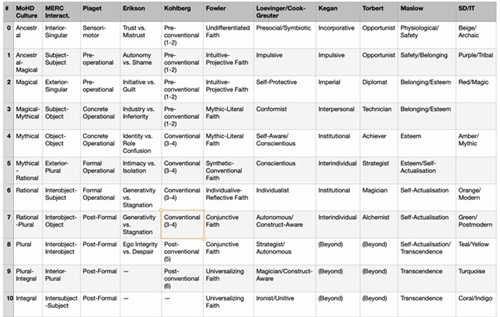
Much of my work including MERC and MOHD falls into a genre of academia called Developmental Theory or Stage Theory. It's an area of study that views humans and humans cultures as progressing in discrete stages of development. It often focuses on one or more types of cognitive development. Cook-Greuters work falls under this genre. So does Maslow's Hierarchy of Needs, which is the most widely know of these theories. Here are some other examples: Jean Piaget's work looked at four stages of cognitive development from childhood to adulthood Erik Erickson's work looked at how development through life appeared to be a result of a 'psychosocial crisis' of opposing forces psychological forces Lawrence Kohlberg extended Piaget's work developing theory of the moral stages of development. James Fowler built upon the work of all of the above to create a theory of faith development. Jane Loevinger inspired Cook-Greuter and developed a theory of ego development tracing how people's core frame of reference for making sense of themselves and the world matures over time Robert Keagan incorporated Piaget, Kohlberg and Cook-Greuter into a single framework organised around the subject-object relationship. William R Torbert was a collaborator of Cook-Greuter. They developed a Theory of action-logic focusing on how people act particularly in leadership and transformational roles Here's a table comparing all of the above frameworks
 All of these practitioners aimed for a universal modelling, but built their theories based on knowledge from W.E.I.R.D [Western, Educated, Industrialized, Rich, and Democratic] cultures only, much like Integral Theory, Spiral Dynamics and metamodernism. The exception is Maslows hierarchy of needs. It was based on his anthropological observations of indigenous peoples of the North American plains, the Siksika, also known as the Blackfoot peoples. Because Maslow conducted his study of the Blackfoot (intersubjective) culture from an outside perspective he viewed it as an (interobjective) system and projected his Eurovision understandings onto it. (By Eurovision I mean the cultures of Europe and their colonial settler expansions, the nations in which the Eurovision Competition has long included, plus the United States of Northern America) In the Siksika communities self-actualisation was the norm, and the community met the needs of each other by valuing generosity over accumulation of resources as a measure of wealth. This is part of the reason why Integral is a heart-mind stage-state. The mind and its cognitive resolution of dichotomies might lead to the stage, but the heart and communal self-actualisation leads to the state (state as both a transient experience and a long term organised community of governance) All stage development is state dependent. However the integral is a state based stage. To continue the metaphor from 'How to Develop Your Consciousness' we can see the weather as states, seasons as stages, climate change as a personality shaped by both state and stage. As I once wrote “the changes in my personality echo the changes in my personal reality”. I introduced 'The Realms of Reality” Model in the article “How to Develop your Consciousness”. There I showed there are five realms each with its own particular set of states: embodied (eg. physical) , energetic (eg. emotional) , imaginal (eg. imaginary), reflective (eg. contemplative), and integral (eg. spiritual). The difference between “ordinary” states and spiritual ones isn't so great. It's mainly a matter of perspective. This can be seen when you appreciate the different Realms of Reality. Waking states are grounded in the embodied realm. Sleeping states are found in the imaginal realm. Both can be seen as spiritual. Note that we can experience an Integral state at any level. These integral states are almost always seen as spiritual. More to the point we can experience states from any level at any stage. So what happens when we do? We collapse our structure of Consciousness as we will see below.
5. The Dangers of EnlightenmentThe greater the distance between your stage and the level that a state is from the more diffculty: articulating that experience to yourself and others; the more di?culty integrating that experience in a healthy grounded manner, and accessing that state again. This directly impacts the three pillars of mental health expression, resilience and agency, which are embodied forms of the three types of power external, resisting and internal, as discussed in 'How to Reclaim your power' Therefore, when people open themselves and their consciousness up to high level state experiences while bypassing proper development they can also open themselves up to power-based mental health issues. Whether nihilism from feeling powerless, or narcissism from feeling powerful, or both if they oscillate between them. This is another reason why the integral stage is state based. All stage development is state dependent. But having a solid structure where you have scaffolded a path through previous levels realms, understood the articulation of a robust amount of pillars across realms (known as lines in Integral Theory), and can access their streams is essential for the Integral stage-state. It cannot be entered without this developed kind of accessible stage experience. It's necessary, but not sufficient. On the other hand scaffolding the knowledge of paths across several states and several levels without experience of those states leads to abstraction and an inability to access those states. As our stage develops we are no longer bound to the earlier states of earlier levels. This liberation is sometimes described as lightness, but there is a risk here. Ungrounded attainment of high level states is sometimes also experienced as the lightness that is described as becoming enlightened. We want the ability of lightness and feeling grounded. After all we can access the Integral states from any level or stage, not only because there are integral states at each level, because our access to states is nonlinear. We can access any state at any time under the right conditions. So it's important to remember the Integral stage is a level driven by a solid well grounded and scaffolded structure with sturdy foundations and consistent high level varied Integral state access. In Integral theory the third tier is the one beyond turquoise/metamodern stage. It's often described as involving psychic abilities and other extra-sensory phenomena (ESP). As I've said above true metamodernism is motivated by intersubjective(interior-plural) interactions. I call this the plural-integral stage. So in my estimation the third tier has one stage: the integral stage, which is motivated by intersubjective-subjective interactions. At that point both duality (the division between good and evil, spirit and matter) and non-duality (the collapse of these distinctions) are held in a diunital, both-and, manner. However, the model is cyclical and non-linear so I propose the possibility for an Integral-ancestral stage and a potential re-description of stage theory after that. The key point is that the Integral stage-state is not accessible without the ability to enter in to and maintain integral states. We can temporarily reach the Integral Level but weaknesses in our overall structure will cause us to collapse and disintegrate to a lower stage. This in itself is an opportunity to really reintegrate. But this is why I refer to it as the Integral Stage-State. Integral states can be achieved at any stage, but unless we scaffold them with good foundations at each stage our state will collapse to a stage lower than the Integral stage-state. Finally, a warning. From my time studying yoga I know that psychic abilities and ESP are part of what are called the siddhis and there's a warning not to chase siddhis as it's dangerous. Much like there is a warning not to chase enlightenment.
6. The intersubjective correctionMost theories do not emphasise how important intersubjectivity (systems of subjects eg. cultures) is to later stages. We can see this in the way that Maslow made self-actualisation about the individual only. Spiral Dynamics Integralists often do the same thing, seeing intersubjective ways of being as only tribal. I am correcting this by identifying subject-subject (individual-individual) interactions as intra-subjective. Intra- meaning within, instead of inter- meaning between or across. Part of the issue is that intersubjectivity is mainly seen as cultural, and not the idea that an individual is a system of many subject selves. At the heart of the matter in Spiral Dynamics Integral the perspectival stage development follows 1st, 2nd and 3rd person in that order. 1st person is Me/I. 2nd person is you. 3rd person is it. As we can see this is taking the order of the rules of grammar for granted. Privileging the cognitive over the relational and pedestaling objective (including interobjective/systemic) ways of knowing as per Eurovision nation values. To ensure that I haven't made the same mistakes, and instead of naming things from personal preference or arbitrary guesswork, I've worked to establish a falsifiable mapping of the development of the types of perspectives and interactions we can have based on George Ritzer's Four Cell Matrix, from his Integrated Paradigm Model, using Wilber's simplified nomenclature, showing how we can structure 11 phases of interactions and perspectives in an additive, non-negating developmental model. You can view that model here. It's what offered better explanatory power than most models above when we looked at the motivating factors behind the understanding of transcendence across cultures.
7. The Magic of Symbolic LifeGoing back to Cook-Greuter: the Ironist/Unitive is able to be the witness of any and all perspective taking. This is linked to intersubjective-subjective interactions where at that level we can see any subject and object has an interiority, and that this interiority forms a system. This means we see all things as having intersubjective potential. For Cook-Greuter, the Magician/ Construct-Aware involves the awareness of the act of constructing perspectives itself and how meaning is made, which relates to the interior-plural interaction. This Magician/Construct-Aware stage relates to turquoise in Spiral Dynamics Integral and is a cross-historical, global view. That means it would necessarily orient itself beyond focusing mainly on the perspective of the Eurovision-logic cultures on the planet. This is something I have worked on in both the articles on the metamodern magicians toolkit and a metamodern definition of magic as symbolic representation. This toolkit is a way to inhabit a diunital, both-and, state where you see both dual and non-dual as complementary opposites. I suggest this path is key to reaching the Integral stage beyond. This leads to metamodern alchemy, which corrects stage theories and leads to MERC I've also worked several times on the idea of the meta myth, and the fact that Moyo Okediji named metamodernism as meta(mythic)modernism before the term became popularised by Eurovision sources. My piece titled Metamodern Alchemy named Sylvia Wynter's work on humans as Homo Narrans, the storytelling species, with narrative as the means by which humans constitute themselves as a species. She speaks about the over representation of Man1 and Man2. Where Man1 is homo politicus, the political species, and Man2 is homo oeconomicus, the economic species. I could propose a Man3, homo techne, the technological species, to suit the hypermodern age, but that's beyond the scope here. The point is that Man1,2 and 3 are not exclusively, but are primarily Eurovision concepts. Wynter sees this overrepresentation as dangerous. She identifies that our narratives have an impact on our neurology by way of the (very real) placebo effect. She suggests that when we live up to our narratives of our cultures and can count ourselves as part of the in-group our brains release feel good chemicals as part of our reward circuits. This in turn has a positive impact on our psychology, which is stress relieving. Wynter calls this symbolic life. I propose this is the evolutionary purpose of the placebo effect. But the reverse is also true, failing to live up to in-group cultural narratives leads to the nocebo effect, the opposite of the placebo effect, detrimental effects caused by negative expectations. Reward circuits in the brain shut down, which is stress inducing, and so bad for general health, leading to symbolic death, and studies suggest earlier actual death. This mechanism may lead to ideological capture and protective identity cognition. Ideological capture is when a field of study or an organisation is dominated by one set of ideas to the extent that other frameworks are excluded. Identity-protective cognition is the idea that most intellectual efforts are spent protecting stabilised identities, including the ideas that have formed them and their identities are attached to. Processing new facts and information so as not to disturb the constructed identity. I propose the mechanism is as follows: 1. Symbolic-death avoidance 2. Identity-protective cognition 3. Ideological capture Identity-protective cognition is the psychological mechanism of symbolic-death avoidance. Ideological capture is institutional outcome when enough people engage in identity-protective cognition. Most of the meta-theories (theories about theories) like Spiral Dynamics, Integral Theory and Metamodernism are often grounded in western philosophy, invoke eastern principles from a western perspective and use indigenous and African cultures as examples of lower stages, if they are included at all. Yet they all argue it is their aim to try create a post-apocalyptic vision of the future for all. This is why the Black Metamodern project was important in finding alternate routes to ground Metamodernism in and on. MoHD places the Integral Stage-State as beyond simply being a cognitive stage of (Euro)vision-logic. Firstly, it goes beyond vision. Secondly, it goes beyond logic. Thirdly, it goes beyond euro-American selective foundations. For a meta-theory to truly go meta (meta as in beyond) it must achieve these three principles. Although Integral theory speaks of the Integral stage as reliant on the concept of the centaur, it does not go meta as described above. The centaur is a half-horse half-man from Greek mythology. The lower half is horse, the upper half is man. The idea is that to go beyond post modernism in the “first tier” to the Integral Stages in the “second tier” we must join body and mind. His method for achieving this is 'vision-logic'. If you know Greek mythology they are a poor choice of mascot, apart from Chiron perhaps. If you don't, look up the context of the painting featuring Centaurs above. Vision-logic is a way of seeing that can take a vision of the entire field and apply logic to it, without collapsing the complexity into a single flat perspective as postmodernism has been accused of doing. It's the capacity to hold multiple contradictory perspectives in mind simultaneously, not as confusion, but as a higher-order synthesis. That sounds a lot like diunital thinking, but the problem is it is still based on Hegel. The quote below shows the method Integral Theory applies for this process is called “Transcend and Include” "Hegel said, 'To supersede is at once to negate and to preserve.' A little more straightforward version of that truth is that each evolutionary stage of transformation 'transcends and includes' ('negates and preserves') its predecessors."[1]
This supports three points: Firstly, the Integral Theory model of development is explicitly of a European lineage being Hegelian. The model's universality requires assessment on that basis. Secondly, there is not positive inclusion when it comes to IT stage theory. The include is to preserve and the preserve is a museum type quality. Not a living presence. The transcend is a negate, negating its living presence. Thirdly, the opposite of transcendence is immanence, not preservation, and not inclusion. This is a classic Hegelian error of a false dichotomy. Hegel never once resolves dichotomy, and this is one of the methods he uses to pretend he does. Finally, this also leads us back to the fact that Emanism/The Stack is not already contained in Integral Theory, Spiral Dynamics or Metamodernism, all of which apply Hegelian Dialectics. Emanism/The Stack is a series of diunital philosophies, developed by applying the diunital method to the dichotomous foundations of western thought. It doesn't transcend, or negate. It holds opposites as complements in a unit of two. It includes Emanance as described above. I am aware that this reading of Hegel is contested. I invite critique on this point. Please show me an instance where Hegel's dialectic produces a genuine resolution of a dichotomy. Not a false dichotomy, not a narrative of resolution, or a 'sublation' that preserves the opposition under a new name, like the claim about resolving the master/slave dialectic by suggesting the slave sees the humanity in the master, but the 'master' still ignoring the humanity in the slave. Please show an actual both-and integration where neither pole is negated, preserved, or transcended. I have not found one. If you have, I will revise my claim. I'm not saying that there is no natural negation process within all the examples of development you could look at. I'm saying it's not the only mechanism, and it only becomes necessary with a particular view of times workings, but this would be a shift along the lines of Gebser and is beyond the scope of this text. I will say that MERC and MOHD show an additive alternative, as do the Realms of Reality model. They all exemplify state and stage development without negation. The main problem is it looks very complex. I'll address this next
8. Complexity: Problem and its solutionThe worst thing about my model is that currently there are around 22 pillars and 11 levels. That's around 242 different states. It's intimidating. Once I've internalised everything a little better I'll be able to simplify it all a bit more. I have already simplified the 11 Gleaning (process/learning) phases down to four: Explore, Map, Assess and Navigate. That was from Determine, Attune, Cohere, Insight, Clarity, Embody, Expression, Agency, Resilience, Homeostasis, and Heterostasis. So fingers crossed for more general simplifications. Stician Samples has mapped those to Spiral Dynamics (SD) stages, finding correspondences with (IT) Integral Theory: Explore: SDIT=Red; Eman=Magical Map: SD=Amber; IT=Blue; Eman=Mythical Assess: SDIT=Orange; Eman=Rational Navigate: SDIT=Green; Eman=Plural I suggest the process as a whole as Metamodern plural-integral (SDIT=turquoise) and the result when all is held is the Eman Nation Integral (SDIT=coral/indigo) My colour choices won't matter to those who aren't familiar with SD/IT but for those of you who are Spiral Dynamicists and Integralists: The colours of the Eman Nation models are different from either Spiral Dynamics, Integral Theory or what Hanzi Freinacht did with Metamodernism. I get that what I've done with the colours is disruptive. I have to accept that as my role with what I've done. However, this was the cleanest way I could colour code my model. I don't know how I could keep the old colours from either Integral or SD without making it look super messy and nonsensical. There were missing stages in between the pre-existing ones. I have to know all of these systems of colouration too. And the colours were the last thing I added. One way we could look at my model is in helping us who are familiar with several stage theories to consciously develop the ability to become cross-paradigmatic (being able to hold and navigate multiple paradigms). It does this by helping us to fully embody the interobjective-interobjective (system to system) thinking and being. This is much needed as that's the epoch we are in and without stable exposure to the ability to take this perspective we can't explore, map, assess or navigate the landscape we live in. Without this capacity we experience collapse and oscillation. I call this type of perspective that comes from interobjective-interobjective interactions an intersubjective perspective, because the opportunity is there to know both systems inside and out, and to hold both systems internalised in one unit. Two (di-) as a unit of one (-unital), and so the path to diunital cognition. 9. Integral as processIntegral is not a destination. It's a process of embodying all of the above. I don't have a 'vision' for you of what it looks like. I only have a feeling that is hard to describe. I know the feeling after working through the process of all the frameworks you can find on my Map of Ideas The furthest I'll go so far to declare a hypothetical future culture called The Eman Nation that is based on the ideas you'll find across my writings and mappings. I don't think it's the place of one person to come up with all the ideas. The future is co-created. My belief is that the more people that internalise diunital ways of being the more we'll be able to contribute to tomorrow's solution that aren't based on yesterday's problems. To me the key differentiator of the third tier is this use of diunital, both-and, ways of thinking, feeling and being. Diunital sees opposites as complementary. Currently most of our models and philosophies are grounded on dichotomous methods that see opposites as antagonistic and contradictory. This of course includes those based on Hegels transcend and include. While this process may begin intellectually we must eventually break down the dichotomies of logic vs illogic, facts vs feeling, subject vs object, and apply diunital thinking to thinking itself. Breaking down the barriers between the heart and mind and revealing the Ori as the calabash that holds both. To talk along the lines of the realms of reality: I don't see one realm as the master key for the Integral Stage-state. The energetic is one of five that needs to be aligned and scaffolded to a high level in order to engage in the process that is the Integral Stage-state. And this is why we can view the Integral stage as a rainbow colour containing all the stages. This is the unfolding of our ancestral light through the metamodern darkness.
10. BibliographyAurobindo, S. (1914-21) The Life Divine. Pondicherry: Sri Aurobindo Ashram Press. Beck, D. and Cowan, C. (1996) Spiral Dynamics: Mastering Values, Leadership and Change. Oxford: Blackwell. Borgmann, A. (1992) 'The postmodern economy', in S. Goldman (ed.) New Worlds, New Technologies, New Issues. Bethlehem: Lehigh University Press, pp. 27-43. Borgmann, A. (1993) Crossing the Postmodern Divide. Chicago: University of Chicago Press. Cook-Greuter, S. (2002) 'A detailed description of the development of nine action logics in the leadership development framework', unpublished manuscript. Erikson, E. (1950) Childhood and Society. New York: Norton. Fowler, J. (1981) Stages of Faith: The Psychology of Human Development and the Quest for Meaning. San Francisco: Harper and Row. Gebser, J. (1949/1985) The Ever-Present Origin, trans. N. Barstad and A. Mickunas. Athens, OH: Ohio University Press. Kahan, D.M., Braman, D., Gastil, J., Slovic, P. and Mertz, C.K. (2007) 'Culture and identity-protective cognition: Explaining the white-male effect in risk perception', Journal of Empirical Legal Studies, 4(3), pp. 465-505. Kahan, D.M. (2017) 'Misconceptions, misinformation, and the logic of identity-protective cognition', Cultural Cognition Project Working Paper Series No. 164. New Haven: Yale Law School. Available at: https://ssrn.com/abstract=2973067 Kegan, R. (1982) The Evolving Self: Problem and Process in Human Development. Cambridge, MA: Harvard University Press. Kegan, R. (1994) In Over Our Heads: The Mental Demands of Modern Life. Cambridge, MA: Harvard University Press. Kohlberg, L. (1981) The Philosophy of Moral Development. San Francisco: Harper and Row. Kroker, A., Kroker, M. and Cook, D. (1990) 'Panic USA: Hypermodernism as America's postmodernism', Social Problems, 37(4), pp. 443-459. Lipovetsky, G. and Charles, S. (2004/2005) Hypermodern Times, trans. A. Brown. Cambridge: Polity Press. Loevinger, J. (1976) Ego Development: Conceptions and Theories. San Francisco: Jossey-Bass. Marvel, G. (2022) How to Solve the Metacrisis. germanemarvel.substack.com Marvel, G. (2023) A Metamodern Theory of Culture. [Online] germanemarvel.substack.com Marvel, G. (2023) Metamodern Alchemy: Development Narrative. [Online] germanemarvel.substack.com Marvel, G. (2023) Dichotomous Dialectics. [Online] germanemarvel.substack.com Marvel, G. (2023) The Gleaning: The Model of Learning of the Eman Nation. [Online] germanemarvel.substack.com Marvel, G. (2023) How to Reclaim Your Power. [Online] germanemarvel.substack.com Marvel, G. (2024) The Divine Matrix of Existence. [Online] germanemarvel.substack.com Marvel, G. (2024) How to Make Sense of It. [Online] germanemarvel.substack.com Marvel, G. (2025) Nested Emergence Theory. [Online] germanemarvel.substack.com Marvel, G. (2026) How to Develop Your Consciousness. [Online] germanemarvel.substack.com Marvel, G. (2026) Nested Emergence Theory (formal paper). [Online] germanemarvel.substack.com Marvel, G. (2026) Practical Diunital Solutions. [Online] germanemarvel.substack.com Marvel, G. (2026) Emanation: Map of Ideas. [Online] emanation.netlify.app Maslow, A. (1943) 'A theory of human motivation', Psychological Review, 50(4), pp. 370-396. Okediji, M. (2011) The Shattered Gourd: Yoruba Forms in Twentieth-Century American Art. Seattle: University of Washington Press. Piaget, J. (1952) The Origins of Intelligence in Children. New York: International Universities Press. Ritzer, G. (1981) Toward an Integrated Sociological Paradigm: The Search for an Exemplar and an Image of the Subject Matter. Boston: Allyn and Bacon. Rorty, R. (1989) Contingency, Irony and Solidarity. Cambridge: Cambridge University Press. Torbert, W. and Associates (2004) Action Inquiry: The Secret of Timely and Transforming Leadership. San Francisco: Berrett-Koehler. Wilber, K. (2000) A Theory of Everything: An Integral Vision for Business, Politics, Science and Spirituality. Boston: Shambhala. Wilber, K. (2014) 'The fourth turning: Imagining the evolution of an integral Buddhism', in The Fourth Turning: Imagining the Evolution of an Integral Buddhism. Boulder: Sounds True, p. 14. Wynter, S. (2003) 'Unsettling the coloniality of being/power/truth/freedom: Towards the human, after man, its overrepresentation — an argument', CR: The New Centennial Review, 3(3), pp. 257-337. Tuesday, June 09, 2026 NOTES[1] Source: Wilber, K. (2014). The Fourth Turning: Imagining the Evolution of an Integral Buddhism (p. 14). Sounds True. (Article originally published in The Huffngton Post, 2014)
Widget is loading comments...
|