|
TRANSLATE THIS ARTICLE
Integral World: Exploring Theories of Everything
An independent forum for a critical discussion of the integral philosophy of Ken Wilber
  Frank Visser, graduated as a psychologist of culture and religion, founded IntegralWorld in 1997. He worked as production manager for various publishing houses and as service manager for various internet companies and lives in Amsterdam. Books: Ken Wilber: Thought as Passion (SUNY, 2003), and The Corona Conspiracy: Combatting Disinformation about the Coronavirus (Kindle, 2020). Frank Visser, graduated as a psychologist of culture and religion, founded IntegralWorld in 1997. He worked as production manager for various publishing houses and as service manager for various internet companies and lives in Amsterdam. Books: Ken Wilber: Thought as Passion (SUNY, 2003), and The Corona Conspiracy: Combatting Disinformation about the Coronavirus (Kindle, 2020).
Check out my other conversations with ChatGPT Between AQAL and KhvarenahToward a Non-Reductionist Model of Iranian Civilizational DynamicsFrank Visser / ChatGPT
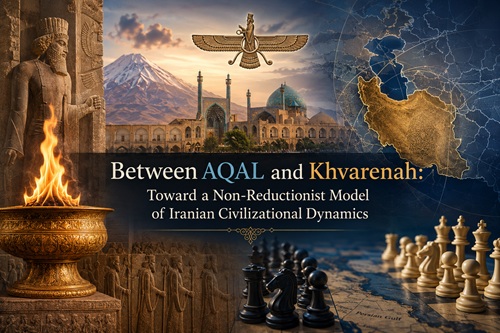 1. The Problem with “One-Key” ExplanationsJoseph Dillard's essay on Iran is driven by a strong interpretive ambition: to explain contemporary Iranian geopolitical resilience through a deep civilizational continuity rooted in Zoroastrian concepts of sacred legitimacy (Khvarenah) and its later Shi'i transformations. Against this, he explicitly rejects developmental psychology and AQAL-style analysis as explanatory tools, arguing that attempts to situate Iran within “levels of development” lead nowhere. The core issue is not whether developmental models are useful, but whether any single explanatory axis—psychological, cultural, or civilizational—can carry the explanatory burden of complex geopolitical outcomes. Both Wilber-style AQAL geopolitics and Dillard-style civilizational continuity theory share the same structural weakness: they elevate one dimension of reality into a master variable. A non-reductionist approach rejects that move altogether. 2. What Is Valid in the Critique of Developmental GeopoliticsDillard is correct on a narrow but important point: developmental psychology, when used as a macro-geopolitical classifier (“Iran is at X stage therefore behaves as Y”), becomes intellectually thin. This is because: • it flattens historical contingency into stage logic • it ignores institutional and strategic constraints • it confuses cognitive-developmental structures with state behavior • it produces post hoc categorization rather than causal explanation In that sense, AQAL-style geopolitical deployment often functions more as interpretive labeling than explanatory mechanism. So the critique of developmental reductionism is legitimate. But it does not follow that developmental psychology is irrelevant. It is simply not sufficient as a macro-explanatory framework. 3. The Problem with Civilizational EssentialismDillard's alternative rests on a longue durée continuity model: Iranian political identity is shaped by a persistent legitimacy structure originating in Khvarenah, continuing through pre-Islamic monarchy, Sassanian state ideology, Safavid Shi'ism, and culminating in the Islamic Republic. This is an intellectually rich hypothesis, and it aligns with scholarly observations that Iranian political culture has long integrated sacred legitimacy and kingship symbolism. Khvarenah itself is historically attested as a concept of divine radiance or legitimating glory associated with rulership, which can be traced across Zoroastrian, Hellenistic, and Islamic Iranian traditions . However, the problem arises when this continuity is treated as a causal essence rather than a recurrent symbolic repertoire. The risks are: • compressing discontinuous historical regimes into a single identity line • treating symbolic similarity as causal continuity • underweighting institutional, economic, and strategic transformations • implying a quasi-invariant “civilizational DNA” This produces explanatory elegance at the cost of analytical precision. 4. What a Non-Reductionist Model Must Do InsteadA more adequate framework is not a synthesis of Wilber and Dillard, but a shift in explanatory architecture. It requires separating four partially autonomous layers of causality: 4.1 Civilizational-Symbolic Layer (Khvarenah domain, but de-essentialized)This layer includes: • durable legitimacy narratives (sacral kingship, divine mandate, martyrdom politics) • symbolic grammars of authority • cultural memory structures that remain available across regimes Khvarenah belongs here, but not as a metaphysical force or civilizational essence. It functions instead as a recurring legitimacy schema that resurfaces under different historical conditions. It explains symbolic resonance, not geopolitical outcomes by itself. 4.2 Institutional-Strategic Layer (missing in both AQAL and Khvarenah accounts)This is the primary driver of modern geopolitical outcomes: • state capacity and bureaucratic coherence • military doctrine and asymmetric warfare • sanctions adaptation mechanisms • proxy networks and regional strategy • energy and economic leverage This layer is historically contingent and cannot be derived from cultural continuity or developmental stage placement. 4.3 Developmental-Distributional Layer (AQAL's proper domain)Developmental psychology is relevant here, but only in a bounded sense: • cognitive complexity of elites • moral reasoning diversity across populations • institutional modernization gradients • educational and technocratic capacity Its value is diagnostic, not deterministic. It maps variation within systems rather than explaining system-level outcomes. 4.4 Contingent Systemic Interaction Layer (real-time geopolitics)This includes: • crisis dynamics and escalation spirals • misperception and intelligence failure • alliance breakdowns • technological asymmetries • market shocks and externalities This layer is where outcomes are often decided, and it is inherently non-essentialist. 5. The Key Reframing: From Essence to InteractionThe central correction to both Wilber and Dillard is this: Neither “developmental stage” nor “civilizational essence” is a sufficient explanatory unit. Iran is not: • a developmental category (AQAL framing) • nor a civilizational constant (Khvarenah continuity framing) It is instead: a strategically adaptive modern state whose behavior emerges from the interaction of symbolic legitimacy structures, institutional capacity, cognitive distribution, and contingent geopolitical pressures. 6. Where Khvarenah and AQAL Actually BelongThe synthesis is not symmetrical but layered: • Khvarenah → legitimacy repertoire (symbolic continuity) They do not compete; they operate at different levels. But neither can explain geopolitical outcomes without the institutional and systemic layers. 7. Conclusion: The Cost of Single-Key TheoryThe deeper methodological issue is not whether Dillard is “right or wrong” about Iran, but whether civilizational explanation can function as a master key. It cannot. What emerges instead is a multi-layered causal field in which: • culture constrains meaning • institutions generate capacity • cognition distributes reasoning styles • contingency determines outcomes Any model that collapses these into a single explanatory principle—whether “developmental stage” or “Khvarenah continuity”—inevitably produces interpretive overreach. The non-reductionist position is therefore not a compromise between Wilber and Dillard, but a rejection of the need for a single dominant explanatory axis at all.
Comment Form is loading comments...
|