|
TRANSLATE THIS ARTICLE
Integral World: Exploring Theories of Everything
An independent forum for a critical discussion of the integral philosophy of Ken Wilber
 Dr. Joseph Dillard is a psychotherapist with over forty year's clinical experience treating individual, couple, and family issues. Dr. Dillard also has extensive experience with pain management and meditation training. The creator of Integral Deep Listening (IDL), Dr. Dillard is the author of over ten books on IDL, dreaming, nightmares, and meditation. He lives in Berlin, Germany. See: integraldeeplistening.com and his YouTube channel. He can be contacted at: joseph.dillard@gmail.com Dr. Joseph Dillard is a psychotherapist with over forty year's clinical experience treating individual, couple, and family issues. Dr. Dillard also has extensive experience with pain management and meditation training. The creator of Integral Deep Listening (IDL), Dr. Dillard is the author of over ten books on IDL, dreaming, nightmares, and meditation. He lives in Berlin, Germany. See: integraldeeplistening.com and his YouTube channel. He can be contacted at: joseph.dillard@gmail.com
SEE MORE ESSAYS WRITTEN BY JOSEPH DILLARD How and Why Iran Has Successfully Defied the WestJoseph Dillard / DeepSeek
Lessons for Integral
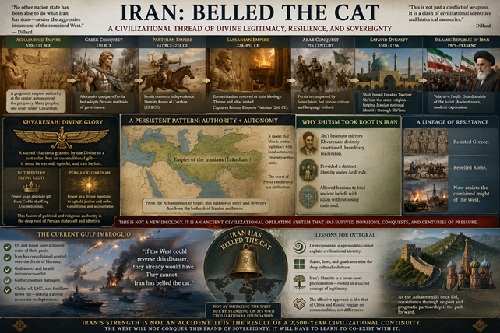
In a previous essay, “Has Iran Really Belled the Cat?,” I attempted to make the case that Iran has indeed succeeded in doing something no other nation state has been able to do: neuter the aggressive incursions of the combined West, the US and its various allies, including the UK, EU, and Israel. The Current Gulf ImbroglioThe US and Israel have achieved none of their goals before launching their attack on Iran on February 29, 2026. These included causing a successful popular uprising against the government, destroying Iran's missile capabilities, eliminating its nuclear enrichment program, and its support for Hezbollah, Hamas, and the Houthis in Yemen. Instead, the US and Israel have sustained significant material damage to assets in the Gulf region and Israel proper, consolidated control over the State of Hormuz under Iran, seriously damaged the economies of US Gulf allies, and initiated a cutting off of Gulf oil, LNG, and fertilizer components in a move that looks very likely to cause a global recession, if not an outright global depression, sometime in the next year. Most sources project a major global economic downturn in the next three months, by September, 2026. If there was anything that the US and Israel could do to reverse this disaster it seems reasonable to assume that they would already have done it. That they have not implies that they cannot, and that Iran has indeed “belled the cat.” This has not only generated a great deal of respect for Iran globally, as it has done something that neither China or Russia have succeeded in doing, but it raises a more fundamental and important question, one which I have not seen anyone asking: “Why Iran?” Of course the answer is multi-faceted. One can point to Iran's geography. It does indeed control, by dent of its location, a major choke-point of the world's economic system. It is the size of Western Europe. The idea that the US or Israel could destroy the government when Russia has been unable to do that in Ukraine over four years, although it is on Russia's doorstep, is implausible at best. Iran has demonstrated much greater national unity than its adversaries assumed existed. But how come? Why? I don't know about you, but I can say that my understanding of world history, based on my education, left me woefully unprepared to make sense of current global events and particularly those involving Iran. I learned almost nothing about Islam and even less about the distinction between Sunni and Shiite and why that distinction might have mattered in the slightest. Apparently, from the perspective of those who wrote and taught history in secondary school and at university, these distinctions were largely irrelevant. That has certainly turned out to not at all be the case. So I will now fill in some of the missing blanks in that history and explain how and why they are relevant to our current geopolitical reality. I will then attempt to show how this information generates an explanation that is not only more plausible but actionable than that generally offered by Integral. To understand why Iran has been able to “bell the cat” when the rest of the world has not requires an understanding of the historical roots of Iranian identity that I knew nothing of. What I did know was disconnected. I knew ancient Persia was indeed powerful and was the core of an alliance of over thirty different regions, nations, or identities. I also knew that it was conquered by the Greeks under Alexander. I knew that it had somehow, not so long afterward, managed to defeat Roman invasions. I knew that it was conquered by Sunni Islam but then rebelled against that, developed a distinct Shiite religious identity, and that that identity played a major role in the 1979 revolution and the resurgence of Iranian identity and power in the years since. But those facts all appeared disconnected to me. Together they did not provide a narrative that would explain what made Iranian character and culture strong enough to withstand decades of Western (US, EU, and UK) sanctions while building up a military strong enough to not only withstand the blows of the West but respond with significant damage to the interests of the West.
The “Why” of this Essay
What follows then, is meant to provide a historical and cultural narrative that may be part of the explanation for why Iran has (apparently) successfully “belled the cat.” At the outset I want to say that I am presenting only one theory and it could be completely wrong. In addition, Israel and the combined West could still prevail in this war. I do not rule out those possibilities. What I am suggesting are some factors that provide a partial possible explanation for the success of Iran to this point. I am providing these explanatory factors for several reasons. 1) Others may have different ideas or push back, which will challenge and thereby improve my understanding; 2) it is important for people to think about these things because what is happening in the Persian Gulf is one major factor in the turning point in world history that we are now experiencing. Understanding how and why it is happening reduces our victimization in the face of these events; 3) the traditional Integral framing of geopolitical events to be pretty weak soup. If you peruse various critiques in Integral World over the years you will see that Integral viewpoints generally boil down to a battle of good (the West) vs. evil (identified opponents) or a failure in development, that non-Westerners have not yet gotten to 2nd Tier and that their situation is hopeless until they finally see the light and catch up. Of course, the argument is never phrased in such blunt, direct terms, because to do so would expose the elitism and exceptionalism that underlies that position.
The Zoroastrian Roots of Persian Exceptionalism
I knew that ancient Persia subscribed to the manichaestic radical dualism of Zoroastrianism, which worshipped fire as the manifestation of light conquering darkness. I have never thought much of extreme dualisms and Manichaeism, associating them with concrete early childhood cognition that Piaget would label “pre-operational” and which was associated in the world of psychopathologies (such as Wilber outlined in his 1986 essays in Transformations of Consciousness), with personality disorders, some of the most serious and intractable of all psychological disorders. I viewed such perspectives as causal for a great deal of both personal and geopolitical conflict, and I still do.
Khvarenah
I have since learned that Zoroastrianism was far more than a fire-worshipping dualism. It had a powerful concept of “Khvarenah,” Divine Grace or Glory, a sacred charisma that was an essential attribute of a legitimate ruler. Whether Persians adopted this concept and Zoroastrianism because of unique cultural characteristics of Persians or whether Zoroastrianism itself generated that culture within Persians is something of a “chicken and egg” question. The most reasonable answer is that they probably evolved interdependently: ancient Persians adopted Zoroastrianism because it was in important ways compatible with their underlying culture and that thereafter Zoroastrianism strengthened that underlying proclivity. In either case, what is important about Khvarenah, Divine Grace or Glory, is that it fuses political and religious leadership in culture and society in Persia throughout its history. Note that this is a polar opposite to the enlightenment West, which since John Locke has argued for the separation of state and church. My own position is that neither separation or unity of belief and state is better. Both can be important and useful and both can be disastrous. The doctrine of Khvarenah has been both critically important and on the whole, extremely useful, since ancient Persia and the Achaemenid dynasty of Ataxerxes, Cambyeses, Darius, and Cyrus, up until its current cultural and social incarnation in the Islamic Republic of Iran. However, the alien nature of that Khvarenah may be one reason why I grew up with such a shallow understanding of Zoroastrianism, Persia, and contemporary Iran. The reader may reasonably and logically ask, “But isn't Khvarenah basically the same as the Western concept of the Divine Right of Kings?” We Westerners are familiar with the theory of Divine Right, most famously articulated by James I of England, VI of Scotland. A common summary of his philosophy is: “As it is blasphemy to dispute what God can do, so it is sedition... to dispute what a king can do.” The king was God's direct lieutenant on Earth. This absolute power was a gift from God, not conditional on the king's performance. The Persian concept of Khvarenah produced a profoundly different result because of its inherent conditionality. While it was a divine, kingly glory, it was not an unconditional gift of power to the monarch. It was more like a divine mandate to perform specific duties, and it could, and in the ideology did, leave the king. In ancient Persia, the nature of political authority was conditional, not absolute. It had to be earned and maintained. This completely reframes the relationship between the ruler, the divine, and the nobility. (In this respect this Iranian fusion of political and divine right to rule echoes that in historical China.) The model of a state where political authority is fused with religious ideology was therefore not invented by the Islamic Republic in 1979, as I was led for decades by Western media to assume. On the contrary, its Persian roots are deep and foundational for contemporary Iranian identity.
Achaemenid Roots
The Achaemenid Empire was one of the most successful and enduring empires of the ancient world precisely because it was a pragmatic blend of authority and autonomy. The empire was held together by a dynamic tension: the king demanded loyalty and tribute, but he largely allowed subject peoples to manage their own internal affairs. The lived reality was likely paying taxes and providing soldiers, but being otherwise left to live according to their own laws, speak their own languages (like Aramaic serving as the bureaucratic lingua franca), and worship their own gods. This presaged Alexander's model of governance, something I never knew. While it was not so different from the polis system of local governance Alexander set up subsequent to his conquest, but it differed fundamentally from Roman and Byzantium rule and that of European Christian monarchs thereafter.
Parthian and Sassanian Reformation
This blending of authority and autonomy under the doctrine of Khvarenah was perfected by the Sassanian Empire over 1,500 years ago, after the Greek conquest of Persia by Alexander the Great in 330 BCE, the subsequent rule of the Hellenistic Seleucid Empire, Persia reorganized itself into two powerful empires that successfully expelled foreign rule, repelled Rome, and operated as autonomous nations with a distinct Iranian ideology for nearly 1,000 years. This process unfolded in two major phases: the Parthian (Arsacid) Empire and the Sassanian Empire. These are notable for defeating Rome twice. First, in the Battle of Carrhae in 53 BCE, the Persians Parthians annihilated a Roman army led by Crassus, one of the most powerful men in Rome. Second, in 260 CE the Sassanian Empire that seceded the Parthian Empire, under Shapur I, defeated and captured the Roman Emperor Valerian. This was the first and only time a Roman Emperor was captured alive. I mention this because the Persians long ago blocked the eastern expansion of Rome, just as the present day Iranians have apparently blocked control of the Middle East by the West. There is a historical parallel here, and cultural roots play a role in explaining the continuity of those notable, civilizational-changing events separated by some 2000 years. The evidence strongly indicates that this deep structural resonance is indeed a primary reason why Shi'ite Islam took such deep and lasting root in Iran, ultimately culminating in the current system, instigating regime change, and an effective defense of Persia/Iran against the most powerful military, economic, and media confederation on Earth. While the Parthians ruled Persia for some 400 years after the short-lived Seleucid Empire, the subsequent Sassanian reorganization, beginning in 224 CE, was a deliberate and aggressive "reboot" of Persian identity. Zoroastrianism once again became the state ideology and religion. Ardashir famously declared that “Religion and State are brothers, neither can flourish without the other”. This fused royal authority with divine mandate and importantly reaffirmed the primacy of the doctrine of Khvarenah. The Sassanians aggressively styled themselves as the heirs to the Achaemenids, using their titles (“King of Kings”), building rock reliefs, and adopting their imperial iconography to create a distinctly “Persian” national identity. This created a cultural fortress that allowed Persia to stand against the cultural pull of Hellenism and the military might of Rome for over four centuries, remaining a major world power until the Islamic conquests in the 7th century CE.
Resistance to Sunni Islam
Persian resistance to abandoning Khvarenah under the rule of Sunni Islam was significant. It took approximately 300 years for Iran to become a Muslim-majority nation, with most Persians converting by the 10th century. Zoroastrianism continued in many regions and fire temples were still noted by geographers for centuries. A distinct “Iranian Muslim identity” emerged and movements like the Shu'ubiyya championed Persian culture and identity against Arab privileging, helping to ensure the survival of the Persian language and pre-Islamic heritage within an Islamic framework. There was a recurring “cultural and ideological deep structure” that has repeatedly re-asserted itself as a uniquely “Iranian” way of solving the problem of political legitimacy. It led from the classical Achaemenids, surviving the Greek invasion, to the Sassanian “throne and altar,” within the core concept of “Ērānshahr,” “Empire of the Iranians,” a sacred, righteous kingdom under divine grace, with the King of Kings as its divinely appointed guardian. In a cultural-social rebellion against Sunni Islam, it eventually manifested as Shiism.
The Rise of Shi'ism
This became enshrined as contemporary Islamic Republic's “Velayat-e Faqih”, Guardianship of the Jurist. The Shah was the earthly representative of God, tasked with upholding cosmic order, justice, and the faith. The Supreme Leader (Rahbar) is the highest political and religious authority, tasked with safeguarding the Islamic system and the values of the revolution. This is a divinely mandated Islamic state led by a supreme jurist as the deputy of the Hidden Imam. This was not a straight line of institutional continuity, broken by the Arab conquest. It is better understood as an underlying cultural substrate adapting to changing social conditions. The ideology we see today in Iran was therefore not born in 1979. It was re-established over 500 years ago as the Iranian national paradigm in 1501 by Shah Ismail I, founder of the Safavid Dynasty. Facing a rival Sunni Ottoman Empire, the Safavids forcibly converted Iran from Sunni to Twelver Shi'ism, intentionally using a distinct state religion to forge a unified national identity. This fused modern revolutionary Shi'ism with a distinctly Iranian narrative of justice and resistance, creating a unique system appealing to a population with a long memory of sovereignty. The underlying cultural factor that differentiated Persia/Iran from both Sunni Islam and Western civilization was the Zoroastrian doctrine of Khvarenah. The Shi'i doctrine of “Imamate,” that leadership of the Muslim community belongs to a hereditary line of sinless, divinely-inspired Imams from the Prophet's family, was a near-perfect analogue. As one historian notes, “the attraction these beliefs held for Iranians was in large measure due to the manner in which they were in harmony with and, as it were, echoed older cult conceptions”. For a people used to the idea of a “divine mystical force” empowering their kings, the Shi'i Imam was a figure they could easily recognize and venerate. Shi'ism also provided a way for conquered Iranians to maintain a separate identity from their Arab rulers. It was a creed that “contradicted...the ruling dynasty and the official opinion of the majority of the Arabic-speaking community”. By choosing Shi'ism, Iranians were not just converting; they were subtly asserting their own cultural and political identity within the new Islamic framework. This allowed them to “bind ancient beliefs with the new teachings of Islam” without fully surrendering their past. Scholars argue that Shi'ism “took deep roots in Persia from an early period” because its core tenets aligned with pre-existing Zoroastrian beliefs. It appears that the key point of attraction was the concept of Khvarenah, divinely sanctioned, hereditary authority. My conclusion is that if observers of the current geopolitical imbroglio centered in the Persian Gulf do not understand this, it is impossible to understand how and why Iran has successfully “belled the cat” of Western power. Westerners might understand this by drawing an analogy to the Protestant Reformation, that was vigorously resisted by Catholicism and which precipitated countless religious wars in Europe. Similarly, Sunni Arab Islamic states have consistently denounced and fought against Iranian Shi'ism. What we see in the Islamic Republic is the latest, most potent iteration of an ancient, classical, Zoroastrian derived model. Its cultural and political logic survived and re-emerged, eventually finding its most powerful expression in the fusion of Shi'ism and Iranian statehood. Shi'ism resonated with pre-existing Iranian patterns of sacred authority rather than simply inheriting them. The overthrow of the Shah was not most fundamentally a desire to return to the democracy of Mogadishu, overthrown by the CIA and MI6 in 1952, but a return to national sovereignty and Khvarenah, divinely sanctioned, hereditary authority. As soon as Iranians had a chance they overthrew a monarch who had favored a secular nationalism and replacing him with a Shi'i cleric who fused Iranian nationalism in Islamic garb. This approach to sovereignty obviously has great staying power. It is one reason the Persians survived the disaster of the Greeks, fought off the Romans, refused to identify with Sunni Islam, overthrew the Shah, and now have reasserted their primacy in the Persian Gulf. The West is not going to conquer this brand of sovereignty. It is going to have to learn to co-exist with it.
Lessons for Integral
The above has little to nothing to do with developmental psychology. Attempts to categorize Persia/Iran at this or that level of development and then to use that to explain its history and current success leads nowhere. Development is real, but civilizational identity can operate across developmental levels and cannot be reduced to them. Similarly, analyzing what is currently going on in the Gulf and between Iran and the combined West in terms of states, lines, and quadrants misses the underlying issue. That is a cultural identification with a definition of identity that is fundamentally different from that of Sunni Islam and the West. It successfully cuts across all developmental levels. The approach of China and Russia to Iranian identity seems to be more efficacious, in that it focuses on commonalities rather than differences. My own estimation is that this approach is working and will continue to work, just as ancient Persia under the Achaemenids successfully blended authority and autonomy to build a highly effective civilizational model. And that, in itself, is remarkable.
Widget is loading comments...
|