|
TRANSLATE THIS ARTICLE
Integral World: Exploring Theories of Everything
An independent forum for a critical discussion of the integral philosophy of Ken Wilber
  Frank Visser, graduated as a psychologist of culture and religion, founded IntegralWorld in 1997. He worked as production manager for various publishing houses and as service manager for various internet companies and lives in Amsterdam. Books: Ken Wilber: Thought as Passion (SUNY, 2003), and The Corona Conspiracy: Combatting Disinformation about the Coronavirus (Kindle, 2020). Frank Visser, graduated as a psychologist of culture and religion, founded IntegralWorld in 1997. He worked as production manager for various publishing houses and as service manager for various internet companies and lives in Amsterdam. Books: Ken Wilber: Thought as Passion (SUNY, 2003), and The Corona Conspiracy: Combatting Disinformation about the Coronavirus (Kindle, 2020).
Check out my other conversations with ChatGPT Who Decides What Wilber Means?Interpretation, Authority, and the Four Quadrants DebateFrank Visser / ChatGPT
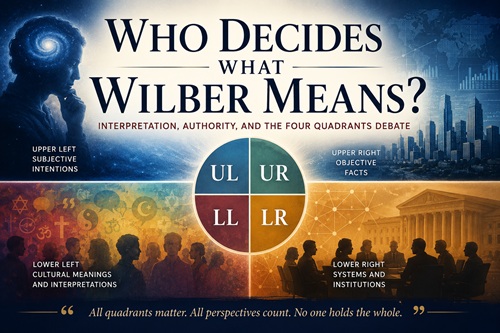 In 2004, longtime Integral commentator Edward Berge published a short but provocative essay on Integral World titled “Who Decides What Wilber Means?” The piece was deceptively modest in length, yet it touched a nerve within the Integral community because it addressed a persistent and emotionally charged problem: who has the authority to determine the “correct” interpretation of Ken Wilber's work? More importantly, Berge used Wilber's own AQAL framework—the four quadrants—to analyze the debate itself. The essay became significant not only because it articulated a structural problem within Integral discourse, but also because it elicited a direct response from Ken Wilber himself. Wilber quoted one of Berge's key observations and replied: “i totally agree with this statement (it's a great statement, by the way).” That endorsement is striking because Berge's analysis implicitly challenged tendencies toward doctrinal rigidity within Integral circles. The controversy reveals a deeper issue that has followed Integral Theory from its inception: is it an open-ended interpretive framework, or does it function increasingly as a system whose meanings are centrally authorized by its founder and loyal interpreters? The Problem of Interpretive AuthorityBerge's essay emerged during a period of intense debate on Integral World between Wilber supporters and critics. These disputes often revolved around what Wilber “really meant” in relation to evolution, spirituality, epistemology, or science. Critics would quote Wilber directly to expose inconsistencies or unsupported claims; defenders would respond that the critics misunderstood Wilber's intentions, developmental level, or technical vocabulary. Berge noticed that these disputes were rarely just about textual interpretation. They were also social and psychological struggles over authority, legitimacy, and group identity. Rather than taking sides, he stepped back and applied AQAL meta-analysis to the controversy itself. This was an elegant move. Instead of asking merely whether a critic's interpretation was right or wrong, Berge asked: what quadrants are involved in interpretation? Wilber's AQAL model distinguishes four irreducible perspectives: • Upper Left (UL): subjective intentions and interior experience. • Upper Right (UR): objective behaviors and observable facts. • Lower Left (LL): shared cultural meanings and interpretations. • Lower Right (LR): social systems and institutional structures. Berge argued that disputes about Wilber interpretation involve all four quadrants simultaneously. The author's intention belongs partly to the UL quadrant. The text itself as an observable artifact belongs partly to the UR quadrant. Interpretive communities belong to the LL quadrant. Publishing institutions, forums, organizations, and power dynamics belong to the LR quadrant. This may seem obvious in retrospect, but it had sharp implications for Integral discourse. The Death of the “Author-God”One implication of Berge's analysis is that meaning cannot be monopolized by authorial intention alone. Even if Wilber knows what he intended to say, texts acquire lives of their own once published. Readers interpret them through their own developmental stages, conceptual frameworks, cultural assumptions, and institutional loyalties. This touches on a longstanding debate in literary theory and hermeneutics. Thinkers such as Roland Barthes and Michel Foucault challenged the idea that authors possess final interpretive authority over their texts. Meaning emerges through interaction between author, text, reader, and culture. Ironically, Wilber's own integral framework supports such a pluralistic understanding of interpretation. If all quadrants matter, then interpretation is never merely a private subjective act of authorial intention. It is also socially mediated, culturally negotiated, and institutionally reinforced. Berge effectively turned AQAL back upon the Integral movement itself. The Integral Community as an Interpretive SystemBerge's essay also exposed how Integral discourse often functioned sociologically. Defenders of Wilber sometimes behaved less like independent interpreters and more like guardians of orthodoxy. Criticism was frequently reframed as misunderstanding, reductionism, “flatland” thinking, or insufficient developmental altitude. This created a peculiar dynamic. Because Wilber's theory includes developmental hierarchies, disagreement could easily become psychologized. Critics were not simply wrong; they were said to occupy less evolved perspectives. Berge's quadrant analysis revealed that such reactions are not merely intellectual. They are Lower Left cultural processes and Lower Right institutional processes. Communities develop shared interpretive norms. Organizations protect symbolic coherence. Loyalty and identity become intertwined with interpretation. Seen this way, debates over “what Wilber means” resemble disputes within religious or ideological traditions. There emerges an implicit distinction between orthodox and heterodox readings. Integral Theory thus faced an uncomfortable question: can a system that prides itself on perspectival openness tolerate genuine interpretive pluralism? Wilber's Surprising AgreementThe most fascinating aspect of the episode was Wilber's response. Rather than rejecting Berge's analysis, he explicitly endorsed it. Referring to one of Berge's formulations, Wilber wrote: “i totally agree with this statement (it's a great statement, by the way).” This response is revealing for several reasons. First, it demonstrates Wilber's capacity for meta-theoretical self-reflection. He recognized that AQAL logically applies to interpretations of AQAL itself. Second, it suggests that Wilber understood the inevitability of interpretive multiplicity. Third, it highlights a recurring tension between Wilber's theoretical openness and the more defensive tendencies sometimes displayed by his followers. Yet Wilber's agreement did not fully resolve the issue. Even if interpretive plurality is acknowledged in principle, the practical dynamics of authority remain. Founders inevitably possess symbolic power. Their endorsements matter disproportionately. Communities still gravitate toward canonical readings. In this sense, Berge identified a structural paradox within Integral Theory: a framework designed to integrate multiple perspectives can itself become enclosed within a hierarchy of authorized interpretations. AQAL Applied ReflexivelyWhat makes Berge's essay enduringly interesting is its reflexivity. AQAL is often used to analyze psychology, culture, spirituality, politics, or science. Berge used it to analyze Integral discourse itself. This reflexive turn is crucial because any comprehensive metatheory must eventually account for its own social and interpretive functioning. Otherwise, it risks exempting itself from the very principles it applies elsewhere. Berge implicitly asked: • Who interprets the interpreters? • What social dynamics govern Integral understanding? • How do power and prestige shape supposedly integral discourse? • Can a developmental model avoid becoming an instrument of intellectual status? These questions remain relevant today, especially as Integral Theory increasingly exists online through podcasts, courses, forums, and institutional branding. The Broader Philosophical IssueThe essay ultimately transcends Wilber studies. It raises universal questions about philosophy, spirituality, and intellectual movements. Every influential thinker generates competing schools of interpretation. This happened with Karl Marx, Sigmund Freud, Friedrich Nietzsche, and Jean Gebser. Followers inevitably debate what the master “really meant.” Over time, interpretive authority becomes institutionalized. Integral Theory is not exempt from this historical pattern. In fact, its grand synthetic ambitions may intensify it. Berge's contribution was to show that Integral Theory already contains conceptual tools for understanding these processes. AQAL can illuminate not only consciousness and culture, but also the sociology of Integralism itself. ConclusionEdward Berge's “Who Decides What Wilber Means?” remains one of the more insightful short essays published on Integral World because it shifted the debate from content to meta-analysis. Instead of arguing over whether critics or defenders had interpreted Wilber correctly, Berge examined the conditions under which interpretation occurs at all. By applying the four quadrants reflexively, he demonstrated that meaning is distributed across intentions, texts, communities, and institutions. Interpretation is never purely objective nor purely subjective. It is a multidimensional process embedded in culture and power relations. Wilber's agreement with Berge was therefore significant. It acknowledged, at least implicitly, that Integral Theory cannot escape the interpretive complexity it seeks to explain elsewhere. The unresolved tension remains fascinating. Integral Theory aspires to include all perspectives, yet every movement gravitates toward orthodoxy. AQAL offers tools for pluralism, yet communities often seek authoritative closure. Berge's essay captured that contradiction with unusual clarity. More than twenty years later, the question still stands: who decides what Wilber means? The Integral answer, if AQAL is taken seriously, may ultimately be: everyone—and no one alone. Appendix: Beyond “Altitude”—Why Berge's Analysis Goes DeeperA common Integral response to criticism runs something like this: Ken Wilber is frequently misunderstood because many readers lack the developmental “altitude” required to grasp the full complexity of his thought. From this perspective, disagreement is often interpreted as a symptom of partial cognition rather than substantive critique. Edward Berge's 2004 essay goes deeper than this familiar defense because it shifts the discussion from developmental capacity alone to the multidimensional conditions of interpretation itself. The “altitude” explanation is largely an Upper Left (UL) account. It focuses on the consciousness, intentions, cognitive capacities, and developmental stage of the interpreter. In AQAL language, misunderstanding occurs because the subject has not yet evolved sufficiently to perceive the higher-order integration Wilber intends. Berge does not deny that developmental differences matter. But he argues—implicitly through his quadrant analysis—that interpretation cannot be reduced to altitude alone. Meaning emerges through interactions across all quadrants. A reader may misunderstand Wilber because of cognitive limitations (UL), but interpretation is also shaped by: • the wording and structure of the text itself (UR), • the interpretive norms of the community reading it (LL), • and the institutional dynamics surrounding Integral discourse (LR). This is a much richer hermeneutic model. For example, two equally intelligent and developmentally sophisticated readers may still interpret Wilber differently because they inhabit different intellectual cultures. A scientifically trained skeptic may emphasize empirical consistency, while a spiritually oriented Integral student may privilege phenomenological resonance. Their disagreement is not necessarily reducible to altitude. Likewise, institutions matter. Organizations, teaching programs, forums, and charismatic authority structures shape which interpretations become socially acceptable. Some readings gain prestige while others are marginalized. This is not merely a matter of consciousness; it is also sociology. Berge's approach therefore avoids a subtle danger within some Integral rhetoric: the tendency to convert disagreement into developmental diagnosis. Once “altitude” becomes the primary explanatory mechanism, critique risks being immunized against serious engagement. The critic is not simply mistaken; the critic is “less evolved.” This can create a self-sealing discourse in which the theory explains away opposition through hierarchical framing. Berge's AQAL application reopens the field. It recognizes that interpretation is inherently plural, culturally mediated, and institutionally conditioned. Even highly developed individuals can disagree because meaning itself is distributed across quadrants. In this sense, Berge's analysis is actually more faithful to the spirit of AQAL than the simplistic altitude-defense often deployed by Wilber loyalists. AQAL was designed to resist reductionism. Yet reducing disagreement to developmental deficiency is itself a form of reductionism—an Upper Left absolutism masquerading as integral thinking. The irony is striking: a genuinely integral hermeneutics must include not only developmental altitude, but also language, culture, power, institutions, group identity, and textual ambiguity. Berge understood that.That is why his short essay remains philosophically important.
Comment Form is loading comments...
|