|
TRANSLATE THIS ARTICLE
Integral World: Exploring Theories of Everything
An independent forum for a critical discussion of the integral philosophy of Ken Wilber
 Ray Harris is a frequent contributor to this website. He has written articles on 9/11, boomeritis, the Iraq war and Third Way politics. Since 2007 he took to writing his novels Navaratri, Wild Child and Eden. Harris lives in Ballarat, Victoria, Australia.
Progressive Politics:
Defining Progressive Politics Colonialism, decolonisation and development Liberal democracy or kleptocracy Colonisation, Decolonisation and DevelopmentA ParadoxRay HarrisDeborah Cheetham is a celebrated Australian soprano, composer and music educator (who is also proficient on the flute and piano). In recognition of her contribution to the arts she has received Australia's second highest honour, the Order of Australia. She is openly gay. She is also Aboriginal, the daughter of a Yorta Yorta woman, Monica Little, sister of the famous Aboriginal country singer Jimmy Little. Monica Little gave birth to nine children, six of whom were removed by the authorities because she was unable to care for them. This makes Cheetham part of the Stolen Generation, those Aboriginal children removed by the authorities in an attempt at forced assimilation. Although, in this case, it seems that her mother simply wasn't able to care for her - her father, an unnamed Irishman, had abandoned her mother when she was eight months pregnant. At the time the state was also removing children from single mothers regardless of race. Fortunately Cheetham was adopted by a middle-class white couple who encouraged her musical talent.
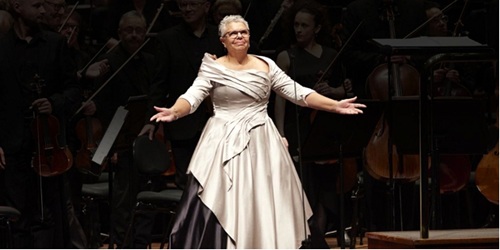
Deborah Cheetham, OA, in concert at the Sydney Opera House
The point here is that Cheetham could not have reached her full potential if Australia had not been colonised. Her chosen discipline, opera, is an elitist European art form. To understand this it is necessary to understand what life was like for Aboriginal women before colonisation. In short, it was brutal. In contrast to recent attempts to romanticise Aboriginal life, it was an almost constant struggle for survival. Depending on the local ecology and season, access to food varied from relative abundance to scarcity. Many tribal groups were semi-nomadic, moving from seasonal food source to seasonal food source. There could be days without any food, especially in the harsh interior.
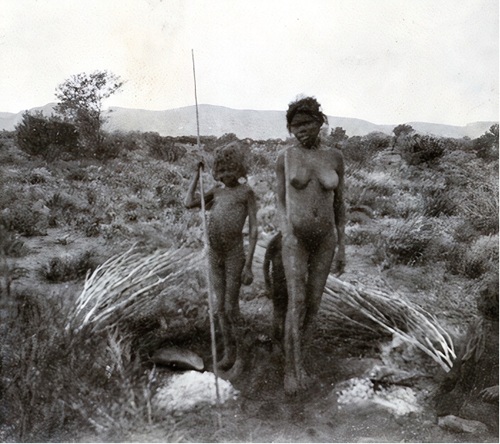
Central Australian Aborigines
Whilst Aboriginal society is not strictly patriarchal, with women having authority over men in specific ritual areas (women's business), it was polygynous with husbands having authority over their wives. There is evidence of violence against women (this has been subject to intense debate). Marriages were often arranged in childhood under complex kinship laws and consummated at the onset of puberty (or late childhood). Aboriginal society also had taboos around virginal blood so girls underwent ritual defloration prior to consummation. This varied from tribe to tribe. In some cases it was performed by women, in others by men. There were also strict rules (based on kinship) over who men and women could interact with. It was taboo to even look at, let alone speak to, the wrong man or woman and any transgression could face violent punishment. As the property of men, women could be traded in exchange for goods or favour. There are accounts of Aboriginal men trading women to white settlers. A major cause of conflict in Aboriginal societies was the kidnapping and rape of women, a theme explored in the film Ten Canoes, conceived by the celebrated Yolngu actor David Gulpilil. To make things worse, because of the impoverished conditions, there was a high maternal and infant mortality rate. Cheetham's mother may still have had nine children, unfortunately, rather than face adoption, most would have likely perished. It is known that Aboriginal society practiced infanticide to control the population - a nomadic woman can only carry one dependent child at a time. Because of the need to focus on survival, little time could be set aside to develop a complex culture, especially a complex musical culture. Every one had to focus on finding food so there were no specialised trades. As a consequence Aboriginal society did not develop the type of musical instruments found in other cultures. The main instrument was percussive, the clap stick, and contrary to common perception, the didgeridoo is not universal, but is instead confined to northern Australia - besides, women are forbidden to use it anyway. Aboriginal singing also lacks melodic and harmonic complexity, taking the form of ritual, rhythmic chanting. Aboriginal society was also generally homophobic, so exclusively lesbian relationships would not have been tolerated. Cheetham is married under Australia's same sex marriage laws. Here it is important to note that there has been a good deal of revisionism in some activist circles to suggest that Aboriginal society tolerated homosexuality. This has been denied by some traditional elders who explicitly opposed marriage reform. The paradoxThe paradox is this: some activists condemn the European colonisation of Australia whilst also condemning the lack of development and opportunity experienced in many Aboriginal communities, especially in remote areas. In other words, there has been unwanted development and at the same time, insufficient development. There can be no denying that the process of colonisation was devastating to traditional Aboriginal cultures. In many areas they have been effectively wiped out. I live on the lands of the Wadawurrung in Western Victoria. The surviving tribal members eventually intermarried, converted to Christianity and abandoned their traditional language and customs. All that remains are fragments. The first tragedy was the spread of European disease, which wiped out over 75% of the population before settlers even arrived. The second tragedy was the often violent displacement of the remaining groups at the hands of genocidal settlers unrestrained by the local authorities. Here genocide is the right term because there was clear intent to eliminate the surviving groups. This was followed by forcing the remnant Aboriginal population onto missions, allegedly for their own safety, but also to try and assimilate them. The racist attitudes of the time guaranteed that Aboriginal people would face severe discrimination, exploitation and marginalisation. This was not universal. There were attempts to address this discrimination, especially in the major cities. Australia gained independence in 1901 and the first government under Edmund Barton planned to grant Aboriginal people full citizenship and the right to vote, unfortunately this was vetoed by the powerful pastoralist lobby. Citizenship was not revisited until 1966, when it received overwhelming support. From the 60's on the issue of Aboriginal rights has been at the centre of Australian politics with a range of progressive reforms: the right to vote, removal of segregationist policies, the recognition of land rights, the creation of land councils and Aboriginal corporations, and the development of programs to reverse racist stereotypes and systemic discrimination. Prejudice still exists and political conservatives continue to resist reform, but Aboriginal people are now represented in every major field. But there is another paradox at play. One that is exemplified by two Aboriginal politicians who represent the extreme ends of the Australian political spectrum. On the far-left sits independent senator Lidia Thorpe from Victoria (who resigned from the Greens over a policy dispute) and on the far-right sits Liberal senator Jacinta Nampijinpa Price, a Warlpiri woman from the Northern Territory. Their political differences expose the differences within the Aboriginal community itself. The first federal Aboriginal senator, Sir Neville Bonner, a Jagera elder, represented the conservative Liberal party from 1971-1983. And Jacinta's mother, Nungarrayi (Bess) Price, served in the Northern Territory Parliament under the conservative Country Liberal Party. There are currently nine members in the federal parliament with Aboriginal heritage. The developmental gapThis sits at the heart of the paradox. There is a significant gap between the wealthy developed nations and the undeveloped nations. This is evident in Australia with some parts of the country, especially in remote Aboriginal communities, living in Third World conditions. The reasons for this are complex. Some of it is due to government neglect and outright racism. Aboriginal welfare was not given priority because they were Aboriginal. Some of it is due to Aboriginal resistance to change and an understandable mistrust of government authority. But it is also logistically difficult and financially prohibitive. People outside Australia sometimes struggle to understand just how large Australia is. Imagine driving from Paris to Moscow with the entire landscape one unending, arid landscape. The most remote community is Kiwirrkurra, home to the Pintupi in the Gibson desert. It is a two-day journey on a rough dirt track from the nearest town, Alice Springs. During the wet season the road can be impassable for weeks. Everything has to be either trucked in or flown in, adding additional fuel costs (but before that could even happen, a road had to be built through the desert). It is not part of the energy grid and any electricity has to be generated using diesel or solar panels. In 2020 the town bore water was declared unfit to drink due to elevated levels of naturally occurring fluoride and nitrate. All water had to be shipped in. The water supply was restored after 2 years at the cost of 6.5 million. And being so remote there is no independent source of income from cattle grazing or mining royalties. The community is entirely dependent on government programs. One might ask why anyone would build a town in the middle of the desert. The answer is that it is the traditional land of the Pintupi who have lived there for thousands of years. A small family group consisting of two co-wives and seven children, known as the Pintupi Nine, were amongst the last Aboriginal groups to make contact. That was in 1984. Most of that group still live in Kiwirrkurra. This is seared into my mind because some of the children are around the same age as me. Meaning that whilst I was growing up in modern suburbia, elsewhere in Australia children my age were living wild in the desert, completely unaware of the rest of the world. Anyway, I digress. The point here is that the Pintupi have always lived in the Gibson desert and the town was built specifically to support them. It took Europe over 3000 years to develop roads, cities, hospitals and schools. It took less than 50 years to create Kiwikkurra in the middle of nowhere.
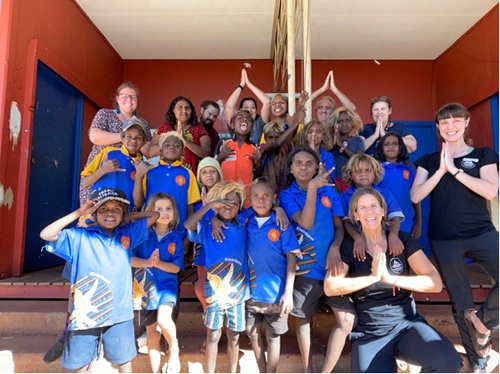
Kiwirrkurra school
Contact versus colonisationJust north of Australia lies Indonesia, a densely populated region that has experienced several waves of colonisation. The first to arrive were Hindus, followed by Muslims and finally, Europeans (primarily the Dutch, who were eventually kicked out by the Muslims, who remained). Only Bali retains a Hindu culture. During this entire period, despite being just a short distance away, Australia remained untouched. There was one exception, fisherman from Sulawesi seeking sea cucumber. They interacted with the local Yolngu people of Arnhem Land and we now know that some Yolngu journeyed back with them and settled in Sulawesi. Before this encounter, Australia had remained isolated for over 60,000 years. The shock is not that it was colonised - that was inevitable - but that it remained isolated for so long. According to some Aboriginal activists, the arrival of the British is a cause for regret. The day set aside to celebrate the British arrival, Australia Day, is subject to widespread demonstrations labelling it Invasion Day. Fair enough. It was an invasion, of sorts.
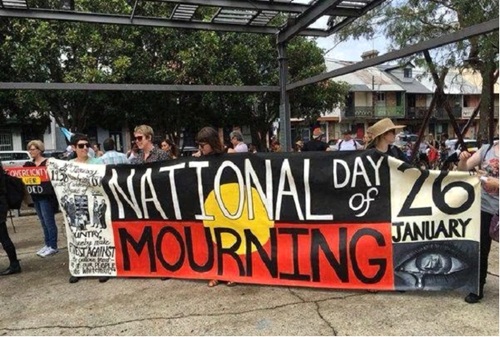
Australia Day reframed as a day of mourning
Relations were initially friendly, with the local Aboriginal population free to walk around and interact. One notable example was the friendship between an unmarried Eora girl called Patyegarang and Lieutenant William Dawes. He recorded the friendship in his diary where he credits her for being exceptionally bright and teaching him the local dialect. The violence began when the settlement expanded into the territory of neighbouring tribes, especially with the discovery of fertile land suitable for European style agriculture. Pemulwuy, a Bidjigal warrior, is recorded as the first to mount a guerrilla campaign against settler expansion. And whilst it is undeniable that there was violence between Europeans and Aboriginal tribes - forced colonisation - the reality is that most of the damage had been done through peaceful contact. As I mentioned above, a majority of the Aboriginal people died of European diseases, not frontier violence. Around 50% of the Eora population died of smallpox within the first year of contact. Further cultural damage was done with the introduction of European ideas, especially Christian morality. For the most part the Eora went about completely naked. Dawes recounts attempting to put a coat around Patyegarang when she entered his hut during a rainstorm. She laughed him off, pointing out that she would dry quicker standing by his fire. The issue of Aboriginal nudity was, and still is, a major issue. Films about the first colony depict the Aboriginal protagonists wearing invented costumes simply to protect European sensibilities and even early illustrations depicted them wearing at least a loin cloth. Then there was the polygamy and the alleged sexual promiscuity of Aboriginal women - that is, compared to the prudish standards expected of Christian women of the period. Safe to say there were radically different rules around nudity and sexuality.
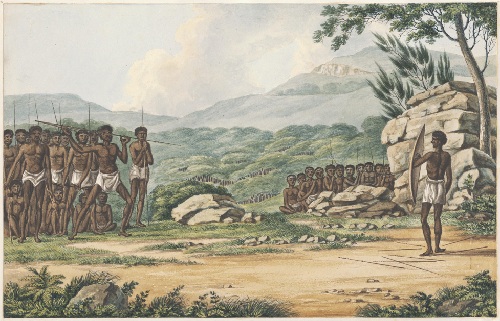
Aboriginal society had not developed cloth so these white loin coverings
are a fiction designed to avoid offending European sensibilities
A further shock was the difference in land use. The Europeans had little understanding of native food sources so they introduced European species and farming methods. Even today Australians shy away from eating kangaroo, despite its health benefits (low fat) and abundance (it's available in supermarkets). One major source of frontier violence was the Aboriginal spearing of sheep and cattle - a hunter-gatherer culture clashing with a pastoral culture. The introduction of alcohol proved to be particularly devastating. My point is this: once contact with European culture was established, Aboriginal culture was doomed. It wasn't colonisation that caused the damage. It was the introduction of new technology, new foods, new ideas and new ways of doing things. In other words, it was development, the very thing activists say they want more of. Which brings me to another paradox. The activists who protest the arrival of the British do not want themselves to return to a pre-contact lifestyle - even where it is still possible, such as Arnhem Land and parts of the York Peninsula. Whilst there are calls to preserve Aboriginal language and traditions, no one is advocating a return to polygamy, to child brides, natural nakedness or to traditional spiritual beliefs. A surprising number of the most prominent activist voices were raised in families that converted to Christianity. Some, like senator Lidia Thorpe (whose Scottish maternal grandfather was a communist trade unionist), have embraced Western socialist ideals. AfricaThe development paradox is especially acute in Africa. Some on the left directly blame colonisation for the many problems Africa faces. At the same time there have been calls for more development and foreign aid to help build hospitals, schools, infrastructure and to provide assistance in times of famine and natural disaster. Again we need to remember what Africa was like before European contact. North Africa had already been colonised by Arabs (and before that Rome and Egypt). Arab slave traders were raiding deep into Sudan and the Sahel and some small African kingdoms also profited by also raiding weaker tribes and selling them to Arab slavers and later, Europeans. But Central and Southern Africa had remained untouched and in the same state of zero development as Australia before contact. There was no infrastructure. No roads, schools or hospitals. Tribal groups ranged the spectrum from the hunter-gatherer Khoi San to the larger pastoral and agricultural confederacies like the Zulu. It was not as culturally static as Australia. There was considerable internal movement, such as the Bantu expansion around 2000 BCE and a much broader range of cultural beliefs and practices, as well as conflict between tribal kingdoms, especially in Western and Central Africa. The process of colonisation was a complex mix of cooperation and conflict. Some tribal groups formed alliances with European powers to gain an advantage over rival tribes, particularly in gaining access to European weapons. The Buganda (modern day Uganda) allied with the British to counter their Bunyoro rivals. Several West African kingdoms happily traded slaves and other goods for European guns. In South Africa the Swazi allied with both the Boers and British against the Zulu. RwandaRwanda is a good example of the process of European colonisation. Prior to European contact the kingdom of Rwanda was an expansionist power competing for regional dominance over the rival kingdoms of Burundi, Bugesera, Giseka, Bunyoro and Buganda. European contact arrived in 1894 in the form of German explorer Count Gustav Adolf von Götzen. The Rwandans formed an alliance with the Germans to avoid being dominated by their rivals. Some colonists and missionaries arrived, but the Rwandans retained control of their government, with Germany ruling indirectly through advisors and agents. It is often argued that the 1994 Rwandan genocide was caused by colonialism. This is only partially true. The division between the Tutsi, Hutu and Twa developed in the pre-contact era with the Tutsi forming the ruling elite, the Hutu the rural peasantry and the minority Twa confined to forests as hunter-gatherers. Over time the Tutsi began to see themselves as superior and to develop discriminatory beliefs and practices. From time to time the Hutu would rebel, but they were suppressed by massacres and property confiscation. The arrival of the Europeans and their social hierarchy and racial theories amplified the existing order. Tensions between the two groups were further exacerbated during the post colonial competition for control. Blaming colonisationAs was the case with Australia, it was inevitable that Africa would become aware of the rest of the world and face radical change as a result. As it is, some African tribes have been able to maintain a degree of isolation and independence that allows them to maintain their traditional way of life, but even these tribes are under pressure from modernity.
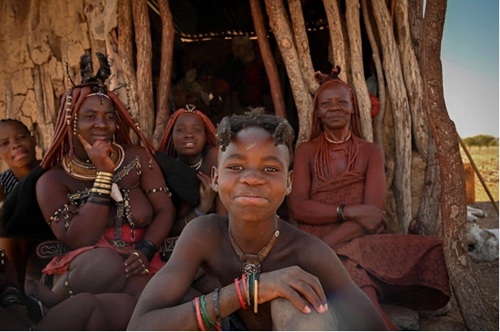
The Himba of Namibia maintain their traditional ways
However, many others, as I have explained, cooperated with Europeans. Perhaps the most radical change was the introduction of capitalism and the exploitation of natural resources. The anti-colonialists argue that Africa's problems have been caused by European exploitation of Africa's natural resources, that Africa was not compensated properly - basically robbed. It was. And still is. This is where we return to the development paradox. In order to extract African resources, European governments and corporations began to build the necessary infrastructure: the railways and roads to transport goods to the newly expanded ports, the administrative structures, schools, hospitals and legal systems. For example, the French built the Dakar-Saint-Louis railway in Senegal (1879-1885) to transport peanuts and other agricultural goods. Following the pattern everywhere else in the world, trade and resource exploitation created new jobs and new cities and disrupted traditional ways of life. The anti-colonialist left argue that this was both a bad thing and that it didn't happen fast or fairly enough - that the colonial powers should have shared more of their profits with the locals, which would have of course, only accelerated local development. Communism is a colonialist projectThe anti-colonialist left has a massive blind spot. Communism is a colonialist project. It objects to the sins of capitalist colonialism whilst seeking its own imperialist ideological expansion. Communist colonialism has two broad features: 1. Converting local indigenous rights movements to communism. In left-speak these become 'liberation' movements seeking to free themselves from capitalist exploitation. However, they often end up being controlled by the much larger communist states such as Soviet Russia or Communist China. 2. The mistreatment of ethnic minorities within communist countries. One of the classic examples of Western colonialist interference is Iran, especially the British exploitation of the oil industry leading to the overthrow of the Mossadegh government. This has become a cause celebre of the regressive left. What they choose to ignore is the close involvement of the Soviets in seeking control of Iranian oil and the role of the Kremlin controlled Iranian communist party, Tudeh, in destabilising both the Mossadegh government and siding with the clerics in the Iranian Revolution. This includes ignoring the fact that during WW2 the British and Soviets became allies in Operation Countenance, an invasion to overthrow the then neutral government of Reza Shah. The great example of communist colonialism is the Chinese annexation of Tibet and the gradual erasure of Tibetan culture. Vietnam provides another example. The process of French decolonisation allowed the US, Russia and China to fill the gap. The Viet Cong were not an indigenous rights movement. They were part of the international communist movement, supported by both the Soviets and Chinese. Vietnam has 54 official ethnic groups. Not all of them sided with the Viet Cong. Some, such as the Montagnards/Degar, Khmer Krom, Sung and Cham resisted both South and North Vietnamese colonisation. This resistance continued long after the Viet Cong victory in 1975. Other notable examples: the Sandinista attacks against the Misikito people, the Maoist Shining Path path persecution of minorities, especially the Asháninka, and the Khmer Rouge attempt to eliminate all ethnic difference in order to create a uniform communist society. Why decolonisation is a regressive movementThere are two ways to define decolonisation. 1. The process where a colonial power is replaced by local governance. For example, the British left India and now India is self-governed. 2. The attempt to reverse the effects of colonisation, especially the alleged ideological/cultural impacts. The period of European colonisation in Africa was relatively brief. The British established the East Africa Protectorate in 1895. This became the Colony and Protectorate of Kenya in 1920. Kenya gained independence in 1963. A period of just 68 years. To provide some contrast, the British had displaced the Omani Arabs, who had controlled the coast and raided the interior for slaves for over 165 years (1730-1895). The process of the European decolonisation of Africa was effectively completed in the latter part of the 20th century. And this is where we come to another blind spot of the regressive, anti-colonialist left. Decolonisation only ever refers to European colonisation, not to Arab/Muslim or communist colonisation. I mentioned above that Indonesia had gone through three waves of colonisation: Hindu, Muslim and European. The Europeans were removed but the Muslims remained. In India the Hindutva movement wants to extend the decolonisation of India to the Muslim population. North Africa is still under Muslim control and the current conflict in Sudan and South Sudan is the result of Arab colonisation and attempts by Islamists to expand Muslim control further south. The reason the anti-Western left ignores the conflict in Sudan is because the West is not involved in supporting either side. Decolonisation becomes regressive when it selectively condemns European colonisation and ignores other forms. The issue of ideological and cultural decolonisation is even more fraught and at times, frankly bizarre. This movement has been influenced by the misreading of postmodernism that has lead to epistemological relativism. The prime example of this is the attempt to decolonise science. Whilst there are genuine issues about access and control within the sciences, the decolonisation debate includes attempts to elevate indigenous knowledge to the same status as empiricism. The most obvious example is medicine, which is often incorrectly labelled 'Western' medicine despite being adopted globally. The rejection of medical intervention because it has been labelled 'Western' has lead to people rejecting inoculation against diseases such as ebola in preference for demonstrably ineffective traditional magic. In Australia, some activists have promoted the idea of indigenous astronomy, which amounts to the naked eye observations of the sky found in every culture and constellations linked to Dreamtime mythology. The right to choose - indigenous rights versus individual rightsThe main objection to change, whether that is through colonisation or contact, is the lack of control over the impact and pace of that change. Prior to the Hindu, Muslim and European colonisation of Indonesia, the islands were home to multiple tribal groups that were absorbed into the dominant culture. There are exceptions, pockets where tribal groups still retain a degree of independence, although the process of colonial expansion continues to face indigenous resistance in West Papua. This pattern is found across the world. Empires expand and absorb the smaller and weaker tribal groups near them. The empires collapse but the local tribes are permanently changed. Britain itself was colonised by several waves. The Celtic tribes are long gone. Who in Britain claims Iceni, Brigante or Trinovantes heritage? It would seem that supporting indigenous rights is an obvious progressive position, but this is where we arrive at another dilemma. Some indigenous cultures are extremely conservative and repressive. The most obvious example is the conflict between rights of indigenous women versus the privileges afforded to indigenous men. The flash points of this conflict are child marriage, female genital mutilation, rape and domestic violence. Child marriage is endemic across Africa. With a few exceptions, the traditional age of consummation is the onset of puberty. An extreme form of this, found in South Africa, is called ukuthwala, the abduction and forced marriage of under age girls. A report in the African Human Rights Law Journal states that: “In the first and second quarter of 2009, the media reported that 'more than 20 Eastern Cape girls are forced to drop out of school every month to follow the traditional custom of ukuthwala (forced marriage)'. Girls as young as 12 years are forced to marry older men, in some cases with the consent of their parents or guardians.” This problem is not confined to just this issue. Slavery is still widely practised in North Africa. According to the NGO Walk Free, the five countries with the highest rates of slavery are North Korea, followed by the African nations of Eritrea, Mauritania, South Sudan and Somalia. Africa also has a problem with the ritual sacrifice of children in traditional witchcraft. Children with albinism are a particular target. An OHCHR report states: “These attacks include the hacking of body parts from persons with albinism, alive or dead, to bring them to so-called witchdoctors and practitioners of traditional medicine to make potions, amulets or charms, thought to bring good luck or wealth to the end user.” It advised: “The independent expert also stressed that addressing deeply rooted beliefs such as belief in the efficacy of human body parts in witchcraft and traditional medicine requires community sensitization on the scientific explanations for albinism. Public education should engage faith-based organizations, traditional leaders, people with albinism and their families.” Please note: “scientific explanations for albinism”.
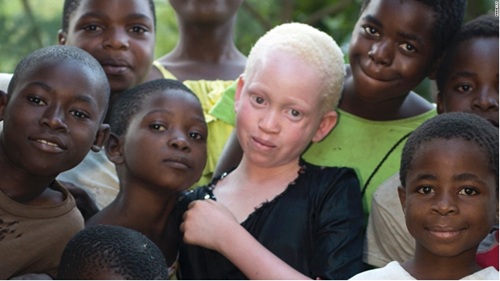
An Africa albino
There can be no doubt that indigenous people face intense pressure from outside forces, especially if their traditional lands hold mineral or forest resources. Indigenous groups in Indonesia and the Amazon basin face violence from illegal logging operations and every year these regions face intense air pollution from fires used for illegal land clearing. In Indonesia it is palm plantations for palm oil, in the Amazon it is to clear the land for cattle grazing. Here I want to note that neither of these regions are under the political control of the 'West'. They are considered part of the Global South linked to the BRICS nations. And in Africa, Russia has been increasingly involved in mineral exploitation, with the Wagner Group offering mercenary services in exchange for access to valuable minerals. The rights dilemmaThe protection of individual rights is often in contradiction with indigenous rights. In Australia's Northern Territory tribal groups such as the Yolngu have been arguing for the NT legal system to recognise tribal law. There have been several cases where Aboriginal men have been found guilty of the rape of a minor, even though the minor was his wife under traditional law. I think most people would accept that the individual rights of the girl would supersede the traditional rights of Aboriginal men. Yet this is precisely what happens with the regressive left. They choose the rights of the traditional culture over the rights of the individual. This is particularly evident in the women's rights movement with feminists living in oppressive traditional societies accusing Western feminists of betraying them. Afghanistan is a good example. Under Taliban rule women faced severe persecution, including public floggings and executions. When US intervention ended Taliban rule, women gained greater freedom, especially in education. That has disappeared with the return of the Taliban. To the regressive left the greater sin was US intervention, not the Taliban's repression of women.
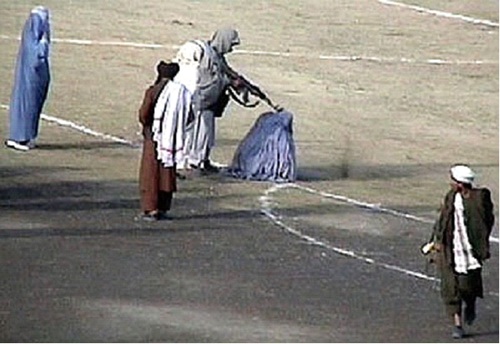
Public execution of a woman by the Taliban
Another example of this are the attacks on Iranian feminist Maryam Namazie. Namazie has automatically gained the ire of the Muslim community because she has rejected Islam and embraced secular humanism - a progressive position. Because she criticises Islam, she has been labelled Islamophobic. When she was invited by the Atheist, Secularist and Humanist Society of Goldsmiths University in 2015 to talk on the issue of blasphemy and apostasy, members of the university's Islamic Society, all men, continuously interrupted her speech. This is hardly surprising. The real shock is that the Goldsmiths Feminist Society issued a statement supporting the actions of the Islamic Society and accused Namazie of Islamophobia. Unfortunately this kind of moral confusion is increasingly all too common, especially on university campuses. Another example is Queers for Palestine. The absurdity in this case is that when interviewed, members of this group were unaware that homosexuality is illegal in Palestine and that a number of Palestinian queers have fled to Israel to escape persecution. Where I standFinding the balance between individual and cultural rights is not easy. I certainly regret the loss of human cultural diversity and I support greater tolerance of that diversity - in certain areas. For example, I would expand marriage equality to include polyamorous marriages. This would allow traditional Aboriginal polygyny. The bottom line is the right to choose. This means I don't support forced or child marriage. If consenting adults wish to follow traditional polygamous arrangements, then fine. Individuals must also have the right to either follow or leave a group. I mentioned the Himba above. Himba children struggle to complete formal education due to cultural and domestic pressures. Consequently the Himba have high rates of illiteracy. This is being challenged by Himba youth who want access to higher education. However, the elders resist education because it encourages the young to question tradition. In my previous essay Defining Progressive Politics I stated that my primary moral concern was that every individual should be able to reach their highest potential. This necessarily means that cultural rights are subservient. They can be upheld provided they do not conflict with the primary moral concern. Change is inevitableThe claim is made that Aborigines are the oldest, continuous culture on the planet. They are certainly ancient, but the Khoi San of Africa are arguably much, much older. Nor was Aboriginal culture continuous. The first people to arrive in Australia likely spoke a single language. At the time of European contact that had expanded to an estimated 250 languages and 800 dialects. And whilst there are similarities in their animist beliefs, these have been adapted to the local landscape, flora and fauna. In Wadawarrung mythology, the creator spirit is linked to a local geographical feature called the Lal Lal gorge. We cannot assume that the Aborigines of 10 or 20 thousand years ago spoke the same language or believed the same things. Traditionalists try to hold onto their language and customs, but history always challenges tradition. It is simply inconceivable that Australia could remain isolated. Outsiders were going to arrive at some time, bringing new diseases, new technology, new ideas. Of the 250 languages, around 100 have disappeared. However, all of them have changed through the introduction of new or loan words, especially the names of things that did not exist in the pre-contact era. This has always been how languages and cultures change. English has evolved over thousands of years and today contains fragments of Celtic, Anglo-Saxon, Nordic and French. The contemporary ear has trouble understanding Shakespearean English and can barely comprehend Middle or Old English. I'm not sure why we need to be so concerned to freeze Aboriginal languages in time. After all, how many languages have been lost to history? Creating a new Aboriginal cultureAt the beginning I mentioned the composer Deborah Cheetham. Her works often use indigenous language. This is the case with several Aboriginal creators who use Western art forms to tell Aboriginal stories: film, contemporary dance, theatre, television drama, painting, sculpture, multi-media (even traditional painting uses modern paints) and in music: rock, country, jazz, opera, hip hop and rap. I'll end this with a video of what has become an Australian rock classic by the Yolngu band, Yothu Yindi, Treaty Now, which calls for a federal treaty with Aboriginal people (my state of Victoria has been the first state to formalise a treaty). This is an excellent example of cultural fusion and the creation of something new.
Yothu Yindi - Treaty (Original Version)
Comment Form is loading comments...
|