|
TRANSLATE THIS ARTICLE
Integral World: Exploring Theories of Everything
An independent forum for a critical discussion of the integral philosophy of Ken Wilber
 Ray Harris is a frequent contributor to this website. He has written articles on 9/11, boomeritis, the Iraq war and Third Way politics. Since 2007 he took to writing his novels Navaratri, Wild Child and Eden. Harris lives in Ballarat, Victoria, Australia. Ray Harris is a frequent contributor to this website. He has written articles on 9/11, boomeritis, the Iraq war and Third Way politics. Since 2007 he took to writing his novels Navaratri, Wild Child and Eden. Harris lives in Ballarat, Victoria, Australia.The Geopolitics of EurasiaThoughts on the recent Dillard/Visser exchangeRay HarrisHow quintessentially Western to be a tourist visiting Rome enjoying a traditional pasta all'Amatriciana. Not because it's a supposedly traditional dish, but because it is a cosmopolitan dish. The tomatoes are native to South America and whilst legend has it that Marco Polo bought pasta back from China, the truth is that pasta came from the Middle East via Arab merchants. But the cosmopolitan nature of Rome goes much further back in history. The ancient Romans were importing silk, spices and gems from China and India by land and ocean. These treasured goods had to pass through intermediate empires, but there were attempts to make direct contact between Rome and China. In 97 ACE the Chinese sent an ambassador to Rome. The mission failed, but in 166 Emperor Marcus Aurelias sent an envoy to China. It succeeded and Roman coins and glassware have been uncovered in China. Understanding this I am somewhat mystified by the recent exchange between Frank Visser and Joseph Dillard on the geopolitics of the Eurasian supercontinent. The truth is that it has always been interconnected and the distinction between the 'West' and the 'East' is arbitrary and historically contingent. An issue I discussed at length in my essay The West isn't Western. The Indo-EuropeansThe Eurasian supercontinent has seen constant waves of migration with cultures and empires rising and falling. Modern Europeans are linguistically and genetically descended from Indo-Europeans who migrated from the Pontic-Caspian steppe (covering Romania, Moldova, southern Ukraine, through the Caucasus to Kazakhstan) between 4000-1000 BCE. The Proto-Indo-European languages branched to form the majority of modern European languages. The genetic evidence supports a common Indo-European origin. As the map below shows, the Indo-Europeans also migrated to the east, particularly into modern day Iran and India, with a branch entering eastern China. 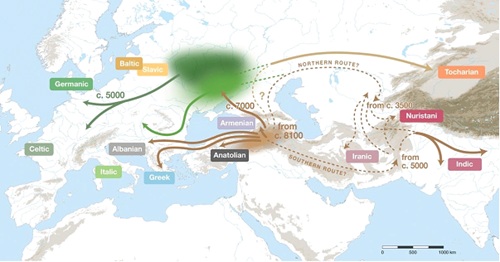 The VikingsIn his recent essay Russophobia, Dillard attempts to draw a distinction between the Russians as Slavic and therefore somehow distinct from Western Europeans. This is incorrect. The Slavs are an Indo-European people who share common traits with their Germanic and Nordic cousins. The Rus are in fact, an excellent example. The Rus were established by the Varangians, a Swedish (Viking) group that had been trading and raiding down the east European river systems. Russian nobility claimed to be descended from the Varangian chieftain, Rurik, who established the Rurik dynasty in 862. The name Rus is said to be a Swedish word for 'the men who row'. The Rus married local Slavs and gradually adopted Slavic languages and customs. Two decades earlier, in 845, Vikings from Denmark rowed down the Seine to lay siege to Paris. The Viking chieftain Rollo, would go on to establish the Duchy of Normandy, which would in turn go on to conquer Britain. This makes the Rus firmly part of the larger European family. And whilst there is certainly a distinct Russian culture, it is only different in the same way that other European cultures differ from each other. Over time the Rus would form alliances and go to war with other European powers, including, ironically, Sweden - St Petersburg had originally been a small Swedish outpost. 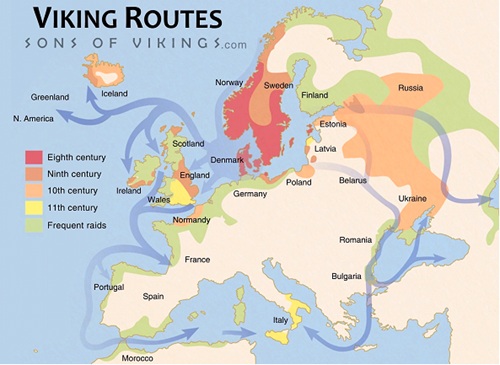 Invasions from the eastThe history of the British Isles, the western limit of the Eurasian landmass, exposes an inconvenient truth for those disposed to the anti-Western narrative. As the ice age ended, people naturally migrated west and north. The history of the British Isles is one of successive migrations and conquest by people from the east. The neolithic people who built the Stonehenge were replaced by Celts, an Indo-European people. The Celts were subjugated by the Romans. The Angles, Saxons, Frisians and Danes replaced the Romans and established warring kingdoms. And finally the Normans conquered and replaced both the Danes and Anglo-Saxons. The Normans retained control resisting challenges from the Spanish, French, Danes and the Germans. The Huns.These migrations were due in part, to the pressure placed on the Europeans from invasions from Asia (370 - 451). Known as the Great Migration, some argue that it began with the invasion of the Huns (under the leadership of Attila), a Mongol people from Central Asia. The period of the great migrations is claimed to have been a major cause in the fall of Rome as the Francs, Goths, Visigoths and Lombards seized control of the Western Roman Empire. The Hunnic expansion reached its limit with the invasion and pillaging of Gaul around 450. 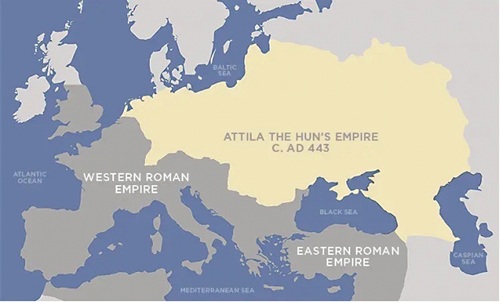 IslamThis is a much bigger story, but safe to say that the expansion of Islam is considered to have taken around 66% of Christian lands. Europe would be challenged by Islamic expansion for around a thousand years. 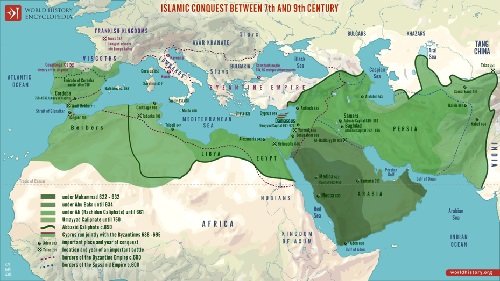 The MongolsCentral Asians again invaded Europe, this time under the command of the Mongol Genghis Khan. This invasion forms a major part of Russian history because the Mongols subjugated the Rus and reduced them to a vassal state. The Mongol Empire controlled much of China, attempting to take Japan twice. 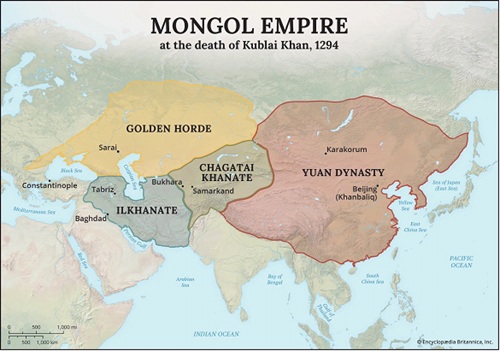 The TurkmenThe Turkmen are another Central Asian ethnic group. They converted to Islam between the 11th and 14th centuries. Under the leadership of Osman 1 they began to erode the power of the remaining Eastern Roman/Byzantine Empire. As the Ottoman Empire they would conquer the capital of the Eastern Orthodox Christian world, Constantinople and push their way into the Balkans. 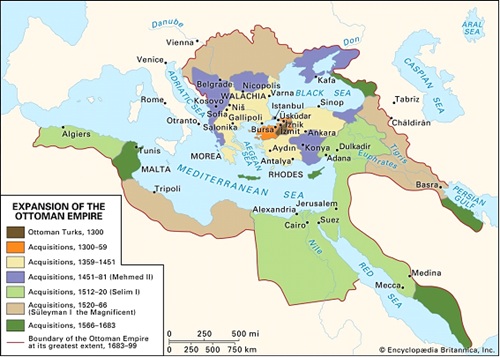 The Russian EmpireWhilst Britain can lay claim to having the largest Empire, that Empire was global. After the Mongol Empire, the Russian Empire was the second largest Eurasian empire. It still controls vast swathes of the Eurasian landmass. I have discussed Russian expansion at length in my essay The Dying Russian Empire 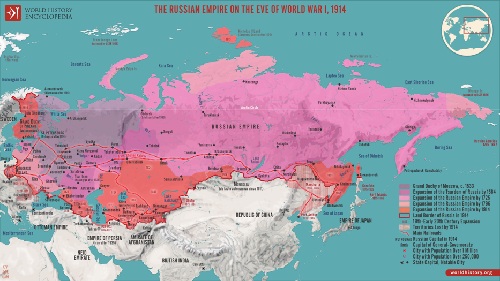 It was always about the Far East.There was nowhere for the West European powers to go except further west. The east was crowded. So Spain, Portugal, France, Britain and the Dutch became maritime powers and sailed west. Not in search of other lands, but to find an alternative route to the far east, especially to India. As the story goes, that's why Marco Polo called the indigenous people of the Americas Indians. Further explorations by Vasco da Gama and Ferdinand Magellan also set out to find an alternative route to the Far East. They succeeded and the rest is history. But they weren't the first. Islam had already arrived and conquered India and much of SE Asia. The Ming Chinese had even made an attempt in 1403 and 1433, creating a navy to rival the first Portuguese ships. But due to internal political pressure they abandoned their naval ambitions (see Ming Treasure Voyages). 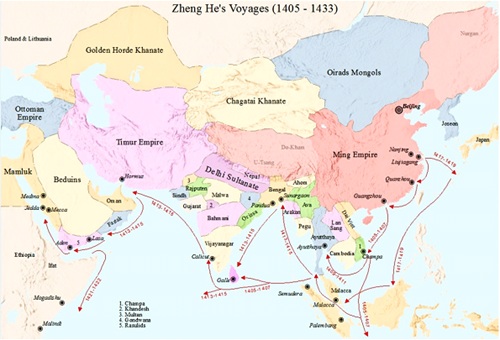 I started this essay by pointing out that Rome was importing silk and other goods from India and China. The fact is that Western Europeans had long known about the wealth to be found in the Far East. The issue was how to safely get there. The traditional pathway along the Silk Road was subject to banditry, piracy and the vagaries of the many shifts in Eurasian geopolitics. This is why I found the title of Dillard's recent essay Europe's Future Lies in Eurasia so puzzling. Europe has ALWAYS been linked to the greater Eurasian continent. The problem isn't economic, it's politicalIt makes perfect sense for both ends of the Eurasian landmass to cooperate and trade. But the problem isn't actually West vs East, it's liberal democracy versus autocracy, human rights versus suppression of those rights, freedom of movement and thought versus constraint. Russia, China, Iran and North Korea all perform badly compared to Europe on a range of measures. British/Russian relations as an exampleDillard's essays assumes a false polarity: Europe versus Russia. The reality is that, as a European nation, Russia has always been deeply engaged in European affairs. Britain and Russia established formal relations in 1553 after English navigator Richard Chancellor made his way to Arkhangelsk at the mouth of the North Dvina River in the White Sea. The British created the Muscovy Company to manage trade relations. In the late 1570's Tsar Ivan IV proposed marriage to Queen Elizabeth. Relations were not always easy but were generally positive. The invasion of Russia by Napoleon looms large in the Russian cultural memory and this is sometimes used as an example of the wicked West attacking Russia. This ignores the fact that Napoleon invaded Russia because it was aiding Britain to escape France's blockade. Tsar Nicholas II was a close cousin of King Edward VII, sharing bloodlines through Queen Victoria and the Danish Royal House. Prince Phillip, Queen Elizabeth's husband had extensive Romanov connections through both paternal and maternal lines. These connections were severed by the Russian Revolution. The Russian oil industryDillard made a typically ill informed statement in "The Future of Europe Lies in Eurasia". Europe's industrial base was built on access to cheap Russian energy. One reason it is cheaper is due to the proximity of Russia compared to the U.S. No, Europe's industrial base was built on steam. Oil came later. Nor did Europe rely on US oil. In fact it was Europe that provided the technology and capital needed to develop both the Russian and Middle Eastern oil fields. The first Russian oil fields were in Baku, now in Azerbaijan. The Russians partnered with French, Swedish and British interests who provided the capital and the technology. The first oil tanker was developed by the Swedish Nobel brothers. It was powered by steam. They made a number of important innovations and built the successful Swedish/Russian oil company Branobel. Branobel was the first to develop pipeline technology. In other words, the Russian oil industry started out as a joint European/Russian venture. The Russian Revolution nationalised the oil industry, ending European cooperation. After the collapse of the Soviet Union Europe again returned to Russian oil - until the invasion of Ukraine. Final thoughtsThe western and eastern limits of the Eurasian landmass have long been connected through trade. However, that trade has been impacted by the rise and fall of friendly and hostile regimes. The modern era is no different. Only this time, the hostile regime is Russia (allied to Iran and China). It didn't have to be that way. Sadly under Putin, Russia chose to turn its back on the rest of Europe. It could have made a different choice.
Widget is loading comments...
|