|
TRANSLATE THIS ARTICLE
Integral World: Exploring Theories of Everything
An independent forum for a critical discussion of the integral philosophy of Ken Wilber
 Dr. Joseph Dillard is a psychotherapist with over forty year's clinical experience treating individual, couple, and family issues. Dr. Dillard also has extensive experience with pain management and meditation training. The creator of Integral Deep Listening (IDL), Dr. Dillard is the author of over ten books on IDL, dreaming, nightmares, and meditation. He lives in Berlin, Germany. See: integraldeeplistening.com and his YouTube channel. He can be contacted at: joseph.dillard@gmail.com Dr. Joseph Dillard is a psychotherapist with over forty year's clinical experience treating individual, couple, and family issues. Dr. Dillard also has extensive experience with pain management and meditation training. The creator of Integral Deep Listening (IDL), Dr. Dillard is the author of over ten books on IDL, dreaming, nightmares, and meditation. He lives in Berlin, Germany. See: integraldeeplistening.com and his YouTube channel. He can be contacted at: joseph.dillard@gmail.com
Check out my other conversations with ChatGPT Why Europe's Future Lies in EurasiaJoseph Dillard / ChatGPT
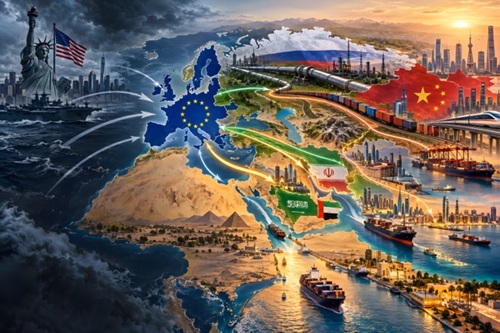 The Case for a Eurasian FutureEurope stands at a crossroads. For nearly eighty years, its security, economic model, and political identity have been anchored in the transatlantic relationship. But the assumptions that underpinned that relationship—American reliability, shared values, and mutual economic benefit—are no longer tenable. The future of Europe lies not westward across the Atlantic, but eastward to Russia and China and southwest to Iran and the Gulf. Geography Is DestinyEurope and Russia share a continent. They cannot move away from each other. The United States, by contrast, is separated by an ocean and has increasingly turned its strategic attention to the Indo-Pacific and its own hemisphere. Geography dictates that Europe's long-term security and economic stability require a working relationship with Russia, not a permanent confrontation. Some European voices are already acknowledging that reality. The war in Ukraine has demonstrated the limits of Western power to impose outcomes on Russia. A durable European order must eventually include Russia, not exclude it. Energy and ResourcesEurope's industrial base was built on access to cheap Russian energy. One reason it is cheaper is due to the proximity of Russia compared to the U.S. The severing of energy ties to Russia has damaged European competitiveness and accelerated deindustrialization. The European Commission has reported that European industrial electricity prices in 2021–23 were roughly two to three times US levels and natural-gas prices three to six times US levels.1 EU industrial production continues to weaken. The value of EU industrial production at constant prices declined 2.0 percent in 2024, its second consecutive annual decline. The value of EU industrial production at constant prices fell for a second consecutive year, including declines of 8.6 percent in electrical equipment, 6.4 percent in motor vehicles and other transport equipment, and 4.7 percent in machinery and other equipment.2 Meanwhile, China has become a major and irreplaceable European trading partner as well as a critical source of both markets and components for its green transition. In 2025 the EU imported approximately €559 billion in goods from China while exporting about €200 billion, producing a goods deficit of approximately €360 billion. China remained Europe's largest source of imported goods.3 In the second quarter of 2026 alone, China supplied 21.9 percent of all extra-EU goods imports.4 Iran and the Gulf states control the energy resources and shipping lanes that Europe still depends on. The future of European prosperity lies in re-establishing pragmatic economic ties with these powers, not in a futile attempt to decouple from them. The Limits of American PowerThe United States has demonstrated that it cannot simultaneously police Europe, the Middle East, and the Indo-Pacific. Its military stockpiles are depleted. Its political system is increasingly unstable and unpredictable. Its commitment to NATO is questioned by its own president. The 2026 National Defense Strategy prioritizes defense of the US homeland, deterrence of China in the Indo-Pacific, greater allied burden-sharing, and expansion of the US defense industrial base; in Europe, it calls for allies to assume primary responsibility for conventional defense with more limited American support.5 The 2026 National Defense Strategy explicitly prioritizes the Western Hemisphere and burden-shifting to allies, signaling a reduced willingness to underwrite European security. Europe cannot base its future on a partner that is both unwilling and unable to guarantee it. The Failure of the Transatlantic Economic ModelThe US has weaponized the dollar, sanctions, and trade policy in ways that harm European interests. At present, the Trump administration is considering restrictions on US diesel exports, including a possible 90-day ban, at precisely the moment when Europe has become unusually dependent on American diesel because Russian and Middle Eastern supplies have been severely disrupted. US diesel has supplied roughly one-third of European imports during 2026 and approximately half by August.6 During the same period, Middle Eastern diesel exports to Europe fell to approximately 110,000 barrels per day in September 2026, their lowest level in more than six years, while European diesel prices reached record levels.7 The EU has long objected to the extraterritorial application of American sanctions. Indeed, the EU's own “Blocking Statute” was created specifically to protect European firms from certain extraterritorial foreign laws, including US sanctions concerning Iran and Cuba. The European Commission states that the EU does not recognize such extraterritorial application and considers those effects contrary to international law.8 The Nord Stream sabotage, the Inflation Reduction Act's protectionist subsidies, and the extraterritorial enforcement of US sanctions have all demonstrated that Washington will prioritize its own interests over those of its allies. The transatlantic economic model has become a source of vulnerability, not strength. The Rise of the Eurasian OrderChina, Russia, and Iran are constructing a multipolar order based on sovereignty, non-interference, and trade in local currencies. As of September, 2026, BRICS contains eleven nations.9 Over 40 additional nations have expressed interest in joining. The Shanghai Cooperation Organization, the Eurasian Economic Union, and the Belt and Road Initiative are creating new institutions and infrastructure that bypass the West. Europe can either be a participant in this new order or become a victim of it. The Southwest: Iran and the GulfIran itself is as large as western Europe. The 2026 war has demonstrated Iran's continuing capacity to impose substantial military, economic, and strategic costs on adversaries despite the conventional military superiority of the United States and Israel. Some analysts consequently expect Iran to emerge from the conflict with much greater influence in the Gulf.10 The Gulf states are already diversifying away from the US, as evidenced by the Iran-Saudi détente and the growing economic ties between the Gulf and China. For various reasons, including the proven inability of the U.S. to provide security, the sheikdoms are facing the prospect of an alliance with Iran.11 The Gulf Cooperation Council is already a major European economic partner. EU-GCC goods trade reached approximately €166 billion in 2025, and the EU was the GCC's second-largest trading partner.12 The EU and United Arab Emirates launched free-trade negotiations in 2025 covering goods, services, investment, renewable energy, green hydrogen, and critical raw materials.13 The 2023 Saudi-Iranian normalization agreement brokered in Beijing was another indication that Gulf states are willing to pursue diplomatic arrangements outside exclusively American-sponsored frameworks.14 Iraq is increasingly integrated into Iran's economic and political orbit. As the petrodollar system erodes, the region is reorienting toward Eurasia. For Europe, this region is not just a source of energy; it is a critical trade route, a market, and a potential partner in managing migration, climate change, and regional stability. The Failure of the American ModelThe US is in relative decline. Its political system is polarized, its infrastructure is aging, and its public health outcomes are poor. It spends more on defense than the next ten nations combined but cannot win wars. Its moral authority has been shattered by its support for genocide in Gaza and its own history of invasion and occupation. The American model is not the future. The future is being built elsewhere. ConclusionObviously, the above analysis runs strongly in opposition to the overwhelming political, military, and public opinion in the West at present. Time-worn assumptions are severely tested in worsening economic conditions. Such circumstances have a way of forcing painful re-evaluations. Nothing in the above implies that Russia is benign or that China offers a superior order in every way. While China has become a manufacturing superpower, India is becoming an increasingly important economic and geopolitical center. The Gulf has accumulated enormous financial resources. Türkiye sits at the intersection of Europe, the Middle East, the Black Sea, and Central Asia. Central Asian states are seeking diversified economic relationships. BRICS has expanded. Supply chains increasingly cross political blocs. The Arctic, Mediterranean, Red Sea, Persian Gulf, Indian Ocean, and Eurasian land routes are becoming parts of an interconnected strategic system. Europe occupies the western edge of this enormous space. Europe's future does not lie with a declining, unpredictable, and increasingly hostile United States. It lies eastward, with Russia and China, and southeast, with Iran and the Gulf. This does not mean Europe must adopt their political systems or abandon its values. It also does not mean that Europe should choose between two dependency systems or give up economic, military, or political ties with the U.S. when they are mutually beneficial. It means recognizing that a multipolar world requires multiple partnerships, and that the most important of those partnerships for Europe in its dawning future lie not across the Atlantic, but across the continent and the Mediterranean. Europe is moving into the enviable position of being able to incorporate the best from multiple world models. The choice is not between the West and the rest. The choice is between clinging to a failed model and embracing a new one. History is moving on. Economic realities are forcing a coming sea change in European attitudes and policies.
Endnotes
1. European Commission, A Clean Transition Dialogue with European Industry and Social Partners: Stocktaking, COM(2024) 163 final, 10 April 2024. The Commission reported that EU industrial retail electricity prices during 2021–23 were two to three times US prices and natural-gas prices three to six times US levels. 2. Eurostat, “Decrease in Industrial Production in 2024,” 24 July 2025. The value of EU sold industrial production at constant prices fell 2.0% in 2024 following a 1.4% decline in 2023. Electrical-equipment manufacturing fell 8.6%, motor vehicles and other transport equipment 6.4%, machinery and other equipment 4.7%, and basic and fabricated metals 4.3%. 3. European Commission, Directorate-General for Trade and Economic Security, “EU Trade Relations with China.” EU goods exports to China totaled €199.5 billion in 2025 and imports €559.5 billion, implying a goods deficit of approximately €360 billion. Machinery and vehicles constituted 54.4% of manufactured imports from China. 4. Eurostat, “Top Trade in Goods Partners in Q2 2026: US and China,” 26 August 2026. China supplied €153.6 billion of the EU's €701.8 billion in extra-EU goods imports during the quarter, or 21.9%, making it the EU's largest external goods supplier. 5. US Department of Defense, 2026 National Defense Strategy, January 2026; Sebastian Clapp and Darius Engel, “The United States' 2026 National Defence Strategy,” European Parliamentary Research Service, April 2026. The strategy emphasizes homeland defense, China and the Indo-Pacific, allied burden-sharing, and strengthening the US defense-industrial base. The European Parliament's analysis interprets it as calling for European allies to assume primary responsibility for conventional defense while the United States supplies more limited critical support. 6. Jillian Ambrose, “EU Says Trump Plan to Ban US Diesel Exports Would 'Negatively Impact Both Sides,'” The Guardian, 24 September 2026; S&P Global Energy, “Trump to Consider Diesel Export Restrictions amid Political Pressure,” 22 September 2026. The Trump administration was considering export restrictions rather than having already imposed them. US diesel exports reached roughly 1.5 million barrels per day during 2026, partly replacing disrupted Russian and Middle Eastern supply; the United States supplied roughly one-third of European diesel imports during the year and about half by August. 7. Claudia Carpenter, “Middle East Diesel Exports to Europe Head for Six-Year Low in September,” S&P Global Energy, 21 September 2026. Middle Eastern diesel exports to Europe averaged approximately 110,000 barrels per day during September, down from 191,000 in August, amid disruption affecting Gulf and Russian supplies. 8. European Commission, “Extraterritoriality (Blocking Statute).” Regulation (EC) No. 2271/96 was adopted in response to extraterritorial US measures involving Cuba, Iran, and Libya and was updated in 2018 following US withdrawal from the Iran nuclear agreement. The Commission states that the EU does not recognize the extraterritorial application of third-country laws and regards such effects as contrary to international law. 9. BRICS Brazil, “About the BRICS.” BRICS currently identifies eleven members—Brazil, Russia, India, China, South Africa, Egypt, Ethiopia, Indonesia, Iran, Saudi Arabia, and the United Arab Emirates—and ten partner countries. According to the official BRICS account, more than thirty countries expressed interest during 2024 in participating either as members or partners. 10. Mohsen Milani, “How Will the Iran War Reshape the Persian Gulf?” Chatham House, The World Today, 14 September 2026. Milani argues that the 2026 conflict exposed vulnerabilities in the existing Gulf security architecture and may leave Iran with greater regional influence, while also creating opportunities for China and encouraging Gulf states to hedge among outside powers. This is analysis rather than an established prediction. 11. Ali Bakir, “Lessons Learned by GCC States in the 2026 US-Israel-Iran War,” Middle East Council on Global Affairs, 14 July 2026. Bakir argues that the conflict demonstrated the dangers of subcontracting Gulf security to a single outside guarantor and recommends indigenous defense capacity and “partnership pluralism.” The analysis also cautions against assuming that rapprochement with Iran alone provides security, noting Iranian attacks on all six GCC states during the conflict.
12. European Commission, “EU Trade Relations with Gulf Region.” EU-GCC goods trade amounted to €165.7 billion in 2025. The EU accounted for 10.9% of GCC global goods trade and was its second-largest goods trading partner. EU imports from the GCC were dominated by mineral products. 13. European Commission, “EU Trade Relations with Gulf Region.” EU-UAE free-trade negotiations were formally launched on 28 May 2025 and encompass goods, services, investment, renewable energy, green hydrogen, and critical raw materials. EU-UAE goods trade is approximately €55 billion, while services trade is approximately €39 billion. 14. Saudi Press Agency, “Joint Trilateral Statement by the Kingdom of Saudi Arabia, the Islamic Republic of Iran, and the People's Republic of China,” 10 March 2023. The agreement followed Chinese-hosted talks in Beijing and provided for restoration of Saudi-Iranian diplomatic relations, reopening of diplomatic missions, and reaffirmation of sovereignty and non-interference. 15. Stockholm International Peace Research Institute, Trends in World Military Expenditure, 2025, April 2026. The United States remained the world's largest military spender, accounting for approximately one-third of global expenditure. US expenditure was approximately 2.8 times China's in 2025, down from 3.2 times in 2024. The five largest spenders—the United States, China, Russia, Germany, and India—collectively accounted for 58% of world military expenditure. Widget is loading comments...
|