|
TRANSLATE THIS ARTICLE
Integral World: Exploring Theories of Everything
An independent forum for a critical discussion of the integral philosophy of Ken Wilber
 Ray Harris is a frequent contributor to this website. He has written articles on 9/11, boomeritis, the Iraq war and Third Way politics. Since 2007 he took to writing his novels Navaratri, Wild Child and Eden. Harris lives in Ballarat, Victoria, Australia. Ray Harris is a frequent contributor to this website. He has written articles on 9/11, boomeritis, the Iraq war and Third Way politics. Since 2007 he took to writing his novels Navaratri, Wild Child and Eden. Harris lives in Ballarat, Victoria, Australia.
The Hypocrites: Part One: Refugees and Immigration Part Two: International Humanitarian Law Part Three: Self-determination Part Four: Genocide The HypocritesPart One: Refugees and ImmigrationRay HarrisAfter revisiting some of the debates on Integral World around key geopolitical issues, especially the Russia/Ukraine and Israel/Palestine conflicts, I was struck by the level of hypocrisy displayed in some of the commentary. Most of it is due to simple partisan prejudice, some of it to ignorance, the remainder to moral confusion. The main culprits are those who belong to a specific lineage of the left, the Campists, or authoritarian left. I say this as a member of a different lineage, the libertarian left (not to be confused with the right-wing Libertarian movement). This division goes back to the origins of socialism and a dispute between the anarchist Mikhail Bakunin and Karl Marx. Marx famously argued that a revolutionary vanguard (dictatorship of the proletariat) should seize the state and use it to impose socialism on behalf of the masses. Bakunin argued that once a vanguard had gained control of the state it would use it to hold onto power and become just another form of oppression. Instead he argued that any substantive change can only arise from the masses themselves. Bottom up versus top down. Marx thought that once the revolution was secured, the vanguard would hand power back to the masses. History proved Bakunin right. The vanguard never relinquished power and instead evolved into some of the most oppressive regimes in human history. Pol Pot committed genocide to impose his idea of a communist society. In North Korea, the leadership devolved to absolutist, idiosyncratic dynastic rule. Meanwhile sections of the non-Marxist left rejected the tactic of revolutionary violence in preference for evolutionary reform through democratic means - democratic socialism. The libertarian left argued for democracy to be extended to all segments of society, including worker's control of corporations. I would argue that the process of democratic reform has done more to improve the lives of the oppressed than revolutionary vanguardism. The two great examples of the Marxist-Leninist approach, Russia and China, have abandoned the communist project. Russia has devolved to the Eurasian fascism promoted by the ideological leader of the 'White' counterrevolution, Ivan Ilyin. China has embraced capitalism whilst retaining a one-party state. Both are socially conservative, with Russia re-embracing the Orthodox Church. Western anti-WesternismThe contest between liberal democratic capitalism and autocratic socialism during the Cold War still reverberates through the Western left. The West is associated with capitalism and so is seen as the enemy of equality and progress, ignoring the clear evidence that liberal democracies lead the way in terms of progressive reform. Let's take just one key example: women's rights. Despite initial hopes that women in communist societies would attain full equality they have not. Only 11 women out the full 205 positions in the Chinese Communist Party's Central Committee are women. This low percentage is mirrored in the number of female CEOs heading Chinese corporations. And whilst Cuba has high female representation in the National Assembly level, this disappears at the leadership level. Compare this to my country, Australia, which has 46% female membership in the House of Representatives and 57% in the Senate - 50/50 parity. A feature of the West is its embrace of self-criticism and reform. As I have pointed out several times, Marx and Engels were bourgeois white European men. The communist alternative is itself Western. There is only one truly non-Western political system outside of traditional feudal systems (think Thailand, Bhutan, etc.) that I can think of that provides a substantial ideological alternative and that is Islamism, rule by Islamic laws and principles. That self-criticism leads to a certain type of myopia that fails to recognise just how progressive liberal democracies are compared to other systems. It also fails to acknowledge the progress that has been made and instead protests that progress has been too slow or not comprehensive enough. Consider the issue of LGBTQI rights. Several liberal democracies have removed discrimination against homosexuals and bisexuals and legalised same sex marriage, so now some sections of the left have shifted focus to demand rights for transexuals who make up only around 0.5% to 1% of the population. The logic seems to be that the West is bad because it's not yet perfect, or not progressing fast enough. Glass half empty versus glass half full. ImmigrationThe countries that have the most generous immigration and refugee resettlement programs are liberal democracies: Canada, the USA, Australia and the Nordic countries. The countries with the most restrictive policies are North Korea, Cuba, China, Vietnam - and Islamic countries Immigration is not of course, a simple matter. The reasons for open or closed door policies are multifaceted and may be a combination of economic capacity, nativism and xenophobia. Whatever the case, differences in policy regarding immigration are a major issue separating left-wing progressivism from right-wing conservatism. Conservative policies typically include:
Progressives typically challenges these policies in preference for.
Case Study 1: The USAGenerating fear of the other is a classic technique of autocrats. Under Trump the target group is illegal migrants, particularly from Latin America, although he has targeted Muslims and other groups. This appeals to his MAGA base of largely disaffected working class and rural whites who feel unable to understand or survive financially in the modern economy. They are easily convinced that migrants are competing against them for jobs and housing or are responsible for crime. Trump notoriously accused a Haitian migrant community of 'eating the dogs and eating the cats'. Generating fear allows autocrats to establish special police and military units to enforce a crackdown, in the process laying the grounds for a police state. In this case it was ICE, (Immigration and Customs Enforcement), Border Patrol, Homeland Security and other assorted agencies. ICE and the Border Patrol effectively terrorised American neighbourhoods as they tracked down and arrested alleged illegals. The Trump administration has also built specialised incarceration facilities and have been accused by several human rights organisations of failing to meet minimum standards in detainee welfare. The US goes through cycles of right wing regression and limitations on human rights. The KKK terrorising the black community, Hoover's FBI, the House Un-American Activities Committee, the McCarthy witch hunts and black lists, Nixon's crackdown on anti-war protests, and now Trump's narcissistic autocratic kleptocracy.
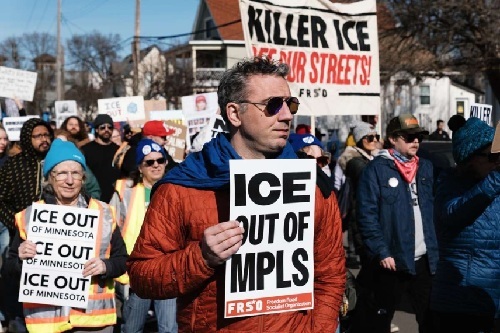
Anti ICE protests, Minnesota
These periods have always been challenged by moderate and left wing citizens. ICE operations were met by protests around the country, leading to the tragic murder of two activists, Renée Good and Alex Pretti. These excesses forced Trump to fire the Director of Homeland Security, Kristi Noem and fascist cosplayer, Gregory Bovino, a Border Patrol commander. Despite these sacrificial offerings, ICE operations continue with Homeland Security claiming they deport around 1,250 per day. Case study 2. Europe and the UKThere has been a recent rise in right-wing, anti-immigrant populism in Europe and the UK specifically in reaction to Muslim immigration from MENA countries - the Middle East and North Africa. The principle concern is that a significant percentage follow Salafist Islam and are sympathetic to several militant groups (ISIS, Hizb-ut Tahrir, the Muslim Brotherhood, etc) thus increasing the risk of domestic terrorist attacks. This concern is well founded with the UK and Europe suffering a number of serious attacks over the decades. Concern has also been raised over the proportion of young Muslim men engaged in the sexual assault of women. In the UK this has involved organised grooming gangs. There is also a growing concern that an increase in the Muslim population will lead to demands to introduce sharia law, and following the actions of self-appointed Muslim vigilante groups such as the Muslim Patrol in London in 2013, concerns that Muslims will increasingly attempt to force their conservative religious standards on their non-Muslim neighbours. Similar concerns have been expressed in Europe, with incidents in Paris prompting the government to enforce the constitutional principle of secularism (Laïcité), with restrictions placed on women wearing the hijab and niqab after accusations that conservative men were pressuring Muslim women to cover up. The European and UK left have opposed these concerns labelling them racist and Islamophobic.
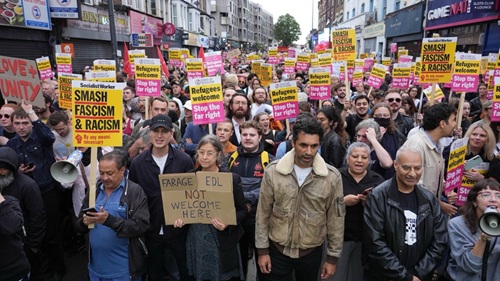
Anti Reform Party protests, UK
The British Brothers' LeagueThe pogroms in Eastern Europe (the Pale of Settlement) in the late 19th century resulted in a wave of Jewish refugees seeking asylum in the UK and the US. There was a mixed reaction with progressives expressing sympathy and conservative nativists voicing alarm. The usual fears were raised that the Jews were taking British jobs and placing pressure on housing and rents. The Conservative MP, Major Evans-Gordon said: “immigration had a deteriorating effect upon moral, financial, and social conditions of the British people, which resulted in lowering the general standard of life”. In 1901 Captain William Stanley Shaw founded the British Brothers' League, an anti-immigrant activist group. In that same year an attempt was made to enact the restrictive anti-immigrant Aliens Act. This was rejected by the Liberal opposition, but a modified version was eventually passed in 1905. The Guardian, regarded as a left leaning news outlet, reported. “When the government launched a royal commission on alien immigration, Evans-Gordon chaired it and set the agenda. It investigated the very charges the BBL had made—that immigrants arrived impoverished, destitute and dirty; practised insanitary habits; spread infectious diseases; were a burden on the rates; dispossessed native dwellers; caused native tradesmen to suffer a loss of trade; worked for rates below the “native workman”; included criminals, prostitutes and anarchists; formed a compact, non-assimilating community that didn't intermarry; and interfered with the observance of Christian Sunday.” While the progressive opposition. “organised their own public meetings to challenge BBL propaganda through an ad-hoc Aliens Defence League, temporarily housed in Brick Lane. They proposed practical solutions: unionising migrant workers so they could fight alongside indigenous workers for better conditions for all, and creating fair rent courts to deal with accusations against landlords, including immigrant landlords.” The Guardian correctly pointed to similarities with contemporary anti-immigrant campaigns. “Today's scare stories about “Muslim extremists” echo those of the St James Gazette, which warned, in 1887, of “foreign anarchists and nihilists” among Jewish immigrants.” Ottoman PalestineWhilst the majority of Eastern European Jewish refugees made their way to the UK and the US, a number sought resettlement in Ottoman Palestine. The first wave, or Aliyah, occurred between 1882 and 1903 (which also included a group of around 3,000 Yemenite Jews and 3,000 Circassian Muslims). In 1891 500 Muslim effendi, or notables, sent a petition to Constantinople demanding an end to Jewish immigration and a ban on Jews buying land and establishing businesses. This was six years before the first Zionist Congress, declared the aim of establishing a legally recognised home for Jews in Palestine. This was not understood, at this early stage, to be an independent state, only that Jews be granted full rights as citizens. It is also interesting to note that some of the initial objection to Jewish migration was that they had been Russian citizens and Russia was a traditional enemy of the Ottomans. Arab nationalist opposition to the Ottoman Empire was in its early stages, with many Arabs loyal to the Turkic Caliphate. The Mandate periodDuring the Nebi Musa celebrations in Jerusalem in 1920, Haj Amin al-Husseini addressed the crowd, whipping up anti Jewish immigration sentiment. Allegedly a small counter protest by Jabotinsky Zionists further outraged the Arabs, who retaliated with force. The riot lasted three days and resulted in the deaths of five Jews with several hundred injured. Four Arabs were killed, with only 18 injured, mostly by British police attempting to quell the riot. During the rampage the Arabs were heard shouting the racist slogans 'Death to the Jews' and 'Palestine is ours and Jews are our dogs'. Here it is worth noting that dogs are considered unclean under Islamic law and are to be kept only as working animals. This would classify it as a race riot. Haj Amin al-Husseini would rise in prominence to be appointed the Grand Mufti of Jerusalem and chairman of the Arab Higher Committee. He would consistently call for the end to Jewish immigration and restrictions on Jews buying land and establishing businesses. As time progressed he shifted to the extreme right advocating for the mass deportation of Jews. The failure of the Arab general strike of the late 30's saw Husseini seek asylum in Germany where he met with Hitler, Himmler and other senior leaders of the Nazi regime. He directly sought Hitler's assurance that Germany would help him solve Palestine's Jewish problem. Whilst there is some debate over how much he knew about the death camps, it is clear he knew of the Nazi program of persecution against Jews and the existence of concentration camps. “The Fuhrer then made the following statement to the Mufti, enjoining him to lock it in the uttermost depths of his heart: 1. He (the Fuhrer) would carry on the battle to the total destruction of the Judeo-Communist empire in Europe. 2. At some moment which was impossible to set exactly today but which in any event was not distant, the German armies would in the course of this struggle reach the southern exit from Caucasia. 3. As soon as this had happened, the Fuhrer would on his own give the Arab world the assurance that its hour of liberation had arrived. Germany's objective would then be solely the destruction of the Jewish element residing in the Arab sphere under the protection of British power. In that hour the Mufti would be the most authoritative spokesman for the Arab world. It would then be his task to set off the Arab operations, which he had secretly prepared. When that time had come, Germany could also be indifferent to French reaction to such a declaration.” This is not a matter of conjecture but of the historical record. There is no doubt. Haj Amin al-Husseini was a Nazi collaborator.
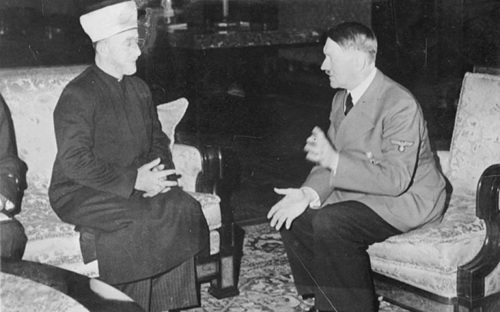
Husseini meets Hitler
The PLO and HamasThe PLO was founded in Cairo in 1964. Ahmad Shukeiri (Shukayri) was appointed its first chairman. Its primary aim was to eliminate the state of Israel and establish a single state under Arab control. When asked by the Lebanese daily Al-Yawm (June, 3rd 1967) prior to the Six-Day War what would happen to the citizens of Israel he replied: “We will endeavour to assist the Jews and facilitate their departure by seas to their countries of origin.” When asked specifically about those Jews born in Palestine he added: “Whoever survives will stay in Palestine, but in my opinion no one will remain alive.” Shukeiri resigned after the Israelis won the Six-Day War. These comments would cause considerable controversy because they implied genocide. His successor Yahya Hammuda reversed Shukeiri's comments by stating that the Jews would not be expelled. He was forced to retract this assurance by the more radical factions. He was replaced by Yasser Arafat in 1969. Article 6 of the PLO Charter clearly states that only those Jews born in Palestine before the 'Zionist invasion' will be granted citizenship. Article 15 calls for the “elimination of Zionism in Palestine”. Article 22 is more expansive: “Zionism is a political movement organically associated with international imperialism and antagonistic to all action for liberation and to progressive movements in the world. It is racist and fanatic in its nature, aggressive, expansionist, and colonial in its aims, and fascist in its methods. Israel is the instrument of the Zionist movement, and geographical base for world imperialism placed strategically in the midst of the Arab homeland to combat the hopes of the Arab nation for liberation, unity, and progress. Israel is a constant source of threat vis-a-vis peace in the Middle East and the whole world. Since the liberation of Palestine will destroy the Zionist and imperialist presence and will contribute to the establishment of peace in the Middle East, the Palestinian people look for the support of all the progressive and peaceful forces and urge them all, irrespective of their affiliations and beliefs, to offer the Palestinian people all aid and support in their just struggle for the liberation of their homeland.” The failure of the PLO to “destroy the Zionist and imperialist presence” would see it modify its position in 1993 to recognise the State of Israel and work towards a two-state solution through the Oslo accords. Hamas was founded in 1987. It took a similar position to the PLO in seeking the elimination of the State of Israel. The difference between the two is that the PLO claimed to be secular whereas Hamas was avowedly Islamist. In Article 31 of their Charter they state: “Under the wing of Islam, it is possible for the followers of the three religions - Islam, Christianity and Judaism - to coexist in peace and quiet with each other. Peace and quiet would not be possible except under the wing of Islam. Past and present history are the best witness to that.” Whilst the Charter does not make it explicit, its constant exhortation to follow Sharia means that Jews and Christians would need to submit to Islam and accept their status as dhimmi - meaning as second-class citizens. After criticism that the Hamas Charter repeated Nazi inspired antisemitic conspiracies and included passages could be interpreted to incite genocide, Hamas issued a modified version in 2017. The newer version tempered its language around Jews and opened the possibility of accepting a two-state solution. It stopped short of recognising the State of Israel. Summary of the Palestinian position regarding immigrationAs we can see the position of the Palestinian leadership, from the Ottoman period on, consistently meets the definition of conservative policies on immigration: stringent numerical limits, restrictions based on race and religion, xenophobia, discriminatory policies, arrest and repatriation. And in the case of the AHC under Husseini, a move as far right as possible by collaborating with the Nazis. The PLO and Hamas were little better, with both advocating the mass deportation of 'Zionist' Jews to their country of origin. How this was to be achieved without considerable distress and violence is not explained. IsraelIt might surprise some to find that Israel allows non-Jews to immigrate and become Israeli citizens. Since 1990 the number of non-Jewish migrants is estimated to be around 400,000. However, Israel does practice discrimination under the right to return policy where Jews are granted automatic citizenship, whereas non-Jews face a number of restrictions, including learning Hebrew. Of course, the dominant issue is the forced expulsion of Palestinians during the 47 Civil War and the war with Egypt, Jordan, Lebanon, Syria and Iraq. Called the Nakba, the Catastrophe, and labelled ethnic cleansing, it saw the internal displacement of around 700,000 Palestinians (most remained within the Mandate borders). The majority fled, many at the command of Arab leaders. Around 70,000 were forcibly evicted. 150,000 chose to remain (the exact numbers are disputed). Those that remained became Israeli citizens, including the Druze and Circassian Muslims who had maintained neutrality. But if the Nakba is to be cited as an example of ethnic cleansing, what do we call the Arab plans to send Zionists back to where they came from? Isn't the left supposed to fight the far right? I always thought so. And the slogans printed on signs and chanted at protests against right-wing anti-immigrant movements confirm this: 'Refugees welcome', 'Fight racism', 'Stop the far right', 'Smash fascism and racism by any means necessary'. But if these protestors are to be consistent shouldn't they oppose the far right in all its manifestations equally, including the Palestinian far right? The progressive positionBoth Zionists and Palestinians fail to meet the criteria. A number of Jewish migrants failed to respect local traditions, causing local resentment. Some Jews were clearly racist in their attitude to Arabs, considering them inferior. Some traditional tenant farmers were evicted without adequate compensation or regard, and Jewish agricultural projects clashed with traditional sheep and goat grazing rights. A number of disputes arose over livestock ruining Jewish crops. Several prominent Zionists understood this and implored their fellow Jews to be more respectful. The early Zionist, Asher Avi Ginsberg, penned an essay after visiting Palestine in 1891 called 'Truth from the Land of Israel' in which he explicitly condemned the actions of some recent migrants, warning that poor treatment of Arabs could only build resentment. At the 1907 Zionist Congress, Yitzhak Epstein argued that Zionism must also be to the economic and educational advantage of the local population. But it is also clear that the local Arabs held racist attitudes to Jews. And whilst some key leaders such as Amin al-Husseini denied the Jewish claims to the land, others acknowledged the Jewish connection. In 1899 Yusuf Diyya al-Khalidi (a distant relative of Palestinian historian Rashid Khalidi), from a prominent Jerusalem Muslim clan, wrote to Zadok Kahn, the chief rabbi of France: “You are well aware that I am talking about Zionism. The idea in itself is only natural, beautiful and just. Who can dispute the rights of the Jews to Palestine? My God, historically it is Your country! And what a marvellous spectacle it would be if the Jews, so gifted, were once again reconstituted as an independent nation, respected, happy, able to render services to poor humanity in the moral domain as in the past!” A progressive approach would recognise that many Jews were genuine refugees seeking asylum and, given their clear connection to the land, had every right to migrate, purchase land and establish businesses. It would also recognise that the authorities had a right to control the numbers at a manageable level - although, as history has shown, the region was able to sustain quite high levels of both Jewish and Arab migration. A progressive approach would have granted all new migrants equal rights under the law, including citizenship. This would include the freedom to practice their religion, to build places of worship and establish schools and community organisations - exactly as Muslim migrants to Western countries are able. If these conditions had been met the Zionist movement may have confined its political demands to the initial goal of creating a home - a safe haven for Jews in their ancestral lands. The demand for a seperate state arose in part, because no state, including an Arab Palestine, would grant them equality and freedom from persecution. As I have explained, from the very outset, their position in Palestine faced considerable opposition. The double standardI have often heard the complaint that 'the Zionists' want to establish an ethno-religious (racist) state that privileges Jews. This definitely applies to the Zionist far right as represented by the settler movement and right-wing politicians such as Smotrich and Ben Gvir. But there are counter examples of progressive Zionists arguing for greater inclusion of minority groups. What is ignored is that the Arabs, specifically Sunni Muslims, also wanted to establish an ethno-religious state, one that privileged Sunni Muslims. Hamas makes this explicit in article 11 of its charter: “This is the law governing the land of Palestine in the Islamic Sharia (law) and the same goes for any land the Moslems have conquered by force, because during the times of (Islamic) conquests, the Moslems consecrated these lands to Moslem generations till the Day of Judgement.” As with Zionism, there are moderate Palestinians who argue for cooperation with Jews. It's just that they represent an even greater minority within the population than their Jewish counterparts and face considerable risk if they speak out. Here we return to Amin al-Husseini as an example because he notoriously declared a jihad against the more moderate Nashashibi clan and their allies. This resulted in the murder of Fakhri al-Nashashibi in Baghdad in 1941. Raghib al-Nashashibi, a former mayor of Jerusalem, survived several attempts and eventually fled to Egypt. And during the Arab revolt of 36-39, around 1,000 Arabs were killed by Husseini aligned forces for allegedly collaborating with the Nashashibi and British, thereby decimating the moderates. The PLO and Hamas also have a history of assassinating their political rivals.

Hamas summarily executing alleged collaborators
So, given this history, why do the progressive 'Western' allies in the pro-Palestinian movement appear to support far-right Palestinian movements and not the moderates? Is it due to ignorance of the history? A good part of the answer seems to be that the left has accepted the argument that the Jews were not genuine refugees or immigrants because Zionism is a 'colonialist project'. I'll examine this topic in a seperate essay which will examine the principle of self-determination and national liberation movements.
Widget is loading comments...
|