|
TRANSLATE THIS ARTICLE
Integral World: Exploring Theories of Everything
An independent forum for a critical discussion of the integral philosophy of Ken Wilber
 Ray Harris is a frequent contributor to this website. He has written articles on 9/11, boomeritis, the Iraq war and Third Way politics. Since 2007 he took to writing his novels Navaratri, Wild Child and Eden. Harris lives in Ballarat, Victoria, Australia. Ray Harris is a frequent contributor to this website. He has written articles on 9/11, boomeritis, the Iraq war and Third Way politics. Since 2007 he took to writing his novels Navaratri, Wild Child and Eden. Harris lives in Ballarat, Victoria, Australia.
Reflections on the Israel Palestine conflict: Strange bedfellows: After Bondi The Neglected Cause: Al-Aqsa The Chosen People The Neglected Cause: Al-AqsaReflections on the Israel Palestine conflict, Part 2Ray HarrisIn this essay, Ray Harris argues that the central role of the Al-Aqsa Mosque and Temple Mount in Islamic belief has been largely overlooked in Western analyses of the Israeli-Palestinian conflict. He contends that the dispute is not fundamentally about territory alone, but about competing religious claims to Jerusalem's holiest site, and that understanding this theological dimension is essential to explaining both the persistence and the intensity of the conflict. (ChatGPT) When Hamas conceived the plan to invade Israel they called it Operation Al-Aqsa Flood. The Western media however, simply called it the Oct 7th massacre, thus secularising what was intended to be a holy jihad. This pattern of secularising the Israel Palestine conflict has been repeated throughout its history, thus minimising the significance of protecting the Masjid al-Aqsa, which incorporates the Haram al-Sharif (Temple Mount), from falling into the hands of the Jews and infidels. This minimisation is remarkable given the many unambiguous signals and statements from the Muslim community that protecting Al-Aqsa is of critical importance. It has also led many non-Muslims to believe that the conflict is primarily about land and sovereignty. Whilst this is undeniably an important factor, it is not the most important. The Night Journey: Al-Aqsa in the Koran and Hadith.Islam began as a small Jewish inspired sect with a focus on Jerusalem, especially as the initial direction of daily prayer. The first mention of Al-Aqsa is in Sura 17 of the Koran - The Night Journey (Al-Isra) or alternately, The Children of Israel (Bani Isra'il). "Exalted is He who took His Servant by night from al-Masjid al-Haram to al-Masjid al-Aqsa, whose surroundings We have blessed, to show him of Our signs." Masjid means mosque/place of prayer and Haram means sacred, a reference to the grand mosque in Mecca with the Kaaba at its centre. Aqsa means the furtherest and whilst the Sura does not mention a location, it is generally understood to mean the Temple Mount located in Jerusalem (not the current physical mosque, which is known as the Al-Jami Al-Aqsa or Qibli mosque). However, it is important to note that not all Muslim scholars agree, with some suggesting that 'furtherest' is not a reference to a geographical location, but to a spiritual one. This is supported by the fact that at the time there were no physical mosques in Jerusalem and the Temple Mount during Byzantine rule was abandoned and treated as a rubbish dump. Details surrounding the night journey were added in the first history of Mohammed written by Ibn Ishaq (699 - 767AD). This source material was repeated in later Hadith.
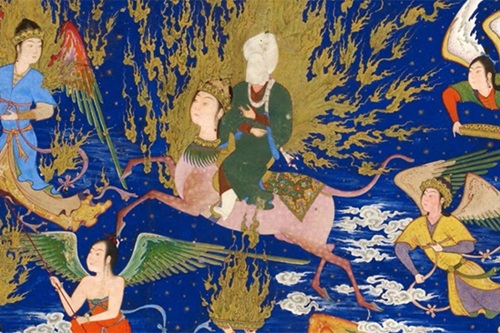
Later artists embellished the image of Buraq adding a human face
Interestingly, Ibn Ishaq also recounts that Mohammed's wife Aisha and a female cousin, Umm Hani, stated that Mohammed was asleep and that the journey happened in a dream. Despite this, many Muslims interpret the story literally to the point of calling the Western (Wailing) Wall the Buraq Wall because that is where Mohammed allegedly tethered Buraq. To mark this, they built a small subterranean prayer hall (musalla) near the Moroccan Gate and called it the Masjid al-Buraq. The dates are important here. Jerusalem was conquered by a Muslim army in 636. The first account of a mosque at the site comes from the Frankish bishop Arculf who described a wooden structure in 670. Ibn Ishraq was born in 699 and died in 767, meaning his history was written some decades later. This has led some historians to claim that these accounts were written to justify the conquest and appropriation of the Temple Mount. It is also equally likely that these stories were shared by word of mouth before being written down. We simply don't know if these claims were sincere or cynically self-serving. Mohammed understood the significance of the Jewish TempleSura 17 is also important because it acknowledges that Moses guided the 'Children of Israel' and that God punished them for failing to follow his commandments, stating 'You will commit evil on earth twice'. Ayat 7 mentions the Temple directly . “'If you do good, you do good for yourselves; and if you do evil, you do it to yourselves.' Then when the final promise came, We sent your enemies to sadden your faces and to enter the temple in Jerusalem, as they entered it the first time, and to destroy what they had taken over with total destruction." Later commentaries agree that this is a reference to the Babylonian destruction of the First Temple, the Temple of Solomon. This agrees with the Orthodox Jewish understanding that the Temple was destroyed because the Jews had sinned. This poses a problem. The Koran consistently repeats that nothing can be achieved without Allah's assistance. Surah 7:6 clearly states: “Then We gave you back your turn against them, and supplied you with wealth and children, and made you more numerous.” Given this, isn't the return of Jews to Israel and the increase in wealth and population a sign of Allah's blessing? And therefore, isn't the defeat of the Arabs a sign that they have sinned? I will return to this question later. The war against the Jews of ArabiaScholars divide the Koran into the Meccan and Medinan revelations. The Meccan period emphasises peace and patience whereas the Medinan shifts focus to issues of justice and war. Sura 7 belongs to the Meccan period. The Medinan period was known for a series of brutal wars against the Jewish and Pagan tribes of Arabia, with Islam the victor. It is during this period that Mohammed changes the direction of prayer from Jerusalem to Mecca. The causes of the conflict are disputed. The Muslim narrative is that the Jews failed to acknowledge Mohammed's legitimacy as the final Abrahamic prophet and turned against him. The Jewish narrative is that he was a false prophet and a trouble maker. Whatever the justification, the followers of Mohammed initiated a number of wars against local Jewish tribes that meet the modern definition of genocide and ethnic cleansing. In the case of the Bani Qurayza 700 males of fighting age (14+) were systematically beheaded and the women and children sold into slavery. Two other tribes, the Bani Nadir and Bani Qaynuqa had their lands and property confiscated and were exiled to Khaybar, an oasis north of Medina. Further hostilities resulted in the Battle of Khaybar. The Jews lost and again had their lands and wealth confiscated. Those who pleaded to remain were forced to pay a protection tax called the jizya. An uneasy peace continued until the death of Mohammed. In 641, the second Caliph, Umar ibn al Khattab, fulfilled Mohammed's alleged decree that 'two religions shall not co-exist on the Arabian peninsula' by expelling the remaining Jews of Arabia (who fled to modern day Syria, Iraq and Yemen). This expulsion happened just a few years after Muslim troops had invaded Jerusalem five years previously in 636. Some may argue that this is ancient history. Not to Islamists who to this day refer to this period with the chant: “Khaybar, Khaybar, O Jews! The army of Mohammed shall return!” The alleged betrayal of Mohammed by the Jews of Medina is considered by Muslims to be as serious a betrayal as the betrayal of Jesus is by Christians. These alleged offences form the basis of deep-seated sectarian animosity. It is considered such an offence that Muslims claim that Allah once again punished the Jews by revoking their claim to the Holy Land, to Jerusalem and to the Temple Mount. It is a repeat of the Exile and Return narrative with Muslims replacing Jews (and Christians) as Allah's chosen. A symbol of domination.The Dome of the Rock (Qubbat as-Sakhrah) with its golden dome dominates the Jerusalem skyline. It was designed to do so to mark Islam's triumph over the Jews and Christians. Inscriptions on the interior specifically denounce Christian doctrine and declare Islam's superiority. The Dome of the Rock gets its name from an area of exposed rock called the Foundation Stone, said in the Talmud the be the exact spot Yahweh created the Earth with the surrounding soil used to create the first man, Adam. It is also considered the place Abraham prepared to sacrifice his son, Isaac . It is for this reason Jews refer to it as the Holy of Holies. A Roman era Midrash says: so is the land of Israel the navel of the world... situated in the centre of the world, and Jerusalem in the centre of the land of Israel, and the sanctuary in the centre of Jerusalem, and the holy place in the centre of the sanctuary, and the ark in the centre of the holy place, and the Foundation Stone before the holy place, because from it the world was founded. It is also believed to be the place of Jacob saw a ladder ascending to heaven and the precise place on the Temple Mount that Mohammed ascended to heaven, surpassing all previous prophets. Its religious significance to Jews and Muslims cannot be dismissed. It is the reason the Dome plays a significant role in the iconography of several Palestinian militant groups, including the Palestinian Civil Police Force.
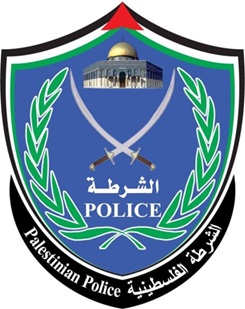
PCPF
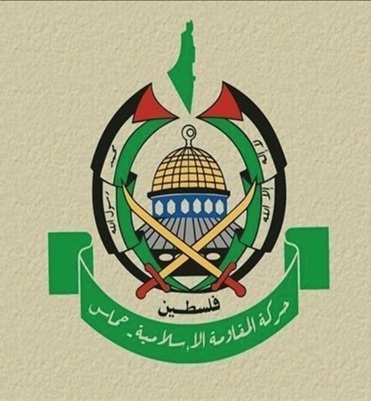
Hamas
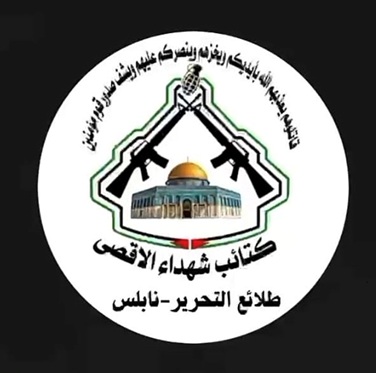
Al-Aqsa Martyrs Brigade
Palestinian Islamic Jihad
These symbols are repeated on flags, banners, badges, headbands, clothing, posters and leaflets. They are ubiquitous. The message is clear. Muslim control of Al-Aqsa will be asserted with violence. The current status of the Temple MountIslam is unique amongst religions in demanding exclusive control of its most holy sites. The entire city of Mecca is off limits to non-Muslims. There is some limited access to Medina, but access to the district surrounding the Masjid an-Nabawi (Prophet's Mosque) is forbidden. Islam exercises similar control over the Temple Mount, which is administered by the Jordanian appointed, Jerusalem Waqf and Al-Aqsa Mosque Affairs Department. Under its administration Muslims have unrestricted access through ten of the traditional gates. Jews and non-Muslims however face a number of restrictions.
In contrast the Western Wall is open to people of every faith, including Muslims.
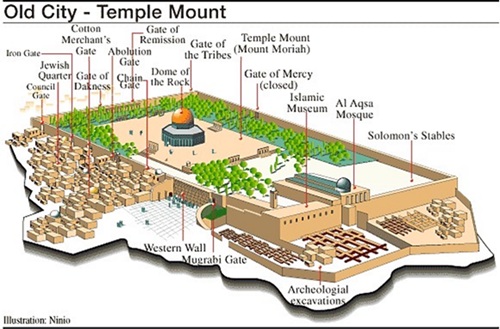 Israeli police are responsible for the security of the area surrounding the Temple Mount, including manning the entry points. They have imposed restrictions on both Muslims and Jews, especially during periods of conflict. The Chief Rabbinate also places restrictions on Jews, declaring that entering the Temple Mount is forbidden under halakhic laws governing the Holy of Holies. This raises the question of the Third Temple. The general view is that it is only the coming Messiah who can initiate the building of a Third Temple. However, there are a minority of Jewish and Christian Zionists who disagree with the Chief Rabbinate and who believe praying on the Mount is a religious duty and that the construction of the Third Temple will hasten the arrival of the Messiah. There are no authorised plans to build a Third Temple. Despite the Chief Rabbinate's ruling, the fear that Jews are planning to take over the Temple Mount, destroy the Dome of the Rock and the Qibli mosque and build the Third Temple has, at times, reached paranoid, conspiratorial levels and been cynically used to incite multiple protests and violent attacks against Jews. The Buraq UprisingOver the time of Muslim control various restrictions have been placed on Jews accessing their holy places. This has ranged from total prohibition to limited access. For instance, the second most holy site in Judaism is the Cave of the Patriarchs in Hebron. Until the '67 war, the caves had been sealed and a mosque built over the entrance. Similar restrictions were applied to the Western Wall. As more Jews arrived during the British Mandate tensions grew over Jewish demands for greater access the Western Wall. The Arab authorities had placed a number of restrictions that made access difficult and local Arabs would harass Jews by throwing insults and stones, along with the occasional physical assault. On August 15th, 1929 a group of young right-wing Zionists marched to the wall to protest the restrictions. The following day the Supreme Muslim Council organised a counter demonstration that turned violent and spread to the Jewish commercial quarter. The Shaw Commission revealed that the Grand Mufti of Jerusalem, Sheikh Amin al-Husseini, had distributed leaflets claiming that the Jews were planning to take the Temple Mount. The Muslim Supreme Council released a memorandum that stated: “Having realized by bitter experience the unlimited greedy aspirations of the Jews in this respect, Moslems believe that the Jews' aim is to take possession of the Mosque of Al-Aqsa gradually on the pretence that it is the Temple...to stop this hostile propaganda which will naturally engender a parallel action in the whole Moslem world, the responsibility for which will rest with the Jews.” (1) Sorry, Muslims have exclusive control of their first, second and third most holy sites and it is the Jews who are being greedy for wanting access to their first? Additional rumours spread throughout the region that the Jews had desecrated a Koran, killed several Muslims and raped women. This resulted in a series of retaliatory attacks by roaming Arab mobs, the most serious being the Hebron and Safed massacres. The mobs killed 133 Jews and wounded 339, most of whom were unarmed. 116 Arabs were killed by Mandate Police suppressing the riots. The details of the massacres are gruesome and includes the murder and rape of children. It is worth emphasising that the main targets of the Arab mobs were not newly arrived Zionist settlers, but established Sephardic and Yishuv communities dating back centuries. This included the Jews of Gaza who were forced to flee, never to return. Under modern definitions the riots were a clear act of genocide and ethnic cleansing provoked because Jews dared 'defile' the area where Mohammed tethered a fantastical beast in a dream. Jordanian control 48-67King Hussein of Jordan had long held an ambition to rule the Palestinian territories. The war of 48 offered Jordan the opportunity for a land grab and whilst some argue the Arab armies failed in their attempt to abort the Jewish state, it was a nonetheless a success for Jordan who gained the West Bank and Eastern Jerusalem, including the Old City and the Temple Mount. With this victory King Hussein promoted the slogan, 'Jordan is Palestine and Palestine is Jordan' and granted the residents Jordanian citizenship. Except for Jews, who were immediately expelled. Jews had lived in the Old City since the time of the Second Temple. The first written account of the Jewish Quarter comes from Muslim historian Mujir al-Din in 1492. Within the first year of Jordanian occupation 97% of the Old City's synagogues and Jewish community centres had either been destroyed or repurposed. Whilst some argue that this was in retaliation for the Israeli expulsion of Arabs during the nakba, it is known that the Arabs had similar plans to expel Jews should they be the victors. In this light Jordanian actions in the West Bank indicate what might have happened had the Arab armies won. Under Jordanian rule Jews were again denied access to the Western Wall, as well as to their second and third most holy sites, the Cave of the Patriarchs in Hebron and Rachel's Tomb in Bethlehem. Moshe Dayan and the 67 agreement.Israel regained Eastern Jerusalem in the Six Day War. It had every opportunity to take control of the Temple Mount but it did not. Whilst the Israeli flag was raised on the Mount, Moshe Dayan, a secular Jew, ordered its immediate removal fearing a wider religious war that would spread outside Israel, famously explaining: “My every instinct cries for grace, generosity, greatness at heart. We must be strong enough to yield when yielding serves the long-term interests of all.” Eventually a status quo agreement was reached that allowed Jordan to retain administrative control of the Temple Mount provided Jews were allowed unrestricted access, a condition that Muslims did not honour and which, as we will see, has been the source of continuing tension and conflict. As part of the status quo agreement access to the Western Wall was restored and expanded with buildings removed to create the plaza that exists today.
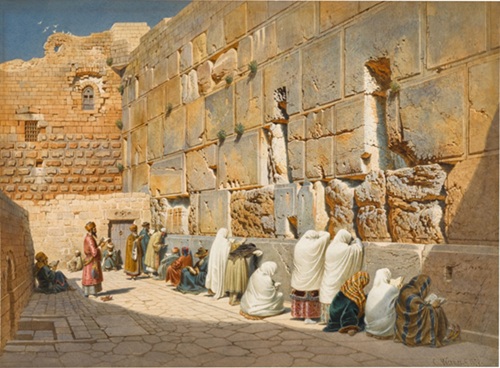
Carl Werner, Western Wall, 1879
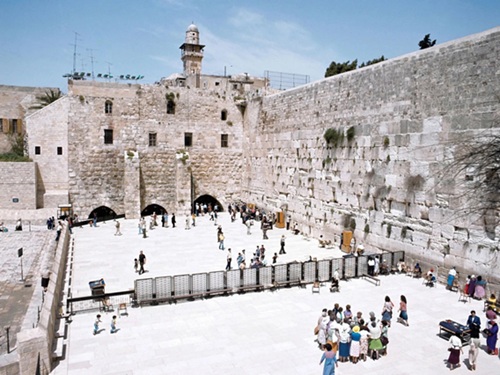
Western Wall today
Disputes over archaeology.Archaeological explorations of the Mount and its surroundings began in earnest in the post 67 period. The Jordanian Waqf and Muslim groups resisted any exploration under the Mount, often falsely claiming that archaeological works undermined the foundations of the Dome and the Qibli mosque. The real concern was that such explorations might provide definitive proof of Jewish claims to the site. The Tunnel RiotsIn 1867 a British Officer, Charles Warren uncovered passages running under the Temple Mount. Fearing damage to the Mount itself, the Ottoman authorities closed the entrance made by Warren. The entrance was reopened in 1967 by the Israeli Minister of Religions. In 1982 the Rabbi of the Western Wall, Yehuda Getz, unblocked another passage that ran directly under the Dome of the Rock. Getz believed it could lead to the discovery of the Ark of the Covenant. A clash between Jewish students and Arab workers in the tunnel lead to the passage being resealed. In 1990 the Western Wall tunnel (which runs under the Western Wall) was opened to tourists, but the cramped conditions led to demands for a second entrance to be created. Whilst there was disagreement between former prime ministers Yitzhak Rabin and Shimon Peres and the Mayor of Jerusalem Ehud Olmert, work on the second entrance began in Via Dolorasa Street. Grand Mufti Ekrima Sa'id Sabri alerted the PA. Within hours hundreds of Palestinian protestors arrived at the scene. The riots continued for four days and spread throughout the West Bank and Gaza. The violence caused the death of 59 Palestinians and 16 Israelis. Despite demands by the US and the UN that Israel close the tunnel it remains open. It is worth reiterating that this tunnel does not run under the Temple Mount and therefore does not violate its sanctity.
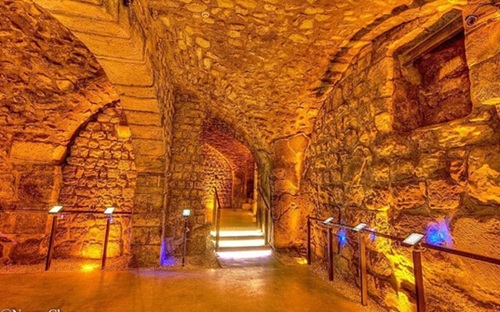
The Western Wall tunnel
Solomon's StablesIn 1996 the Waqf acquired a permit to convert the area known as Solomon's Stables into an alternative area for prayer in case of wet weather, especially during the crowded periods of Ramadan. It was revealed later that the Waqf had actually planned a mosque to accommodate 10,000 worshippers. Work began in late 96 using heavy machinery without a municipal permit or supervision by archaeologists. Despite protests from the worldwide archaeological community about the destruction of valuable archaeological material, the work continued. The area is now called the Al-Marawni mosque. Archaeologists mounted a salvage operation on the site waste called the Temple Mount Sifting Project. It uncovered remnants and damaged artefacts covering every period of Jerusalem's history dating back to the Neolithic. Around 40% of the material covered the period of Herod and the Second Temple. Unsurprisingly the Waqf appointed archaeologist reported that they found nothing of interest after they had examined the material. To this day the Waqf and PA continue to resist archaeological explorations of the Temple Mount. Yasser Arafat and Temple denialism.A 1925 guide book distributed by the Supreme Muslim Council headed by Amin al-Husseini (before he was appointed Grand Mufti) states: “The site is one of the oldest in the world. Its sanctity dates from the earliest (perhaps from pre-historic) times. Its identity with the site of Solomon's Temple is beyond dispute.” (2) As mentioned above, Mohammed and subsequent Muslim scholars knew full well that Al-Aqsa was the site of the First and Second Temples. That is why they appropriated it - to assert Islam's superiority. Yet at the Camp David Accords in 2000, Yasser Arafat famously declared that the Temple was not located on the Temple Mount but in Yemen, citing the work of discredited historian Kamal Salibi (professor emeritus at the American University of Beirut) who argued that many of the events in the Bible took place in South Arabia. The Camp David Accords failed. The reasons for the failure are disputed along partisan lines. However there seems to be general agreement that the issue that caused Arafat to physically walk out was control of the Temple Mount. Hassan Asfour, a member of the Palestinian negotiating team confirmed this, quoting Arafat: "For peace I could give you the right to build a temple in Nablus but not in Jerusalem since the Jews have been present in Yemen and not in Jerusalem”. (3) Denialism has been used by the Palestinian cause as part of a deliberate disinformation campaign designed to delegitimise Jewish claims to the land. Arafat and the PLO borrowed socialist polemic that Zionism was a colonial project conceived by 'Western' imperialists. This is in denial of the abundant archaeological and cultural evidence, including the Koran, that Judaism is indigenous. This denialism still exists today. As recently as 2023, Mahmoud Abbas, who has repeatedly denied the existence of the Temple, addressed the UN, falsely stating that 'They dug under Al-Aqsa… they dug everywhere and they could not find anything'. The Al-Aqsa intifada
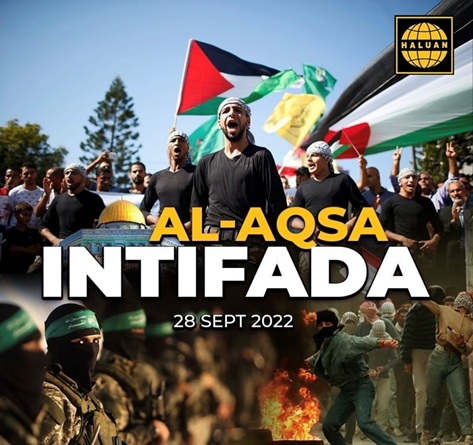 The reasons for the Second Intifada are complex and certainly tied to the failure of the Oslo process, however, Muslims also refer to it as the Al-Aqsa Intifada. In September 28th, 2000, opposition leader Ariel Sharon protested the policy of discrimination against Jews visiting the Temple Mount by holding a press conference on its grounds. There can be no doubt that this was an intentionally provocative act, but it was also perfectly legal under the Status Quo Agreement. Of course, opinions differ according to partisan bias, but it is clear that Sharon did not attempt to enter either the Dome of the Rock or the Qibli mosque, or to offer any prayers. Despite its legality Muslim protestors immediately took violent offence by throwing whatever came to hand at the delegation and shouting, 'we will redeem the Haram with blood and fire'. Israeli police responded with tear gas and rubber bullets. If Sharon's visit to the Mount ignited a fire, the actions and statements of Palestinian leaders poured fuel onto it. Arafat claimed that Sharon's visit was 'an attack against Islamic sacred places'. The then head of the Waqf, Abu Qteish, used the loud speaker system to call on the faithful to defend the Mount. The day after riots broke out around the Mount, with Muslim protestors hurling stones down onto Jews praying at the Western Wall in scenes reminiscent of the Buraq Uprising of 1929. At the end of the day 7 Palestinians had died and 300 wounded, with 70 Israeli police also wounded. The rest is history. The violence spread throughout Israel, the West Bank and Gaza. By the end of the conflict in 2005 there had been an estimated 3,300 Palestinians and 770 Israelis killed. The Universal Declaration of Human RightsIn 1948 the UN passed the Universal Declaration of Human Rights. Article 18 states: “Everyone has the right to freedom of thought, conscience and religion; this right includes freedom to change his religion or belief, and freedom, either alone or in community with others and in public or private, to manifest his religion or belief in teaching, practice, worship and observance.” In 1981 the UN expanded Article 18 with the Declaration of the Elimination of All Forms of Intolerance and of Discrimination Based on Religion or Belief. Article 2 states:
The restrictions on non-Muslims accessing the Temple Mount are in direct contravention of these declarations. As I said above, Islam is the only religion to exclude non-Muslims from entering their most holy sites. In the case of Mecca it is an entire city, in the case of Medina it is a district and in Jerusalem, an entire compound. In contrast Muslims are permitted to enter the holy cities and compounds of every other religion. For example, there are around 400 mosques in Israel, with 73 located in Jerusalem. Rome, the centre of the Christian West, is home to the largest mosque in Europe and even the Vatican has set aside a dedicated prayer room for visiting Muslim scholars at the Vatican Apostolic Library.
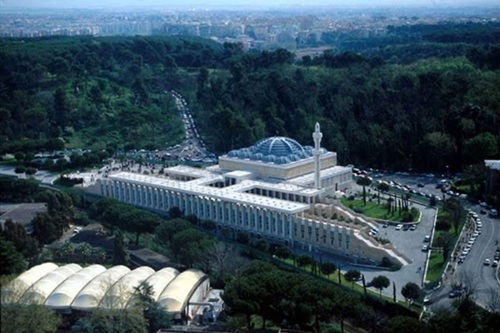
The Great Mosque of Rome
This tolerance and generosity is not reciprocated. The core issue.The core issue is supremacism. Mohammed believed he was the final and greatest of the Abrahamic prophets. To reinforce this megalomaniacal delusion he imagined he flew to the Temple Mount on a magical donkey and ascended to the highest heaven, surpassing previous prophets. When the Jews of Arabia rejected his claims he attacked them. He won and to further assert his claim his followers exiled the remaining Jews of Arabia and seized control of Jerusalem in full knowledge of the religious significance of the city and the Temple Mount. It was a statement of revenge and domination. It is still a symbol of domination. To surrender control of the Temple Mount would be to admit that Islam is not superior - an idea many Muslims are clearly prepared to die to defend. A fact declared in the name of the militant group, the Al-Aqsa Martyrs Brigade. Islam was supposed to have defeated and subdued the Jews and Christians. The fact that Christians actually dared to retake Jerusalem during the Crusades is still shocking to many Muslims who still consider it an insult to the divine order. And if the Crusades were a shock, then the return of the Jews has been an even greater shock. If everything is Allah's will, then the return of the Jews must also be Allah's will. This idea directly challenges Mohammed's claims to have defeated and replaced the Jews. This cannot be allowed to happen. Religious myths are not coherent. They contain multiple contradictions and inconsistencies and believers reinterpret and modify them to suit. Islamist groups such as Hamas believe they are acting on Allah's behalf in preventing the Jews from building the Third Temple. Article 15 of their constitution makes this clear: “It is necessary to instil in the minds of the Moslem generations that the Palestinian problem is a religious problem, and should be dealt with on this basis. Palestine contains Islamic holy sites. In it there is al-Aqsa Mosque which is bound to the great Mosque in Mecca in an inseparable bond as long as heaven and earth speak of Isra` (Mohammed's midnight journey to the seven heavens) and Mi'raj (Mohammed's ascension to the seven heavens from Jerusalem).” Final thoughtsI have often heard secular Westerners protest that the Jewish claim that they have a right to live in Israel because they are the chosen people is invalid because it is religious superstition. Yet they rarely recognise that Muslims make a similar claim - that they have replaced Jews as the chosen people. In my previous article 'Strange Bedfellows' I quoted the founder of the Australian Students for Palestine, Omar Hassan: “For most people, the alternative to the perpetual apartheid and oppression entailed by the two-state solution is the creation of a democratic state for all inhabitants of the area. Far from “driving Jews into the sea”, the idea is for Arabs and Jews to live together peacefully, with equal rights in a liberal democratic set-up.” (4) This is extraordinarily naive. If Arabs and Jews are to live together peacefully with 'equal' rights then Muslims must surrender control of the Temple Mount to a civil authority that would allow unrestricted access to people of all faiths, including entry into the Dome of the Rock. Such an authority might also permit the building of a synagogue on the Mount whilst preserving the Dome as a world heritage building. It would also permit non-invasive archaeological explorations. It is clear that Islam has no intention of doing so and that it will violently resist any such attempt. NOTES
The advent of AI, especially Google AI, makes it easier to verify and source any of the material contained in this article.
Widget is loading comments...
|