|
Search through thousands of pages on Integral Theory
TRANSLATE THIS ARTICLE
Integral World: Exploring Theories of Everything
An independent forum for a critical discussion of the integral philosophy of Ken Wilber
More essays by Ray Harris
 Ray Harris is a frequent contributor to this website. He has written articles on 9/11, boomeritis, the Iraq war and Third Way politics. Since 2007 he took to writing his novels Navaratri, Wild Child and Eden. Harris lives in Ballarat, Victoria, Australia.
Strange bedfellows:
After Bondi
Reflections on the Israel Palestine conflict, Part 1
Ray Harris
Ray Harris argues that the Israel-Palestine conflict has created unlikely alliances between Western progressives and authoritarian Palestinian movements. Blending history, political analysis, and Integral Theory, he contends that trauma fuels ideological regression on both sides while questioning whether Western activists misunderstand the nature of Palestinian politics. (ChatGPT)
Introduction.
Australia is not known for gun violence. After Australia's worst mass shooting at Port Arthur in 1996, a range of laws restricting gun ownership were immediately introduced. There were a total of 58 victims at Port Arthur, with 35 dead and 23 wounded. The shootings were indiscriminate, the motive was mental illness and personal grievance.
Despite the gun law reform Australia experienced another mass shooting at Bondi on December 14th, 2025. This time there were a total of 56 victims, just two less than Port Arthur, 15 dead and 41 wounded. The shootings were targeted, the motive was ISIS inspired ideological hatred of Jews.
As was expected, the various authorities initiated a range of reviews and inquiries and Australia is currently in the middle of a Royal Commission on Antisemitism and Social Cohesion. Australia has also appointed a special envoy to investigate Islamophobia. Both the Jewish and Muslim communities have reported a sharp increase in hate crimes: from online abuse to individual verbal and physical assaults, to attacks on religious schools, synagogues and mosques.
There is general agreement that the root cause of this communal tension is the escalation of the Israel Palestine conflict after Operation al-Aqsa Flood on October 7th, 2023 and the ongoing Israeli attacks targeting Hamas, Hezbollah and Iran.
Australia is not alone in experiencing a significant rise in communal violence caused by the ongoing I/P conflict, it is widespread, at least in the West.
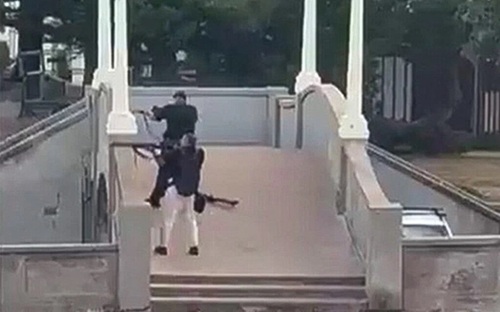
The Bondi shooters
Who is behind the violence?
The pattern is much the same around the world, with some variations due to local culture and demographics. Generally speaking attacks on Jews are perpetrated by far-right nativists and Muslim extremists. Attacks on Muslims are almost exclusively at the hands of far-right nativists. For example, the Christchurch mosque massacre on March 15th, 2019 in which 51 were killed and 89 injured. The perpetrator was an Australian inspired by white supremacist conspiracies regarding the Great Replacement. Far-right nativists are just as likely to attack Jews as they are to attack Muslims, both being seen as racial outsiders. An example of a white supremacist attack on Jews was the Pittsburg Tree of Life synagogue massacre in October 2017 in which 11 died and 6 were wounded.
But have you noticed what is missing? There are almost no accounts of Jewish extremists attacking anyone outside the parameters of the I/P conflict. Certainly not in Australia. There have been ten Islamist inspired terrorist attacks in Australia and multiple thwarted plots, but not a single account of Jews involved in terrorist plots of any kind. This pattern is repeated in Europe; multiple attacks by far-right nativist and Muslim extremists but none by Jewish extremists.
There is an exception. The United States.
Demographics.
The US is the only country outside Israel in which Jews outnumber Muslims. Whilst there are around 7.5 million Jews in the US, there are only 4.5 million Muslims. The balance is reversed in every other country. In the UK 6.5% are Muslim and only 0.5% are Jews, in France 10% are Muslim and 0.9% are Jews, in Canada it is 5% compared to 1%, and in Australia 3.5% compared to 0.5%.
Kahanism and the Jewish Defence League.
Rabbi Meir Kahane was born in New York in 1932. His paternal grandfather settled in Safed in Ottoman Palestine in 1873 after fleeing the Polish pogroms. His father was born in Safed, his mother was born in Russia. They met in New York after they had both fled political violence. His mother; the Russian revolution, and his father; attacks by Arabs, which killed an uncle in Safed in 1929.
Inspired by the Revisionist Zionism of Ze'ev Jabotinsky, Kahane formed the Jewish Defence League in 1968 at the height of the civil rights movement and the establishment of militant groups such as the Black Panthers and the American Indian Movement. Its primary aim was to protect Jews from antisemitic attacks, but it transitioned to small scale attacks against Soviet interests in protest at the Soviet treatment of Jews. There were also attacks and threats against neo-Nazis and Palestinian organisations. It was declared a domestic terrorist organisation by the FBI in 2001.
The JDL has been linked to only one death, the assassination of Palestinian activist Alex Odeh in 1985. Over the same time period Muslim extremists have been responsible for over 3,150 deaths (including 9/11) in the US, with far-right nativists responsible for the overwhelming majority of incidents and around 390 deaths.
Kahane moved to Israel in 1971 where he formed the far-right party, Kach. Kach, and a splinter group, Kahane Chai, were banned from participating in Israeli elections and declared a terrorist organisation after a supporter, Baruch Goldstein, opened fire at the Ibrahim Mosque in Hebron in 1994, killing 29 and wounding 125. Kahane was assassinated in New York in 1990 by an Arab-American, El Sayyid Nosair, who has been linked to Al-Qaeda.
I've skipped over much of the detail, whilst certainly fascinating it's a digression from the main point. Whilst Jewish militant organisations such as the JDL certainly exist, they have primarily been active in the USA, Israel and to a lesser extent France and Canada. In contrast far-right nativist extremists are found in nearly every country and Muslim extremists in any country that has a Muslim population, even if small.
Jews are attacked wherever they are. In 1994 a suicide bomber drove a van into the Jewish cultural centre in Buenos Aires killing 85 and wounding over 300. A subsequent investigation blamed Hezbollah. In 2008 in India, Islamists attacked a local Chabad outreach centre in Mumbai, killing 6.
Strange bedfellows
Two days after the October 7th massacre in Israel, a group of around 1000 Palestinian supporters met at the Opera House to protest against Israel and the Sydney Council's decision to illuminate the sails of the Opera House with the colours of the Israeli flag as a mark of respect. Anti-Israeli and antisemitic slogans were shouted, Palestinian flags flown and a banner read 'Israel is a Terrorist State'. There was no sympathy for the 1,195 killed and the 4,800 wounded, which included the deaths of 71 foreign nationals and 36 children. The attacks were minimised and justified as legitimate resistance.
This protest took place 18 days before Israel responded by attacking Gaza.
The protest was organised by two Australian born Palestinians, Fahad Ali and Amal Naser. This was the beginning of a series of pro-Palestinian protests held around the country (and throughout the Western world). In Sydney the protests were organised by the Palestinian Action Group headed by long time socialist activist Josh Lees, with Amal Naser a key organiser. Unfortunately these demonstrations also attracted Muslim extremists who displayed the black Shahada flag associated with ISIS.
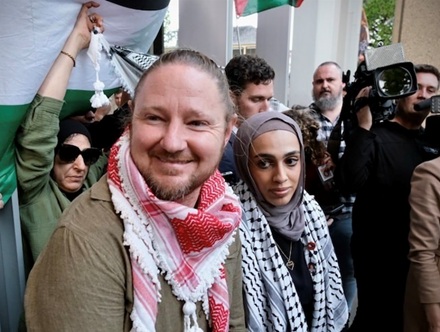
Josh Lees with Amal Naser
But why is Josh Lees heading the PAG? He's not Palestinian, he's not a Muslim, he's a white Australian socialist.
Here's how he describes his activism:
“This is why I have been an activist and a socialist for most of my adult life. The media keep printing these lists of all the social justice campaigns I've been involved in, as though it's, like you said, some “gotcha” against me. But I'm proud of this history. Socialists understand that all the ills of this world are interconnected: we can't just be single issue activists or we'll never get to the root of the problem, which is capitalism.”
“So yes, I have campaigned for refugee rights, for marriage equality, against the mega-rich, against the sacrifice of our health and lives to the altar of profits during the COVID pandemic, against runaway climate change, for workers' rights and more. This does not negate mine or anyone's activism in the Palestine solidarity movement. Strong movements enhance and can build on one another.” (1)
Misunderstanding Palestinian politics
Josh Lees is a member of an Australian Trotskyist faction called Socialist Alternative (not to be confused with another faction, Socialist Alliance). Another member is Melbourne based Lebanese Australian, Omar Hassan, who founded Students for Palestine. The standard Trotskyist tactic is to infiltrate/appropriate a cause in order to persuade people to join the larger revolutionary cause. Hassan has written a number of articles on the Palestinian issue for socialist outlets. In Red Flag he states:
“For most people, the alternative to the perpetual apartheid and oppression entailed by the two-state solution is the creation of a democratic state for all inhabitants of the area. Far from “driving Jews into the sea”, the idea is for Arabs and Jews to live together peacefully, with equal rights in a liberal democratic set-up. In many ways this is a worthy goal, and when it was developed in the 1960s, it was a progressive position for the Palestinian liberation movement to adopt. But many of the same issues that make the two-state solution unworkable also apply to one state. Most importantly, the Israeli state will not accept equality between Jews and Palestinians. Its founding ideology is that of an ethno-state: a state that exists for a particular ethnic group, with others as second-class citizens.” (2)
A worthy goal indeed, the glaring flaw in this statement is that the majority of Palestinians have never accepted a state in which Jews and religious minorities have equal rights, let alone one based on liberal democracy, or for that matter, peace. They want, just like their Zionists counterparts, an ethno-state that privileges their ethnic group, specifically Sunni Muslims, in which Jews and non-Muslims accept their fate as a second-class minority.
Palestinian politics has always leant towards far-right nativism, first as Arab nationalism, then as Palestinian nationalism.
Arab society was (and still is to some extent) feudal with a clear distinction between an educated ruling elite and a worker/peasant class, the effendiya and fellahin, with politics the exclusive domain of the effendiya. This tradition came under challenge from two modernising forces. The first was a series of Ottoman reforms called the Tanzimat (reorganisation). The second was Jewish immigration, which introduced European political concepts (especially socialism, as we shall see), as well as new agricultural and industrial methods.
The political leadership of Palestine was distributed amongst a few effendiya families (most notably the al-Husseini, al-Nashashibi and al-Khalidi, etc.). There was no fellahin representation. Whilst there were disagreements and factions amongst the effendiya (especially the al-Husseini and al-Nashashibi), they nonetheless came to an agreement to form the Arab Higher Committee, appointing Hajj Amin al-Husseini, Grand Mufti of Jerusalem, as its leader.
Husseini was a Nazi collaborator who repeated Nazi antisemitic tropes and sought their help to solve Palestine's Jewish problem.
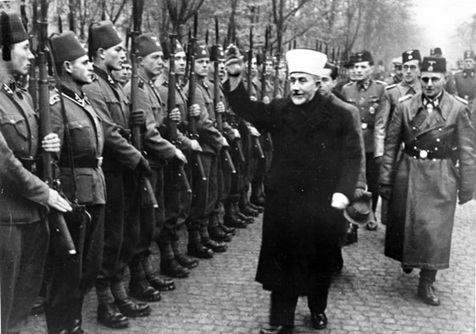
Husseini saluting the Bosnian Muslim division of the Waffen SS in 1943
In a clear example of the enemy of my enemy is my friend, the Ottomans allied with Germany in WW1, whilst the Arabs allied with Britain and France. Dissatisfied with the British and French mandates after WW1, many Arabs again turned to Germany. The irony is that whilst the socialist left often points to British and French imperialism in the ME, they selectively ignore German imperialist ambitions. Germany coveted ME oil reserves just as much as other Western powers. As a consequence, events in Germany had a significant influence on the Ba'athist, Pan-Arab and Islamist movements, with each showing a preference for authoritarian rule over democracy. One of the founders of the Ba'athist movement, Sami al-Jundi directly admitted the connection: “We were racists, admiring Nazism, reading its books and the sources of its thought.”
The fact is, the majority of conflict in the ME is due, not to Western imperialism, but to internal power struggles between four authoritarian movements: the traditional Arab ruling elites allied with the US, the Ba'athists allied with Russia, and Sunni and Shia Islamists. In September 1970 the al-Hashemi of Jordan violently repressed the PLO in an action known as Black September. In 1980 Ba'athist Iraq invaded Iran in order to prevent the Iranian revolution spreading to Iraq's Shia population. In February 1982 the Assad regime attacked the Muslim Brotherhood in Hama, massacring an estimated 40,000 civilians. In Iraq in 1988, Hussein notoriously purged the Kurdish population. Known as the al-Anfal (spoils of war) campaign, it lead to the death or disappearance of around 70,000-100,000. In 1990 Hussein invaded Kuwait and deposed the ruling family, the al-Sabah. The US responded to protect its Arab allies. The Second Gulf war eventually ousted the Ba'athist regime but unleashed the previously repressed Kurdish, Shia and Sunni Islamist forces, leading to decades of deadly internal conflict. The Arab Spring protests of 2011 in Syria were met by severe repression, which in turn unleashed a decades long civil war. Backed by Russia and Iran, the Assad regime battled competing opposition forces, including several Sunni Islamist groups, most notably ISIS. The Assad regime was eventually overthrown by Islamist forces who now govern the country. It is estimated that the war resulted in around 650,000 deaths, with half of them civilian.
The list of atrocities perpetrated by these movements is long, the violations against humanitarian law common: torture, arbitrary imprisonment, summary executions; forget the Geneva conventions.
Today Palestinian politics is split between Islamist groups such as Hamas and Islamic Jihad and a conservative, corrupt and paternalistic Palestinian National Authority. Hamas controls Gaza and the PNA struggles to control the West Bank. Neither show any sign of adopting the progressive causes championed by their progressive allies in the West.
The Western left has fallen for an illusion created by Yasser Arafat and the Palestinian Liberation Organisation. Namely that the Palestinian cause is part of a network of liberation movements that will realise the dream of a socialist, progressive politics. The only thing stopping it, as Lees and Hassan incorrectly believe, is capitalism, which in their brand of socialism is synonymous with Western imperialism, or more specifically, the US/Israel alliance.
But as history has shown, many of these liberation movements devolved into either terrorist organisations or authoritarian states that killed thousands and liberated no-one.
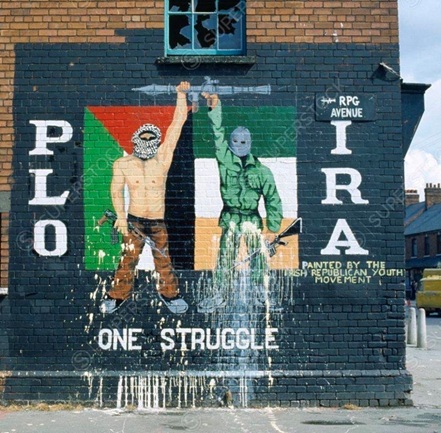
Mural in Belfast
Palestinian communism.
Whilst Palestinian (and Arab) politics is dominated by far-right movements, there are Palestinian communists: the Popular Front for the Liberation of Palestine (PFLP), the Democratic Front for the Liberation of Palestine (DFLP) and the Palestinian People's Party (PPP), all of whom form small minority factions within the Fatah dominated PNA. The Democratic Front split from the Popular Front over the issue of a single state vs a two state solution. Both rejected the Oslo accords, which the PPP supported.
The irony is that these organisations were inspired by Jewish settlers, especially Ashkenazi from the second Aliyah. As is typical of socialist organisations, there have been multiple factional splits and several name changes. A Palestinian branch of the Socialist Workers Party (also called the Jewish Communist Party, MOPSIM) was established in 1919.
At that time the main issue dividing the various communist movements was internationalism. The Comintern, the central authority, had followed Lenin's demand that all communist parties reject any form of nationalism, declaring:
“Any attempt to build Communist organisations on ethnic lines contradicts the principle of proletarian internationalism”. (3)
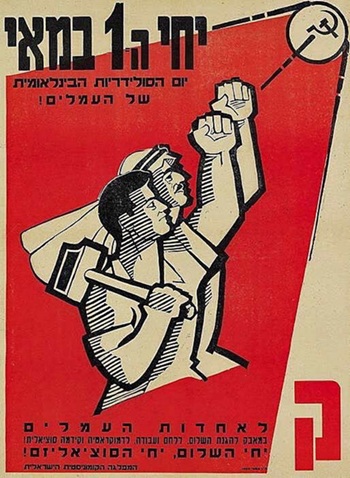
Arab and Jewish workers unite!
The expectation was that Jewish communists would ally with the Arab fellahin to overthrow the ruling effendiya class. However differences over support for Zionism caused a split. The pro-Zionist faction called themselves the Palestinian Communist Party and the anti-Zionist faction, the Communist Party of Palestine. These factions reunited in 1923 as the Palestine Communist Party, accepting the Comintern's directive to support the Arab proletariat. In 1934 a Palestinian Arab Christian, Radwan Al Hilu, was appointed secretary general. In 1943 internal tensions caused a split between Arab and Jewish members, with Arabs forming the National Liberation League, which in time evolved into the PPP, with Jews creating the Israeli Communist Party (MAKI). Confused? Welcome to the factional games of the left.
Needless to say that the Arab elites objected to any attempt to unionise and organise. Indeed, part of their objection to Jewish immigration was the introduction of socialist principles and worker's rights. The leader of the Arab Higher Committee, al-Husseini, accepted the Nazi characterisation of Jews as part of a worldwide communist conspiracy.
This is where we arrive at an obvious contradiction. The socialist left rejects Zionism for being a nationalist movement, or in modern parlance, an ethno-religious project, yet it supports the nationalist aspirations of the Palestinians. The PLO expressly rejected internationalism whilst borrowing the language of internationalist liberation movements, some of which are also ethno-religious movements. What is the IRA, which formed an alliance with the PLO, if not an ethno-religious movement - nativist Irish Catholics opposing English Protestant colonisers? The PLO also formed alliances with the FMLN in El Salvador, the FSLN (Sandinistas) in Nicaragua, the ANC in South Africa, the Japanese Red Army, the Red Army Faction in Germany, as well as establishing formal relations with North Vietnam. The common enemy? US imperialism.
The indigenous solution - Islamism
A further contradiction is that whilst the Jewish and Arab communists claimed they were rejecting Western imperialism, they nonetheless embraced another form of Western imperialism, Marxism. Article 22 of the Hamas Charter recognises this and states:
“The imperialistic forces in the Capitalist West and Communist East, support the enemy with all their might, in money and in men. These forces take turns in doing that. The day Islam appears, the forces of infidelity would unite to challenge it, for the infidels are of one nation.” (4)
The idea that the infidels, capitalist and communist, are of one nation is common to the many Islamist movements throughout the Muslim world. This was the hard lesson learned by the communists who supported the Iranian Revolution of 79. No sooner had the revolution overthrown the US backed Shah, than the clerics turned on the communists in a series of violent purges. And in Afghanistan the Taliban first defeated the Russians and then the US. Both Iran and Afghanistan are today deeply conservative theocracies.
Palestine has two major Islamist parties, Hamas and Palestinian Islamic Jihad, as well as several smaller factions, including ISIS and al-Qaeda affiliates.
As is known Hamas won an election in Gaza and formed a government. Polls taken in September 2024 suggest that it has strong support in the West Bank.
“When asked which political party or movement they support, the largest percentage (36%) said they prefer Hamas, followed by Fatah (21%), 6% selected third parties, and 29% said they do not support any of them or do not know. Three months ago, 40% said they support Hamas and 20% said they support Fatah. Support for Hamas today stands at 37% in the West Bank (compared to 41% three months ago) and for Fatah at 18% (compared to 17% three months ago). In the Gaza Strip, support for Hamas stands at 35% (compared to 38% three months ago) and support for Fatah at 26% (compared to 24% three months ago).” (5)
There is a chance that Hamas could gain control of the West Bank - which is why the PNA have suspended elections..
The day after
The chant is: 'free, free, free Palestine, from the river to the sea, Palestine shall be free'. Suppose that goal is realised. What does that actually look like?
In 2005 Israel unilaterally withdrew from Gaza and handed control to the PNA. What followed was a civil war between Hamas and the PNA. The causes behind the civil war are complex and contested along partisan lines. What we do know is that it resulted in around 600 deaths (including around 120 civilians), with human rights organisations claiming that war crimes had been committed by both sides. Much has been said about Israeli war crimes in the current conflict, especially the targeting of hospitals, but as a Human Rights Watch report states, neither Hamas nor Fatah respected the neutrality of hospitals.
“In addition, Fatah and Hamas forces engaged in battles in and around two Gaza Strip hospitals on Monday. After Hamas fighters killed Fatah intelligence officer Yasir Bakar, Fatah gunmen began firing mortars and rocket-propelled grenades at Shifa Hospital in Gaza City, drawing Hamas fire from inside the building, killing one Hamas and one Fatah fighter. At a hospital in Beit Hanun, three family members with ties to Fatah, `Id al-Masri and his sons, Farij and Ibrahim, were killed, and others wounded. Hospital officials reported that the three were being treated for injuries sustained earlier. One was reportedly shot at close range.” (6)
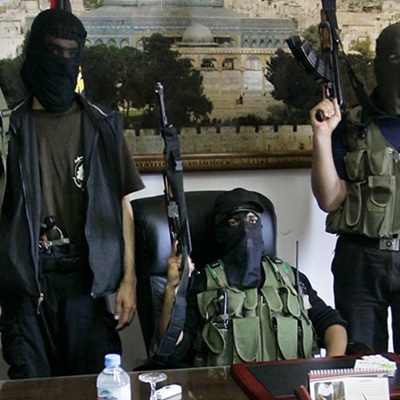
Hamas fighters in the offices of the PNA in Gaza
Since taking control Hamas has ruled Gaza with an iron fist. No elections have been held and it has tortured and arbitrarily executed political opponents. Yahya Sinwar, the alleged mastermind behind Operation al-Aqsa Flood, was called the Butcher of Khan Younis because of his treatment of political opponents.
Hamas created a formal army of around 30,000 fighters organised into 5 regional brigades and 24 battalions. It built substantial tunnel systems throughout Gaza which it used to hide and move combatants and smuggle in weapons and material used to assemble missiles. It indiscriminately fired around 20,000 of those missiles into Israel. Whilst many misfired or were shot down, around 50 people were killed, including foreign nationals, local Bedouin and 14 children. Only 5 victims were active members of the IDF and considered legitimate targets under international law.
Like all authoritarian systems Hamas created a corrupt ruling elite that had access to considerable wealth whilst suppressing and exploiting the ordinary citizen. Far from creating economic equality, it created a new cast of effendi and fellahin. In his statement above Josh Lees says that he is 'against the mega-rich'. Is he aware that the Hamas leadership now lives outside Gaza in luxury accomodation in Qatar and Turkey, with the three primary leaders: Khaled Meshal, Ismail Haniyeh and Moussa Abu Marzook alleged to be worth a combined 11 billion with a broad portfolio of shares and real estate, their children benefitting from these spoils just as the children of ruling elites have always done? Doesn't this make them capitalists? Even Yahya Sinwar is reported to have been worth between one to five million. And how did they accumulate this wealth? By taxing the population, siphoning aid, and from support from friendly regimes like Iran. Reports from Gaza suggest that Hamas has tightened its grip on the Palestinian zone and is again controlling aid and demanding taxes. A kleptocratic elite has reappeared.
The Palestinian centre.
Fatah is supposed to be a secular, social democratic party, albeit one that has struggled to hold regular elections or to pursue the progressive agenda typical of other social democratic parties, especially in regard to human rights and social justice. This is due in part, to the fact that Palestinians are religiously conservative. Over time Fatah has moved towards the religious right.
Palestinian politics is notable for a rapid churn in new parties and coalitions, most of which fail to gain any seats. Very few are either democratic or progressive in the Western sense.
A good example is the Third Way party founded in 2005 by Palestinian Christian Hanan Ashrawi and the economist, former minister of finance (2002-2005) and Prime Minister (2007-2013), Salam Fayyad,. Both are respected, high profile Palestinians. It ran on a platform of liberal democracy and free market reform. It only received 2.4% of the vote, giving it only two seats in the legislative council. This failure saw it withdraw from the electoral process.
Election results tell the story. There is no effective left wing or centrist alternative in Palestine. It is a contest between the Hamas and Fatah.
The decline of the Israeli left
I've already touched on some of this, but I'll make it explicit. Just as the Palestinian left has seen a decline in support, so has the Israeli left. The early Zionist movement had strong socialist leanings, especially in the kibbutz and labour movements. The first prime minister, David Ben Gurion, was the leader of MAPAI, a democratic socialist party. But as the conflict has continued, Israelis have shifted further to the right, favouring the Revisionist and Religious Zionist parties. The ghost of Kahane lives on in the smaller far-right parties that are in coalition with Netanyahu's Likud. The coalition deal places Itimar Ben-Gvir, leader of the Kahanist Jewish Power (Otzmar Yehudit) party in charge of national security and Bezalel Smotrich, leader of the Religious Zionist Party (Tkuma) as minister for defence.
Both are far-right nativists who support the violent suppression of Palestinian aspirations and the expansion of settlements in the West Bank.
Here I want to note that there is little to distinguish Religious Zionism from Islamism. Both want to establish conservative political systems based on religious law, both want to establish supremacist ethno-religious states and both advocate the use of genocidal violence to achieve their goals. Neither believe they can live together and that only one can triumph.
The difference between Palestine and Israel is that the left still has a significant presence and it still holds elections. The power of the left can be seen in the many street demonstrations protesting the current government's policies on judicial reform and the war in Gaza. The Israeli left often sends observers to the West Bank to monitor right wing settler violence. One of the tragedies of Oct 7th was the massacre of the residents of kibbutz Nir Oz and Be'eri. Both were founded by leftist Zionist organisations and were known to be progressive (and anti-Netanyahu), with a number of members active in the peace movement. One of the peace activists killed was Vivian Silver. In 1999, Silver founded the Arab-Jewish Center for Equality, Empowerment and Cooperation with Bedouin feminist and peace activist, Amal Elsana Alh'jooj. Silver worked on several social justice projects with Gazans. Her charred remains were identified using DNA five weeks after October 7th.
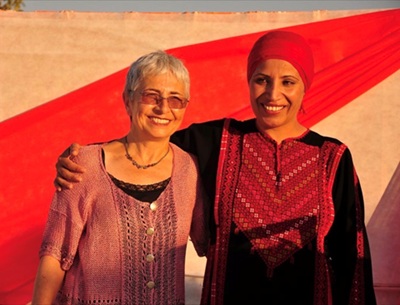
Vivian Silver and Amal Elsana Alh'jooj
There is a ray of hope. Israel is due for elections in October '26 and Likud and its far-right coalition partners seem likely to face defeat, moving Israel politics back to the centre.
Unfortunately there seems to be no such shift in Palestinian politics, rather a further shift to the far-right under Hamas.
Armed resistance, armed persistence
Many in the pro-Palestinian movement justify Hamas's actions by claiming the right to armed resistance. At the same time they cite Israel's many contraventions of international law whilst sidestepping Palestinian contraventions. There seems to be some confusion over what international law says on the matter.
International humanitarian law is clear that any right to resist is constrained by other laws and conventions. In essence the principles of necessity, proportionality and distinguishing between civilians and combatants. The taking of hostages is prohibited in all cases.
This assumes of course, that all sides accept and abide by international law. Islamists and communist revolutionaries do not. Jihadists reject international law as a Western, infidel construct and instead turn to the rules of war as defined by the Salafist or Jihadist interpretation of Sharia. Marxist-Leninists reject it as an instrument of capitalist hegemony and claim a right to use violence in the revolutionary struggle.
Needless to say that appealing to international law whilst selectively ignoring it is blatant hypocrisy. You have heard the expression 'one person's terrorist is another person's freedom fighter' used to excuse attacks against civilians: the suicide bombing of a popular cafe, opening fire on patrons at a nightclub, using a vehicle to mow down pedestrians or hijacking a plane and flying it into a building.
In any case, there is no law or convention that I am aware of that argues that any given side cannot resist the resistance. People who are being shot at will shoot back. They don't stop shooting because people outside the conflict protest that they are morally or legally in the wrong. The legality of any action can only decided by the appropriate court after the fact, specifically the International Court of Justice (ICJ), and the International Criminal Court (ICC). Hamas does not recognise the jurisdiction of either, whereas Israel recognises the ICJ, but not the ICC.
Unfortunately we live at a time when state and non-state actors ignore international law at will, so we are reduced to the realist principle of might makes right.
So the Palestinians appeal to international law for protection whilst ignoring it when it suits them and appealing to a supposed unrestrained right to resistance. At the same time Zionists claim that it is they who are the victim of Arab/Palestinian aggression and that they have the right to resist.
Stalemate.
Regression in Integral Theory.
Most members of the Integral community are idealists and optimists who imagine a future of developmental progress. Depending on the developmental model, the assumption is that people and societies are evolving along a spectrum to a more advanced level.
Regression - devolution - is also part of the process. This is true in any model, but I'll confine my remarks by using just two: Maslow's hierarchy of needs and Spiral Dynamics.
A change in life conditions will cause a shift in values. Certain life conditions encourage developmental progress. Equally, some life conditions not only frustrate developmental progress, some destroy it.
The single most destructive force is violence. As soon as anyone is either physically or verbally threatened the body produces the stress hormones, cortisol and adrenalin, the subconscious flight or fight response. If you are under immanent threat of physical harm you must act immediately by either fleeing or physically repelling the attack. If you are not trained in any form of self-defence or do not have the right weapons you risk injury or death. You cannot take the time to think about it.
We also know that long term exposure to cortisol and adrenaline has a deleterious effect on the body as well as the mind. This is called post traumatic stress disorder (PTSD). People who suffer PTSD loose the ability to regulate their emotions and are often highly reactive. When their PTSD is triggered they can resort to violence and cause harm to others. Traumatised individuals can traumatise others. This is well understood in inter-generational family trauma.
When violence is organised and used to achieve a political or economic goal, the result is both individual and group trauma. If the violence includes the destruction of property and permanent disability through injury, the individual or group loses the ability to meet their basic needs. Cities and towns destroyed through bombardment or invasion are plunged into destitution where their basic physiological needs, Maslow's basic level, cannot be met. Driven by desperation people's behaviour and values change. In SD terms they devolve to Beige, Purple and Red.
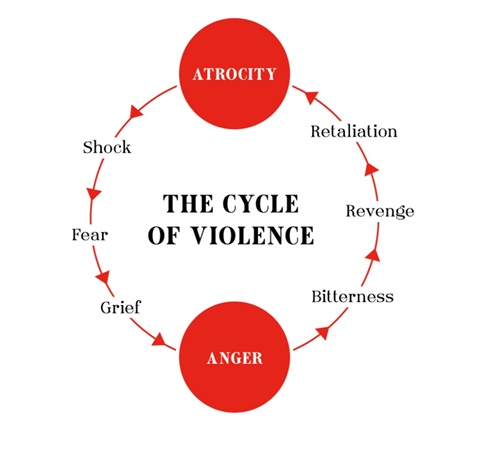
Identity and trauma based narratives
Identity is a narrative we construct to define our place in a group. We tell ourselves that we are part of a family, a locality, a peer group, an ethnic group, a religion, a nation, a class, and so on. In many cases, this narrative incorporates experiences and stories of trauma, of persecution - of being a victim. These can exist at every level of our identity narrative. An individual may have experienced personal, family, local, peer group, ethnic group, etc trauma. I simply do not have the space to deal with each one, rather I want to focus on how trauma impacts nationalist or ethno-religious narratives.
As individuals and cultures evolve along the developmental spectrum they become less attached to fixed identity narratives. Identity becomes flexible and temporary. In contrast, identity is fundamental at the lower stages. It becomes fixed and must be defended against change and challenge. Nativists feel threatened by pluralist, multicultural societies.
Unless a group exists in isolation they have likely faced a threat to their existence through conflict with other groups. Some densely populated regions have seen constant conflict spanning thousands of years. The Middle East is considered to be the birthplace of the first city-states, with Uruk in Iraq dating back to around 3500 BCE. Since then multiple civilisations have risen and fallen, been absorbed or altered, with languages, customs and mythologies completely lost through brutal wars and invasions. Generation after generation had to find way to cope with these traumatic events. These coping mechanisms form part of the group narrative and personal identity. Myths and rituals around persecution, trials and quests, conquering heroes and eventual domination and redemption are created. Most modern states celebrate conflict and wars through parades and remembrance days, monuments and statues.
The Abrahamic mythos is a case in point. The righteous are persecuted by evil doers but will eventually triumph or be rescued by the Maschiach (messiah), the second coming of Christ or the reappearance of the Mahdi. This will occur after a period of violent purges known as Armageddon (Malhama al-Kubra in Islam). Those who are indoctrinated in these myths literally believe they have a divine duty to bring these events about. In the case of the I/P conflict this applies to zealots on both sides.
These mythologies normalise the cycle of violence. Revenge and retribution are demanded, violence becomes a virtue and death is rewarded in a glorious afterlife. And whilst such fanaticism is found in all three Abrahamic faiths, it is has reached its most extreme form in the doctrine of Istishhad (martyrdom) in jihadist Islam. So extreme that children are indoctrinated to aspire to become martyrs and effectively offered as sacrifices to the holy cause. Yahya Sinwar stated that he thought the death of 100,000 civilians would be an acceptable sacrifice. Excluding combatant deaths the civilian death toll is estimated to be around 50-60,000.
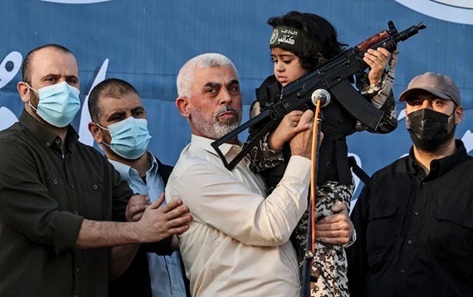
Yahya Sinwar with sacrificial child
Breaking out of the cycle
If this was easy it would have happened by now. Christians might argue that Jesus provided a way, 'forgive your enemy', but they quickly turned that message into one of persecution and redemption through magical resurrection, then engaged in centuries of traumatising conflict over doctrinal purity. The early Church had its own cult of martyrdom.
Whilst each of the Abrahamic traditions developed a philosophy of pacifism to varying degrees, the rejection of violence finds its fullest expression in the Eastern religions, particularly with the concept of ahimsa. We know that Alexander's conquest took him to India where he encountered Buddhism, so it is entirely possible that the concept of non-harm made its way into the larger Hellenic world of the Seleucid and Ptolemaic empires, where it may have informed Jesus's teachings.
Pacifism was reinforced in the 20th century, most notably through the social activism of Gandhi, Martin Luther King and Nelson Mandela. A theory and practice of non-violent conflict resolution was developed. A prime example was South Africa's truth and reconciliation process.
However, for this process to succeed both sides need to submit to it and abide by its rulings. It cannot work if either side is unwilling to participate.
Palestinian rejectionism
There is an assumption in pro-Palestinian circles that the British did not consult with the Arab leadership over the future of Palestine and that the British favoured the Zionists.
This is simply not true.
The historical record shows that the British were divided over the issue, with pro-Arab and pro-Zionist factions in the Foreign Office. The fact is that the British were unable to satisfy either side with Zionists accusing them of being pro-Arab, especially after the White Paper of '39 rejected a two-state solution and restricted Jewish immigration.
The tactic of the Palestinian leadership to reject compromise is also a matter of record. Under the leadership of al-Husseini, the AHC refused to participate in the Peel Commission in '37, the London Conference in '39 and the UN partition plan in '47.
The pattern of refusing to compromise, of all or nothing, has been a consistent feature and is repeated in article 13 of the Hamas Constitution:
There is no solution for the Palestinian question except through Jihad. Initiatives, proposals and international conferences are all a waste of time and vain endeavors. The Palestinian people know better than to consent to having their future, rights and fate toyed with.” (7)
After years of refusing to compromise and pursuing the path of violence, Yasser Arafat moderated his position and agreed to participate in the Oslo Accords. Palestinian opposition to the accords resulted in Arafat refusing to finalise the process at the Camp David Summit in 2000. This was followed by a period of violence known as the Second Intifada.
In 2017 Hamas released a revised constitution which accepted a two-state solution (without formally recognising the state of Israel). Again there was internal dissent with the attack of Oct 7th marking a return to the policy of jihad.
The lesson of Iran
“Eventually, sometime after the collapse of the Pahlavi state and in the course of the Left's struggle for its rightful place in the political arena of the new Republic, it became clear that two strategic mistakes had been committed: namely, neglect of the question of democracy, and underestimation of the power of the Islamic clergy.” (8)
In a few short years after the CIA supported coup that removed the Mossadegh government, the Shah faced increasing opposition from the Iranian left: the Tudeh Party supported by the Soviets and militant groups such as Fada'i Khalq, the Mujahideen e Khalq (MEK) and smaller Maoist factions. Like his Arab royalist allies he instigated a policy of brutal repression using the notorious secret police unit, SAVAK. These tactics only served to build resentment. The left and the clerics under Khomeini formed an alliance, which culminated in the Iranian revolution of '79.
The revolution was celebrated by Western leftists who saw it as a blow against US Imperialism. That celebration was short lived. In 1981 the clerical regime instigated a cultural revolution designed to eliminate political and religious rivals. These purges culminated in the mass execution of political prisoners in 1988.
It is estimated that the Shah's repression resulted in around 4,000 deaths. Khomeini's purges resulted in an estimated 7,000, with some suggesting it is much higher. Subsequent waves of repression have added to that figure with the death toll of the most recent protests estimated to be in the thousands. The Iranian Revolutionary Guards have proven to be far more brutal than SAVAK.
In their obsession with Western imperialism, especially US imperialism, the various socialist factions continue to make the mistake of allying with far more repressive, far-right political ideologies. In this case the enemy of their enemy is not their friend. A Hamas controlled Palestinian state would turn on the left.
NOTES
- Red Flag Staff, "Palestine solidarity, socialist activism and the fight for a better world: an interview with Josh Lees", Redflag, February 15, 2026.
- Omar Hassan, "Two-state solution is rubbish, what will it take to liberate Palestine?", Redflag, September 07, 2025.
- Philip Marfleet, "National liberation and the left in Palestine", International Socialism, 5th April 2026
- "Hamas Covenant 1988, The Covenant of the Islamic Resistance Movement", The Avalon Project, 8 August 1988.
- "Press Release: Public Opinion Poll No (93)", Polls and Survey Research (PCPSR), 3-7 September 2024.
- "Gaza: Armed Palestinian Groups Commit Grave Crimes", Human Rights Watch, June 12, 2007.
- "Hamas Covenant 1988, The Covenant of the Islamic Resistance Movement", The Avalon Project, 8 August 1988.
- Val Moghadam, "Socialism or Anti-Imperialism? The Left and Revolution in Iran", New Left Review, December 1987.
|