|
TRANSLATE THIS ARTICLE
Integral World: Exploring Theories of Everything
An independent forum for a critical discussion of the integral philosophy of Ken Wilber
 Dr. Joseph Dillard is a psychotherapist with over forty year's clinical experience treating individual, couple, and family issues. Dr. Dillard also has extensive experience with pain management and meditation training. The creator of Integral Deep Listening (IDL), Dr. Dillard is the author of over ten books on IDL, dreaming, nightmares, and meditation. He lives in Berlin, Germany. See: integraldeeplistening.com and his YouTube channel. He can be contacted at: joseph.dillard@gmail.com Dr. Joseph Dillard is a psychotherapist with over forty year's clinical experience treating individual, couple, and family issues. Dr. Dillard also has extensive experience with pain management and meditation training. The creator of Integral Deep Listening (IDL), Dr. Dillard is the author of over ten books on IDL, dreaming, nightmares, and meditation. He lives in Berlin, Germany. See: integraldeeplistening.com and his YouTube channel. He can be contacted at: joseph.dillard@gmail.com
Check out my other conversations with ChatGPT A Response to Frank Visser's Critique of Adaptive Reorganization TheoryJoseph Dillard / ChatGPT
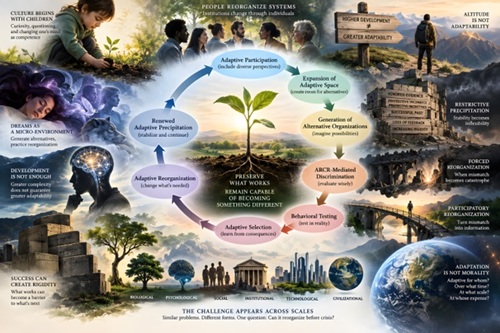 Frank Visser's critique of my essay, “Adaptive Reorganization Theory as a Corrective to Integral Developmentalism,” raises exactly the questions that a theory of adaptive reorganization ought to welcome. If Adaptive Reorganization Theory cannot reorganize in response to criticism, then it fails one of its own most basic tests. Visser accepts an important part of my argument: developmental altitude should not be confused with adaptive capacity. Highly developed individuals can become rigid. Sophisticated institutions can become incapable of correction. Elaborate scientific paradigms can defend themselves against anomalous evidence. Technologically advanced civilizations can become increasingly effective at preserving conditions that threaten their own stability. Greater complexity, consciousness, sophistication, differentiation, or development therefore does not necessarily imply greater adaptability. Where Visser presses harder is on what follows. If developmental altitude is not the master variable, why should adaptive reorganizability replace it? More importantly, does invoking adaptive reorganization actually explain anything? Or have I merely replaced Wilber's Eros with a more naturalistic-sounding black box? That is the most important challenge in his critique. If “adaptive reorganization” merely means that adaptive systems survive because they reorganize adaptively, then Visser is correct: the explanation is circular. ART becomes meaningful only if reorganizability can be decomposed into more specific conditions, mechanisms, and testable consequences. The theory is therefore not complete when it says that systems must reorganize. Its real task is to explain how successful organization can remain stable enough to preserve what has been learned while remaining capable of reorganizing when the conditions that made that organization successful change. That is the problem ART is increasingly attempting to specify. The Evolutionary QuestionART did not begin with the claim that adaptive reorganizability is the ultimate value of the universe, nor did it develop as a critique of Wilber's AQAL. It began with a simpler and more troubling observation: successful adaptation does not guarantee continued adaptation. Indeed, success can create the conditions that make subsequent adaptation more difficult. Human beings have become extraordinarily successful at modifying their environments. We inhabit nearly every terrestrial ecological niche, construct complex cultures, develop scientific knowledge, transform ecosystems, build global institutions, and generate technologies at a pace unmatched by any previous species, yet nothing in evolutionary history guarantees that intelligence, consciousness, technological sophistication, spiritual realization, moral development, or cultural complexity will exempt humanity from extinction. These capacities may greatly improve survival, but they can also become parts of increasingly successful organizations that are difficult to revise. The question that generated ART was therefore not, “Where is evolution going?” It was almost the opposite: “Why should we assume that we are exempt from where evolution has taken most forms of life?” Extinction is not an anomaly in evolutionary history. It is overwhelmingly common. Yet extinction is not inevitable simply because it is common. Some lineages persist through enormous environmental changes, and adaptability clearly matters. This raises a more interesting question than whether an organism is well adapted at a particular moment: What allows already successful organization to remain capable of reorganizing when the conditions that made it successful change? The difficulty is that adaptation itself can contribute to the problem. Successful organisms become fitted to ecological niches. Successful behaviors become habits. Successful psychological strategies become identities. Successful organizations develop procedures, competencies, bureaucracies, and incentive structures. Successful societies develop laws, institutions, traditions, ideologies, and economic arrangements. Successful civilizations accumulate increasingly elaborate structures for preserving and reproducing what has worked. None of this is inherently pathological. Preservation is indispensable. A system that could not retain successful organization would continually have to rediscover what it had already learned. The problem arises when the mechanisms that preserve successful adaptation begin reducing the system's capacity to reorganize when circumstances change. What once supported adaptation can then become an obstacle to further adaptation. Evolutionary biology already distinguishes among several relevant concepts. Evolution refers broadly to inheritable change through time. Adaptation refers to traits or changes shaped by selection in relation to environmental conditions. Adaptability refers to the capacity to respond effectively when those conditions change. ART adds a narrower question: How capable is an established organization of altering itself when its current adaptations constrain further adaptation? That is what I mean by adaptive reorganizability. Reorganization is not necessarily adaptive. Cancer reorganizes cellular relationships. Trauma can reorganize psychological functioning. Ecological invasion reorganizes ecosystems. Revolution reorganizes political institutions. Mutation reorganizes genetic information. Financial crises reorganize economies. Change alone does not imply improvement. For ART, adaptive reorganization therefore requires something more than change. It requires that alternative organizations be generated, discriminated, tested against consequences, and selected in ways that support continuing functioning under changing conditions. ART calls the stabilization of successful organization adaptive precipitation. It calls the stabilization of organization that increasingly excludes the information, participation, variation, or experimentation necessary for renewed adaptation restrictive precipitation. The distinction matters because adaptation is not synonymous with wisdom, health, or long-term viability. Addictions can be highly effective adaptations to immediate psychological circumstances. A bureaucracy can adapt extremely well to internal incentives while becoming less responsive to the environment it was created to serve. A corporation can adapt to quarterly financial pressures while damaging the ecological or social conditions on which its future depends. Adaptation concerns fit. Adaptive reorganizability concerns the ability to revise that fit. This distinction becomes especially important in humans because our capacity to generate new conditions may be outpacing our capacity to reorganize around their consequences. We can understand accurately why a behavior is destructive and continue it. We can invent technologies faster than institutions can accommodate them. We can discover environmental consequences without generating incentives sufficient to address them. Organizations can identify their structural failures and still reproduce them. Civilizations can accumulate extraordinary technical capacities while remaining organized around incentives inherited from very different circumstances. The problem, then, is not simply insufficient intelligence, creativity, information, development, or innovation. A system can possess all of these and still fail to reorganize. Generating alternatives is not enough. Increasing participation is not enough. Decentering is not enough. Innovation is not enough. Sublimation is not enough. The bottleneck may lie increasingly in discrimination, selection, and reorganization. Why the Personal Scale Remains CriticalAny theory proposing that human institutions require greater adaptive reorganizability eventually encounters a practical problem: institutions do not reorganize in the abstract. They reorganize through people. Those people possess identities, loyalties, careers, fears, habits, economic interests, reputations, status positions, ideological commitments, expectations, and relationships. They live inside incentive environments that reward some forms of participation and punish others. Consequently, recognizing the need for reorganization is radically different from actually reorganizing. This is one reason I have become increasingly skeptical of approaches that assume insight naturally produces transformation. Individuals often know what they need to change and still do not change. Organizations commission reports identifying serious problems and then neutralize the recommendations. Governments accumulate evidence while maintaining policies that generated the problem. Scientific communities can recognize anomalies for years before reorganizing dominant assumptions. Legal decisions in which the evidence is clear can still be subverted. The difficulty is not necessarily ignorance; existing organization is supported by incentives. This is where the psychological origins of ART become important. The problem I encountered in dreams and Integral Deep Listening turned out to resemble the problem encountered in organizations and civilizations: generating alternatives is often easier than reorganizing established structures around them. Human innovation may therefore be outpacing human reorganizability. We already live in environments of extraordinary cognitive abundance. We have more information, interpretations, options, models, strategies, technologies, and proposed solutions than any previous civilization. The challenge is increasingly not the absence of alternatives but our ability to select among them and reorganize around what proves useful. Artificial intelligence may widen that gap dramatically. AI can generate alternative designs, explanations, strategies, technologies, and conceptual frameworks at extraordinary speed. It does not automatically improve the criteria by which we choose among them, nor does it ensure that individuals or institutions can reorganize around their consequences. If adaptive reorganization is a genuine bottleneck, then ART cannot remain merely an academic theory. Better explanations will not be enough. A theory that applies elegantly to civilizations but provides no practical benefit to a frightened child, a conflicted family, a therapist and client, a struggling employee, or someone confronting a recurring nightmare is unlikely to generate the cultural practices required to influence civilization. Reorganizability must be learned. Children therefore need environments in which changing one's mind in response to better information is experienced as competence rather than humiliation. Curiosity, questioning, and correction need to be rewarded rather than treated as threats to authority. Families need ways to protect autonomy without sacrificing reciprocity. Schools need to reward correction as well as correctness. Organizations need incentives for revealing failure rather than concealing it. Scientific communities need structures that can distinguish necessary disciplinary stability from defensive protection of established paradigms. Governments need institutions capable of incorporating contradictory information without either suppressing dissent or becoming incapable of decision. Adaptive reorganization would therefore have to become cultural. That cannot happen quickly. Existing structures are not merely intellectual. They are biological, psychological, familial, economic, institutional, cultural, and political. They accumulated because they often worked. Their staying power should not be underestimated. Children can potentially learn reorganizability more effectively than adults whose identities and incentives have already become deeply precipitated. A culture capable of greater adaptive reorganization would therefore likely emerge across generations, not through a single intellectual conversion. This is why the personal level remains indispensable. ART grew upward from questions encountered in psychology toward broader evolutionary hypotheses. If those hypotheses are useful, they must eventually travel downward again and become practicable in ordinary life. That is where Integral Deep Listening remains important. IDL provides one possible micro-environment for practicing what larger systems may also require: temporarily loosening established organization, allowing alternative centers of information to participate, accurately understanding what they communicate, discriminating among their proposals, testing those proposals behaviorally, learning from the consequences, and incorporating what works without granting any perspective—including ART or IDL itself—permanent authority. This is not mysterious. We can easily identify cases in which individuals, families, organizations, and societies create conditions that support or suppress adaptive reorganization. The difficult problem is usually not imagining alternatives. It is changing incentive structures that experience those alternatives as threatening. Reorganizability Is Not Its Own ExplanationVisser asks the obvious questions. Why does one organization reorganize successfully while another fails? How does a system detect relevant feedback? How does it distinguish signal from noise? What allows feedback to be incorporated rather than rejected? What prevents endless reorganization from destroying accumulated functionality? These questions expose an important clarification: reorganizability is not itself a causal mechanism. It is a capacity that requires explanation. ART increasingly decomposes that capacity into a sequence of distinguishable functions:
Adaptive Participation → Expansion of Adaptive Space → Generation of Alternative Organizations → ARCR-Mediated Discrimination → Behavioral Testing → Adaptive Selection → Adaptive Reorganization → Renewed Adaptive Precipitation
Each stage identifies a different problem. A system must first receive information that its existing organization may exclude. It must possess enough adaptive space for alternatives to become available. It must generate possible organizations rather than merely criticize what already exists. It must discriminate among alternatives rather than assuming novelty is beneficial. It must test possibilities against consequences. It must select among them. Finally, successful reorganization must become stable enough to function. The last step is easy to overlook. Reorganization is not the opposite of organization. Adaptability does not require permanent instability. Precipitation preserves what adaptation has learned. Reorganization revises what adaptation has learned. Adaptive systems require both. The problem arises when stabilization increasingly prevents access to the information, perspectives, experiments, or alternatives required for renewed adaptation. That is what ART calls restrictive precipitation. The important question therefore is not, “Can this system change?” Almost every system eventually changes. Species disappear. Governments fall. Organizations collapse. Identities fragment. Technologies become obsolete. Ecosystems shift into new configurations. The more interesting question is whether a system can participate in its own reorganization before accumulated mismatch forces reorganization upon it. From Forced Reorganization to Participatory ReorganizationThis distinction points toward one of ART's deeper propositions: reorganization is inevitable over sufficiently long periods; adaptive reorganization is not. A corporation that ignores technological change will eventually be reorganized by markets. A political system incapable of incorporating legitimate grievances may eventually be reorganized through revolt, defeat, fragmentation, or collapse. An individual who repeatedly ignores contradictory psychological information may eventually encounter a crisis that reorganizes priorities involuntarily. An ecosystem unable to absorb accumulating disturbances may cross a threshold into another configuration. Reality can reorganize systems that cannot reorganize themselves. ART is especially interested in whether systems can convert forced reorganization into more participatory forms of reorganization: whether mismatch can become information before it becomes catastrophe. That requires something more demanding than mere openness. The established center must sometimes temporarily surrender its monopoly over the definition of the problem, the relevant evidence, the legitimate participants, and the possible solutions. Psychological Geocentrism as a Starting ProblemI have used the term psychological geocentrism to describe the ordinary tendency of an established identity or organizational center to experience its own perspective as the natural center of the relevant world. This does not mean centers are pathological. Systems require centers. Individuals require sufficiently continuous identities. Governments require decision structures. Organizations require procedures. Scientific disciplines require paradigms. Organisms require regulatory organization. The problem is not that systems have centers; the problem arises when a center loses the ability to recognize information that requires it to reorganize itself. Decentering therefore cannot be an end state. Permanent decentering would merely replace rigidity with disorganization. A more complete adaptive sequence is:
center → decenter → expand → discriminate → test → recenter
Functional non-dualism, polycentrism, generative sublimation, ARCR, and behavioral testing describe different functions within this process rather than independent philosophical doctrines. Functional non-dualism temporarily loosens the assumption that a problem must be solved by choosing one already established pole over another. Polycentrism allows multiple centers of perspective and information to participate without prematurely reducing them to a single authoritative viewpoint. Generative sublimation increases the availability of alternative organizations. ARCR assists discrimination among the relationships among those alternatives. Behavioral testing subjects proposals to consequences rather than granting them authority because of their source. The goal is therefore neither centralization nor decentralization. The deeper issue is recenterability: can a system construct a new center after encountering information that its previous center could not adequately contain? What Does ARCR Add?Visser is especially justified in asking how ART distinguishes useful reorganization from destructive reorganization. Variation is not enough. Cancer produces variation. Psychosis can radically reorganize experience. Revolutions reorganize political institutions. Financial crises reorganize economies. Artificial intelligence generates enormous numbers of alternative informational configurations. Social media expands participation while often degrading collective discrimination. More participation is therefore not necessarily adaptive. Neither are greater diversity, creativity, novelty, decentralization, complexity, or disruption. ART consequently requires criteria for selection. One current hypothesis concerns a configuration I call ARCR: autonomy, reciprocity, confirmation, and reliability. Autonomy preserves differentiated centers rather than prematurely assimilating them. Reciprocity requires participating centers to take account of effects on one another rather than externalizing costs. Confirmation requires sufficiently accurate understanding of information before it is accepted, rejected, or acted upon. Reliability extends successful relationships and agreements through time so that coordination and testing become possible.
These are hypotheses about conditions that may improve the quality of adaptive discrimination and selection. They are not proposed as cosmic virtues, moral absolutes, or substitutes for ethics. A novel perspective is not adaptive simply because it is novel. A dream image is not wise because it appears in a dream. A dissident is not correct merely because an institution rejects him. A majority is not correct because it is a majority. Artificial intelligence is not correct because it can produce an impressive synthesis. An Integral theorist is not correct because a claim is associated with a supposedly higher developmental altitude. Alternatives must be discriminated and tested. ARCR is proposed as selection infrastructure, not ethical revelation. Whether it improves adaptive outcomes is an empirical question. The Difference Between Eros and ReorganizabilityVisser worries that ART may replace Wilber's Eros with another black box. The warning is valuable, but the distinction is important. If adaptive reorganizability becomes an invisible force that explains every successful transformation retrospectively, then the criticism succeeds. ART would simply say, “The system survived because it reorganized adaptively,” and whatever survived would count as evidence for the theory. That would explain very little. The alternative is to decompose reorganizability into potentially observable variables. How quickly does a system detect mismatch? How readily can contradictory information enter it? How many plausible alternative configurations can it generate? How accurately can competing perspectives represent one another? How easily can small, reversible experiments be conducted? How rapidly are failed assumptions corrected? Are failures concealed or incorporated? Can incentive structures themselves be modified? Does successful organization become increasingly insulated from correction? Those questions generate empirical predictions. ART predicts, for example, that systems capable of generating novelty but incapable of correcting their selection criteria will not necessarily become more adaptive. It predicts that successful systems may begin losing reorganizability before conventional performance measures decline. It predicts that suppression of corrective information may precede visible systemic failure. It predicts that environments protecting differentiated participation while maintaining mechanisms of discrimination and testing may, under some classes of changing conditions, outperform environments that maximize either centralized control or unconstrained variation. These predictions may turn out to be wrong, and that is precisely the point. ART differs from a metaphysical explanatory principle to the extent that its claims can be operationalized, compared, and rejected. AQAL Is Not Merely a Static MapVisser also corrects an overstatement in my earlier contrast between AQAL and ART. I have sometimes characterized AQAL as primarily an architecture and ART as primarily a theory of process. That distinction is too simple. Integral Theory clearly contains theories of process. Differentiation, integration, transcend-and-include, transformation, translation, tetra-meshing, stages, states, and evolutionary emergence all describe forms of change. The more accurate distinction is that AQAL tends to interpret process through a developmental and, at times, explicitly teleological framework, whereas ART attempts to understand adaptive change without assuming a universal developmental direction. ART does not deny development. Children develop. Organisms develop. Cognitive capacities develop. Cultures accumulate knowledge. Technologies become more sophisticated. Institutions differentiate. The question is whether development should occupy the privileged explanatory position. A more developed system can be less reorganizable than a simpler one. A highly differentiated bureaucracy may respond more poorly to novel conditions than a smaller organization. A sophisticated worldview may become more effective at rationalizing its assumptions. Greater intelligence can improve both error correction and self-deception. Development and reorganizability are therefore different dimensions. Neither can simply be inferred from the other. ART and Evolutionary BiologyVisser's most consequential scientific challenge may be his insistence that ART engage much more seriously with evolutionary biology. Evolutionary biology already contains extensive work on plasticity, robustness, evolvability, developmental constraint, niche construction, drift, self-organization, modularity, selection, and major evolutionary transitions. ART does not simply redescribe these ideas in new vocabulary and declare a new theory. ART proposes that a recurring higher-order problem may appear across adaptive systems: successful organization must become stable enough to preserve functionality while remaining sufficiently reorganizable to respond when the conditions that selected that organization change. Whether this pattern genuinely extends across biological, psychological, organizational, scientific, technological, and civilizational domains remains to be demonstrated. Cross-domain analogy is not evidence of cross-domain mechanism. That distinction matters especially because artificial intelligence makes elegant analogy extremely easy. A conceptual sequence can appear coherent across immune systems, corporations, dreams, governments, and artificial intelligence without demonstrating that the same causal mechanisms operate in each. ART should therefore distinguish three levels of claim. At the weakest level, adaptive reorganization is a heuristic that helps us notice similar problems across domains. At a stronger level, ART proposes functional similarities among otherwise different systems. At its strongest and most scientifically interesting level, ART identifies mechanisms sufficiently general to justify genuinely cross-domain predictions. Adaptation Is Not MoralityVisser raises an even deeper objection: what if an adaptive system is terrible? ART does not claim that “more adaptive” means “better.” A dictatorship can adapt. A pathogen can adapt. A corporation can adapt brilliantly to consumer demand while producing destructive externalities. Cancer cells can adapt successfully at the expense of the organism that sustains them. Adaptation therefore cannot serve as a moral criterion. An ART analysis must always ask questions that adaptation alone cannot answer: “Adaptive for whom?” “Adaptive relative to what environment?” "Adaptive over what period?” “At what organizational scale?” “At whose expense?”"What consequences are excluded from the system's definition of success?” Cancer can be adaptive at the level of a cellular lineage while catastrophic at the level of the organism. A corporation can adapt successfully to quarterly financial incentives while degrading the ecological conditions on which its future markets depend. A government can increase short-term stability by suppressing information while simultaneously reducing its capacity to detect accumulating mismatch. This is one reason reciprocity matters within ART. It does not solve morality. It does, however, force attention toward relationships among centers and toward costs that one center may be exporting to another. These questions do not provide predetermined answers. They improve the informational conditions under which answers are selected. Is ART Becoming Another Master Theory?Visser's warning here deserves serious attention. Integral Theory places development near the center of its explanatory system. ART could simply repeat the move and place adaptation there instead. It doesn't do that. ART does not need to claim that everything is “really” adaptive reorganization. Love, art, contemplation, play, spirituality, scientific curiosity, and creativity do not have to be reduced to adaptive function. Dreams do not have to have evolved for adaptive reorganization. Where systems confront changing conditions while attempting to preserve some existing organization, adaptive reorganization may provide a useful explanatory framework. Dreaming illustrates the distinction well. Dreams generate alternative configurations of memory, affect, identity, agency, prediction, and relationship. That does not mean dreams are automatically adaptive. Recurrent nightmares may repeatedly generate organizations that fail to resolve waking mismatch. Lucidity may increase awareness and agency without producing useful behavioral change. Dream interpretation may produce insight without reorganization. The interesting question is not whether dreaming is inherently adaptive. It is whether particular forms of dreaming and dream inquiry increase subsequent adaptive capacity under specified conditions. The same standard should apply everywhere else ART is invoked. IDL as a Micro-Environment for Testing ARTVisser asks where the proposed mechanisms can actually be investigated. One answer is Integral Deep Listening. IDL is not proof of ART. It is better understood as a deliberately structured micro-environment in which several ART hypotheses can be operationalized. It is also the methodology from which many of the questions that later generated ART originally emerged. The process begins with life issues that identify perceived mismatch. Epoché temporarily loosens the authority of established interpretations. Identification with alternative perspectives establishes differentiated centers. Interviewing creates reciprocal information exchange. Repeated checking of assumptions supports confirmation. Recommendations generate alternative organizations. Those recommendations are not accepted because they came from a dream, an intuition, an “inner voice,” or an interviewed perspective. They are discriminated. SMARTER (Specific, Measurable, Attainable, Relevant, Evaluated, Rewarding) implementation turns recommendations into behavioral experiments. Accountability and repetition introduce reliability. Consequences are observed. Successful changes may then become incorporated into waking organization.
The sequence can therefore be represented as:
precipitated waking organizationr → mismatch → decentering → alternative participation → generative sublimation → ARCR-mediated discrimination → behavioral testing → adaptive selection → reorganization → renewed precipitation
If IDL does not produce measurable improvements under conditions in which ART predicts that it should, that is evidence ART must confront. If simpler interventions work equally well or better, ART must confront that too. If ARCR fails to predict adaptive outcomes, it should be modified or abandoned. A methodology for adaptive reorganization cannot be used to protect a theory of adaptive reorganization. The Problem of AI-Assisted Theory BuildingVisser also comments perceptively on the use of ChatGPT in developing these arguments. Artificial intelligence can generate conceptual coherence faster than evidence can justify it. That is a genuine danger. AI is extremely good at identifying patterns, constructing conceptual symmetries, drawing analogies, and producing persuasive formulations. Concepts can therefore acquire the appearance of theoretical maturity before their empirical foundations deserve it. A beautiful conceptual architecture is not evidence. The proper response is not to reject AI-assisted theorizing but to distinguish hypothesis generation from confirmation. AI can be useful for generating counterarguments, identifying hidden assumptions, constructing competing explanations, locating inconsistencies, suggesting operational definitions, and asking what observations would falsify a claim. It can function as a perspective partner, but neither elegance nor agreement between a human theorist and an AI constitutes confirmation. Reality retains veto power. Ideas should be judged by their usefulness, explanatory power, predictive performance, and empirical support, not by whether their source is human or artificial. If ART had been generated entirely without AI, that would not validate it. If AI had contributed substantially to its development, that would not invalidate it. The source of an idea does not determine whether it survives testing. What Would Count as Evidence Against ART?A theory of adaptive reorganization requires clear conditions under which it would have to change. If developmental altitude consistently predicts adaptive correction better than reorganizability does, ART would require major revision. If systems with poor access to discrepant information adapt as effectively under changing conditions as systems with strong access to it, one of ART's central assumptions would be weakened. If suppression of dissent reliably improves long-term adaptation across changing environments, ART's emphasis on expanded participation would require revision. If behavioral testing adds little to the quality of adaptive selection, ART has exaggerated its role. If autonomy, reciprocity, confirmation, and reliability fail to predict successful reorganization, or if other variables explain the same outcomes substantially better, ARCR should lose its privileged status. If greater reorganizability consistently reduces a system's ability to respond effectively to changing conditions, then ART has misunderstood its central variable. And if ART becomes increasingly elaborate in explaining away such failures, that would itself constitute restrictive precipitation within ART. This last possibility matters most. A theory of adaptive reorganization cannot make itself exempt from adaptive reorganization. The Question Is Not Whether ART Replaces WilberVisser concludes that I have not replaced Wilber's developmental theory but have identified a dimension developmentalism needs to take seriously. That is closer to my own position than the language of replacement suggests. ART did not develop as a response to Integral Theory. It is not in competition with AQAL or with developmental theory in general. It treats theoretical systems, metaphysical claims, dream figures, intuitions, scientific models, and spiritual perspectives as possible sources of information and emerging potentials. Their recommendations may be useful in some contexts and not in others. ART is primarily interested in what happens when those recommendations are tested. It does not need to determine the metaphysical legitimacy of a perspective before examining what follows from acting on it. In that sense, ART would not decide in advance whether advice attributed to Jesus Christ, Lucifer, a dream figure, an artificial intelligence, a therapist, or an Integral theorist deserves more authority because of its source. It asks instead: What happens when the recommendation is implemented? If the recommendation fails, ART need not conclude that the source is universally untrustworthy. It concludes only that this recommendation, under these conditions, did not support adaptive reorganization. ART therefore does not need to become a new master framework. It does not need to prove that development is unimportant, stages are unreal, consciousness is irrelevant, spirituality is reducible, or Integral Theory has nothing useful to contribute. Its challenge is more modest and, in another sense, more demanding. It asks whether systems can preserve what has worked without becoming trapped by what has worked. It asks whether children, adults, organizations, scientific communities, and societies can learn to recognize mismatch before mismatch becomes crisis. It asks whether information that challenges existing assumptions can reach the centers capable of acting on it. It asks whether alternative organizations can emerge without immediately being assimilated or suppressed, whether those alternatives can be discriminated without destroying the diversity that generated them, whether they can be tested against consequences, and whether successful innovations can become stable without becoming immune to later correction. The deepest contrast may therefore not be between lower and higher, first tier and second tier, traditional and modern, conventional and post-conventional, or fragmented and Integral. It may be between different relationships to correction. Can a system learn that its current organization no longer works before reality imposes the lesson more violently? Can it participate in its own reorganization before accumulated mismatch forces reorganization through crisis? That is not a claim about where evolution is going. It is not a claim that the universe prefers complexity, consciousness, spirituality, integration, or adaptive reorganization. It is a hypothesis about what happens to organized systems when what previously worked no longer does. Whether that hypothesis survives criticism is not something ART should decide in advance. The criticism is part of the experiment.
For additional information on ART, see AdaptiveReorganizationTheory.Com; for information on IDL, see IntegralDeepListening.Com. Widget is loading comments...
|