|
TRANSLATE THIS ARTICLE
Integral World: Exploring Theories of Everything
An independent forum for a critical discussion of the integral philosophy of Ken Wilber
 Dr. Joseph Dillard is a psychotherapist with over forty year's clinical experience treating individual, couple, and family issues. Dr. Dillard also has extensive experience with pain management and meditation training. The creator of Integral Deep Listening (IDL), Dr. Dillard is the author of over ten books on IDL, dreaming, nightmares, and meditation. He lives in Berlin, Germany. See: integraldeeplistening.com and his YouTube channel. He can be contacted at: joseph.dillard@gmail.com Dr. Joseph Dillard is a psychotherapist with over forty year's clinical experience treating individual, couple, and family issues. Dr. Dillard also has extensive experience with pain management and meditation training. The creator of Integral Deep Listening (IDL), Dr. Dillard is the author of over ten books on IDL, dreaming, nightmares, and meditation. He lives in Berlin, Germany. See: integraldeeplistening.com and his YouTube channel. He can be contacted at: joseph.dillard@gmail.com
SEE MORE ESSAYS WRITTEN BY JOSEPH DILLARD
Check out my other conversations with ChatGPT When Perspectives Do Not ReorganizeAn Evolutionary Critique of the Harris-Dillard DebateJoseph Dillard / ChatGPT
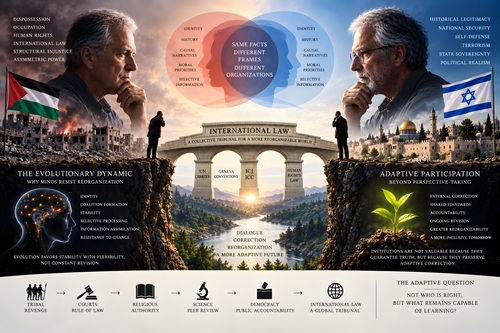 Frank Visser's essay, When Integral Perspectives Become Irreconcilable is one of the most perceptive analyses yet written of why intelligent people sharing an integral vocabulary nevertheless arrive at radically different political conclusions. Using the exchange between Ray Harris and myself over Israel and Palestine as his case study, Visser argues that the debate persists because we disagree not simply about facts, but about causal narratives, historical starting points, moral priorities, and the relative importance of competing perspectives. Since no mutually accepted procedure exists for adjudicating these deeper assumptions, each of us interprets new evidence within an already established framework. The result is an argument capable of continuing indefinitely.
Much of this diagnosis is persuasive. Yet from the perspective of Adaptive Reorganization Theory (ART), it remains incomplete. Visser explains why intelligent people fail to converge. ART asks a deeper question: Why has evolution repeatedly produced adaptive systems that become organized in ways that make them increasingly resistant to discovering when they themselves are wrong? That question shifts the discussion from politics to evolution. My debate with Harris is not merely about Gaza. It illustrates a recurring adaptive phenomenon found throughout biology, psychology, organizations, science, and civilizations. What Visser Explains WellVisser correctly observes that the disagreement between Harris and myself is not primarily about facts. Neither of us lacks information. Rather, we organize information differently. This distinction is consistent with contemporary cognitive science. Human beings evolved not merely to collect facts but to organize experience into coherent causal models capable of guiding behavior. Information acquires meaning only within larger organizational frameworks. Consequently, two individuals may possess essentially the same factual knowledge while arriving at dramatically different conclusions because they assign different causal significance to those facts. Visser's analysis of historical starting points is equally insightful. Harris and I both insist that October 7 cannot be understood in isolation, yet we begin the historical narrative in different places. Harris emphasizes centuries of Jewish persecution, antisemitism, and the struggle for national survival. I emphasize dispossession, occupation, and asymmetries of political and military power. Neither beginning is objectively “wrong.” Each establishes an organizational framework within which subsequent events acquire different meanings. Visser also identifies what may be Integral Theory's greatest practical limitation. Integral encourages the inclusion of multiple perspectives, yet including additional perspectives does not tell us how those perspectives should be weighed when they remain fundamentally incompatible. My exchange with Harris demonstrates this clearly. Both of us believe we are recovering neglected perspectives. Both believe the other assigns inappropriate explanatory weight to competing evidence. Perspective-taking alone does not determine adaptive judgment. Why Evolution MattersOne might reasonably ask why evolutionary theory belongs in a political debate at all. The answer is that politics is one manifestation of a much larger adaptive problem. Every adaptive system must solve the same fundamental challenge: “How can it preserve enough stability to retain what already works while remaining sufficiently flexible to reorganize when reality changes?” This problem applies equally to immune systems, nervous systems, scientific paradigms, corporations, governments, and civilizations. Natural selection does not optimize for objective truth. It optimizes for adaptive success. Throughout evolutionary history, success often depended more upon maintaining coalition membership, protecting identity, coordinating collective action, and preserving organizational stability than upon continually revising one's beliefs. Under many conditions, excessive flexibility would have been maladaptive. Organisms that reorganized too readily could become indecisive, socially isolated, or unable to act effectively. Evolution therefore favors systems capable of balancing continuity and change rather than maximizing either one alone. Viewed in this light, our debate becomes interesting precisely because it illustrates how difficult that balance is to maintain. Beyond Perspectives: Adaptive ParticipationThis is where ART extends Integral Theory. Integral's great contribution has been demonstrating that every perspective reveals only part of reality. Its characteristic response has therefore been to include more perspectives. This has been enormously valuable, yet inclusion alone is insufficient. One may understand another person's position perfectly while remaining entirely unchanged by it. Our exchange demonstrates exactly this. Both of us understand each other's arguments remarkably well. Neither of us reorganizes. This points toward one of ART's central distinctions: While perspective-taking concerns representation, adaptive participation concerns reorganization. These are fundamentally different capacities. Perspective-taking asks whether another viewpoint has been included. Adaptive participation asks whether that viewpoint possesses sufficient influence to reorganize the adaptive organization itself. Evolution ultimately selects not for systems capable of representing alternative possibilities but for systems capable of reorganizing effectively when changing conditions require it. That is a different criterion altogether. Precipitation and the Defense of Successful Organizations ART proposes that Harris and I are not merely defending opinions; we are defending adaptive organizations. Every adaptive system gradually stabilizes through repeated successful functioning. Scientific paradigms become established. Organizations develop routines. Governments become bureaucratized. Individuals consolidate identities. Civilizations institutionalize successful practices. ART refers to this increasing organizational stability as precipitation, a term from chemistry describing the transformation of the immaterial to the material, like water vapor into rain or ice. Its opposite is sublimation, the transformation of the material to the immaterial, like the evaporation of dry ice or death. Precipitation is not pathological. Without it there would be no expertise, no institutions, no accumulated knowledge, and no civilization. Its danger appears only when successful organizations become so stable that new information is reorganized into existing frameworks more readily than the frameworks reorganize themselves. At that point, adaptive stability gradually becomes adaptive rigidity. This explains why evidence rarely changes minds. When Harris encounters evidence of Israeli wrongdoing, it is interpreted within a broader framework emphasizing Jewish historical vulnerability, terrorism, and existential security. When I encounter evidence of Hamas atrocities, it is interpreted within a broader framework emphasizing occupation, dispossession, and structural domination. Neither of us necessarily rejects the evidence. Instead, each incorporates it into an already established adaptive organization. This is precisely what ART predicts. International Law as an Evolutionary InnovationVisser concludes that no shared tribunal exists capable of adjudicating our disagreement. ART suggests a different interpretation. The problem is not the absence of a tribunal; the problem is the incomplete evolutionary acceptance of one. International law represents one of humanity's most ambitious adaptive innovations. Its purpose is not simply legal; it addresses a recurring evolutionary problem: How can societies resolve conflicts without requiring either side to remain the final judge of its own conduct? Evolution repeatedly generates external mechanisms of correction. Science externalized correction beyond individual investigators through replication and peer review. Independent courts externalized correction beyond personal vengeance. Constitutional government externalized correction beyond executive authority. International law attempts to externalize correction beyond the nation-state itself. Its adaptive significance lies not in guaranteeing truth but in reducing self-reference. Adaptive systems become increasingly dangerous when they become sole judges of themselves. International law attempts to reduce precisely that tendency. Institutional Existence versus Institutional AcceptanceWhy, then, does international law fail to settle disputes like Gaza? Because there is an important distinction between institutional existence and institutional acceptance. Evolution frequently produces institutions before adaptive systems become willing to submit to them. Constitutional courts, peer review, elections, scientific consensus, anti-corruption agencies, and international law all illustrate this pattern. The institutions exist, yet participation remains incomplete. Neither Harris nor I deny that international law exists. Our disagreement concerns something deeper. I regard international humanitarian law, the Geneva Conventions, the United Nations Charter, the ICJ, and related institutions as humanity's emerging adaptive mechanisms for external correction. Harris appears to assign greater weight to national sovereignty, historical legitimacy, self-defense, and political realism when these conflict with supranational legal institutions. Our disagreement therefore concerns not merely Gaza; it concerns whether international law has become humanity's legitimate adaptive tribunal. My appeal to international law is therefore not primarily jurisprudential; it is evolutionary. International law represents an adaptive innovation that attempts to externalize corrective feedback beyond the nation-state, just as science externalized correction beyond the individual investigator. The issue is not merely legality; it is whether adaptive systems should increasingly submit themselves to external mechanisms capable of preserving reorganizability. Correctness versus ReorganizabilityPerhaps ART's most important contribution is distinguishing correctness from reorganizability. These are not the same. An organization may correctly interpret present circumstances while becoming progressively incapable of recognizing future error. Conversely, another organization may presently hold mistaken conclusions while remaining highly capable of self-correction. Evolution ultimately favors neither certainty nor skepticism. It favors adaptive systems capable of continual revision while preserving sufficient continuity to remain functional. The evaluative question therefore changes. Instead of asking, “Who is correct?” ART asks, “Which framework remains most capable of future correction?” “Which assumptions remain open to falsification?” “Which organization encourages stronger participation by disconfirming evidence?” “Which preserves greater reorganizability under changing conditions?” These questions concern long-term adaptive capacity rather than immediate ideological victory. What This Reveals About Integral TheoryVisser concludes that perspectives do not adjudicate themselves. ART agrees completely, but evolution suggests something further. Adaptive systems survive not because they accumulate ever more perspectives, but because they evolve increasingly reliable institutions capable of allowing perspectives to correct one another. Science, constitutional government, peer review, and international law are all attempts to institutionalize adaptive correction. Integral Theory has brilliantly explored how perspectives can be expanded and integrated. ART asks the next evolutionary question: “How do adaptive systems preserve the capacity to reorganize those perspectives when reality demands it?” That question applies not only to my debate with Harris but equally to Integral Theory itself. As Visser has argued repeatedly over the years, Integral often responds to scientific criticism not through adaptive reorganization but by subsuming new information into its existing conceptual structure. From an ART perspective, this is precisely what increasingly precipitated adaptive organizations tend to do. The issue is therefore not unique to politics; it concerns Integral's own capacity for future evolution. ConclusionViewed evolutionarily, the my debate with Harris is not an anomaly. It illustrates a recurring adaptive phenomenon. Humans evolved minds capable of constructing coherent explanatory systems, defending coalitional identities, and integrating new information without unnecessary disruption. These capacities are often adaptive, yet under conditions of polarization they become increasingly precipitated. Organizations gradually become better at defending coherence than at reorganizing themselves. Visser correctly identifies this as an epistemological problem. ART places it within a broader evolutionary framework. The enduring significance of debates such as Harris versus Dillard therefore lies not primarily in determining who ultimately proves correct about Gaza. It lies in asking whether humanity is capable of developing institutions that preserve corrective participation even when doing so threatens existing identities, loyalties, and power. That is not simply a political question; it is an evolutionary one, and it is precisely the question Adaptive Reorganization Theory was developed to investigate. Widget is loading comments...
|