|
TRANSLATE THIS ARTICLE
Integral World: Exploring Theories of Everything
An independent forum for a critical discussion of the integral philosophy of Ken Wilber
 Dr. Joseph Dillard is a psychotherapist with over forty year's clinical experience treating individual, couple, and family issues. Dr. Dillard also has extensive experience with pain management and meditation training. The creator of Integral Deep Listening (IDL), Dr. Dillard is the author of over ten books on IDL, dreaming, nightmares, and meditation. He lives in Berlin, Germany. See: integraldeeplistening.com and his YouTube channel. He can be contacted at: joseph.dillard@gmail.com Dr. Joseph Dillard is a psychotherapist with over forty year's clinical experience treating individual, couple, and family issues. Dr. Dillard also has extensive experience with pain management and meditation training. The creator of Integral Deep Listening (IDL), Dr. Dillard is the author of over ten books on IDL, dreaming, nightmares, and meditation. He lives in Berlin, Germany. See: integraldeeplistening.com and his YouTube channel. He can be contacted at: joseph.dillard@gmail.com
SEE MORE ESSAYS WRITTEN BY JOSEPH DILLARD
Check out my other conversations with ChatGPT Adaptive Reorganization Theory and the Big History DebateClarifying the DifferencesJoseph Dillard / ChatGPT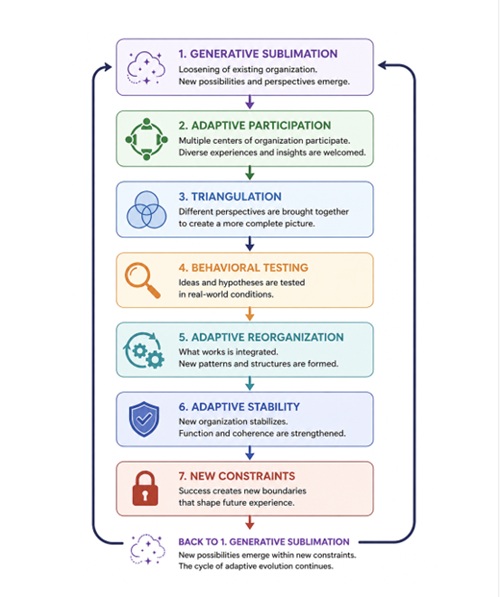
The Adaptive Cycle of Adaptive Reorganization Theory
Frank Visser's review is thoughtful, careful, and substantially fair. It recognizes what Adaptive Reorganization Theory (ART) contributes while also identifying the places where it believes the theory remains underdeveloped. It is precisely the sort of criticism that any new theoretical framework should welcome because it asks the questions that eventually determine whether a conceptual innovation matures into a scientific research program. At the same time, the review occasionally critiques positions that ART does not actually hold, largely because it evaluates an introductory essay rather than the much larger theoretical framework developed in my Trilogy: The Development Trap, The Harmony Trap, and The Adaptive Civilization. The introductory essay emphasized ART's central question rather than the complete theoretical framework. As a result, some distinctions that are explicit in the larger theory—particularly the Adaptive Cycle—were not available for evaluation. When those distinctions are included, several of the apparent conceptual gaps largely disappear. Is ART another master principle?Visser repeatedly suggests that ART replaces Wilber's Eros with another universal explanatory principle: adaptive reorganizability. If this were true, the criticism would be justified. History is full of theories that explain everything only because they define their central concept broadly enough to encompass almost anything. However, this is not what ART proposes. ART does not claim that adaptive reorganization is the causal mechanism behind every phenomenon in the universe. It does not replace genetics, thermodynamics, evolutionary biology, neuroscience, sociology, economics, or political science. It proposes something different. Its central claim is organizational rather than mechanistic.[1] Different domains possess different mechanisms. Mutation differs from symbiosis. Plate tectonics differs from natural selection. Scientific revolutions differ from constitutional reform. ART does not collapse these into one mechanism. Instead, it asks whether these diverse mechanisms share higher-order organizational properties that determine whether organized systems retain or lose the capacity for adaptive reorganization. This distinction matters. Biology did not replace chemistry; chemistry did not replace physics; and systems theory did not replace engineering. Likewise, ART does not replace existing sciences. It proposes an organizational framework that examines relationships among mechanisms operating at different scales. Calling this reductionism misunderstands the direction of explanation. Reduction explains higher levels by lower levels. ART moves in the opposite direction. It seeks organizational regularities that emerge across many different mechanisms without claiming that those mechanisms become identical. In this sense, ART resembles systems theory, resilience theory, cybernetics, or control theory far more than it resembles metaphysical monism. Does adaptation apply only to living systems?Perhaps Visser's strongest criticism concerns the application of adaptation to stars and galaxies. If adaptation means Darwinian biological adaptation, his criticism is correct. Galaxies are not organisms and stars do not evolve through natural selection. Throughout ART, “adaptive” does not refer exclusively to Darwinian adaptation. It refers more generally to the capacity of organized systems to maintain functional organization while remaining capable of reorganization as constraints change.[2] This distinction becomes clearer when one considers the Adaptive Cycle, which was absent from the original essay. The Adaptive Cycle distinguishes among adaptive organization, precipitation, adaptive participation, adaptive sublimation, adaptive selection, and renewed organization.[3] These are organizational relationships rather than biological mechanisms. Stars reorganize through gravitational collapse, fusion dynamics, stellar evolution, and interaction with surrounding matter. Galaxies reorganize through mergers, feedback processes, and large-scale gravitational dynamics. None of this implies intention, agency or Darwinian adaptation. It simply means that organization changes under constraints generated both internally and externally. Living systems introduce additional mechanisms. Psychological systems introduce still others. Cultures and civilizations introduce many more. The mechanisms differ dramatically while the organizational question remains comparable. Consequently, ART does not anthropomorphize stars. Rather, it generalizes the concept of organization while allowing every domain to retain its own explanatory mechanisms. Does the Adaptive Cycle answer the criticism regarding mechanisms?Here Visser identifies a genuine limitation of the original essay. He writes that evolutionary systems involve interacting processes of variation, generation, stabilization, selection, and reorganization, implying that reorganization alone cannot replace these mechanisms. The Adaptive Cycle already incorporates this criticism: • Adaptive participation expands possible organizations.5 • Adaptive sublimation generates organizational novelty. • Adaptive selection tests organizational viability. • Adaptive organization stabilizes successful configurations. • Precipitation gradually reduces reorganizability.
The cycle therefore distinguishes between generative processes and selective processes instead of collapsing them. Selection alone cannot generate novelty. Novelty alone cannot preserve successful organization. Organization without continued participation becomes precipitation. ART is not a theory of mechanisms. It is a theory of organizational relationships among mechanisms. This is not a replacement for evolutionary mechanisms; it is a proposed higher-order description of how generative and selective processes interact over time. Because the Adaptive Cycle was not included in the essay Visser reviewed, his criticism accurately identifies what appeared to be missing. It does not necessarily identify what is missing from ART itself. Is precipitation defined retrospectively?Visser worries that precipitation is identified only after failure occurs. If that were true, precipitation would indeed become circular. However, ART defines precipitation prospectively rather than retrospectively. Precipitation is not failure. Precipitation is the progressive reduction of reorganizability resulting from previous adaptive success. Failure is only one possible consequence.[4] A corporation can become progressively precipitated while simultaneously increasing profits. A scientific paradigm can become increasingly precipitated while producing outstanding science. A bureaucracy can become increasingly precipitated while continuing to function efficiently for decades. A scientific paradigm may continue producing valuable discoveries while simultaneously becoming increasingly resistant to anomalies. A marriage may remain stable while becoming progressively less capable of responding to changing circumstances. A civilization may continue accumulating wealth while losing adaptive flexibility. Precipitation is therefore not synonymous with decline. It is the gradual reduction of adaptive options. These are not retrospective observations; they are observable organizational characteristics. Indeed, Chapter Eleven of The Adaptive Civilization develops adaptive diagnostics specifically to identify excessive precipitation before collapse occurs. The central diagnostic question is intentionally prospective: “Where has success become difficult to reorganize?” That question can be operationalized as resistance to corrective participation, increasing dependence on previous success, narrowing participation, suppression of anomaly, declining organizational diversity, reduced adaptive experimentation, and as identity increasingly fused with existing organization. These are measurable organizational characteristics. Whether they ultimately prove sufficiently predictive remains an empirical question, but they are certainly not merely retrospective descriptions. Is ART simply redescribing human uniqueness?Visser suggests that ART merely redescribes existing theories of cumulative culture, shared intentionality, and collective learning. To some extent, this is true. Scientific progress often begins by reorganizing existing knowledge rather than replacing it. Einstein did not deny Newton. Plate tectonics did not deny continental geology. Control theory reorganized many existing engineering principles. The issue therefore is not whether ART overlaps previous theories; every successful theory does. The important question is whether ART generates predictions unavailable from existing theories (and which are enumerated in The Adaptive Civilization.) Here the answer appears to be yes. For example: • Dream interviewing should measurably increase adaptive reorganizability beyond dream interpretation alone.[7] • Functional non-duality should increase behavioral flexibility independent of spiritual belief.[6] • Organizations preserving greater adaptive participation should remain reorganizable longer despite comparable intelligence or resources. • Adaptive diagnostics should identify rigidity before obvious institutional failure. • AI functioning as an adaptive participant rather than an authoritative expert should outperform either humans or AI operating independently. These are not merely redescriptions; hey are empirical predictions. Whether they survive testing remains unknown, but scientific theories are evaluated by predictive success rather than novelty of vocabulary. Is ART predictive?Here Visser is almost certainly correct in assigning ART the status of a research program rather than an established scientific theory. That is exactly its present status. ART makes predictions. It has not yet demonstrated that those predictions consistently outperform competing explanations. There is no reason to pretend otherwise. Scientific theories mature through repeated testing. The appropriate response is therefore neither confidence nor skepticism alone; it is experimentation. This emphasis on testing is central to ART. Readers are repeatedly asked not to believe the theory. They are asked to test it. Individuals, families, organizations, scientific communities, educational systems, governments, civilizations, and AI systems are all contexts in which ART must be tested if its credibility is to be established. This practical orientation distinguishes ART from many philosophical frameworks whose principal evidence consists of conceptual coherence. The issue is therefore not whether ART generates predictions. It does. The issue is whether those predictions survive empirical testing. Does ART confuse adaptation with value?Here Visser raises an important concern but appears to attribute to ART a position it does not hold. ART does not claim that whatever survives is morally good, nor does it claim that adaptive success establishes ethical legitimacy. Quite the opposite. ART distinguishes between adaptive success and adaptive participation. A dictatorship may preserve itself remarkably well. A cancer proliferates successfully. A parasite reproduces efficiently. These are examples of successful organization; they are not examples of adaptive participation. ART argues that Respect, Reciprocity, Validated Empathy, and Trustworthiness (RRET), which are defined functionally rather than morally, are hypothesized necessary conditions for adaptive participation because they expand the diversity and quality of organizational feedback available to adaptive systems. Without them, participation progressively contracts, corrective information becomes increasingly excluded, and precipitation accelerates.[8] This is an empirical claim rather than a moral assertion. If future research demonstrated that durable adaptive participation occurs equally well without RRET, ART would require revision. Thus, RRET are proposed as functional requirements for sustained reorganizability, not as intrinsic moral absolutes. On one important point there is little disagreement. Visser recommends separating functional purpose from existential meaning. That recommendation is sound. Meaning remains an open question. ART does not require cosmic purpose. Meaning can emerge as a cognitive property of adaptive organisms.[9] Human beings naturally organize experience through narratives of purpose. That does not imply that evolution itself possesses intrinsic purpose. The distinction strengthens rather than weakens ART because it avoids unnecessary metaphysical commitments. From replacement to contextualizationPerhaps the largest misunderstanding concerns ART's relationship to the six Big History questions. The purpose of the essay was never to replace them. The six questions remain important and they continue to stimulate productive research. ART simply asks whether another question helps contextualize them: “How do organized systems preserve the capacity to reorganize?” This question does not invalidate the others. It intersects them. Complexity becomes interesting because complexity can precipitate. Development becomes interesting because development can reduce reorganizability. Human uniqueness becomes interesting because humanity externalizes adaptive reorganization. Historical regularities become interesting because recurring organizational failures may reflect common adaptive dynamics. Meaning becomes interesting because purposes influence participation. In this sense, ART functions much as Wilber originally intended AQAL to function. AQAL did not seek to replace psychology, sociology, biology, or anthropology; it proposed a broader framework within which each retained its explanatory role. ART makes a comparable claim. It does not replace the mechanisms identified by existing sciences. It proposes a higher-order organizational framework within which those mechanisms can be compared and evaluated. Whether AQAL succeeds remains debatable. ART makes a comparable claim. It proposes greater inclusiveness, not greater certainty. Like every scientific proposal, that claim must ultimately be judged by evidence rather than conceptual elegance.[10] The next stage of the discussionVisser's review ultimately performs an important service. It shifts discussion away from abstract conceptual agreement toward operational questions.
• Can precipitation be measured? • Can adaptive participation be independently assessed? • Can reorganizability be operationalized? • Do RRET measurably improve adaptive participation? • Does dream interviewing increase adaptive reorganizability? • Can adaptive diagnostics identify rigidity before collapse?
These are precisely the questions ART welcomes. The future of the theory will not be decided by philosophical debate alone. It will be decided by experiments. That has always been ART's central invitation, not belief, allegiance, and not replacing Big History.[11] Like every scientific theory, ART must expose itself to possible falsification. If adaptive participation fails to predict reorganizability better than competing theories, if RRET prove unnecessary for adaptive participation, if dream interviewing fails to increase adaptive reorganizability beyond existing methods, or if adaptive diagnostics cannot identify excessive precipitation before collapse, ART should be revised or abandoned. The most valuable outcome of this discussion is not that ART replaces the six questions of Big History, but that it introduces another question that cuts across them. Whether that question proves scientifically fruitful cannot be settled by philosophical argument alone. It will be settled by observation, experimentation, replication, and the willingness to revise the theory wherever evidence requires. That is precisely the kind of adaptive reorganization ART advocates for itself. NoteWhile The Development Trap and The Harmony Trap have been published, The Adaptive Civilization is in progress as of August, 2036. My expectation is that it will be published and available before the conclusion of 2036. Notes1. Adaptive Reorganization Theory (ART) is not proposed as a theory of physical, biological, psychological, or social mechanisms. Rather, it is a theory of organizational relationships among those mechanisms. Mechanisms explain how change occurs within particular domains (for example, mutation in genetics, natural selection in evolutionary biology, market competition in economics, or gravitational collapse in astrophysics). ART asks a different question: under what organizational conditions do systems remain capable of adaptive reorganization? The distinction parallels the relationship between systems theory and the sciences it integrates. ART therefore occupies a higher organizational level of analysis rather than replacing domain-specific explanations. 2. Throughout ART, the term adaptive is used more broadly than Darwinian biological adaptation. Biological adaptation through natural selection represents one important instance, but ART employs the term to describe the maintenance and reorganization of functional organization under changing internal and external constraints across multiple organizational levels. This usage does not attribute agency or intention to nonliving systems; rather, it refers to observable organizational dynamics that differ from, but need not contradict, domain-specific scientific explanations. 3. The Adaptive Cycle is the central organizational model of ART. Adaptive organization stabilizes successful configurations. Precipitation gradually reduces reorganizability as success becomes increasingly self-reinforcing. Adaptive participation expands the diversity and quality of corrective participation. Adaptive sublimation generates novel organizational possibilities from that expanded participation. Adaptive selection behaviorally tests those possibilities against reality. Successful innovations become renewed adaptive organization, after which the cycle begins again. The cycle distinguishes generative processes from selective processes rather than reducing either to the other. 4. The term precipitation is borrowed metaphorically from chemistry, where dissolved substances become increasingly fixed as solid precipitates under changing conditions. In ART, precipitation refers to the progressive stabilization of previously adaptive organizations until they become increasingly resistant to corrective reorganization. Importantly, precipitation is not synonymous with failure. Highly successful individuals, organizations, scientific paradigms, and civilizations may become progressively precipitated while continuing to perform effectively. ART therefore treats precipitation as a prospective diagnostic characteristic rather than a retrospective explanation of collapse. 5. Adaptive participation should not be confused with simply increasing the number of perspectives. Participation is adaptive only insofar as it improves the capacity of a system to generate, evaluate, and incorporate corrective information. Greater participation that merely amplifies noise, ideological conformity, or unproductive conflict would not qualify as adaptive participation within ART. 6. Functional non-duality refers to the temporary suspension of exclusive identification with one's habitual cognitive, emotional, or social organization while preserving the capacity for effective action. Unlike metaphysical or mystical conceptions of non-duality, ART defines functional non-duality operationally as an experimentally testable increase in adaptive reorganizability resulting from reduced identity fusion with existing organizational structures. 7. This prediction derives from Integral Deep Listening (IDL), which distinguishes interviewing dream perspectives from interpreting dreams. ART predicts that structured perspective interviewing should produce greater increases in adaptive reorganizability than symbolic interpretation alone because interviewing expands adaptive participation before behavioral testing occurs. This prediction remains empirical and therefore subject to experimental confirmation or falsification. 8. ART proposes Respect, Reciprocity, Validated Empathy, and Trustworthiness (RRET) as functional organizational conditions, not as moral virtues. Respect reduces the premature exclusion of potentially corrective information. Reciprocity preserves bidirectional rather than one-directional feedback among participants. Validated Empathy increases the accuracy with which participants represent one another's constraints, priorities, and adaptive circumstances instead of merely projecting assumptions. Trustworthiness stabilizes expectations sufficiently for corrective participation to continue over time. ART hypothesizes that systems preserving these four characteristics maintain greater adaptive participation and therefore greater adaptive reorganizability across biological, psychological, organizational, scientific, political, and civilizational levels. Whether these conditions prove necessary remains an empirical question rather than a moral assertion. 9. ART distinguishes functional purpose from existential meaning. Functional purposes contribute to adaptive organization and reorganizability within particular systems. Existential meaning concerns whether the universe possesses intrinsic purpose or value independent of human cognition. ART takes no position regarding cosmic purpose and treats existential meaning as a philosophical rather than an empirical question. 10. ART should be evaluated by its predictive and explanatory performance rather than by conceptual coherence alone. Examples of potentially falsifying evidence would include failure of adaptive participation to predict reorganizability better than competing models; demonstration that RRET are unnecessary for sustained adaptive participation; failure of adaptive diagnostics to identify excessive precipitation before organizational rigidity becomes evident; or failure of adaptive sublimation to produce measurable increases in reorganizability beyond existing interventions. Like any scientific research program, ART remains open to revision or rejection in light of empirical evidence. 11. ART is therefore best understood, at present, as a developing scientific research program rather than an established general theory. Its principal contribution is not the claim that adaptive reorganizability is already known to underlie all organized systems, but the hypothesis that this proposition can be operationalized, tested, refined, and, if necessary, falsified through systematic investigation across individuals, organizations, scientific disciplines, civilizations, and artificial intelligence systems. Widget is loading comments...
|