|
TRANSLATE THIS ARTICLE
Integral World: Exploring Theories of Everything
An independent forum for a critical discussion of the integral philosophy of Ken Wilber
 Dr. Joseph Dillard is a psychotherapist with over forty year's clinical experience treating individual, couple, and family issues. Dr. Dillard also has extensive experience with pain management and meditation training. The creator of Integral Deep Listening (IDL), Dr. Dillard is the author of over ten books on IDL, dreaming, nightmares, and meditation. He lives in Berlin, Germany. See: integraldeeplistening.com and his YouTube channel. He can be contacted at: joseph.dillard@gmail.com Dr. Joseph Dillard is a psychotherapist with over forty year's clinical experience treating individual, couple, and family issues. Dr. Dillard also has extensive experience with pain management and meditation training. The creator of Integral Deep Listening (IDL), Dr. Dillard is the author of over ten books on IDL, dreaming, nightmares, and meditation. He lives in Berlin, Germany. See: integraldeeplistening.com and his YouTube channel. He can be contacted at: joseph.dillard@gmail.com
SEE MORE ESSAYS WRITTEN BY JOSEPH DILLARD
John Mearsheimer's Response to Visser's Critique of Putin's ArgumentJoseph Dillard / ChatGPT
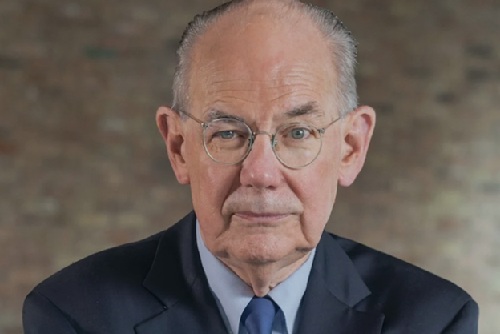 John Mearsheimer is a structural realist whose theory of offensive realism explains international politics in terms of anarchy, survival, self-help, and power maximization. His work consistently emphasizes that actors in an anarchic system will behave in ways that ensure survival above all else, often leading to competition and conflict. This analytic posture colors how he would respond to Visser's argument.[1] Mearsheimer's position represents a substantial repudiation of Visser's critique on grounds of geopolitical realism as an approach to understanding why nations act as they do, a subject on which Mearsheimer has a stellar track record. That does not mean that Mearsheimer is “right” in any ultimate or even moral sense. First, there are many scholars who disagree with his position. Secondly, there are many good people, including Visser, who disagree with his position on moral grounds. That being the case, this discussion involves geopolitics. Authority in geopolitics does not rest on moral insight, diplomatic success, or policy influence. It rests on something narrower, more austere, and—when it works—deeply unsettling: Mearsheimer has repeatedly made structural predictions about great-power behavior that later events conformed to, often despite being politically unpopular at the time. Morally framed arguments do not share that record of predictive accuracy. Within the bounds of his purview, geopolitical realism, Mearsheimer has been able to successfully predict important world events where other approaches have failed. What Mearsheimer's authority is based onMearsheimer is authoritative in structural realist analysis, not in ethics, diplomacy, conflict resolution, nation-building, human rights, predicting precise timelines or leaders' intentions. His authority is strongest when the question is: “Given an anarchic international system, uneven power distribution, and security dilemmas, what behaviors are likely—regardless of intentions?”
That is a conditional, systemic authority, not prophetic omniscience. 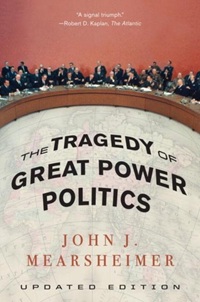
While Mearsheimer's authority comes from his track record, not his resume, it establishes standing. He has earned a PhD, Cornell University, is a tenured professor at the University of Chicago, one of the world's top International Relations theory centers. He is the author of The Tragedy of Great Power Politics, and the central figure in offensive realism, a major IR theory. This establishes standing, but not correctness. His authority comes from track record, not résumé. Mearsheimer has been notably “right” in a number of major predictions. It is on the basis of these that his international credibility largely stand. In 2015 he stated, “The West is leading Ukraine down the primrose path, and the end result is that Ukraine is going to get wrecked.”
From 1993 onward, in policy memos and articles, a 2014 Foreign Affairs essay and numerous lectures and interviews long before 2022, Mearsheimer predicted that expanding NATO eastward would be perceived by Russia as an existential threat and eventually provoke a forceful response, especially regarding Ukraine. What was the actual outcome? In 2014 Russia invaded Ukraine (Crimea). It followed that with a full-scale invasion in 1922. Russia explicitly cited NATO expansion and Western alignment as core threats. This does not mean that Russia was morally justified or that Ukraine deserved invasion. It means that his prediction about structural incentives was borne out. But that was not the only time that Mearsheimer has made geopolitical predictions that have proven accurate. Beginning in the 1990's Mearsheimer claimed that the U.S. post-Cold War strategy of spreading liberal democracy through military power would fail to produce stable democracies, generate resistance, drain U.S. power, and undermine its own legitimacy. He made these predictions citing the Iraq War, Afghanistan, regime-change interventions, and democracy promotion as strategy. What was the outcome of his predictions? The overthrow of Saddam Hussein's government in Iraq destabilized the region and empowered Iran. Afghanistan collapsed back to Taliban rule. U.S. credibility weakened, followed by domestic exhaustion with interventionism. Here again, Mearsheimer's structural critique outperformed moral optimism. In the early 2000's Mearsheimer predicted that China would not peacefully integrate into a U.S.-led order. He accurately predicted that a rising China would seek regional dominance, that the U.S. would attempt to contain it, and that strategic rivalry was inevitable, regardless of economic interdependence:
“If China continues its impressive economic growth, the United States and China are likely to engage in an intense security competition.” — The Tragedy of Great Power Politics What was the outcome? U.S.-China rivalry now defines global geopolitics. Trade interdependence did not prevent strategic competition. There is a growing militarization of the South China Sea with Taiwan as the focal flashpoint. Again, Mearsheimer's structural prediction was confirmed. A final area where Mearsheimer has been correct, and one that is particularly relevant to addressing Visser's argument, was his prediction that moral narratives would follow power rather than restrain it. He has stated that states adopt moral rhetoric to justify actions taken for security reasons and that hypocrisy is systemic, not anomalous. This aligns with observed behavior of nation states across decades. There is a documented record of widespread use of humanitarian language to justify wars and of selective moral outrage depending on alliances. Mearsheimer has noted that moral framing tracks interests remarkably well - as it does in Visser's argument. This is not to claim that Mearsheimer is always right. As he acknowledges, he is not. He has underestimated nationalism and identity in some contexts. He has discounted ideology more than events justify. He offers few constructive solutions beyond restraint and his framework can become pessimistic to the point of paralysis. These are not failures of intelligence but are known limits of structural realism. Mearsheimer has been “right” when and where he has identified the direction of pressure created by the system, even when policymakers denied that pressure existed. Mearsheimer's brand of being “right” is authoritative, useful, and relevant when the question is, “What behavior is likely under pressure?” Related to this discussion, it asks, “What behaviors of Putin and Russia are likely when under pressure?” Mearsheimer does not provide a moral defense of Putin's actions because he notes that morality is not the determining factor in geopolitical behavior and outcomes. His successful predictions validate his claim. Mearsheimer does not ask, “What should we value?” “How do we heal conflict?” “How do cultures transform?” “How do individuals or societies evolve ethically?” His value is clarity regarding predictable geopolitical outcomes, not morality. He has correctly anticipated where structural pressures would snap before events made it obvious. He has remained consistent even when politically inconvenient. Using John Mearsheimer as a lens to critique Frank Visser's essay is valuable not because Mearsheimer is “right” and Visser is “wrong,” but because Mearsheimer represents a maximally constraining counter-perspective—one that forces the essay to clarify what kind of claim it is actually making: moral, explanatory, or predictive. Here are the key reasons Mearsheimer is a useful perspective for this purpose. Mearsheimer cleanly separates explanation from moral judgmentVisser's essay is primarily normative. Its core move is to argue that explaining behavior as “everyone does it” does not justify behavior morally. While this is a legitimate moral argument, a cursory examination of my response exposes this as a straw man argument, not reflecting what I said:
“Emphasizing Western colonialism while ignoring Russia's own imperial past is a way of emphasizing others' faults while minimizing one's own. While it is difficult to defend this, again - this is an equal opportunity diversion, meaning people in all societies and cultures do it. That does not excuse it, but it does help us remember that by pointing it out in others we are thereby employing that very technique to change the subject from when and how we use it ourselves.” It should be clear from that passage from my introductory paragraph that I was not justifying Putin's speech or actions regarding Ukraine based on “whataboutism,” “everybody does it.” I was pointing out that doing so is a logical fallacy, whether Putin or the West does it. In Visser's essay it avoids Putin's point by changing the subject from our behavior to the behavior of Putin and Russia. In this case, it means focusing on Putin's immorality while ignoring our own and using that to claim the moral high ground, a claim that is hardly credible, as we support genocide, fascism, terrorism, and corruption. Mearsheimer's work is useful precisely because he insists—often uncomfortably—that moral judgment is analytically irrelevant to explaining state behavior. Mearsheimer forces the question: “Is Visser trying to explain state behavior, or evaluate it ethically?” By applying Mearsheimer's lens, we see that Visser is doing the latter while sometimes appearing to do the former. Mearsheimer exposes that ambiguity. Mearsheimer treats rhetoric as epiphenomenal, not causalVisser's essay focuses heavily on selective memory, hypocrisy, moral framing, and defensive rhetoric. Mearsheimer's realism asks a bracing question: “Even if all of that is true, does it actually cause state behavior?” From Mearsheimer's perspective, states adopt moral narratives after strategic decisions are made. Rhetoric is for domestic and international legitimation. The real drivers are anarchy, insecurity, and power distribution. Using Mearsheimer reveals that Visser's critique operates at the level of discourse ethics, not causal geopolitics. That doesn't make Visser wrong, but it clarifies the scope and limits of the argument. Visser spends considerable effort arguing that “everyone does it.” Mearsheimer neutralizes the “everyone does it” debate entirely. Mearsheimer short-circuits this debate by saying, in effect, “Of course everyone does it. That's what the system rewards.” From his realist perspective hypocrisy is not a moral failure; it is a structural feature of an anarchic system. The system selects for actors who justify power moves defensively If Visser's argument depends on exposing hypocrisy, realism asks whether that exposure has any explanatory or predictive value. It doesn't. Visser operates mainly at the level of ethical reasoning, narrative accountability, and public discourse. Mearsheimer operates at the level of structural constrains, systemic incentives, and power distributions. Putting Mearsheimer in dialogue with Visser forces a clarification:
This contrast helps readers avoid category errors, that is, criticizing explanations for failing to meet moral standards they were never meant to satisfy. Mearsheimer resists moralizing geopolitics on purpose. Visser's essay implicitly assumes that moral clarity is politically valuable. Mearsheimer represents the strongest rejection of that assumption. His position is not that morality is bad, but that moral clarity does not explain or stop great power competition. Mearsheimer forces Visser's argument to confront the possibility that moral critique does not alter outcomes. It raises the uncomfortable question of whether moral discourse primarily serves self-validation rather than policy effectiveness. As Gregg Henriques has pointed out in his Unified Theory of Knowledge, cognition exists largely to justify identity. Mearsheimer helps distinguish responsibility from causality. Visser wants to preserve moral responsibility while allowing explanation. Mearsheimer insists that causality must be analyzed without moral overlay. This distinction matters because moral responsibility answers who should be blamed while causal analysis answers what will happen next. Mearsheimer helps expose when Visser's critique slides between these two registers. In integral or pluralistic discourse, some perspectives are valuable because they constrain speculation. Mearsheimer's is one of those perspectives. He functions as a reality check against moral inflation, a guardrail against conflating discourse analysis with geopolitics, and a reminder that systems can be cruel, indifferent, and repetitive. Using Mearsheimer to critique Visser does not invalidate Visser's moral argument. It forces it to be explicit about what it is—and is not—claiming. Mearsheimer is useful as a critique of Visser's essay because he forces a sharp distinction between explanation and judgment, treats hypocrisy as structural, not moral, ignores rhetoric in favor of systemic incentives, clarifies levels of analysis, and challenges the assumption that moral clarity changes behavior He is not a better moral thinker than Visser; he provides a better stress test. That is exactly why invoking him is intellectually honest rather than evasive. In summary, Visser's essays regarding Putin and my response miss the mark on several accounts: 1) In geopolitics morality is a means of justification, not a causal explanation. 2) In geopolitics morality is largely used to claim the high ground and bash the opposition. 3) Hypocrisy is a reality. One would be more than remiss if they did not point out the massive hypocrisy of the West's geopolitical position. 4) Complaining about Putin's rhetorical style does not address the legitimacy of his arguments for his primary audience: Russians. Visser seems to assume that Russia is imperialistic. This claim is usually supported by two historical facts: The Soviet Union's occupation of Eastern Europe after World War II and its invasion of Ukraine. It is not irrelevant to point out that both were, from a Russian perspective, responses to Western actions rather than imperialism. Westerners and Western media tend to ignore that reality. Russians don't. NOTES
[1] See for example: Frank Visser, "Empire in Anti-Imperial Drag: Putin's Multipolar Rhetoric Revisited", "Everyone Does It: Why Dillard's Defense Misses the Point", and "Provocation Is Not Justification: Clarifying a Critical Distinction in the Ukraine War", www.integralworld.net, December 2025.
Widget is loading comments...
|