|
TRANSLATE THIS ARTICLE
Integral World: Exploring Theories of Everything
An independent forum for a critical discussion of the integral philosophy of Ken Wilber
 Dr. Joseph Dillard is a psychotherapist with over forty year's clinical experience treating individual, couple, and family issues. Dr. Dillard also has extensive experience with pain management and meditation training. The creator of Integral Deep Listening (IDL), Dr. Dillard is the author of over ten books on IDL, dreaming, nightmares, and meditation. He lives in Berlin, Germany. See: integraldeeplistening.com and his YouTube channel. He can be contacted at: joseph.dillard@gmail.com Dr. Joseph Dillard is a psychotherapist with over forty year's clinical experience treating individual, couple, and family issues. Dr. Dillard also has extensive experience with pain management and meditation training. The creator of Integral Deep Listening (IDL), Dr. Dillard is the author of over ten books on IDL, dreaming, nightmares, and meditation. He lives in Berlin, Germany. See: integraldeeplistening.com and his YouTube channel. He can be contacted at: joseph.dillard@gmail.com
SEE MORE ESSAYS WRITTEN BY JOSEPH DILLARD
THE DREAMING KOSMOS
A Naturalistic Approach to Emergence and Transformation through Transpersonal Dream Yoga Harnessing Negentropy, Chaos Theory, and the Attractor Informational network to Unlock Emerging Potentials Chapters 01 | 02 | 03 | 04 | 05 | 06 | 07 | 08 | 09 | 10 11 | 12 | 13 | 14 | 15 | 16 | 17 | 18 | 19 | 20 21 | 22 Contains AI-generated content. The Precipitation of Waking RealityIndra's Net and the Rain That Becomes the WorldThe Dreaming Kosmos, Chapter 17Joseph Dillard
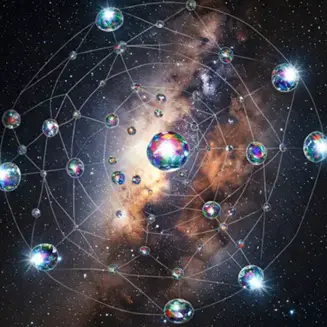 In the Vedic image of Indra's Net, the universe is imagined as an infinite lattice of jewels, each reflecting all others. No jewel acts alone; no reflection originates in a single place. When rain falls upon the net, it does not belong to any one node. It appears everywhere at once, yet differently at each point of intersection. Waking reality precipitates in much the same way. What we call “the world” is not simply perceived; it condenses. It forms when distributed experience, somatic, emotional, cognitive, cultural, and entropic, can no longer remain diffuse. As with dreams, waking reality takes shape when thresholds are crossed and holding capacities are exceeded. Reality does not wait for permission. It rains. This chapter extends the logic of precipitation from dreams into waking life, showing how identity, intention, worldview, culture, and even seemingly “objective” reality emerge as condensed solutions to ongoing adaptive pressures. Dream and Waking Reality: One Process, Different ConstraintsThe perspectives of the attractor basins from which dreams precipitate do not disappear upon waking. They converge and stabilize into what we call waking reality. This becomes immediately apparent when we interview the personifications of our waking life issues: the anxious supervisor, the blocked creativity, the chronic irritation, the rigid belief. They speak with the same structural autonomy as dream figures.. Integral Deep Listening does not treat dreams and waking life as separate domains. Both are expressions of the same selfless-organizing, non-agentic process, operating under different constraints. From the perspectives of both dream and waking interviewed perspectives there is no difference: both are equally precipitations of the same underlying selfless ground. Dreaming loosens constraints; waking tightens them. But precipitation governs both. IDL Dream Yoga exists to support evolutionary emergence across these domains through a curriculum of healing, balancing, and transformation, anchored in the cultivation of four core relational qualities: respect, trustworthiness, empathy, and reciprocity. These qualities do not impose meaning; they stabilize viable forms after precipitation has already occurred. Intention Reconsidered: Not Agency, but Adaptive BiasIn common usage, intention implies agency, choice, or will. In The Dreaming Kosmos, intention is understood differently: as emergent adaptive bias within a selfless-organizing system. Intention does not decide; it weights probability. Intention influences what precipitates, not because it commands reality, but because it alters saturation conditions and thresholds. In both waking life and dreams, intention precipitates from five primary sources. These sources shape not only dream holons, but the emergence of self, culture, and collective reality. The Five Sources of Intentional PrecipitationSomatic and Survival Attractor Basins The most powerful and reliable source of precipitation is physiological survival. Maslow identified these as physiological and safety needs; Wilber describes them as foundational relational exchanges of security. Digestive distress, chronic pain, sexual arousal, illness, and autonomic activation exert enormous gravitational pull on experience. These attractor basins are deeply baked into evolutionary history. As a result, they dominate both dream content and waking perception. A body under threat precipitates a world organized around threat. This is not pathology; it is adaptive condensation. Emotional and Psychological Concerns After somatic factors, emotional salience is the strongest precipitant. Worries, conflicts, shame, ambition, fear of rejection, financial anxiety, these saturate the psyche rapidly and reliably precipitate narrative form. The Law of Parsimony applies here: before invoking symbolic, cultural, or transpersonal explanations, we first rule out somatic and emotional precipitation. Most dreams, and most waking “problems”, resolve at this level. Deliberate Pre-Sleep and Waking Intentions Conscious intention, goal setting, incubation, planning, can influence precipitation, but it is far weaker than most people assume. Few individuals consistently set intention before sleep, and even fewer do so skillfully. When conscious intention does appear in dreams or waking insight, it does so after being filtered through more dominant attractors. Interviewing dream or life elements reliably discloses how conscious intent was absorbed, distorted, or ignored by the system. Cultural and Collective Attractor Basins No precipitation occurs in isolation. News cycles, political climates, economic instability, collective trauma, and cultural narratives saturate the field in which individual experience condenses. These influences may appear overtly as say, a public figure in a dream, or covertly in tone, style, or assumptions. Culture extends to Zeitgeist, the overall context of assumptions upon which a culture or civilization is built. That Zeitgeist can be present, guiding collective and individual groupthink, or it could be on the horizon, in the process of being born, as a future fad, fashion, dogma, or informational meme. Culture acts out of awareness, like dreams, as atmospheric pressure: rarely noticed, yet profoundly influential. Entropic or Edge-of-Chaos Potentials The faintest and rarest source of precipitation arises near the edge of chaos, relatively unconditioned by embodiment or immediate survival relevance. These include moments of creative breakthrough, apparent precognition, visitation dreams, non-dual experiences, and deep reorganizations of meaning. Such precipitations are often dismissed because they lack immediate adaptive clarity. They may “leak in” unexpectedly, without explanation. The only meaningful test is applicability: does the information enhance viability when operationalized? Validated precognitive data, such as Krippner's dream telepathy research, suggest that some precipitations may originate near this edge.[1] These are emerging potentials of a natural sort, and only few of them push their way into individual or collective consciousness. IDL, by providing them voice and waking partnership, greatly increases the likelihood that these will take root in waking reality. Dream Elements, Autonomy, and Phenomenological AccessDream elements, and waking life personifications, are themselves secondary attractors, co-created within a larger attractor basin. Like rain, wind, and terrain, they arise relationally. Their intentions are not visible through observation alone. A rock by the roadside discloses nothing until we become it, take its perspective, and give it voice. Phenomenological identification, temporarily releasing the core identity attractor basin, reveals perspectives otherwise inaccessible. This is why IDL interviewing reliably dissolves the assumption that dream elements lack intention. They do not lack intention; they lack identification with our priorities. When Precipitation Goes Wrong: Maladaptive Stabilization Across ScalesPrecipitation itself is not pathological. What goes wrong is where, how, and how long a form stabilizes relative to the conditions that produced it. Across biological, familial, social, and cultural domains, the same pattern repeats: adaptive condensation becomes maladaptive when it cannot re-enter solution. Biological Mis-Precipitation: When Survival Never Powers DownAt the biological level, precipitation errors most often involve chronic activation of survival attractor basins. A nervous system shaped by early threat may stabilize hypervigilance as “reality.” Chronic inflammation, pain syndromes, or hormonal dysregulation precipitate worlds organized around danger, depletion, or urgency. Sleep deprivation collapses holding capacity, forcing premature waking precipitation in the form of irritability, paranoia, or rigid certainty. In such cases, the world appears hostile not because it is, but because the body has already decided it must be. This is not a belief error; it is a saturation artifact. Familial Scripting: Inherited Precipitates Posing as IdentityFamilies transmit precipitates long before individuals possess reflective agency. A child raised in emotional volatility may precipitate vigilance, appeasement, or dissociation as identity. Rigid family roles (caretaker, scapegoat, achiever, invisible one) stabilize relational chaos but persist long after the original saturation has passed. Intergenerational trauma localizes as “this is just how we are,” converting contingency into essence. These scripts are not learned ideas; they are relational weather patterns that hardened early and rarely dissolved. Social and Cultural Scripting: When Orientation Becomes ObligationAt larger scales, cultures script perception before reflection is possible. Gender roles, success narratives, moral binaries, and productivity myths precipitate as defaults rather than choices. National myths convert historical adaptation into moral destiny. Economic saturation precipitates identities organized around scarcity, competition, or worth-through-output. Once stabilized, these scripts resist revision because they coordinate behavior efficiently, even when they generate suffering. Toxic Emotional Drama: Affect as Runaway PrecipitationEmotion is meant to be transient precipitation—localized, informative, dissolvable. Toxic drama arises when affect never returns to the sky. Recurrent resentment stabilizes identity around grievance while shame precipitates self-concepts organized around concealment or self-attack. Chronic outrage functions as a moral stimulant, temporarily restoring agency while preventing integration. Drama persists not because it is pleasurable, but because it maintains coherence when nothing else does. Cognitive Errors as Over-Stabilized MeaningCognitive distortions, biases, and fallacies are not primarily thinking errors; they are meaning precipitates that hardened too quickly or too early. Common examples include Catastrophizing, in which future saturation precipitates as certainty. In confirmation bias, selective reinforcement of an existing attractor basin occurs. Fundamental attribution error generates an identity hardened from momentary behavior. False dichotomies occur when there is premature localization where ambiguity is required. Post hoc reasoning involves narrative precipitation being mistaken for causality. These errors persist because they reduce uncertainty rapidly, not because they are irrational. When Worldviews Become Toxic BasinsWorldviews fail when they cannot metabolize disconfirming experience. Scientific reductionism collapses subjective meaning, spiritual bypassing dissolves practical responsibility, ideological absolutism forbids revision, and relativism prevents commitment. Each represents precipitation without reversibility. The worldview no longer stabilizes reality; it filters it until only self-confirmation remains. Why These Failures Are So ConvincingMis-precipitated realities feel more real, not less. They are coherent, predictive, socially reinforced, and biologically anchored. This is why argument fails. One cannot reason a system out of a stabilization that reason did not create. IDL as a Corrective Without OppositionIntegral Deep Listening does not challenge these precipitates directly. It does not dispute beliefs, correct distortions, or dismantle scripts. It does something more basic: it increases holding capacity. By personifying and interviewing stabilized elements—symptoms, identities, beliefs, emotions, roles—IDL allows them to speak their adaptive logic, reveal their original saturation conditions, offer updated recommendations, and voluntarily loosen their own grip. No attractor is attacked. It is invited to re-enter solution. Why Some Attractors Live at the Edge of ChaosDreams operate near the edge of chaos because constraints are loosened via reduced prefrontal control, diminished temporal anchoring, and high entropy. This allows maximal recombination and novelty. Waking identity, habits, and worldviews are stabilized far from chaos because their function is reliability. Neural reinforcement, social feedback, cognitive bias, and narrative continuity deepen their basins. This difference explains why dreams blur life and death, past and future, self and other, while waking identity insists on distinction. It also explains why the practice of IDL dream yoga can move one into relatively non-dualistic spaces easily and naturally without ritual or altered states. Worldviews as Precipitated Attractor BasinsWorldviews are among the most stable precipitates. Once formed, they resist dissolution because they stabilize identity itself. Recursive Relevance Realization helps explain how such attractors form and maintain coherence across quadrants.[2] But RRR alone cannot explain the polycentric autonomy of perspectives revealed through IDL. For that, phenomenological suspension of identity is required. When identity loosens, worldview can re-enter solution. IDL therefore trains polycentric worldview formation: the capacity to inhabit multiple coherent perspectives without collapse. Precipitation: Naturalistic, Not MetaphysicalThe precipitation described in The Dreaming Kosmos is explicitly naturalistic. It is not the metaphysical descent of matter from spirit, nor a teleological unfolding of consciousness. In chemistry, geology, meteorology, and dynamical systems, precipitation occurs when thresholds are exceeded. Forms arise, stabilize, and may later dissolve.[3] Psychological, cultural, and entropic precipitation obey the same logic. They emerge from matter, not from spirit. They are bottom-up, falsifiable, and reversible. Spiritual traditions may use precipitation metaphorically to describe meaning. This work does not. Transformation, Emergence, and Autopoiesis RevisitedTransformation is not permanent residence at the edge of chaos. It requires repeated, recoverable precipitations. Emergence names the novelty that results. Autopoiesis describes how new forms maintain themselves. Most systems fail at transformation because they lack balance. IDL is designed as a yoga of return, to chaos, to precipitation, and back to stability. Applications: Re-Entering the RainBegin with what is already condensed, A bodily tension that will not release; a family role that still organizes behavior; a belief that feels unquestionably true; or an emotion that reliably hijacks the moment. Personify it. Interview it. Ask not why it is wrong, but what it is stabilizing. Then widen the inquiry: What conditions caused this to precipitate? What conditions would allow it to dissolve? What would replace it if it softened? Transformation does not require insight, belief, catharsis, or transcendence. It requires listening at the site of condensation. Indra's Net does not prevent the rain. It allows reflection, redistribution, and return. And so can we.
NOTES
Widget is loading comments...
|